
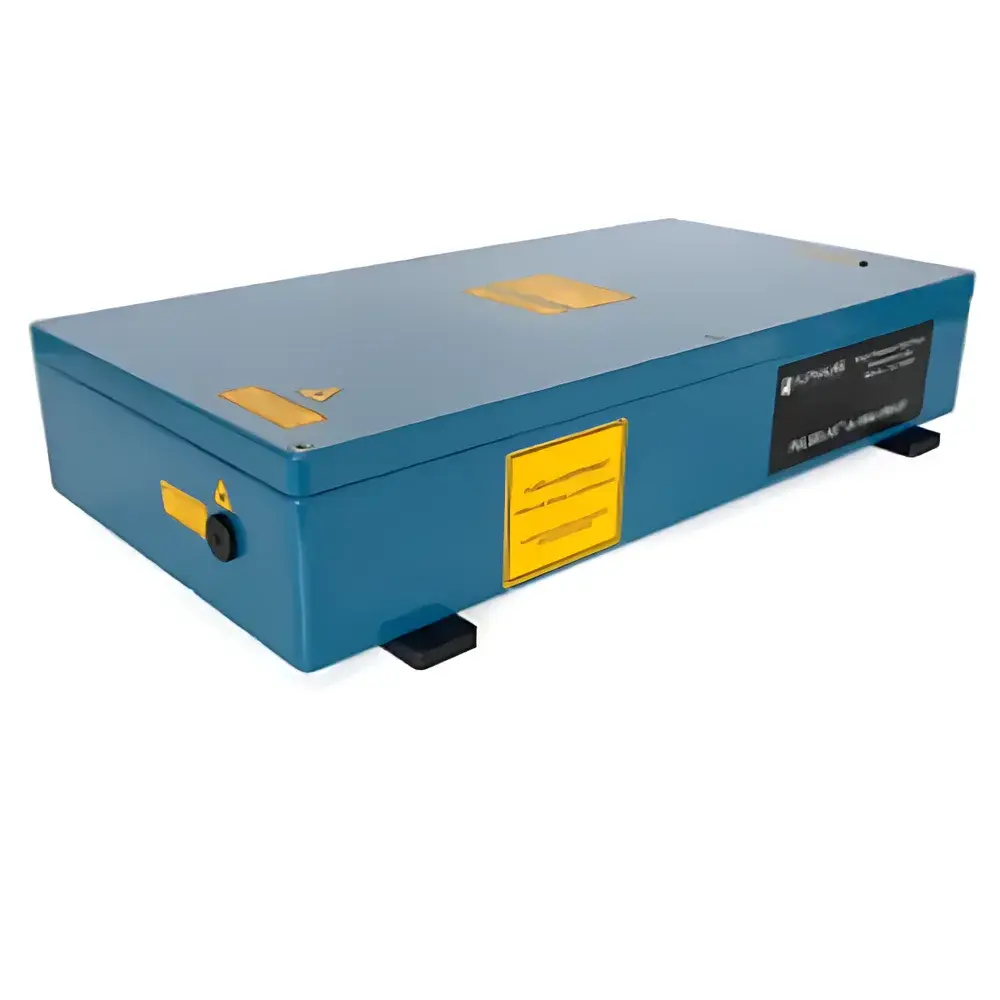
Alphalas PULSELAS-A-1064-10W-SF Single-Frequency High-Power Nanosecond Laser System
| Brand | Alphalas |
|---|---|
| Origin | Germany |
| Model | PULSELAS-A-1064-10W-SF |
| Wavelength (fundamental) | 1064 nm |
| Pulse Energy (1064 nm) | 1 mJ |
| Average Power (1064 nm) | 10 W |
| Peak Power (1064 nm) | >80 kW |
| Pulse Width (FWHM, 1064 nm) | <12 ns |
| Repetition Rate | 10 kHz |
| Spectral Linewidth (1064 nm) | <40 MHz |
| Beam Quality (M², 1064 nm) | <1.2 |
| Power Stability (RMS) | ≤1% |
| Polarization Ratio (1064 nm) | >100:1 |
| Beam Diameter (1/e², 1064 nm) | 1.4 mm ±10% |
| Beam Divergence (1064 nm) | 1.0 mrad ±10% |
| Harmonic Options | 532 nm / 355 nm / 266 nm |
| Remote Control Interface | Ethernet (LAN, RJ-45) |
| Cooling | Closed-loop liquid cooling |
| Warm-up Time to 95% Output | <5 min |
| Operating Temperature | 20–28 °C |
| Compliance | ISO 11146 (beam quality), IEC 60825-1 (laser safety), CE-marked |
Overview
The Alphalas PULSELAS-A-1064-10W-SF is a diode-pumped, single-frequency (single longitudinal mode), Q-switched nanosecond laser system engineered for high spectral purity and exceptional temporal–spatial coherence. Operating at the fundamental wavelength of 1064 nm with a repetition rate of 10 kHz, it delivers 1 mJ per pulse and an average output power of 10 W—achieving peak powers exceeding 80 kW. Its near-transform-limited spectral linewidth (<40 MHz) and diffraction-limited beam quality (M² < 1.2, ISO 11146-compliant) are realized through intracavity frequency-selective elements and rigorous thermal and mechanical stabilization. The system supports harmonic generation via external nonlinear crystals, enabling stable, low-noise output at 532 nm, 355 nm, and 266 nm—each maintaining high beam fidelity and polarization extinction ratios (>10⁴:1). Designed for integration into precision optical infrastructure, it features Ethernet-based remote monitoring and control, closed-loop liquid cooling, and rapid thermal stabilization (<5 min to 95% rated power), making it suitable for deployment in controlled laboratories as well as field-deployable metrology platforms.
Key Features
- Single longitudinal mode (SLM) operation with side-mode suppression ratio (SMSR) >25 dB
- Pulse energy stability ≤1% RMS over 8 hours (measured at 1064 nm)
- Near-diffraction-limited beam profile (TEM₀₀, M² < 1.2 at 1064 nm)
- Optimized cavity design enabling <12 ns FWHM pulse duration with Gaussian-like temporal shape
- Integrated Ethernet interface (RJ-45) supporting TCP/IP commands for real-time parameter adjustment and status polling
- Modular architecture: separate laser head (344 × 120 × 600 mm, 11 kg), diode driver (483 × 89 × 341 mm, 8 kg), and recirculating chiller (483 × 132 × 615 mm, 14 kg)
- Comprehensive interlock system compliant with IEC 60825-1 Class 4 laser safety requirements
- Optional continuous-wave (CW) single-frequency seed output (5 mW, free-space, 1064 nm) for hybrid pump-probe or seeding applications
Sample Compatibility & Compliance
The PULSELAS-A-1064-10W-SF is compatible with standard optical tables, kinematic mounts, and harmonic generation modules (e.g., BBO, LBO, CLBO crystals) used in nonlinear optics laboratories. Its output beam meets ISO 11146 beam propagation standards, with M², divergence, and beam parameter product (BPP = 0.338 mrad·mm) fully characterized and traceable. The system adheres to CE marking directives, including EMC Directive 2014/30/EU and Low Voltage Directive 2014/35/EU. For regulated environments—such as pharmaceutical analytical labs or aerospace metrology facilities—the laser’s deterministic pulse timing, TTL-synchronized trigger output, and audit-ready operational logs support alignment with GLP and GMP documentation practices. While not inherently FDA 21 CFR Part 11–compliant, its Ethernet interface enables integration with validated third-party data acquisition software that implements electronic signature and audit trail functionality.
Software & Data Management
Control is executed via Alphalas’ proprietary LabView-based GUI or direct ASCII command protocol over TCP/IP. The interface provides real-time monitoring of output power, internal temperature sensors (diode junction, crystal mount, chiller outlet), pulse-to-pulse energy deviation, and synchronization signal integrity. All operational parameters—including repetition rate (configurable within ±10% of nominal), Q-switch delay, and interlock status—are programmable and loggable. Data export supports CSV and HDF5 formats, facilitating post-acquisition analysis in MATLAB, Python (NumPy/Pandas), or commercial spectroscopy suites. Firmware updates are delivered via secure HTTPS download and applied without hardware reset. No cloud connectivity is embedded; all data remains on-premise unless explicitly routed through user-configured network infrastructure.
Applications
- High-resolution laser spectroscopy: Doppler-free saturation spectroscopy, cavity ring-down measurements, and Lamb-dip experiments requiring narrow linewidth and long coherence length (>7.5 m at 1064 nm)
- Nonlinear frequency conversion: Efficient SHG, THG, and FHG in bulk and waveguide crystals due to high peak intensity and spatial coherence
- Fiber Bragg grating (FBG) inscription: Precise phase-mask or point-by-point writing with sub-micron positional repeatability enabled by stable pulse energy and pointing stability (<5 µrad)
- LIDAR and atmospheric sensing: Elastic and Raman backscatter profiling in optical meteorology, leveraging high pulse energy and low timing jitter (<100 ps RMS)
- Interferometric metrology: Dynamic displacement measurement using heterodyne or homodyne detection schemes requiring phase-stable pulses
- Holographic recording: Single-pulse off-axis holography with minimal speckle noise and high fringe contrast
- Photolithography R&D: Maskless direct-write patterning of photoresists sensitive to UV harmonics (266 nm, 355 nm)
FAQ
Is the laser qualified for use in cleanroom environments?
Yes—the laser head and chiller are designed for Class 1000 (ISO 6) compatibility; all external surfaces are non-outgassing stainless steel or anodized aluminum, and no internal oil-based lubricants are used.
Can repetition rate be adjusted beyond 10 kHz?
Standard operation is fixed at 10 kHz, but custom variants supporting 1–20 kHz (with corresponding pulse energy scaling) are available under OEM agreement.
What is the typical lifetime of the Nd:YAG crystal and pump diodes?
Under nominal operating conditions (20–28 °C ambient, proper cooling maintenance), the Nd:YAG rod exhibits >10⁹ shots lifetime; pump diodes are rated for >20,000 hours MTBF.
Does the system include beam expansion or collimation optics?
No—beam diameter (1.4 mm ±10%) and divergence (1.0 mrad ±10%) are specified at the output aperture; optional Galilean telescopes for beam resizing are available as accessories.
How is laser pointing stability quantified?
Pointing drift is measured as <5 µrad RMS over 8 hours at 300 mm from the output port, verified using quadrant photodiode tracking under thermal equilibrium conditions.




