
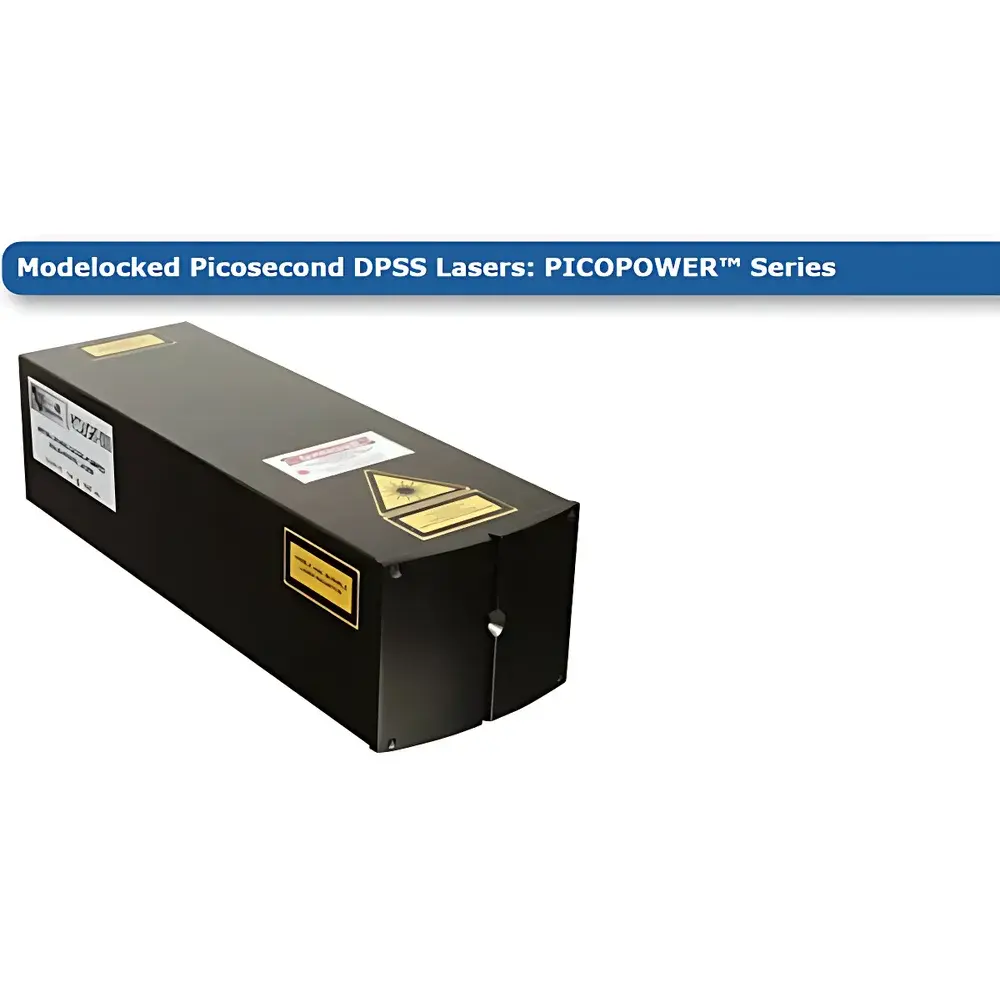
Alphalas RG1-1064-10K High-Energy Picosecond Laser System
| Brand | Alphalas |
|---|---|
| Origin | Germany |
| Model | RG1-1064-10K |
| Wavelength | 1064 nm (fundamental), optional harmonics at 532 nm / 355 nm / 266 nm |
| Pulse Width | <30 ps (FWHM) |
| Pulse Energy | 50 µJ @ 1064 nm |
| Peak Power | >2 MW @ 1064 nm |
| Timing Jitter | 3.5 ps RMS to external trigger |
| Repetition Rate | Adjustable |
| Beam Profile | Gaussian TEM₀₀ |
| Cooling | Air-cooled |
| Form Factor | Compact, OEM-integrated design |
Overview
The Alphalas RG1-1064-10K is a diode-pumped solid-state (DPSS) picosecond laser system engineered for high-repetition-rate, high-peak-power applications requiring precise temporal control and excellent beam quality. Operating at the fundamental wavelength of 1064 nm with sub-30 ps pulse duration (FWHM), the RG1-1064-10K leverages passive mode-locking in a monolithic microchip cavity architecture—enabling intrinsic stability, low timing jitter (<3.5 ps RMS to external trigger), and robust performance without active stabilization electronics. Its Gaussian TEM₀₀ spatial profile ensures diffraction-limited focusing critical for nonlinear optical interactions and high-resolution material processing. Designed for integration into turnkey scientific and industrial platforms, the system features air cooling, compact mechanical footprint, and compatibility with both internal clock triggering and externally synchronized operation—making it suitable for time-resolved pump-probe experiments, ultrafast spectroscopy, and precision ablation workflows where synchronization fidelity and pulse-to-pulse stability are essential.
Key Features
- Sub-30 ps pulse width (FWHM) at 1064 nm with <3.5 ps RMS timing jitter relative to external TTL trigger input
- 50 µJ pulse energy at 1064 nm, delivering >2 MW peak power per pulse
- Harmonic generation options: frequency-doubled (532 nm), tripled (355 nm), and quadrupled (266 nm) outputs available via integrated or external nonlinear crystals
- Adjustable repetition rate enabling flexible synchronization with detectors, delay stages, or scanning systems
- Air-cooled, maintenance-free operation with no water chiller or high-voltage power supply required
- Monolithic microchip resonator design ensures long-term alignment stability and resistance to environmental vibration
- OEM-ready mechanical housing with standardized mounting interfaces (e.g., M4/M6 tapped holes) and electrical I/O connectors compliant with industrial signal protocols
Sample Compatibility & Compliance
The RG1-1064-10K is compatible with a broad range of optically transparent and absorbing materials—including fused silica, sapphire, silicon wafers, polymeric substrates (e.g., PMMA, PI), and thin-film metal coatings—enabling non-thermal ablation, selective layer removal, and subsurface modification. Its ultrashort pulse duration minimizes heat-affected zones, supporting ISO 11146-compliant beam characterization and ASTM F2792-12 standards for laser-based micromachining process validation. The system meets CE marking requirements under the EU Machinery Directive 2006/42/EC and Electromagnetic Compatibility Directive 2014/30/EU. Laser safety classification complies with IEC 60825-1:2014 (Class 4), and full documentation—including LSO instructions, interlock schematics, and nominal ocular hazard distance (NOHD) calculations—is provided for institutional laser safety officer (LSO) review and facility registration.
Software & Data Management
While the RG1-1064-10K operates as a stand-alone hardware module, its TTL-compatible trigger interface enables seamless integration with third-party control environments including LabVIEW, MATLAB, Python (via PySerial or NI-VISA), and EPICS-based synchrotron or free-electron laser timing systems. All operational parameters—including repetition rate selection, external trigger enable/disable, and status monitoring (e.g., Q-switch readiness, temperature lock, emission confirmation)—are accessible through RS-232 or USB-C serial communication using ASCII command protocol. Firmware logs include timestamped thermal sensor readings, pulse count accumulation, and error event flags—supporting GLP-compliant audit trails when interfaced with validated laboratory information management systems (LIMS). No proprietary GUI is bundled; this design prioritizes deterministic real-time control and avoids software dependency in mission-critical experimental setups.
Applications
- Time-resolved fluorescence lifetime imaging (FLIM) and time-correlated single-photon counting (TCSPC) with picosecond excitation resolution
- Multi-photon excited fluorescence (MPEF) and second-harmonic generation (SHG) microscopy in biological tissue sections and live-cell assays
- Precision micromachining of brittle materials (e.g., display glass, MEMS wafers) with minimal microcracking and edge charring
- Terahertz (THz) generation via optical rectification in ZnTe or GaP crystals, supported by high peak power and low jitter
- Ultrafast transient absorption spectroscopy and coherent anti-Stokes Raman scattering (CARS) pump-probe configurations
- Laser-induced breakdown spectroscopy (LIBS) with improved plasma confinement and spectral line resolution compared to nanosecond sources
FAQ
Is harmonic generation included by default in the RG1-1064-10K configuration?
No—harmonic wavelengths (532 nm, 355 nm, 266 nm) require optional external or integrated nonlinear crystals. Base configuration delivers only 1064 nm output.
What is the maximum allowable ambient operating temperature?
The system is rated for continuous operation between +15 °C and +30 °C, with relative humidity ≤60% non-condensing. Extended operation above 30 °C may reduce pulse energy stability and diode lifetime.
Can the laser be triggered synchronously with a femtosecond oscillator?
Yes—the low-jitter external trigger input accepts TTL-level signals with programmable delay (0–100 ns, 10 ps resolution) and supports phase-locking to master oscillators via auxiliary RF reference inputs on custom-configured units.
Does the RG1-1064-10K support pulse-on-demand operation?
It supports external single-shot triggering but does not implement burst-mode or arbitrary pulse train generation natively; such functionality requires external pulse pickers or FPGA-based gate controllers.
Are calibration certificates traceable to NIST or PTB available?
Yes—optional factory calibration reports for pulse energy (traceable to PTB-standard calorimeters) and temporal pulse width (via autocorrelation with certified SHG crystal) can be supplied upon request with documented uncertainty budgets.






