
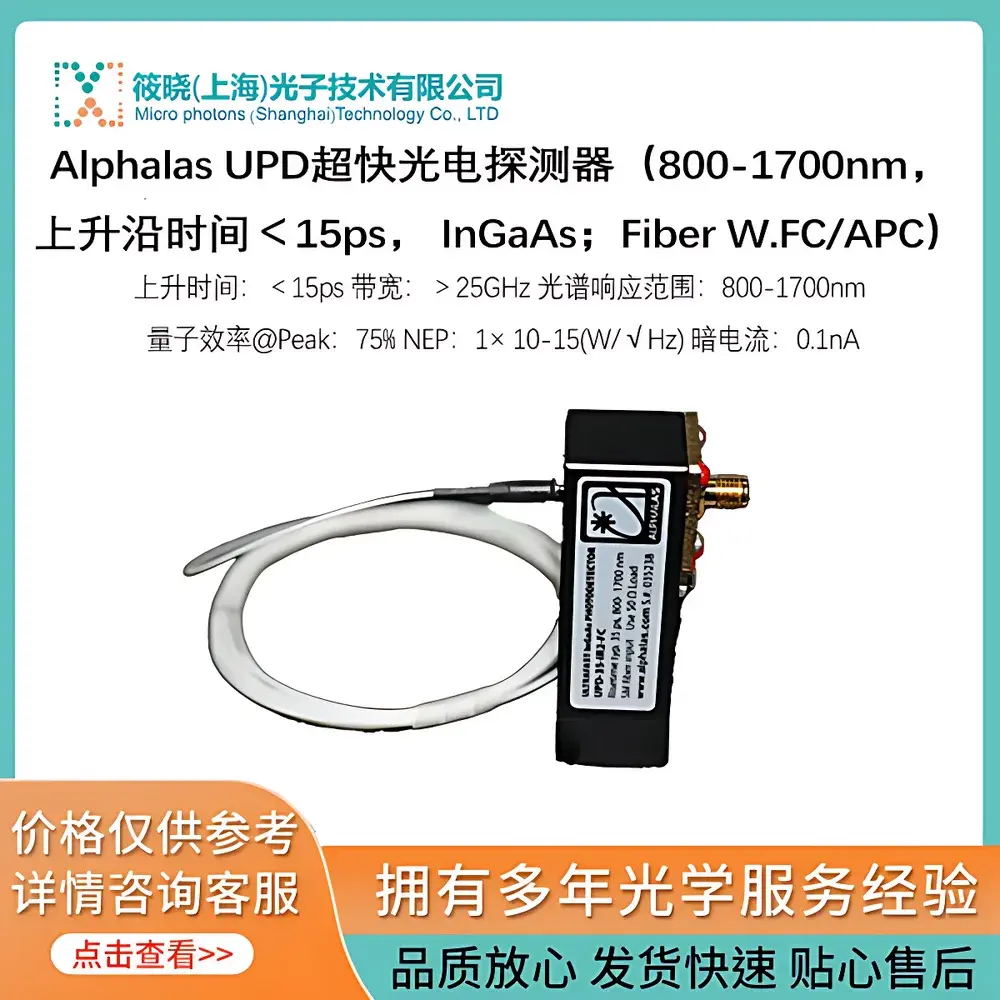
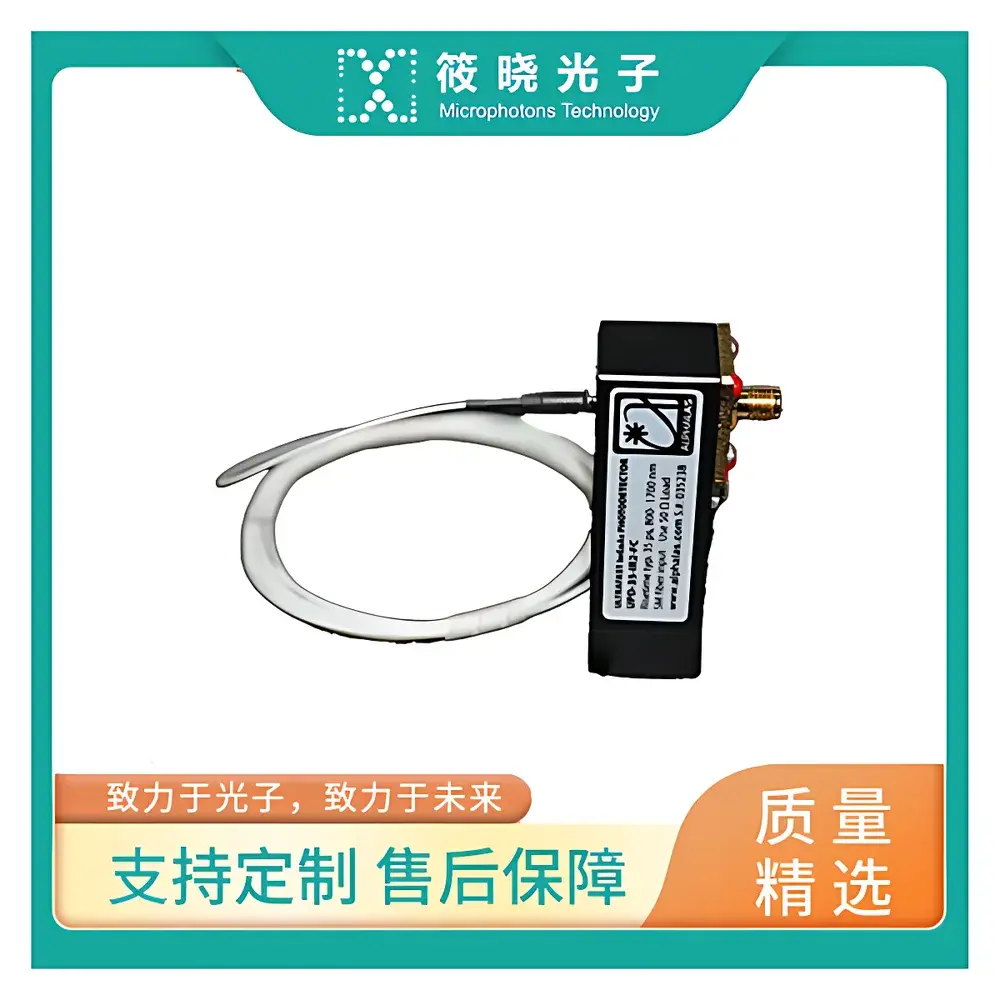
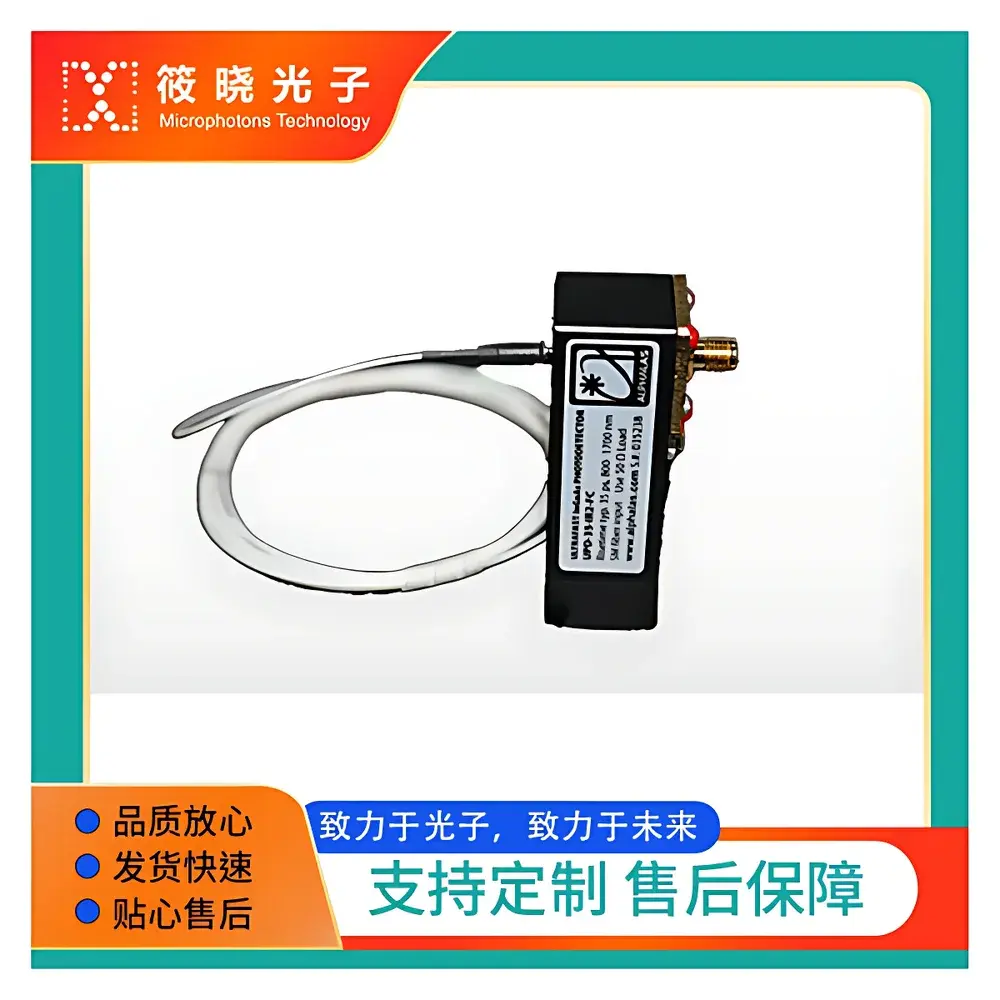
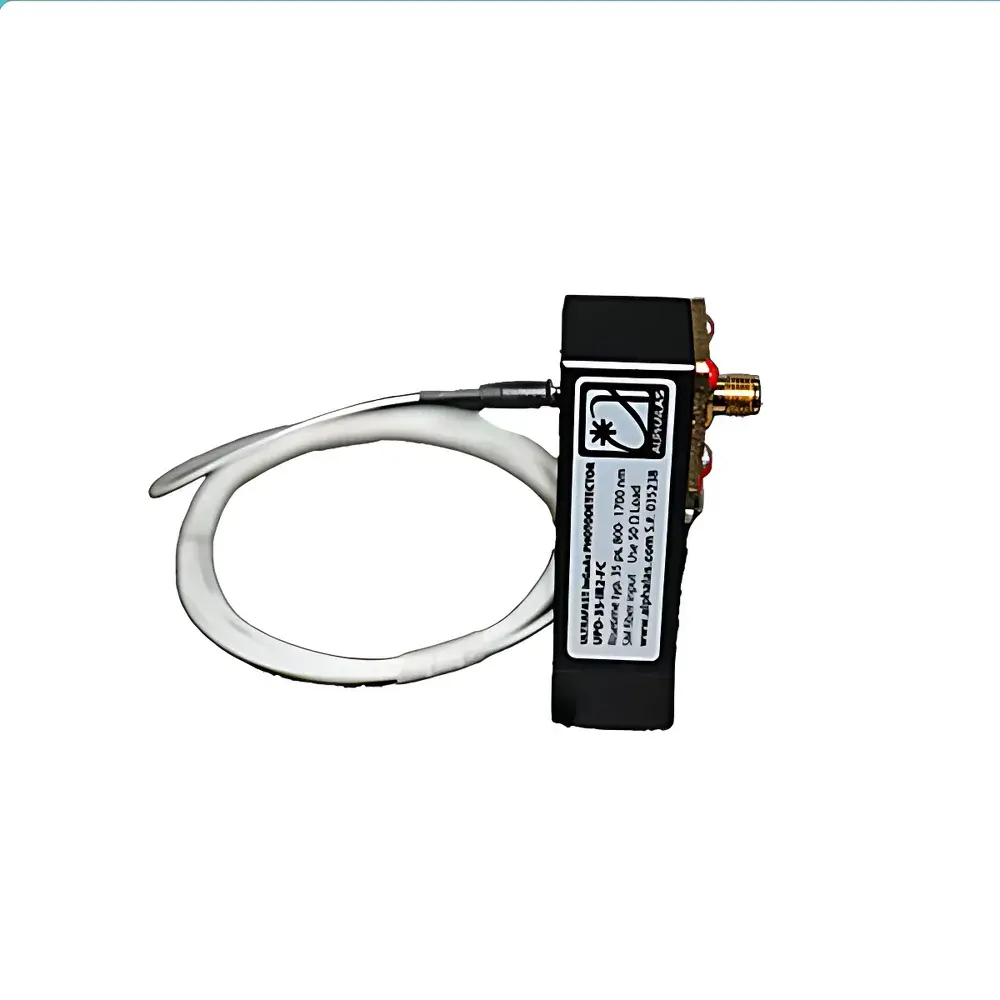
Alphalas UPD-15-IR2-FC Ultrafast InGaAs PIN Photodetector (800–1700 nm, FC/APC Fiber-Coupled)
| Brand | Alphalas |
|---|---|
| Model | UPD-15-IR2-FC |
| Detector Material | InGaAs |
| Spectral Range | 800–1700 nm |
| Rise Time | <15 ps |
| 3-dB Bandwidth | >25 GHz |
| Active Area | Fiber-coupled, 9 µm core |
| Quantum Efficiency @ Peak | 75% |
| NEP | 1.0×10⁻¹⁵ W/√Hz |
| Dark Current | 0.1 nA |
| Optical Input | FC/APC fiber connector |
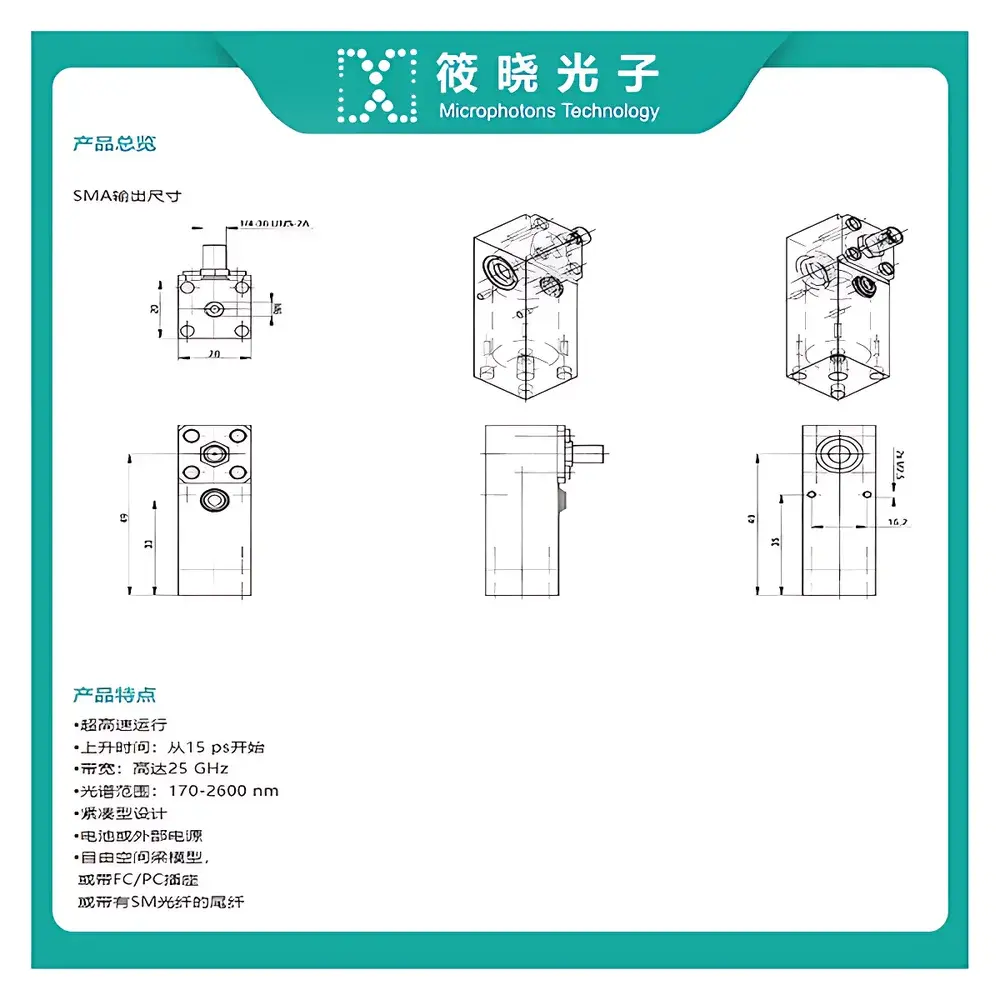
| RF Output | SMA |
Overview
The Alphalas UPD-15-IR2-FC is an ultrafast photodetector engineered for time-resolved optical measurements requiring sub-15 ps temporal resolution and broadband near-infrared sensitivity. Based on a low-capacitance, diffusion-limited InGaAs PIN diode architecture, it operates on the principle of high-speed photocurrent generation under reverse bias, with intrinsic carrier transit times minimized through optimized epitaxial layer design and low-inductance packaging. Its fiber-coupled configuration—featuring a precision-aligned 9 µm single-mode fiber terminated with an FC/APC connector—ensures minimal modal dispersion and repeatable coupling efficiency across wavelength bands from 800 nm to 1700 nm. This makes the UPD-15-IR2-FC particularly suited for applications demanding phase-coherent detection in ultrafast laser systems, such as autocorrelation, streak camera triggering, pump-probe spectroscopy, and high-bandwidth optical communications characterization.
Key Features
- Sub-15 ps rise time and >25 GHz small-signal bandwidth, enabling direct measurement of femtosecond-scale optical pulses without external deconvolution
- Fiber-pigtailed input with FC/APC interface ensures low back-reflection (< −60 dB) and stable alignment under thermal or mechanical stress
- High quantum efficiency (75% at 1550 nm) combined with ultra-low noise-equivalent power (1.0×10⁻¹⁵ W/√Hz) supports high signal-to-noise ratio detection in low-light conditions
- Integrated 50 Ω matched RF output via SMA connector minimizes impedance mismatch and preserves pulse fidelity up to 25 GHz
- Hermetically sealed TO-46 package with thermally stable ceramic substrate ensures long-term performance stability under continuous operation
- No internal amplification—preserves linearity over >40 dB dynamic range (typ. 1 mW optical input), critical for quantitative intensity calibration
Sample Compatibility & Compliance
The UPD-15-IR2-FC is compatible with standard single-mode telecom fibers (SMF-28, HI1060) and supports polarization-maintaining (PM) fiber integration upon request. Its spectral response aligns with ITU-T G.694.1 DWDM channel grids and covers key laser emission bands including Ti:sapphire (700–1000 nm), Er-doped fiber lasers (1530–1565 nm), and Tm/Ho-based sources (1800–2100 nm, edge response). The device complies with IEC 61315:2019 (optoelectronic semiconductor devices – test methods) and meets RoHS 2015/863/EU requirements. While not certified for medical or aerospace use out-of-the-box, its design adheres to traceable metrology practices suitable for GLP-compliant laboratories performing laser parameter validation per ISO/IEC 17025.
Software & Data Management
As a passive analog detector, the UPD-15-IR2-FC requires no embedded firmware or driver software. It interfaces seamlessly with industry-standard oscilloscopes (Keysight Infiniium, Tektronix DPO70000SX), RF spectrum analyzers (Rohde & Schwarz FSW), and digitizers (Spectrum Instrumentation M4i series) via 50 Ω coaxial cabling. For time-domain analysis, users may apply manufacturer-provided impulse response correction files (in .s2p format) to compensate for frequency roll-off above 15 GHz. Calibration certificates—including spectral responsivity (A/W vs. λ), rise time verification traceable to NIST-traceable reference detectors, and NEP measurement reports—are supplied with each unit and archived digitally for audit readiness per FDA 21 CFR Part 11 when used in regulated R&D environments.
Applications
- Ultrafast laser pulse characterization: intensity autocorrelation, FROG, SPIDER, and cross-correlation gating
- High-speed optical sampling in time-domain reflectometry (TDR) and optical time-domain reflectometry (OTDR)
- Synchronization of multi-channel laser systems (e.g., seeded OPA pumps, dual-comb interferometers)
- Characterization of modulated signals in 100G/400G coherent optical transceivers
- Time-of-flight measurements in LiDAR and quantum optics experiments involving photon-pair detection
- Reference detection in metrology-grade optical frequency comb stabilization loops
FAQ
What is the maximum average optical power this detector can handle without damage?
The UPD-15-IR2-FC is rated for ≤10 mW average optical power under continuous wave (CW) illumination; exceeding this may induce thermal drift in responsivity or accelerate dark current aging.
Can it be used with polarization-maintaining fiber?
Yes—custom versions with PM fiber pigtails (e.g., PANDA or Bowtie type) and aligned slow-axis coupling are available upon request, with extinction ratio >20 dB maintained across the operating band.
Is DC coupling supported?
No—the detector is AC-coupled via integrated blocking capacitor to suppress low-frequency drift; for DC or quasi-static measurements, the UPD-50-SP or UPD-100-IR1-P series are recommended alternatives.
How is calibration traceability established?
Each unit undergoes spectral responsivity calibration using a NIST-traceable calibrated photodiode (Hamamatsu S1337-1010BR) and a monochromator-based setup compliant with ISO/IEC 17025 clause 6.4; full uncertainty budgets are provided in the certificate.
Does the FC/APC connector support angled physical contact with SMF-28?
Yes—the FC/APC interface is manufactured to IEC 61754-13 Class A specifications, ensuring insertion loss 60 dB when mated with compliant adapters and cables.





