
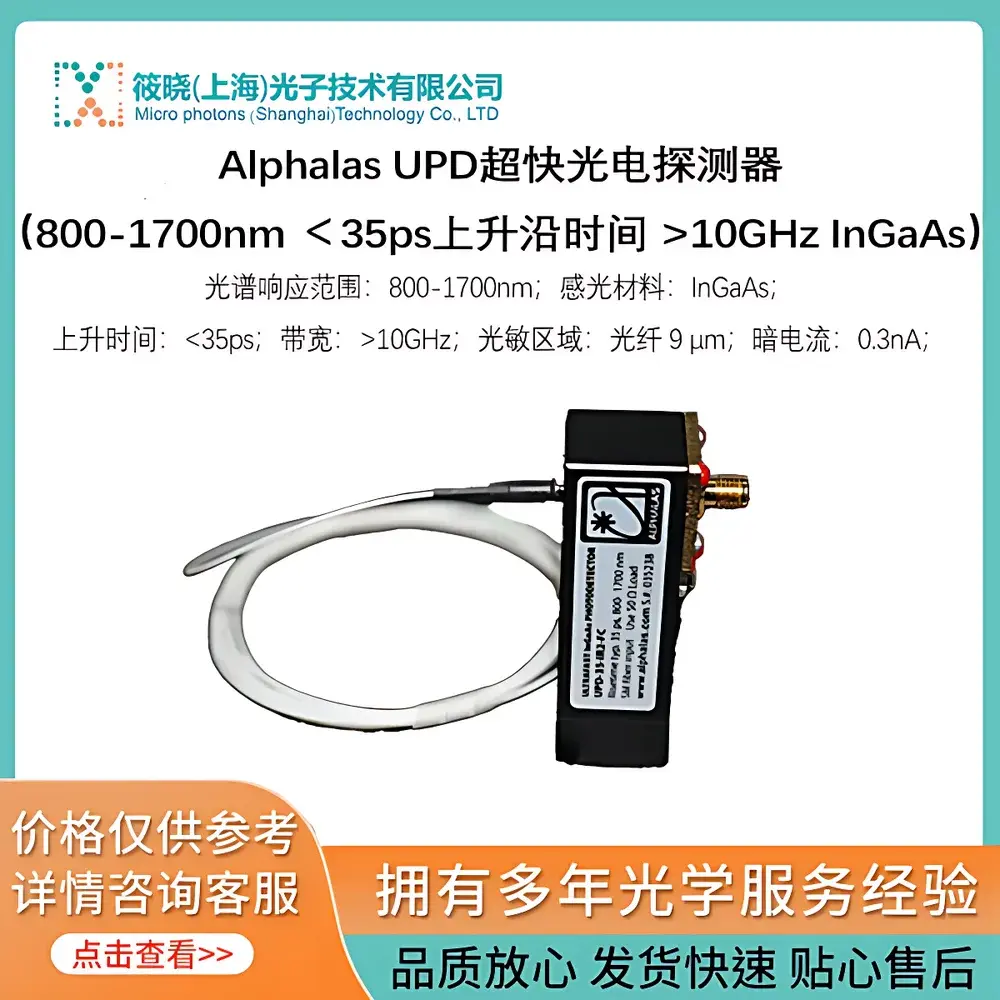

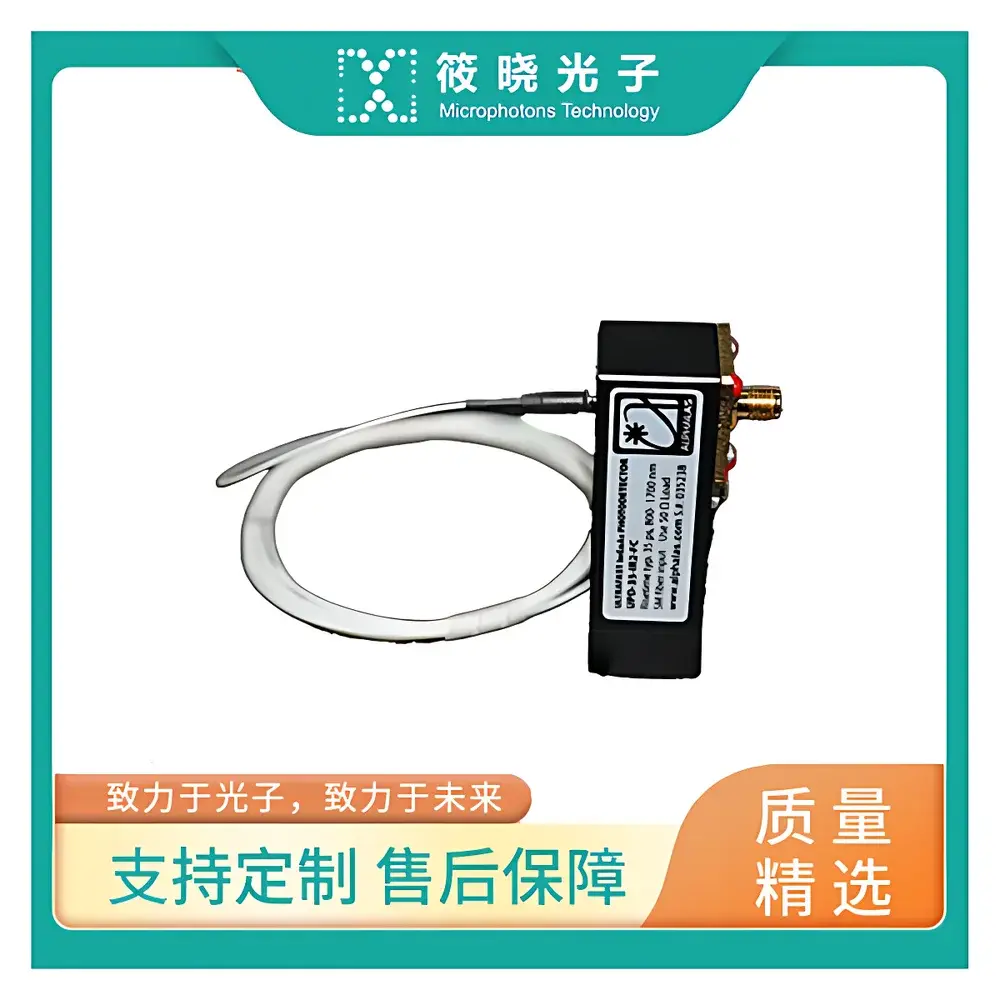
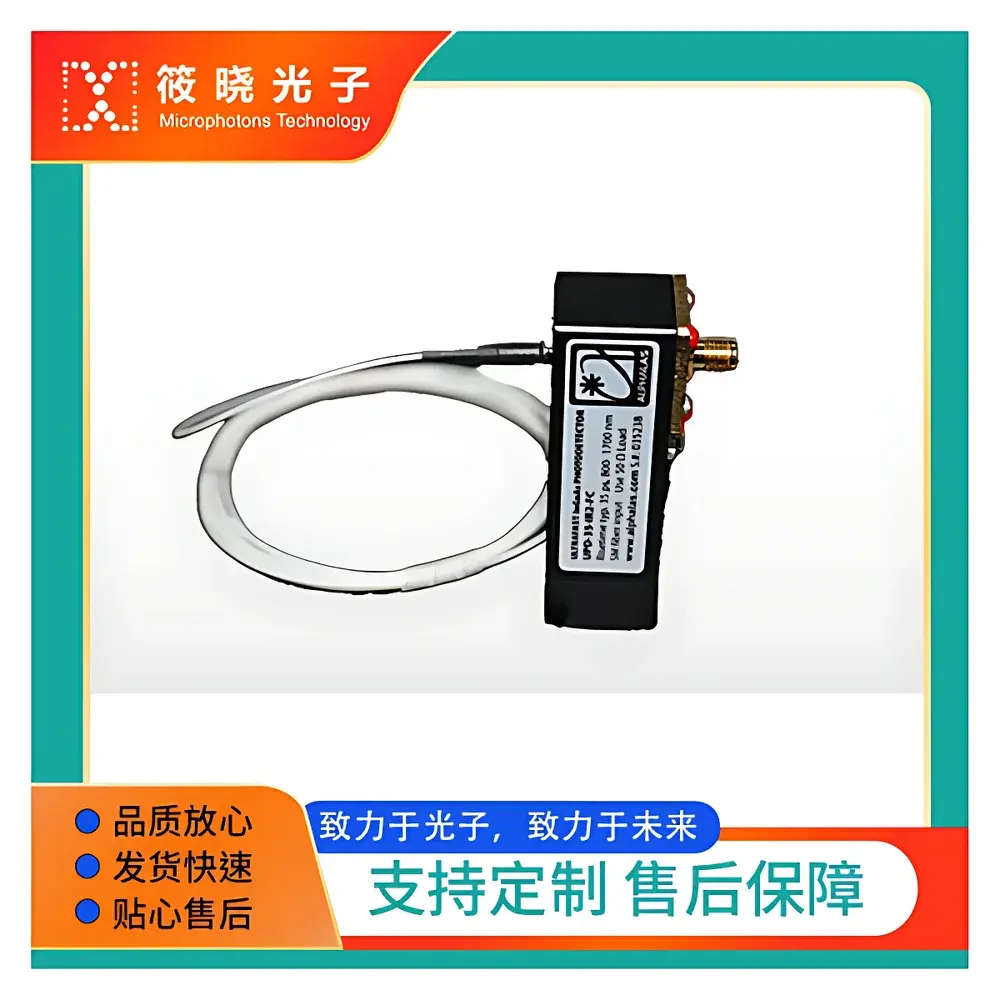
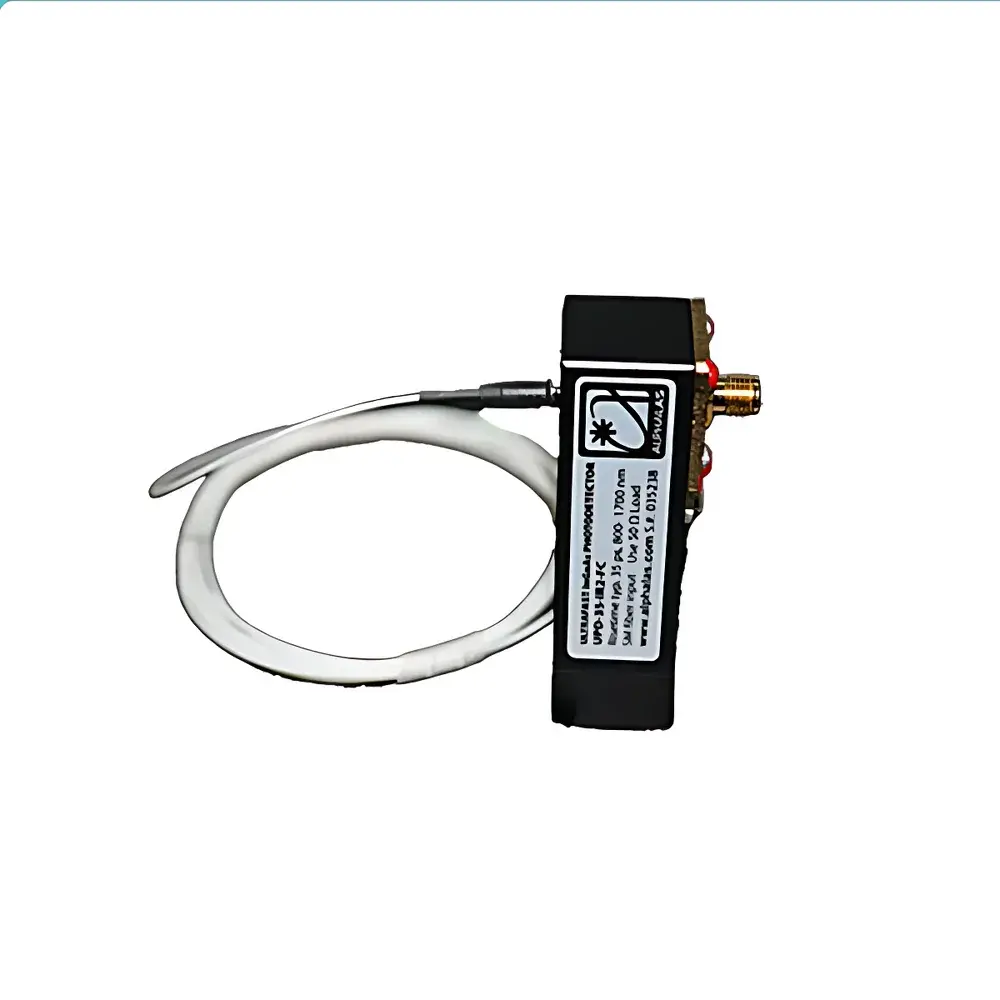
Alphalas UPD-35-IR2-FC Ultrafast Photodetector (800–1700 nm, <35 ps Rise Time, 10 GHz Bandwidth, InGaAs, FC/PC Fiber Input)
| Brand | Alphalas |
|---|---|
| Origin | Germany |
| Model | UPD-35-IR2-FC |
| Spectral Range | 800–1700 nm |
| Photosensitive Material | InGaAs |
| Rise Time | <35 ps |
| 3-dB Bandwidth | >10 GHz |
| Active Area | Ø50 µm (0.0024 mm²) |
| Dark Current | 0.3 nA |
| Input Interface | FC/PC fiber connector |
| Output Connector | SMA |
| Package | Hermetically sealed anodized aluminum housing |
| Power Supply | Battery or external DC (±5 V) |
| Impedance | 50 Ω matched |
Overview
The Alphalas UPD-35-IR2-FC is a high-performance ultrafast photodetector engineered for time-resolved optical measurements in the near-infrared (NIR) spectral region. Based on low-capacitance InGaAs PIN photodiode technology and integrated microwave packaging, it delivers sub-35 ps rise time and >10 GHz small-signal bandwidth—enabling faithful capture of ultrashort optical pulses, transient photocurrents, and high-frequency modulated signals. Its FC/PC fiber-coupled input ensures repeatable, alignment-free coupling with standard single-mode telecom fibers (SMF-28), minimizing insertion loss and modal noise. The detector operates under 50 Ω impedance matching to preserve signal integrity in time-domain applications such as optical sampling, laser pulse characterization, THz generation diagnostics, and high-speed optical communications testing. Housed in a compact, hermetically sealed anodized aluminum enclosure, it supports both battery-powered field operation and stable lab-based DC powering (±5 V), making it suitable for integration into OEM systems, lock-in compatible setups, and portable metrology platforms.
Key Features
- Sub-35 ps electrical rise time (10%–90%) with <100 ps pulse width (FWHM) under optimized conditions
- DC–>10 GHz frequency response, verified per IEC 61280-2-9 and IEEE Std 1476–2021 measurement protocols
- Fiber-pigtailed FC/PC input for low-reflection, polarization-insensitive coupling to SMF-28 fiber
- Low dark current (≤0.3 nA at 5 V reverse bias), enabling high dynamic range (>60 dB) in low-light pulsed applications
- Hermetic aluminum housing with RF-shielded SMA output, compliant with MIL-STD-810G for mechanical robustness
- Integrated 50 Ω output termination; optional high-impedance operation via external load for enhanced voltage responsivity
- Compatible with industry-standard oscilloscopes (≥20 GHz analog bandwidth), spectrum analyzers, and real-time digitizers
Sample Compatibility & Compliance
The UPD-35-IR2-FC is designed for use with continuous-wave (CW) and pulsed laser sources operating between 800 nm and 1700 nm—including Ti:sapphire oscillators (800 nm), Yb-fiber amplifiers (1030–1080 nm), Er-fiber lasers (1550 nm), and OPO outputs (up to 1700 nm). Its Ø50 µm active area provides optimal trade-off between speed and coupling efficiency for single-mode fiber delivery. The device meets RoHS Directive 2011/65/EU and REACH Regulation (EC) No. 1907/2006. While not certified for medical or aerospace safety standards, its electrical performance adheres to ISO/IEC 17025 traceable calibration practices when used with NIST-traceable reference detectors (e.g., Hamamatsu C12702 series). It supports GLP-compliant documentation workflows when paired with Alphalas’ optional calibration certificate (NIST-traceable responsivity at 1310 nm and 1550 nm).
Software & Data Management
The UPD-35-IR2-FC is a passive analog transducer and does not include embedded firmware or digital interfaces. Signal acquisition relies on external instrumentation—such as Keysight Infiniium oscilloscopes, Tektronix DPO70000SX series, or Zurich Instruments HF2LI lock-in amplifiers—with full support for automated data logging via SCPI commands. When integrated into automated test systems, it complies with IEEE 488.2 (GPIB) and LXI Class C standards through host controller software (e.g., LabVIEW 2023 SP1, Python PyVISA 1.13+). For traceable calibration reporting, users may import factory-provided responsivity curves (A/W vs. wavelength) into MATLAB or Python-based analysis pipelines for deconvolution of system-level impulse response. No FDA 21 CFR Part 11 compliance is required, as the device performs no data storage or user-accessible configuration.
Applications
- Characterization of femtosecond and picosecond laser pulses (autocorrelation validation, FROG cross-check)
- Time-of-flight measurements in optical coherence tomography (OCT) reference arms
- High-speed optical interconnect testing (10G/25G/50G PAM4 eye diagram analysis)
- Photonic integrated circuit (PIC) output monitoring under modulated bias conditions
- Synchronization of pump-probe experiments requiring jitter <100 fs RMS
- Calibration transfer standard for broadband NIR power meters and optical attenuators
FAQ
What is the maximum average optical power this detector can handle without saturation or damage?
The UPD-35-IR2-FC is rated for ≤10 mW average optical power at 1550 nm with proper heat sinking. Sustained exposure above 5 mW may induce thermal drift in responsivity; derating is recommended above 70 °C case temperature.
Is the detector sensitive to polarization state?
No—its fiber-coupled design renders it polarization-insensitive within ±0.5 dB across the full 800–1700 nm band, as verified by Mueller matrix characterization per IEC 61282-10.
Can this detector be used with free-space beams?
Not directly—the FC/PC input requires fiber delivery. For free-space applications, consider the UPD-35-IR2-FR (free-space collimated input) or UPD-35-UVIR-P (MgF₂ window variant).
Does Alphalas provide NIST-traceable calibration certificates?
Yes—optional calibration at 1310 nm and 1550 nm is available upon request (certification includes uncertainty budget per GUM Annex H).
What is the typical junction capacitance and how does it affect bandwidth?
Measured capacitance is ≤0.15 pF at 5 V reverse bias. Combined with 50 Ω termination, this yields the specified >10 GHz bandwidth; bandwidth scales inversely with square root of total circuit capacitance.





