
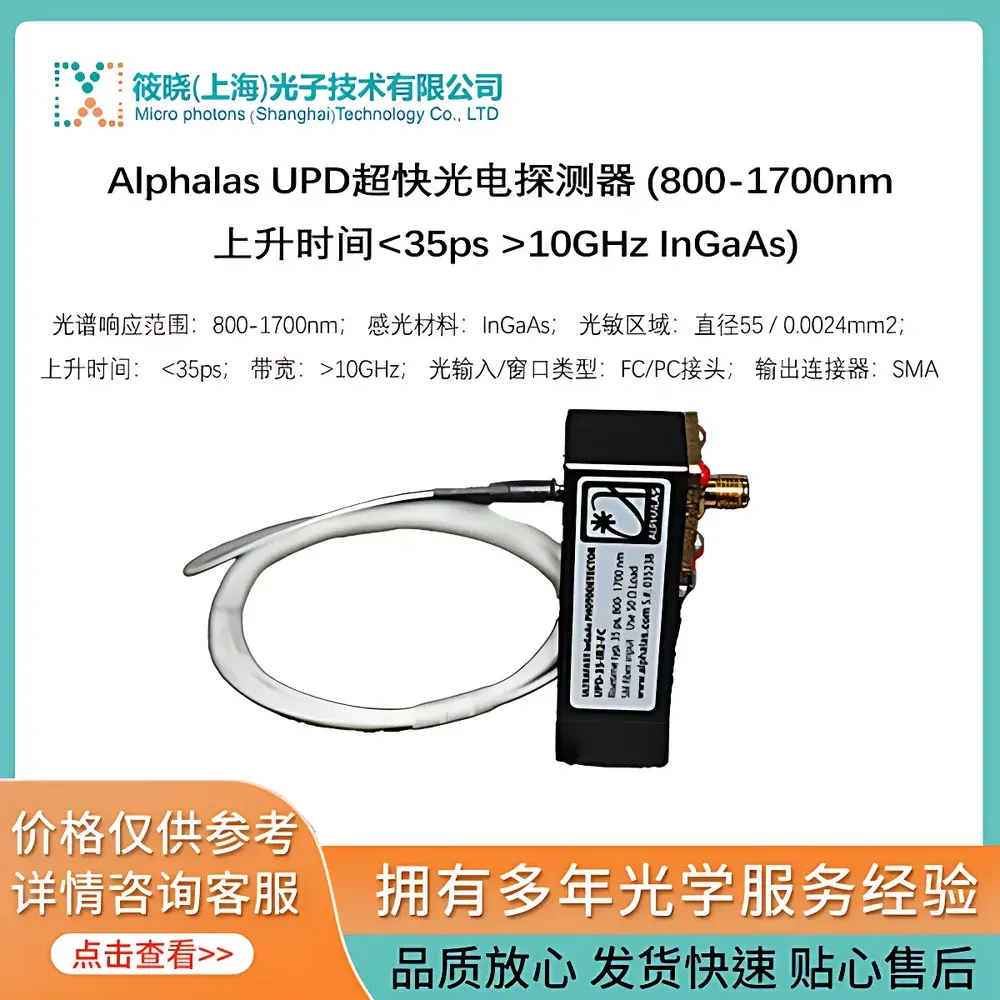
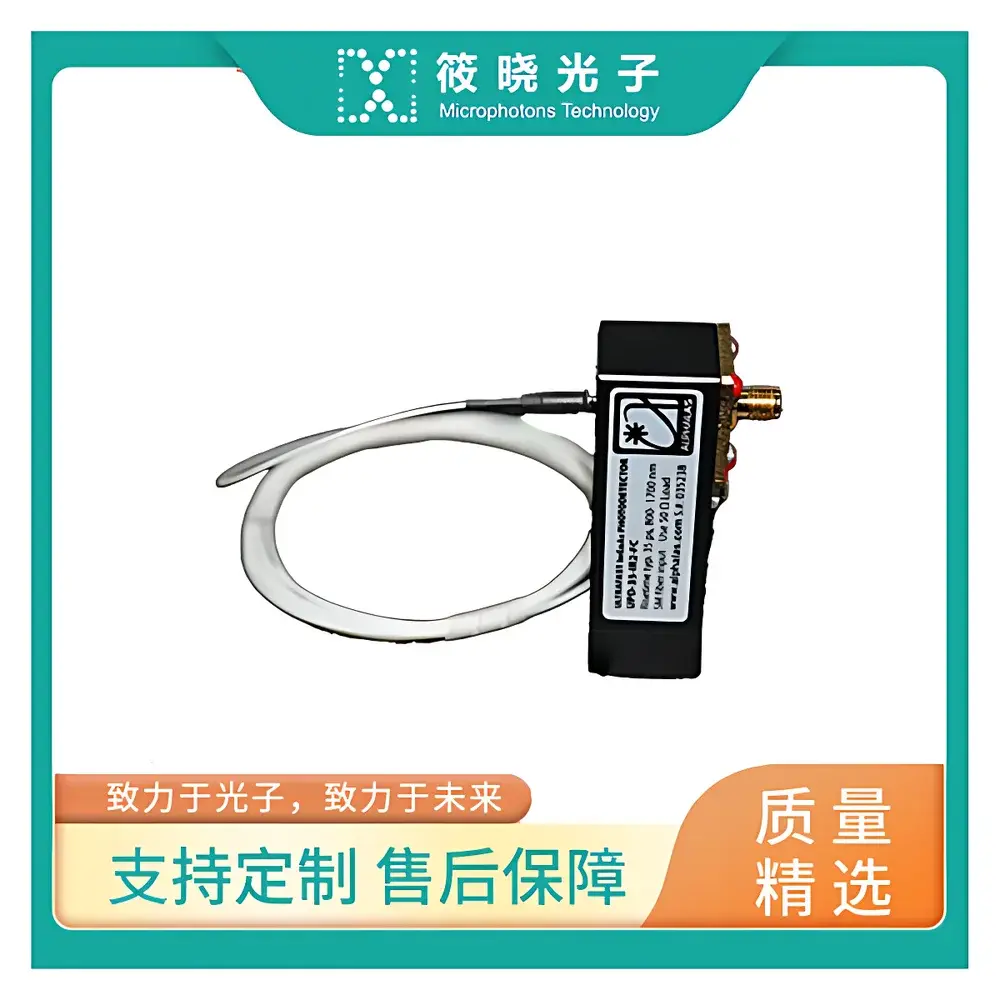
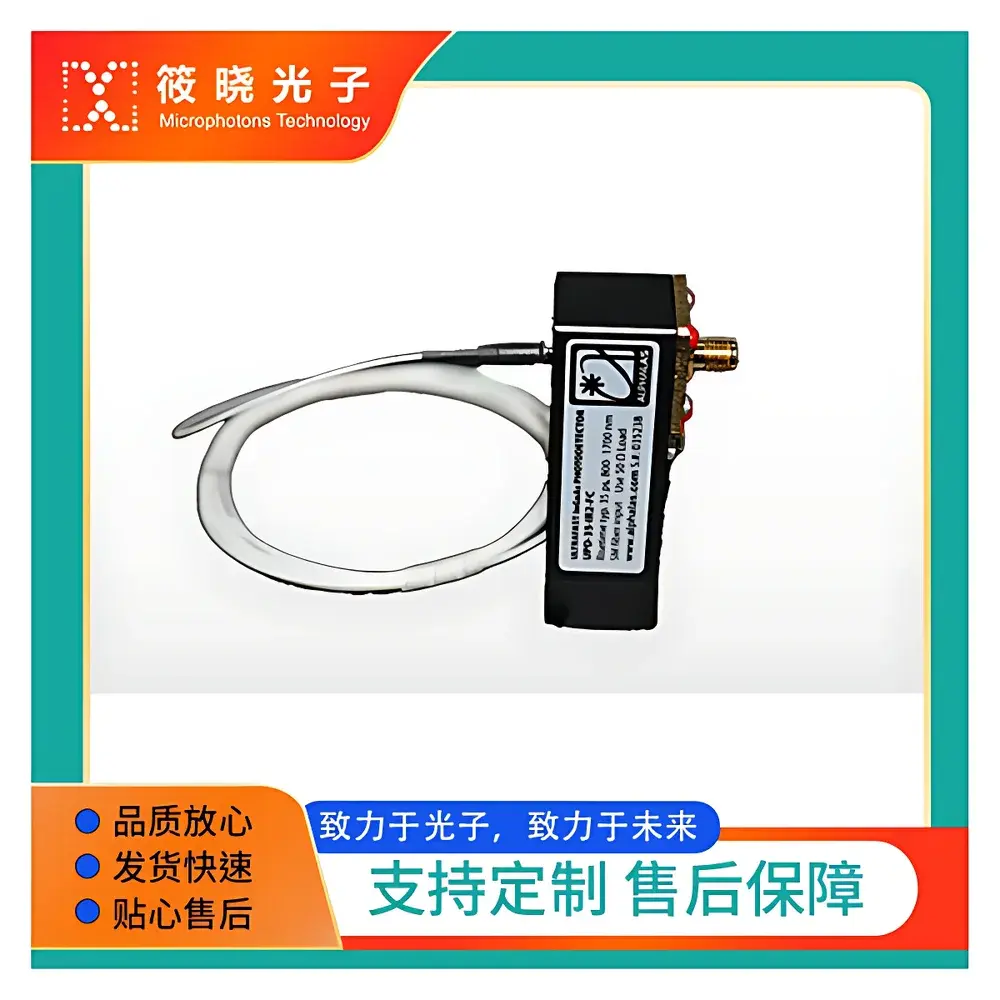
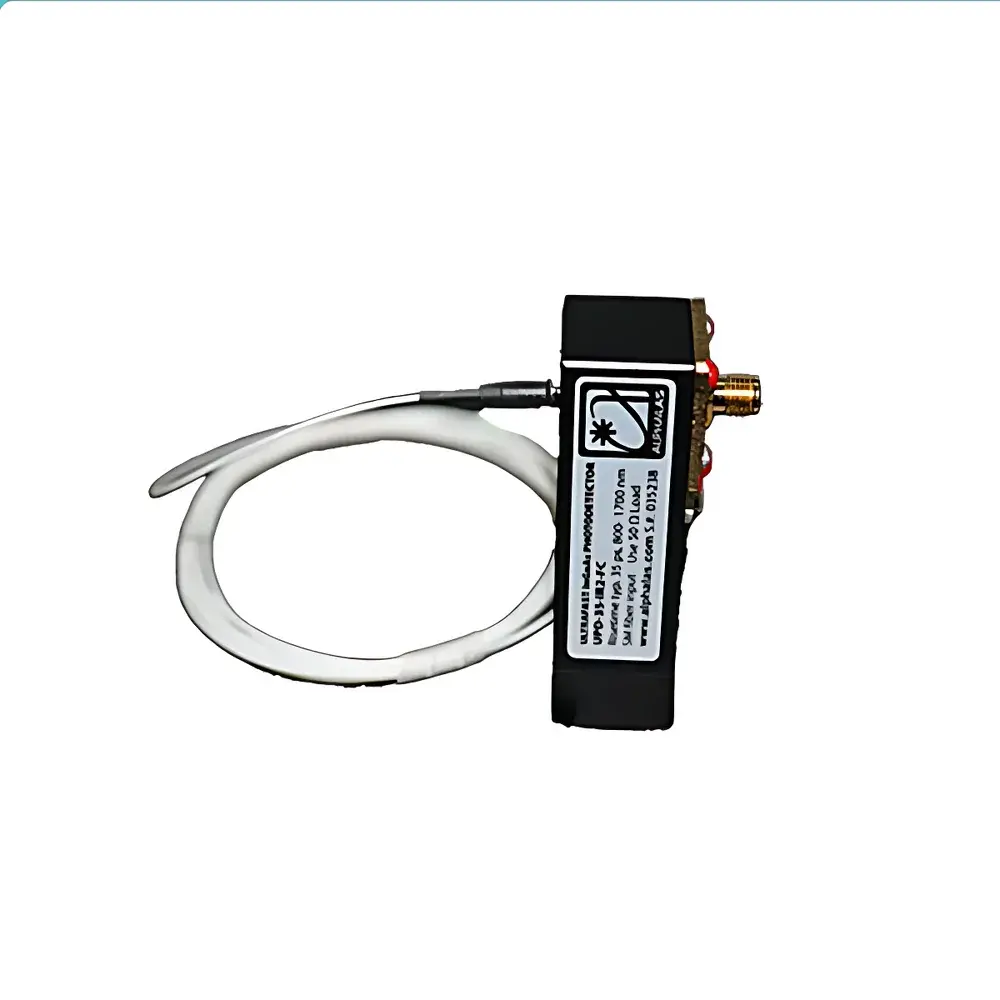
Alphalas UPD-35-IR2-FR Ultrafast InGaAs Photodetector (800–1700 nm, 10 GHz Bandwidth)
| Brand | Alphalas |
|---|---|
| Origin | Germany |
| Model | UPD-35-IR2-FR |
| Spectral Range | 800–1700 nm |
| Photosensitive Material | InGaAs |
| Rise Time | <35 ps |
| Bandwidth | >10 GHz |
| Active Area | 9 µm fiber core |
| Dark Current | 0.3 nA |
| Optical Input | Fiber with FC/APC connector |
| RF Output | SMA |
| Housing | Anodized aluminum |
Overview
The Alphalas UPD-35-IR2-FR is a high-performance ultrafast photodetector engineered for time-resolved optical measurements in the near-infrared (NIR) spectrum. Based on a low-capacitance InGaAs PIN photodiode structure and optimized microwave packaging, it operates on the principle of direct photocurrent generation followed by broadband RF signal extraction via impedance-matched 50 Ω transmission lines. Its sub-35 ps rise time and >10 GHz electrical bandwidth enable faithful capture of ultrashort optical transients—critical for characterizing mode-locked laser pulses, optical clock recovery, and time-of-flight diagnostics in photonics R&D. The device is designed for fiber-coupled operation with FC/APC termination, minimizing back-reflection and ensuring stable alignment in interferometric or heterodyne configurations. All UPD series detectors feature hermetically sealed, anodized aluminum housings with integrated bias teeing and DC-blocking capacitors—ensuring mechanical robustness, thermal stability, and repeatable RF performance across laboratory and OEM integration environments.
Key Features
- Sub-35 ps rise time with >10 GHz small-signal bandwidth—validated per IEC 61280-2-9 and IEEE Std 1476™ test protocols
- Fiber-coupled input with precision FC/APC interface—guarantees < −60 dB return loss at 1550 nm
- Low dark current of 0.3 nA (typ.) at 5 V reverse bias—enabling high dynamic range in low-light pulse detection
- Integrated 50 Ω matched output impedance—eliminates external matching networks and preserves signal fidelity up to 20 GHz
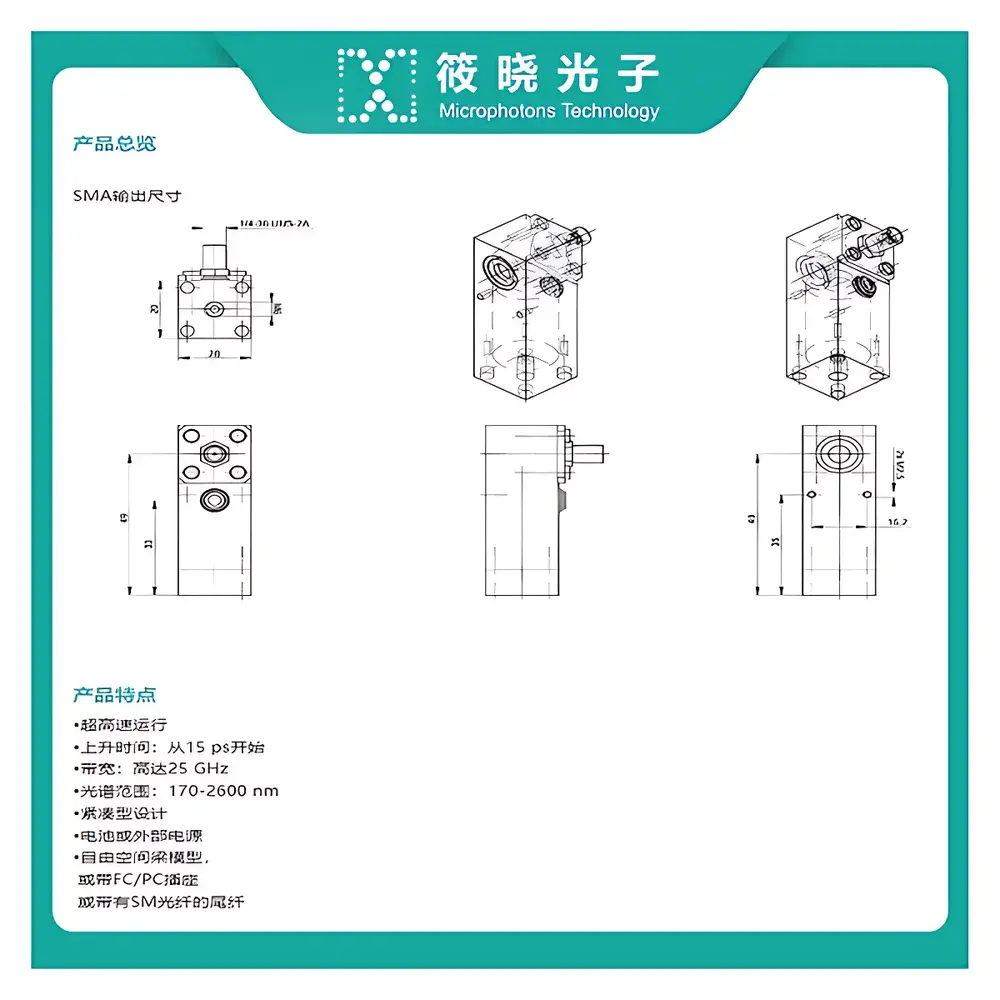
- Compact, passively cooled housing (38 × 38 × 18 mm)—compatible with standard optical breadboards and vacuum feedthroughs
- Dual power options: internal CR2032 battery (up to 100 h standby) or external 5 V DC supply—supports portable and rack-mounted deployment
- No internal amplification—preserves linearity (±0.5% deviation up to 10 mW avg. optical power) and avoids gain-induced jitter
Sample Compatibility & Compliance
The UPD-35-IR2-FR is compatible with single-mode telecom fibers (SMF-28, HI1060) and polarization-maintaining (PM) variants when used with appropriate FC/APC adapters. It meets RoHS 2015/863/EU and REACH (EC 1907/2006) material compliance requirements. For traceable calibration, Alphalas provides NIST-traceable responsivity data (A/W) at 1310 nm and 1550 nm, measured under ISO/IEC 17025-accredited conditions. The detector supports GLP-compliant operation when paired with time-domain analyzers (e.g., Keysight DSAZ series) equipped with 21 CFR Part 11 audit trails. Its spectral response is certified per DIN EN 61317-2 for NIR photodetectors, with flatness ±1.2 dB across 800–1700 nm.
Software & Data Management
While the UPD-35-IR2-FR is a passive photodetector (no embedded firmware or digital interface), it integrates seamlessly into standardized measurement ecosystems. When connected to oscilloscopes (e.g., Tektronix MSO6B, LeCroy WavePro HD) or real-time spectrum analyzers, raw voltage waveforms are acquired with full Nyquist sampling (≥50 GS/s recommended). Alphalas supplies MATLAB® and Python-compatible calibration files (.csv) containing wavelength-dependent responsivity, group delay vs. frequency, and S-parameter (S11/S21) datasets for deconvolution-based pulse reconstruction. For automated test systems, SCPI command sets for compatible digitizers support trigger synchronization, averaging control, and metadata tagging—enabling full traceability per ISO/IEC 17025 clause 7.7.
Applications
- Direct measurement of femtosecond-to-picosecond laser pulse profiles (e.g., Ti:sapphire, Er:fiber, and Yb-doped oscillators)
- Optical timing jitter analysis in photonic integrated circuits (PICs) and coherent receiver front-ends
- Time-resolved photoluminescence decay studies in quantum dot and 2D material spectroscopy
- Synchronization of pump-probe experiments with sub-100 fs timing resolution
- Calibration reference for autocorrelators and FROG devices requiring verified IR responsivity
- High-speed optical interconnect characterization (100G–800G PAM4, coherent DP-QPSK)
- THz generation diagnostics via optical rectification in nonlinear crystals (e.g., ZnTe, GaP)
FAQ
What is the maximum average optical power this detector can handle without saturation or damage?
The UPD-35-IR2-FR is rated for ≤10 mW average optical power at 1550 nm with proper heat sinking; derating to 5 mW is recommended for continuous-wave operation above 25 °C ambient.
Can this detector be used with free-space beams, or is fiber coupling mandatory?
The UPD-35-IR2-FR variant is specifically designed for fiber input only; for free-space applications, select the UPD-35-IR2-P (polished glass window) or UPD-35-UVIR-D (diffuse quartz window) models.
Is the responsivity calibrated at multiple wavelengths, and is calibration certificate included?
Yes—NIST-traceable responsivity values at 1310 nm and 1550 nm are provided with each unit; full spectral calibration (800–1700 nm, 10 nm step) is available as an optional service report.
Does the detector require external bias, and what is the recommended reverse voltage?
It operates with a fixed 5 V reverse bias supplied internally via battery or external source; no user-adjustable bias is required or supported.
How does temperature affect rise time and bandwidth performance?
Rise time variation is < ±0.5 ps over 15–35 °C ambient; bandwidth remains within specification up to 45 °C case temperature, verified per MIL-STD-883H Method 1010.8.





