
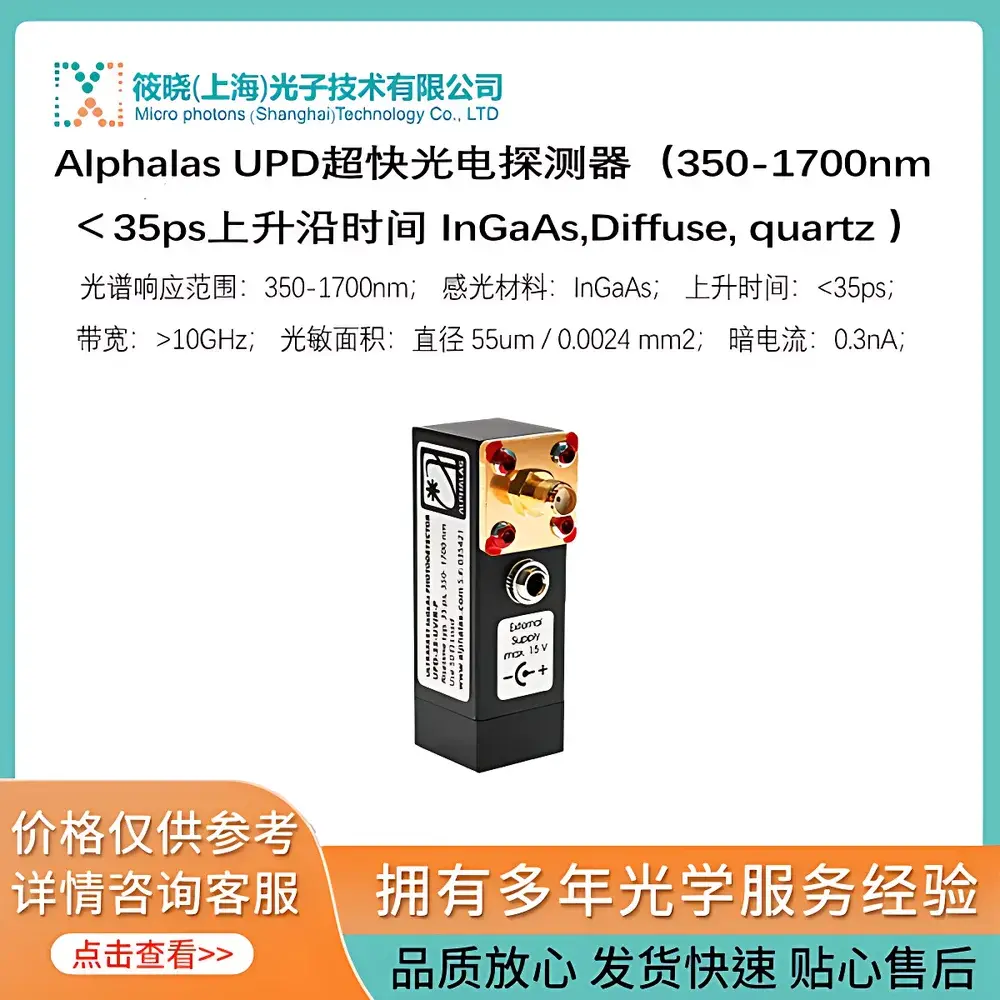

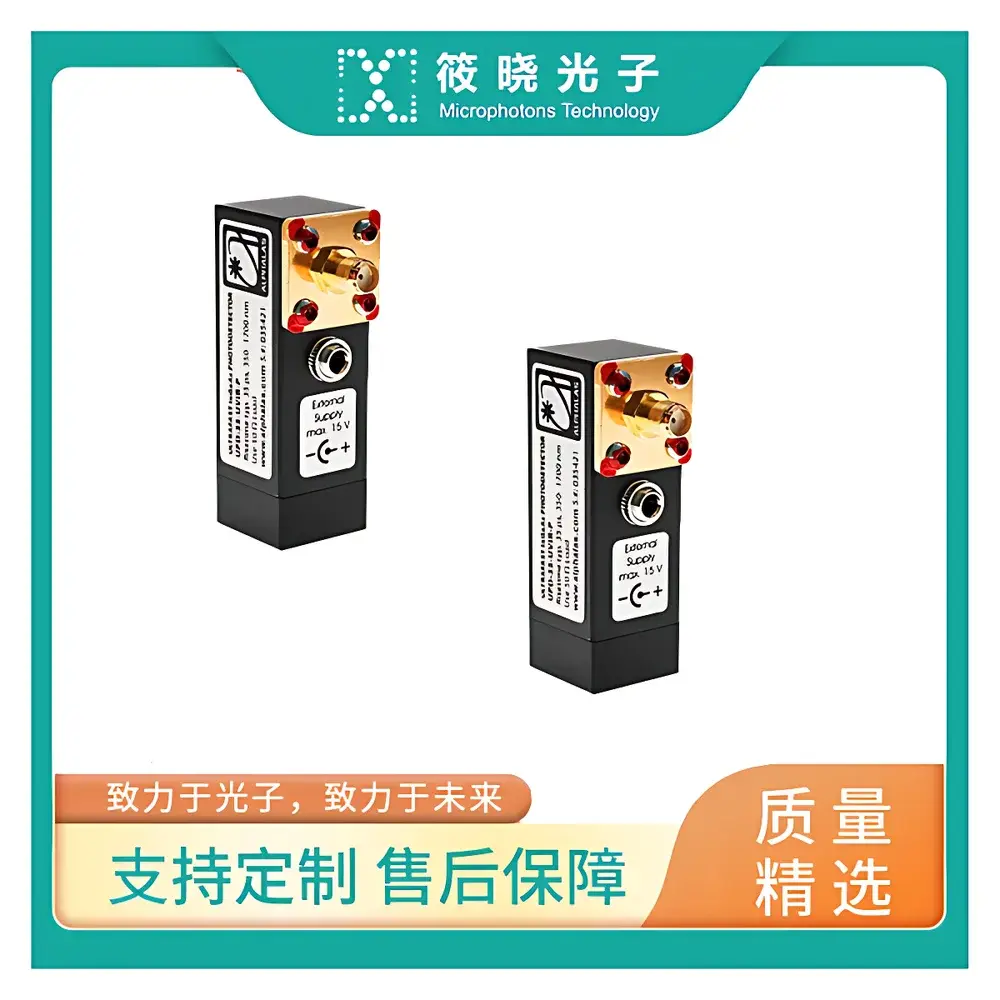
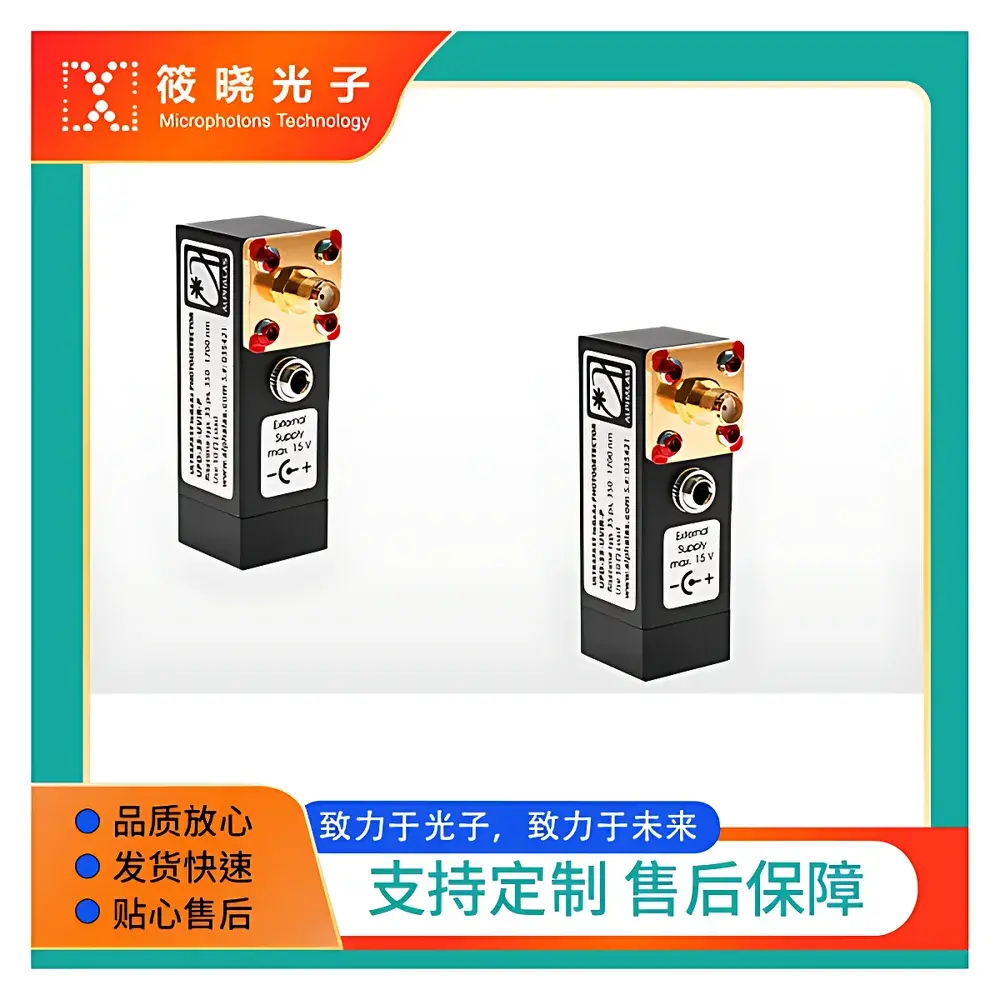
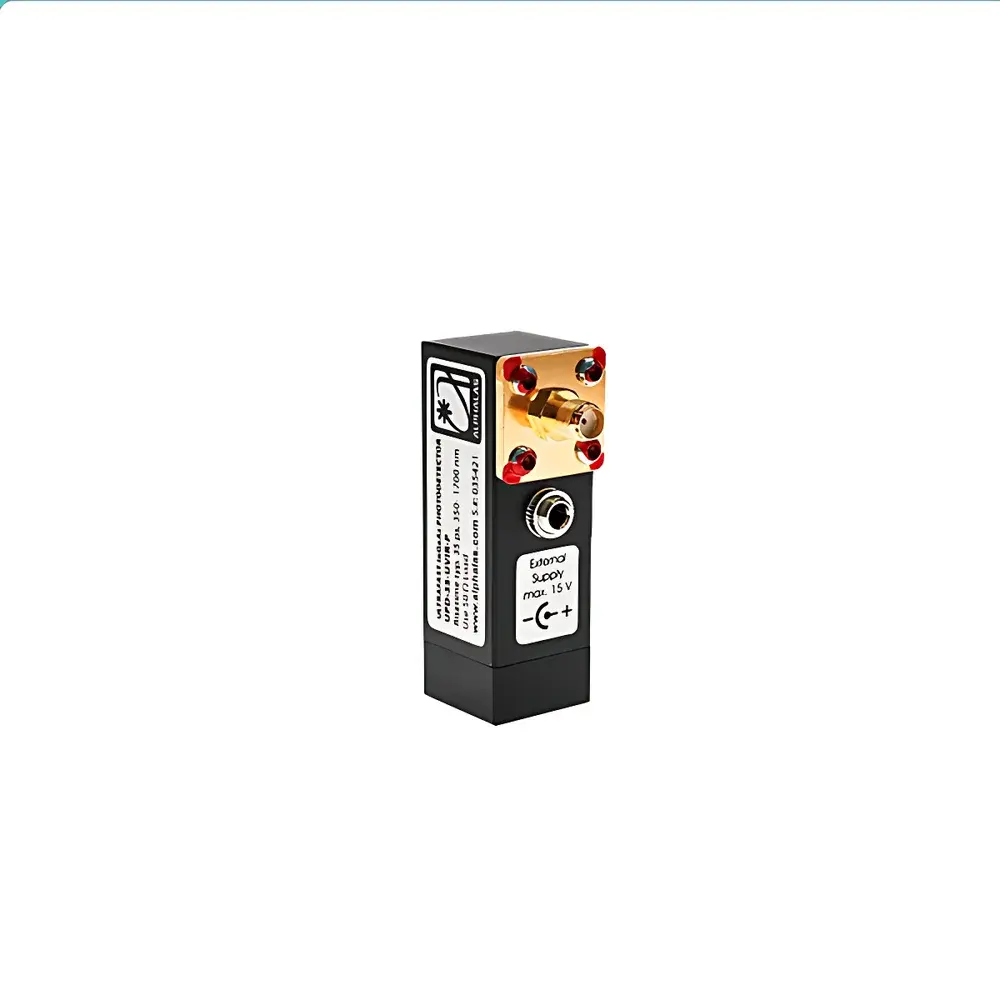
Alphalas UPD-35-UVIR-D Ultrafast Photodetector (350–1700 nm, Diffuse, Quartz Window)
| Brand | Alphalas |
|---|---|
| Origin | Germany |
| Model | UPD-35-UVIR-D |
| Spectral Range | 350–1700 nm |
| Active Area | 35 µm diameter |
| Window Material | UV-grade fused silica (quartz) |
| Detector Type | PIN photodiode with ultra-low capacitance packaging |
| Rise Time | <35 ps (typ.) |
| Bandwidth | >10 GHz (DC–10 GHz, –3 dB) |
| Responsivity | 0.6 A/W @ 800 nm, 0.9 A/W @ 1300 nm, 0.7 A/W @ 1550 nm |
| Dark Current | <100 pA (at 0 V bias) |
| Bias Voltage | 0 to −12 V (reverse bias recommended for max speed) |
| Output Connector | SMA female |
| Housing | Hermetically sealed TO-8 can with integrated 50 Ω termination |
| Compliance | RoHS, CE marked |
| Operating Temperature | −40 °C to +70 °C |
| Storage Temperature | −40 °C to +85 °C |
Overview
The Alphalas UPD-35-UVIR-D is a high-performance ultrafast photodetector engineered for time-resolved optical measurements requiring sub-35 ps temporal resolution and broad spectral coverage from the deep ultraviolet (350 nm) through the near-infrared (1700 nm). Built around a low-capacitance, diffusion-illuminated InGaAs/InP PIN photodiode structure, it delivers exceptional bandwidth (>10 GHz, DC-coupled) without external amplification—enabling direct integration into high-speed oscilloscopes, RF spectrum analyzers, and time-correlated single-photon counting (TCSPC) systems. Its hermetically sealed TO-8 package incorporates an integrated 50 Ω termination and SMA output connector, minimizing signal reflection and preserving pulse fidelity. The UV-grade fused silica (quartz) window ensures high transmission down to 350 nm while maintaining mechanical robustness and long-term stability under ambient laboratory conditions.
Key Features
- Ultrafast response: <35 ps rise time (typ.), enabling precise measurement of picosecond-scale optical transients
- Broad spectral sensitivity: 350–1700 nm—optimized for Ti:sapphire, Yb-fiber, Er-fiber, and OPO-based ultrafast laser systems
- Diffuse illumination design: Uniform responsivity across incident angle (±15°), reducing alignment sensitivity in free-space setups
- Quartz (UV-grade fused silica) input window: High UV transmission, low autofluorescence, and superior resistance to thermal shock and humidity
- Integrated 50 Ω termination: Eliminates need for external matching networks; ensures impedance-controlled signal integrity up to 10 GHz
- Low dark current (<100 pA at 0 V) and low noise equivalent power (NEP < 15 pW/√Hz @ 1550 nm), supporting high-dynamic-range detection
- Hermetic TO-8 metal can housing: Provides EMI shielding, mechanical rigidity, and compatibility with vacuum-compatible optical benches
- DC-coupled output: Supports both pulsed and CW optical signal analysis without AC coupling artifacts
Sample Compatibility & Compliance
The UPD-35-UVIR-D is compatible with standard free-space optical paths, fiber-pigtailed configurations (with appropriate collimation optics), and vacuum-integrated beamlines (when mounted with compatible flanges). Its quartz window meets ISO 10110-3 surface quality standards (scratch-dig 20–10), and its optical path is free of organic adhesives or epoxy coatings that could outgas or degrade under UV exposure. The device complies with RoHS Directive 2011/65/EU and carries CE marking per EU Electromagnetic Compatibility (EMC) Directive 2014/30/EU and Low Voltage Directive 2014/35/EU. While not certified for medical or aerospace use, its design adheres to key principles of GLP-compliant instrumentation—traceable calibration documentation, stable gain characteristics over temperature, and repeatable electrical interface specifications.
Software & Data Management
As a passive, analog-output detector, the UPD-35-UVIR-D does not include embedded firmware or proprietary software. It interfaces natively with industry-standard acquisition platforms—including Keysight Infiniium oscilloscopes, Tektronix DPO70000SX series, Zurich Instruments HF2LI lock-in amplifiers, and National Instruments PXIe chassis—via its 50 Ω SMA output. For time-domain analysis, users commonly apply post-acquisition deconvolution using MATLAB or Python (SciPy) to correct for system impulse response when characterizing ultrafast pulses. Alphalas provides traceable NIST-traceable responsivity calibration data (per wavelength point) and full electrical S-parameter files (S11/S21) for SPICE or ADS modeling. All calibration certificates include uncertainty budgets compliant with ISO/IEC 17025:2017 requirements for accredited calibration laboratories.
Applications
- Characterization of femtosecond and picosecond laser pulses (autocorrelation verification, FROG support)
- Time-of-flight measurements in LIDAR and optical time-domain reflectometry (OTDR)
- High-speed optical communications testing (10+ Gbaud NRZ/PAM4 eye diagram analysis)
- Ultrafast spectroscopy: pump-probe, transient absorption, and THz electro-optic sampling
- Quantum optics experiments requiring low-jitter, high-bandwidth single-shot detection
- Calibration transfer standards for photodetector linearity and temporal response validation
- Integration into OEM ultrafast diagnostic modules for industrial laser processing monitoring
FAQ
What is the maximum optical input power this detector can handle without saturation or damage?
The UPD-35-UVIR-D is rated for peak optical powers up to 10 mW (CW-equivalent) at 1550 nm. At shorter wavelengths (e.g., 350–500 nm), derating to ≤3 mW is recommended due to increased photon energy and potential surface heating. Permanent damage threshold exceeds 100 mW for nanosecond pulses (10 ns, 1 kHz rep rate), but linear operation is maintained only below the specified saturation level.
Can this detector be used with reverse bias, and what effect does bias have on performance?
Yes—reverse bias (0 to −12 V) is recommended to minimize junction capacitance and maximize bandwidth. At −12 V, rise time improves by ~15% versus zero bias, and dark current increases to <500 pA (still well within low-noise operating range). Bias voltage is supplied externally via the SMA center pin (grounded shield); no internal bias circuitry is present.
Is the quartz window AR-coated, and if not, what is its average reflectivity?
The standard UPD-35-UVIR-D uses uncoated UV-grade fused silica. Average reflectivity is ~3.5% per surface (7% round-trip) across 400–1600 nm. Optional broadband AR coatings (350–2000 nm, R < 0.5% per surface) are available upon request and documented in custom calibration reports.
How is traceability ensured for calibration data provided with each unit?
Each detector ships with a calibration certificate referencing NIST-traceable standards (NIST SRM 2033 for responsivity, NIST SRM 2034 for spectral irradiance). Uncertainty budgets follow EURAMET cg-19 guidelines and include contributions from source stability, reference detector drift, and spectral mismatch error—typically ±2.5% (k=2) at 800 nm and ±3.8% at 1550 nm.




