
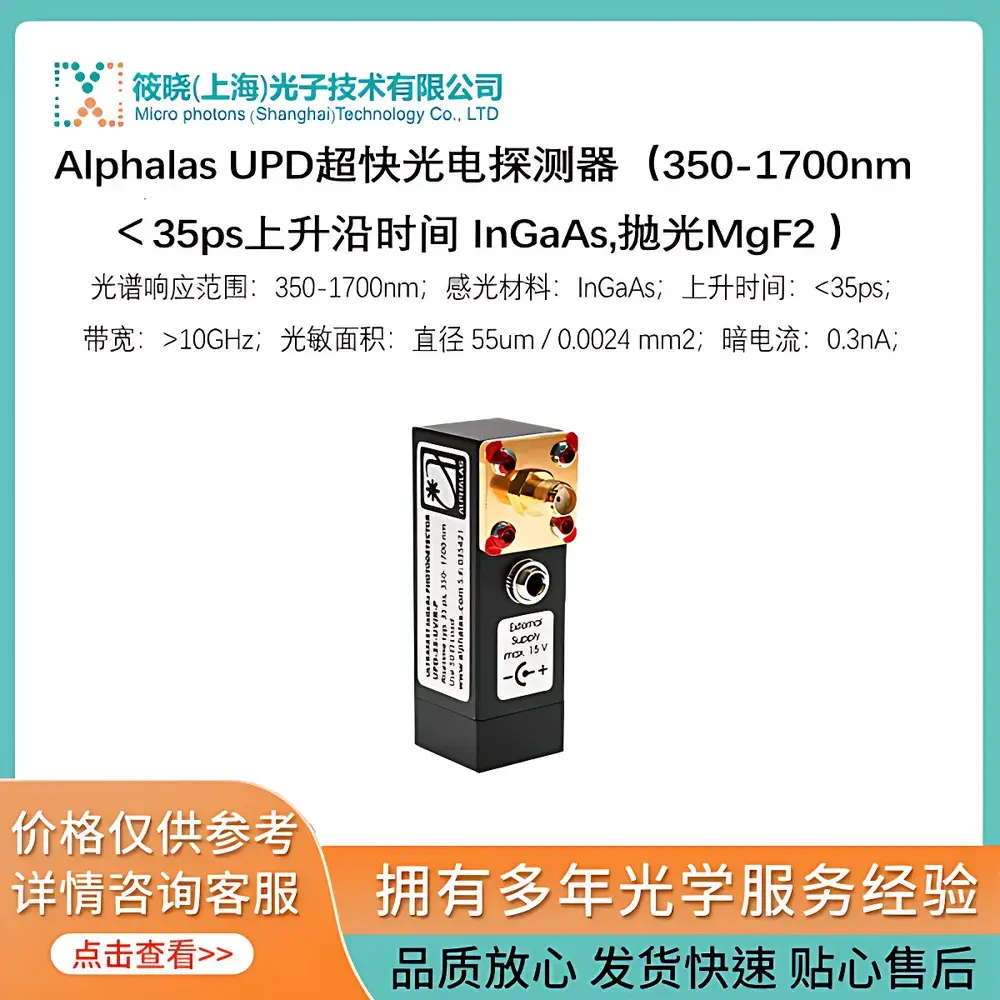

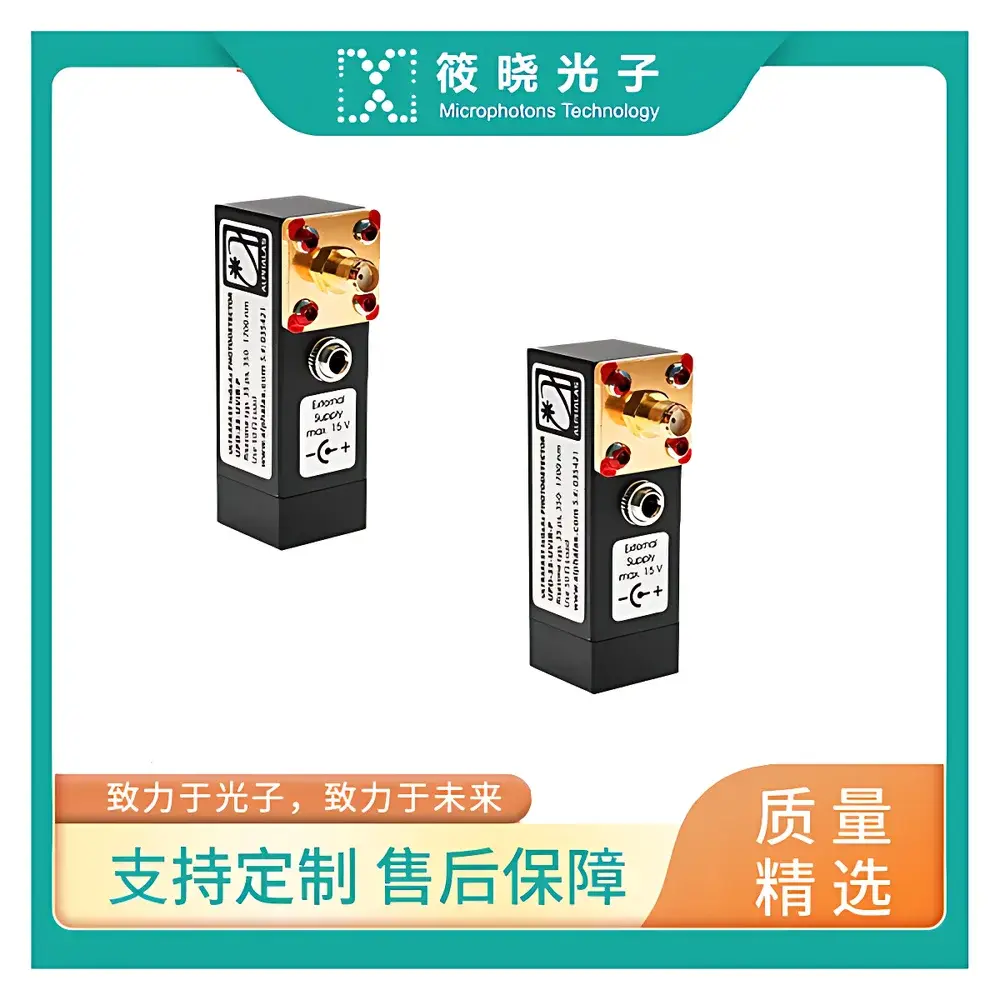
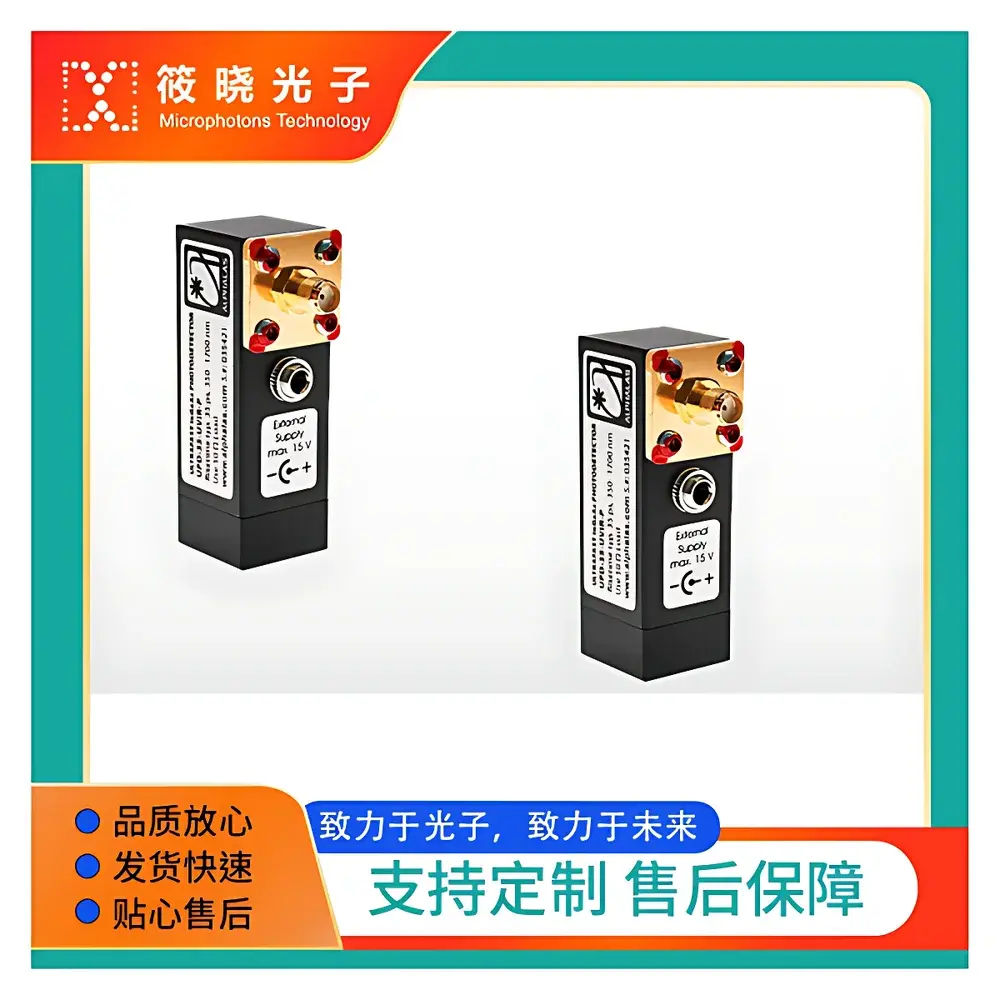
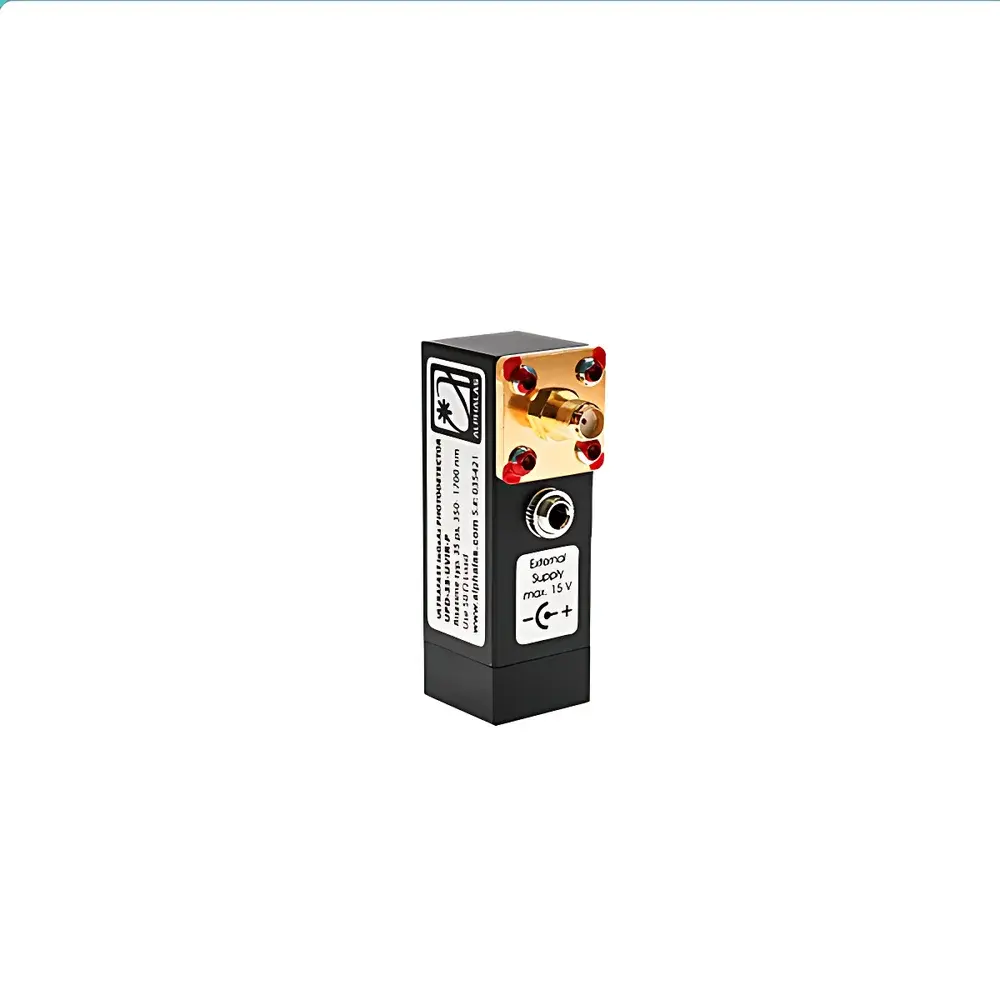
Alphalas UPD-35-UVIR-P Ultrafast Photodetector with Polished MgF₂ Window (350–1700 nm)
| Brand | Alphalas |
|---|---|
| Origin | Germany |
| Model | UPD-35-UVIR-P |
| Spectral Range | 350–1700 nm |
| Photosensitive Material | InGaAs |
| Rise Time | <35 ps |
| Bandwidth | >10 GHz |
| Active Area | Ø55 µm (0.0024 mm²) |
| Dark Current | 0.3 mA |
| Optical Input | Polished MgF₂ Window |
| RF Output Connector | SMA |
| Housing | Anodized Aluminum, Battery/External Power Compatible |
Overview
The Alphalas UPD-35-UVIR-P is a high-performance, free-space-coupled ultrafast photodetector engineered for time-resolved optical measurements requiring sub-35 ps temporal resolution and broad spectral coverage from the near-ultraviolet through the short-wave infrared. Based on a low-capacitance InGaAs PIN photodiode structure, it operates on the principle of photocurrent generation under reverse bias, optimized for minimal carrier transit time and parasitic inductance/capacitance. Its monolithic design integrates impedance-matched 50 Ω microwave packaging directly at the diode anvil, enabling faithful reproduction of optical pulse waveforms without distortion—critical for applications such as autocorrelation, pump-probe timing, and RF photonics characterization. Unlike photomultiplier tubes or APDs, this detector delivers intrinsic linearity, DC-to-10+ GHz bandwidth, and immunity to gain noise or afterpulsing, making it suitable for quantitative intensity and timing metrology in research-grade laser laboratories.
Key Features
- Sub-35 ps rise time with >10 GHz electrical bandwidth—validated via calibrated step-response measurement using picosecond laser pulses and high-bandwidth sampling oscilloscopes.
- Broad spectral responsivity from 350 nm to 1700 nm, enabled by a custom InGaAs epitaxial layer stack and anti-reflection-coated polished magnesium fluoride (MgF₂) entrance window—optimized for UV transmission down to 350 nm while maintaining IR transparency up to 1700 nm.
- Compact, ruggedized housing fabricated from precision-machined anodized aluminum, providing EMI shielding, thermal stability, and mechanical robustness for integration into vacuum chambers or optical tables.
- Dual power options: internal rechargeable battery (enabling portable, ground-loop-free operation) or external 5 V DC supply—both configured to deliver stable reverse bias without introducing low-frequency ripple or switching noise.
- 50 Ω matched RF output via SMA connector; compatible with standard high-bandwidth oscilloscopes, spectrum analyzers, and lock-in amplifiers without external termination.
- Free-space input geometry supports collimated beam alignment, enabling precise spatial mode matching and minimizing coupling losses associated with fiber pigtailing.
Sample Compatibility & Compliance
The UPD-35-UVIR-P is designed for use with continuous-wave (CW), modulated, and pulsed laser sources—including Ti:sapphire, OPOs, fiber lasers, and supercontinuum sources—operating within its specified spectral and power density limits (≤10 mW average power, ≤10⁴ W/cm² peak irradiance). Its polished MgF₂ window exhibits <0.5% surface reflectivity per interface across 350–1700 nm, ensuring high throughput and minimal group delay dispersion. The device complies with IEC 61340-5-1 (ESD control), RoHS Directive 2011/65/EU, and CE marking requirements for electromagnetic compatibility (EMC Directive 2014/30/EU). While not certified for medical or industrial safety-critical systems, its performance parameters are traceable to NIST-traceable calibration standards used in Alphalas’ internal metrology lab, supporting GLP-aligned experimental documentation.
Software & Data Management
As a passive analog transducer, the UPD-35-UVIR-P does not incorporate embedded firmware or digital interfaces. It outputs a voltage signal proportional to incident optical power (responsivity: ~0.65 A/W at 1550 nm), fully compatible with third-party data acquisition systems. When paired with high-fidelity digitizers (e.g., Keysight Infiniium, Tektronix DPO70000SX), users can perform time-domain analysis—including jitter quantification, pulse width (FWHM) extraction, and cross-correlation—with sub-picosecond timing uncertainty. For compliance-driven environments, integration with LabVIEW™ or MATLAB® scripts enables automated logging of timestamped waveform captures, supporting 21 CFR Part 11 audit trails when deployed with validated acquisition hardware and electronic signature workflows.
Applications
- Pulse shape and duration characterization of femtosecond and picosecond laser systems, including FROG and SPIDER validation setups.
- Optical synchronization and timing distribution in multi-channel ultrafast experiments (e.g., attosecond streaking, electron diffraction).
- High-speed optical communications testing—bit-error-rate (BER) analysis, eye diagram generation, and jitter decomposition at 10+ Gbaud rates.
- Heterodyne and homodyne detection in quantum optics, where phase-preserving amplitude detection is essential for quadrature measurements.
- Real-time monitoring of mode-locking stability and Q-switching dynamics in solid-state and fiber lasers.
- Time-of-flight measurements in LIDAR development and nonlinear frequency conversion efficiency optimization.
FAQ
What is the maximum average optical power the UPD-35-UVIR-P can handle without damage?
The detector is rated for ≤10 mW average power under uniform illumination; exceeding this may cause thermal drift in responsivity or permanent degradation of the InGaAs junction.
Is the MgF₂ window AR-coated, and what is its transmission profile?
Yes—the window features a single-layer MgF₂ anti-reflection coating optimized for 350–1700 nm, achieving >95% transmission across the band with <0.3% residual reflectivity per surface.
Can this detector be used in vacuum environments?
Yes—the hermetically sealed aluminum housing and absence of outgassing adhesives or plastics permit operation at pressures down to 10⁻⁶ mbar; optional vacuum-compatible SMA feedthroughs are available upon request.
How does the UPD-35-UVIR-P compare to photomultiplier tubes (PMTs) in UV sensitivity?
While PMTs offer higher gain in deep UV (<200 nm), the UPD-35-UVIR-P provides superior timing fidelity, linear response over 6 decades of intensity, and no dark-count noise—making it preferable for quantitative, high-repetition-rate UV-NIR measurements above 350 nm.
Is factory calibration provided with each unit?
Each detector ships with a NIST-traceable responsivity curve (A/W vs. wavelength) measured at three discrete wavelengths (405 nm, 808 nm, 1550 nm), along with rise time verification data referenced to a calibrated photoconductive switch standard.




