
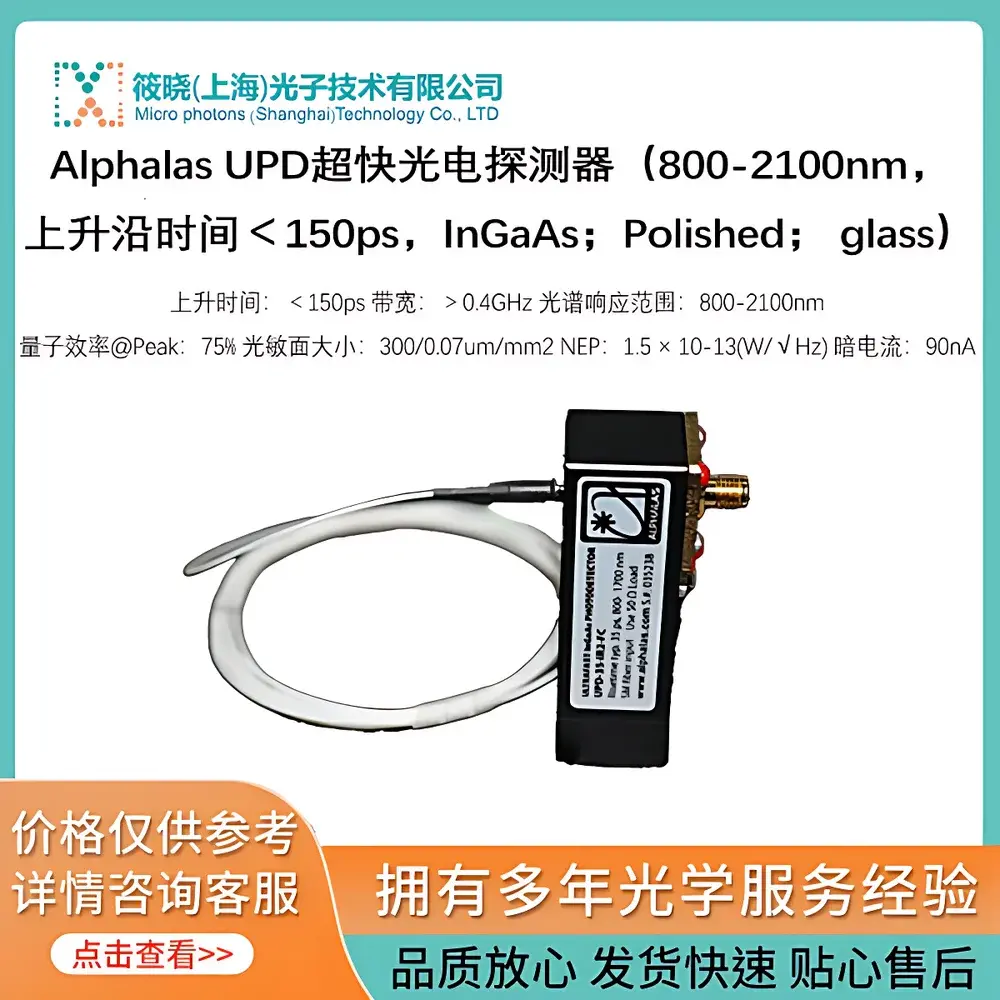
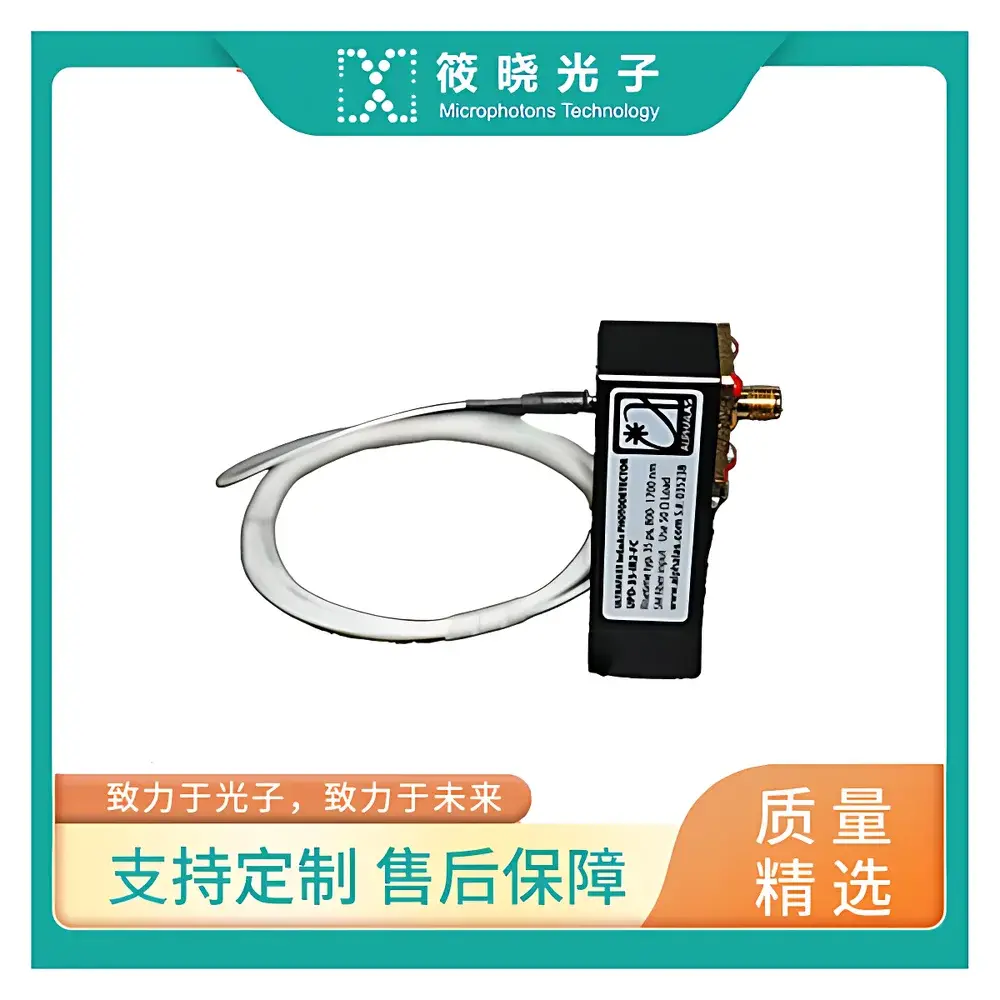
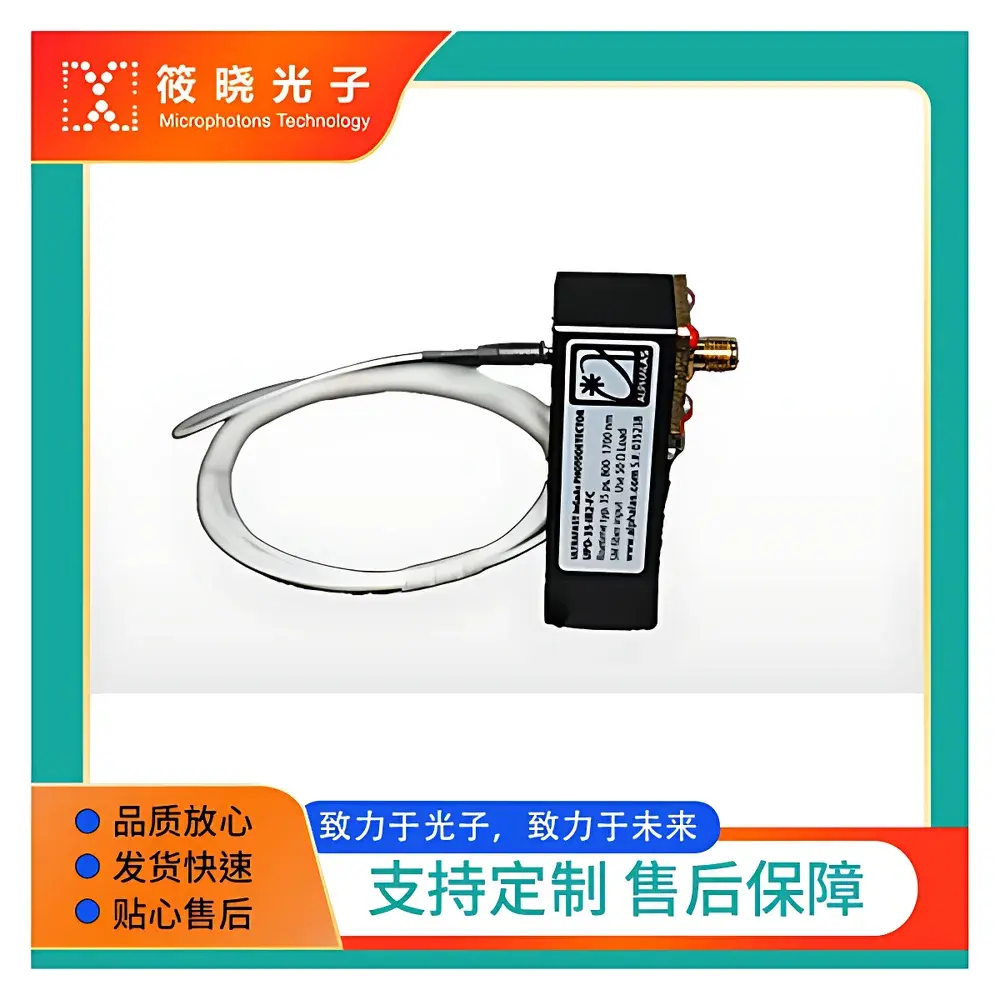
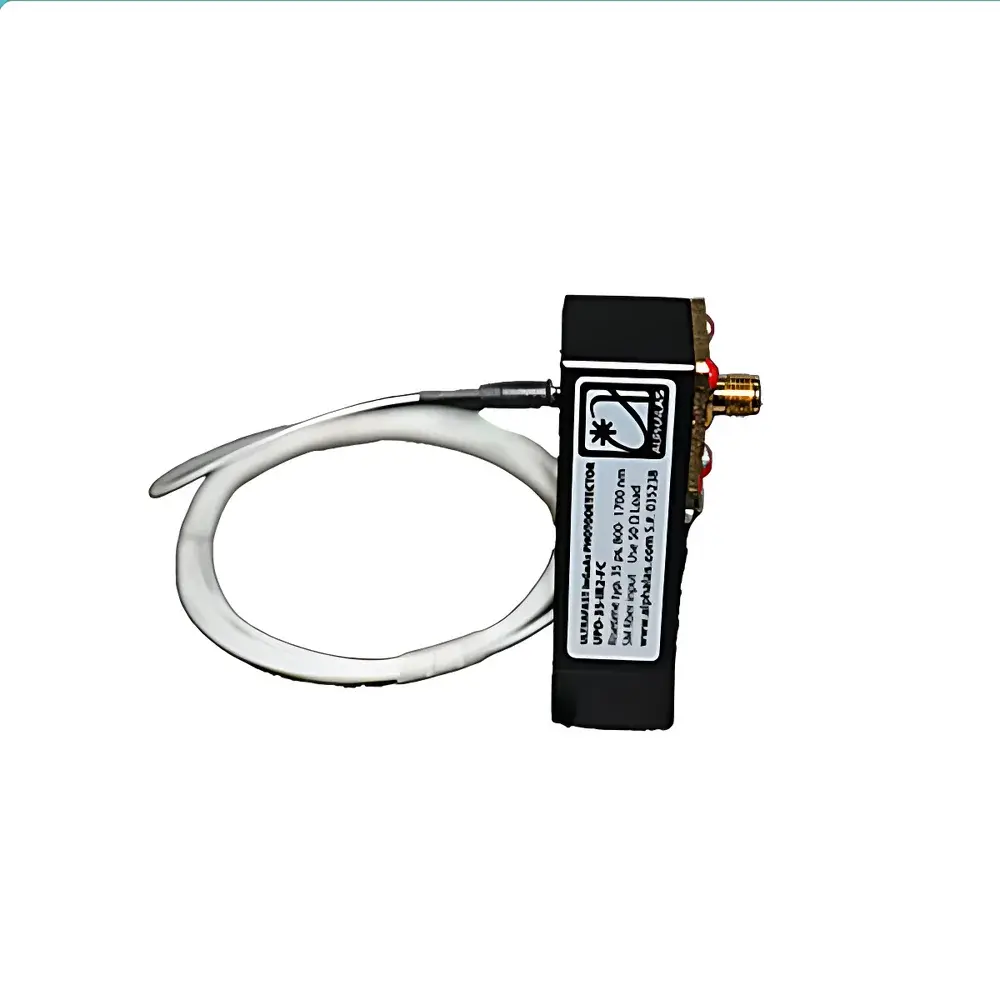
Alphalas UPD-3N-IR2-P Ultrafast InGaAs Photodetector (800–2100 nm, Polished Glass Window)
| Brand | Alphalas |
|---|---|
| Model | UPD-3N-IR2-P |
| Detector Material | InGaAs |
| Spectral Range | 800–2100 nm |
| Rise Time | 150 ps |
| 3-dB Bandwidth | >2.3 GHz |
| Active Area Diameter | 100 µm |
| NEP | ≤1.5 × 10⁻¹⁵ W/√Hz |
| Dark Current | ≤0.5 nA |
| Optical Input | Free-space, polished fused silica/glass window |
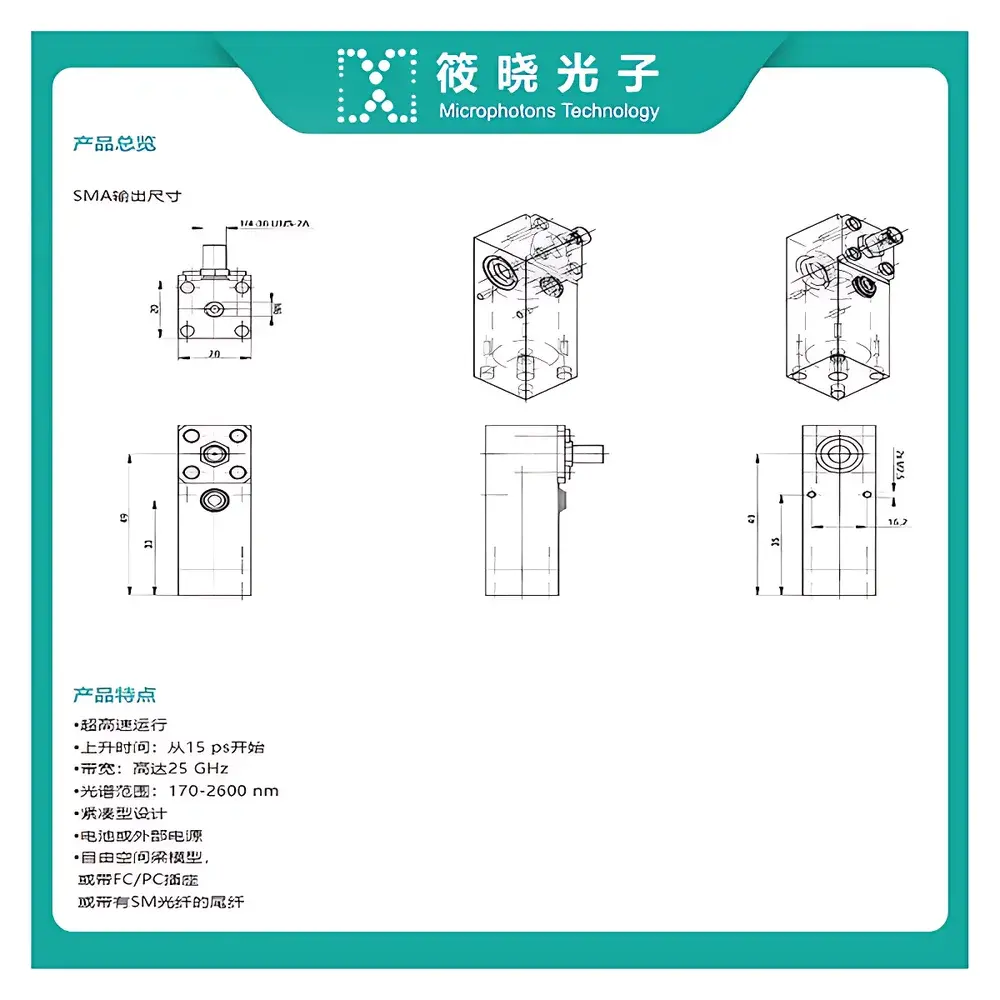
| RF Output Connector | SMA |
Overview
The Alphalas UPD-3N-IR2-P is a high-speed, free-space-coupled InGaAs photodetector engineered for time-resolved optical measurements in the near- to short-wave infrared (NIR–SWIR) spectrum. Operating on the principle of photoconductive carrier generation and ultra-low-capacitance PIN junction design, this detector delivers sub-nanosecond temporal response with optimized linearity and low-noise performance. Its extended spectral sensitivity—from 800 nm to 2100 nm—enables critical applications in ultrafast spectroscopy, laser pulse characterization, optical time-domain reflectometry (OTDR), and quantum optics experiments where conventional Si or standard InGaAs detectors fall short beyond 1700 nm. The device features a hermetically sealed TO-8 package with an AR-coated, polished fused silica input window, ensuring high transmission (>95% across 1000–2000 nm) and minimal group delay dispersion—essential for preserving femtosecond-to-picosecond pulse fidelity.
Key Features
- Extended infrared spectral response up to 2100 nm—enabling detection of O-H, C-H, and N-H vibrational overtones in molecular spectroscopy
- 150 ps rise time and >2.3 GHz small-signal bandwidth—validated via calibrated step-response measurement per IEC 61280-2-9
- Low-noise transimpedance amplifier integration option available (UPD-3N-IR2-P-TIA), delivering 10⁴ V/A gain with <5 pA/√Hz input-referred current noise
- Active area of 100 µm diameter with uniform quantum efficiency (>70% at 1550 nm, >50% at 2000 nm)
- Hermetic TO-8 metal-can packaging with gold-plated leads—qualified to MIL-STD-883H for thermal shock and humidity resistance
- SMA female RF output connector with 50 Ω impedance match—designed for direct interfacing with high-bandwidth oscilloscopes (≥20 GHz) and RF digitizers
- No internal bias circuitry required—operates at zero-bias (photovoltaic mode) for minimal dark current drift and optimal dynamic range
Sample Compatibility & Compliance
The UPD-3N-IR2-P is compatible with collimated free-space beams of Ø ≤ 80 µm (recommended for full active-area utilization) and supports polarization-insensitive detection across the operational wavelength band. Its polished glass window exhibits negligible wavefront distortion (<λ/10 @ 633 nm), making it suitable for interferometric and coherent detection setups. The detector conforms to RoHS 2015/863/EU and REACH SVHC regulations. While not intrinsically certified for medical or aerospace use, its electrical and thermal performance aligns with key requirements of IEC 61326-1 (EMC for laboratory equipment) and ISO/IEC 17025:2017 clause 5.5.2 for traceable photodetector calibration. For GLP/GMP environments, optional NIST-traceable responsivity calibration (at 1064 nm, 1310 nm, 1550 nm, and 2000 nm) is available with uncertainty <±2.5% (k=2).
Software & Data Management
The UPD-3N-IR2-P operates as a passive analog sensor and does not embed firmware or onboard digital control logic. However, it is fully interoperable with industry-standard data acquisition platforms—including Keysight Infiniium real-time oscilloscopes, Tektronix DPO70000SX series, and National Instruments PXIe-5171R digitizers—via standard 50 Ω coaxial cabling. When paired with calibrated reference sources (e.g., NIST-traceable CW lasers or pulsed Ti:Sapphire systems), users can implement time-domain impulse response deconvolution using MATLAB or Python-based toolkits (e.g., SciPy.signal.deconvolve). Alphalas provides comprehensive datasheets with full S-parameter (S11/S21) network analyzer measurements (up to 20 GHz), enabling accurate system-level signal integrity modeling in ADS or CST Studio Suite.
Applications
- Time-of-flight (ToF) measurements in gas sensing and LIDAR prototype development
- Characterization of mode-locked fiber lasers emitting at 1950–2050 nm (e.g., Thulium- or Holmium-doped systems)
- Optical coherence tomography (OCT) system validation at 1300 nm and 1600 nm center wavelengths
- Ultrafast pump-probe experiments probing carrier dynamics in 2D materials (e.g., black phosphorus, MoTe₂)
- Calibration transfer standards for IR photodiode responsivity intercomparisons in national metrology institutes
- High-speed optical shutter synchronization in ultrafast electron diffraction (UED) beamlines
FAQ
What is the maximum average optical power the UPD-3N-IR2-P can handle without saturation or damage?
The detector is rated for ≤10 mW average optical power under uniform illumination; exceeding this may induce thermal nonlinearity or accelerate dark current drift. For pulsed operation, peak power must remain below 1 W (for <10 ns pulses) to avoid transient avalanche effects.
Is the polished glass window anti-reflection coated?
Yes—the fused silica window features a broadband MgF₂-based AR coating optimized for 1000–2100 nm, achieving <0.5% residual reflectance per surface.
Can this detector be used in vacuum or cryogenic environments?
The TO-8 package is vacuum-compatible (10⁻⁶ mbar); however, operation below –20 °C is not recommended due to potential condensation risk and thermo-mechanical stress on the epoxy-free die attach.
Does Alphalas provide calibration certificates with traceability to NIST or PTB?
Yes—optional factory calibration includes spectral responsivity (A/W) at four wavelengths, with full uncertainty budget per ISO/IEC 17025 and traceability documented to PTB (Germany) or NIST (USA).
How is the 150 ps rise time measured and verified?
Rise time is determined using a calibrated 10 ps optical pulse train from a mode-locked Ti:Sapphire laser, with convolution deconvolution applied to remove instrument response contributions per IEEE Std 181-2011.




