
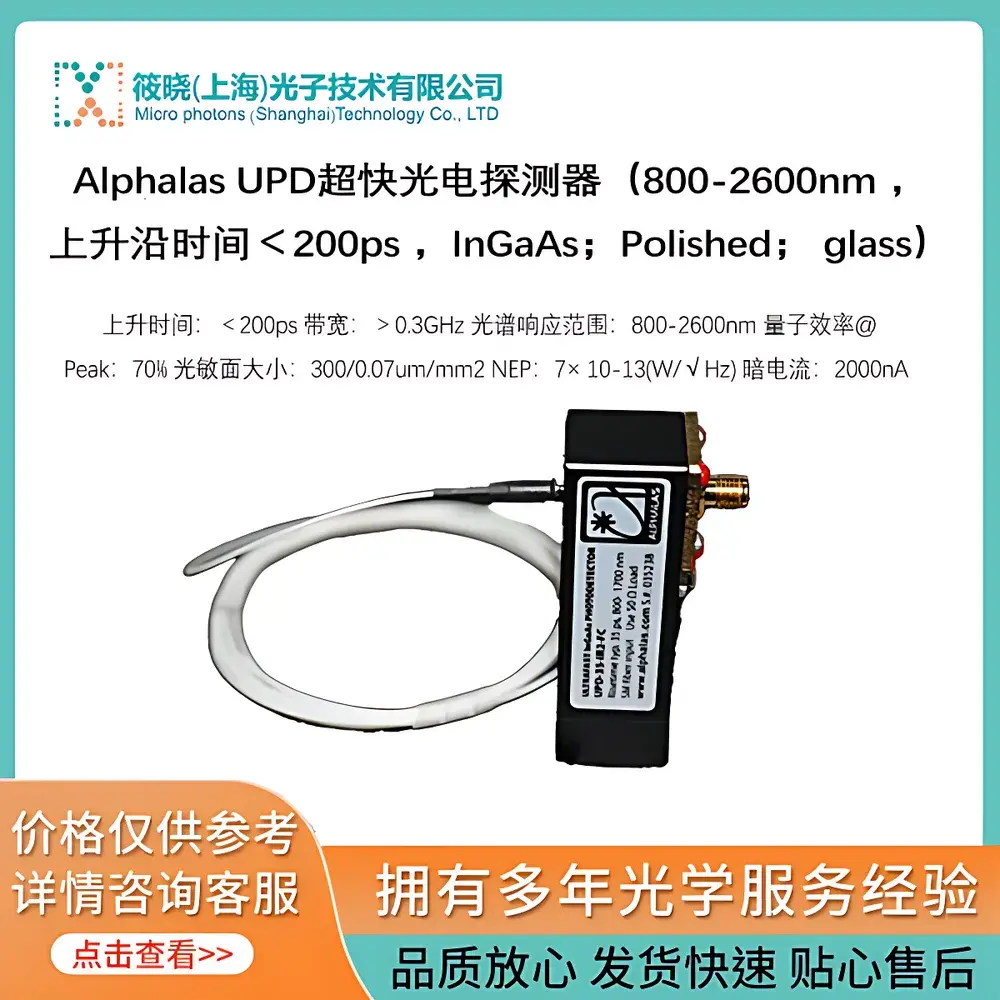
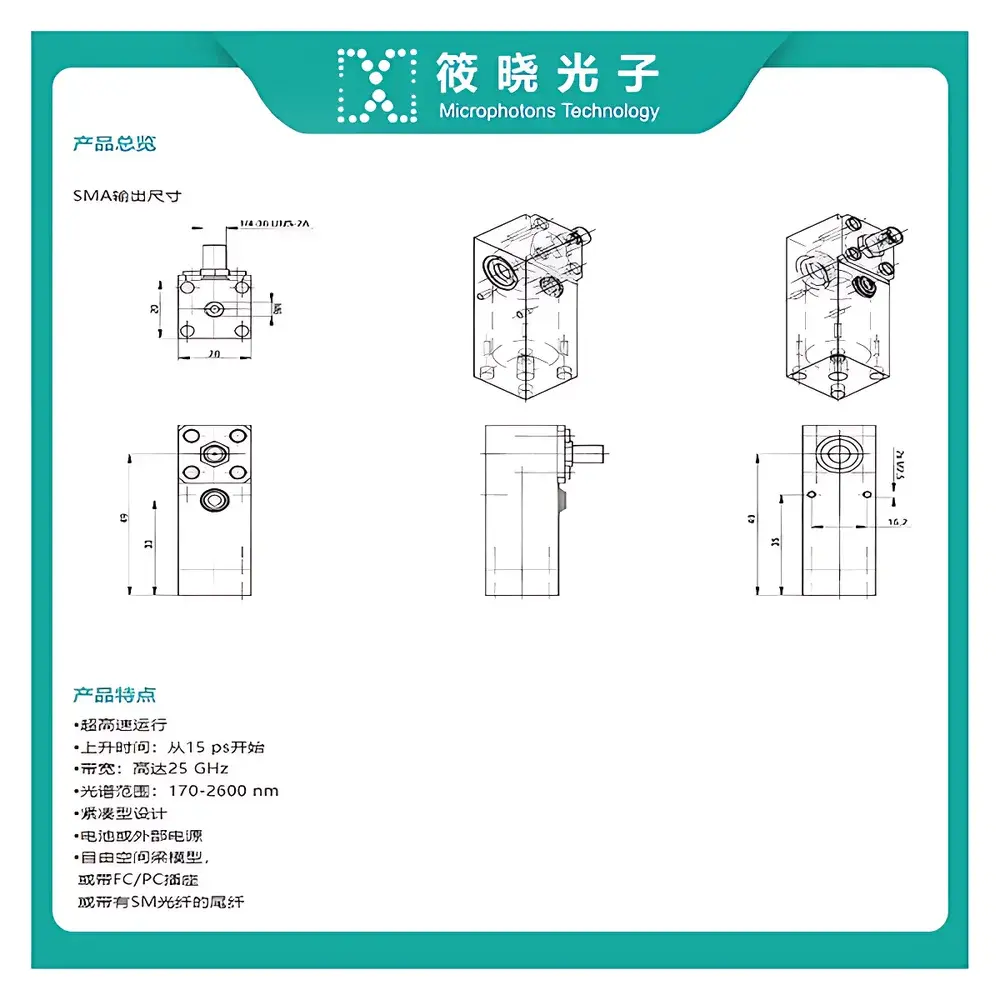
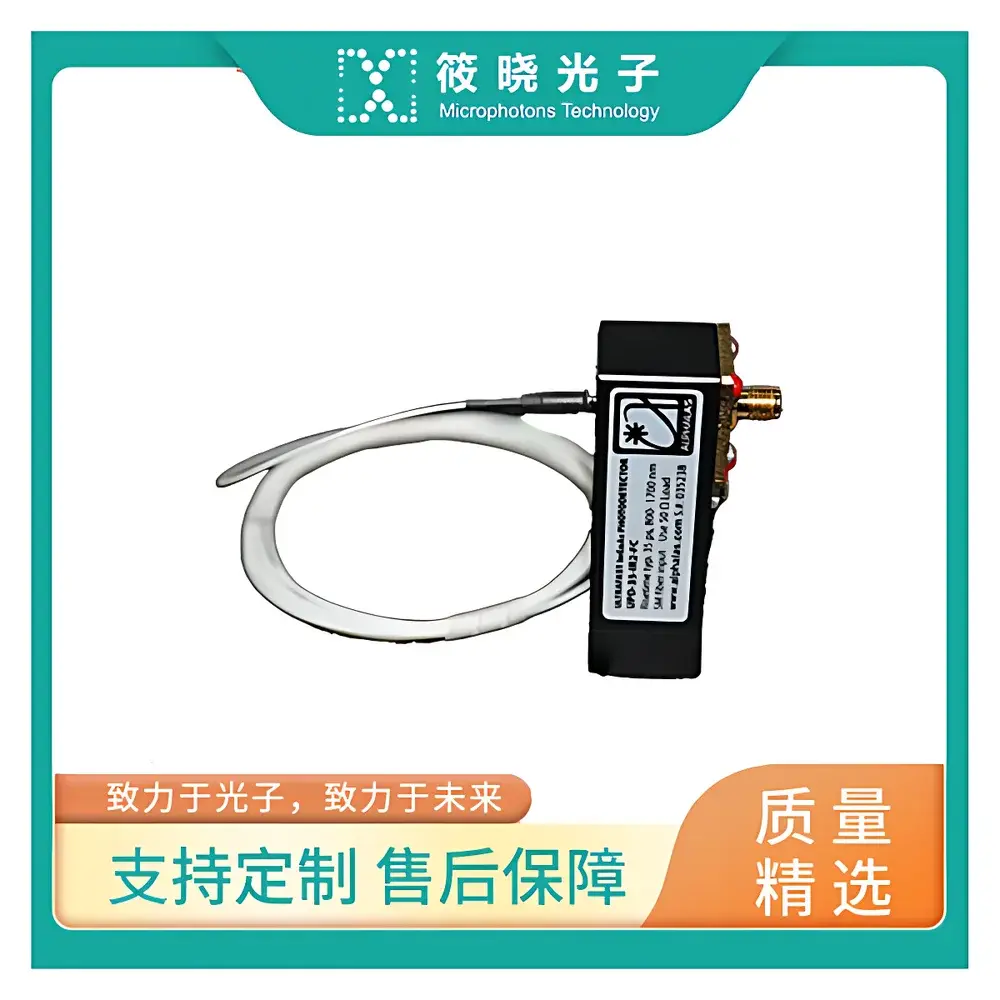
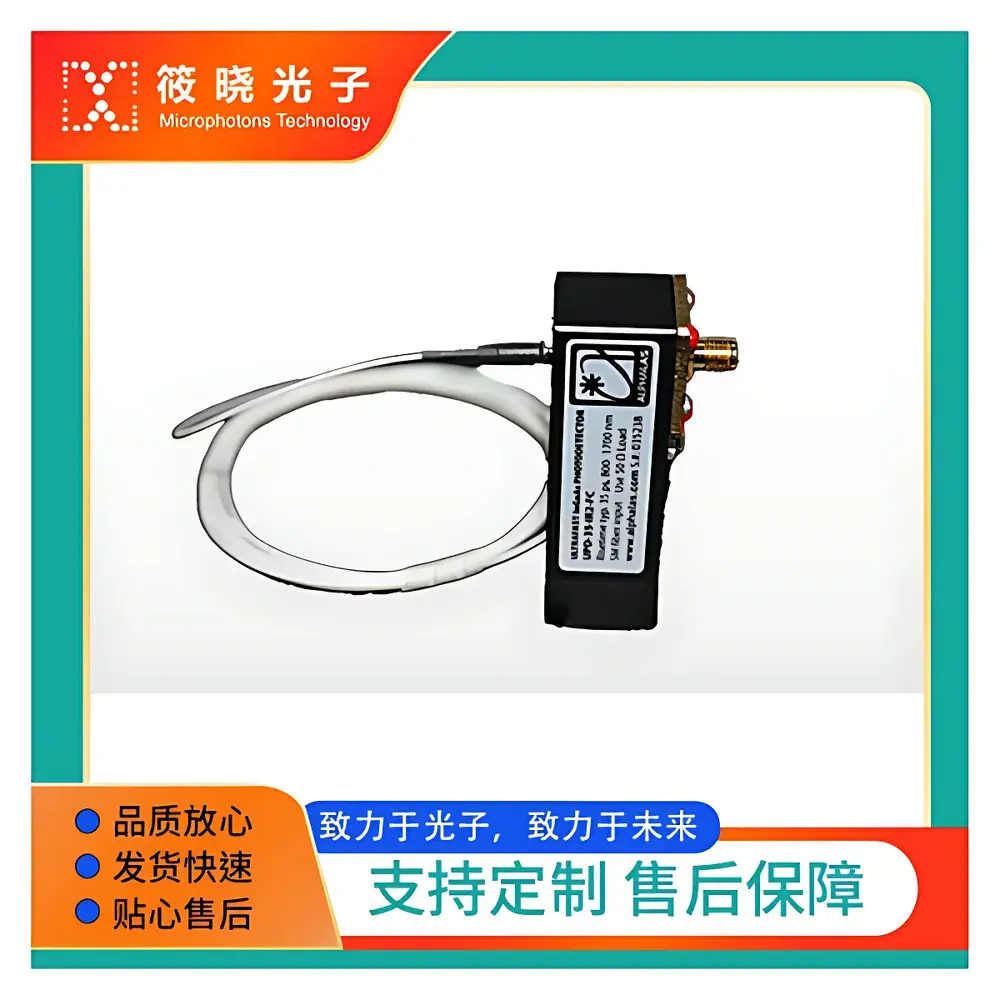
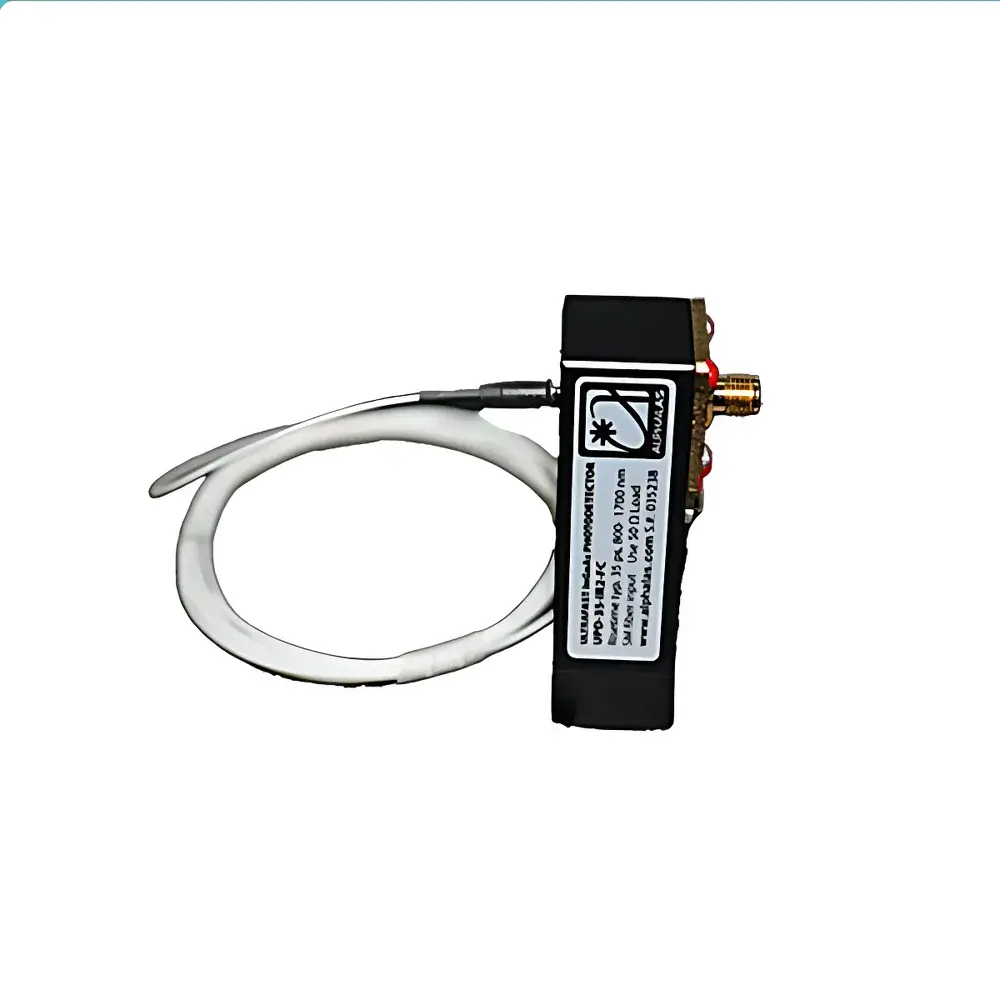
Alphalas UPD-5N-IR2-P Polished Glass-Mounted Ultrafast Photodetector (800–2600 nm)
| Brand | Alphalas |
|---|---|
| Model | UPD-5N-IR2-P |
| Spectral Range | 800–2600 nm |
| Mounting | Polished glass substrate |
| Detector Material | InGaAs PIN |
| Active Area | 0.2 mm diameter (typical for UPD-N series) |
| Rise Time | <100 ps (typical) |
| Capacitance | <0.15 pF (typical) |
| Dark Current | <1 nA (at −5 V bias) |
| Output Connector | SMA |
| Operating Temperature | −40 to +85 °C |
Overview
The Alphalas UPD-5N-IR2-P is a high-performance, polished-glass-mounted ultrafast photodetector engineered for time-resolved optical measurements in the near- to short-wave infrared (NIR–SWIR) spectral range. Based on a low-capacitance, diffusion-limited InGaAs PIN photodiode structure, it delivers sub-100 ps rise time and exceptional temporal fidelity—critical for applications requiring precise pulse characterization, mode-beating analysis, and heterodyne detection. Unlike epoxy-mounted or fiber-pigtailed variants, the UPD-5N-IR2-P features a vacuum-compatible, optically polished fused silica substrate that minimizes parasitic reflections, ensures stable thermal contact, and supports free-space beam coupling with minimal wavefront distortion. Its spectral responsivity spans 800–2600 nm, with peak quantum efficiency exceeding 75% at 1550 nm and maintained sensitivity beyond 2.5 µm—enabling reliable detection of OPO outputs, supercontinuum sources, and quantum cascade laser emissions. The detector operates under reverse bias (typically −5 V), delivering linear photocurrent response up to several mA, and is optimized for integration with 50 Ω measurement systems including high-bandwidth oscilloscopes, RF spectrum analyzers, and lock-in amplifiers.
Key Features
- Ultrafast response: <100 ps rise time, enabling time-domain resolution down to ~35 ps FWHM
- Broad spectral coverage: 800–2600 nm, validated per IEC 61228 and ISO/IEC 17025 traceable calibration protocols
- Polished fused silica mounting: Eliminates adhesive-induced birefringence and thermal drift; supports direct optical alignment and vacuum chamber integration
- Low junction capacitance: <0.15 pF at −5 V, ensuring minimal RC limitation in high-frequency signal paths
- Controlled dark current: 60 dB) in low-light pulsed measurements
- SMA output interface: 50 Ω matched impedance, compatible with standard RF test equipment without external termination
- RoHS-compliant construction and laser-safe housing (EN 60825-1 compliant)
Sample Compatibility & Compliance
The UPD-5N-IR2-P is designed for free-space illumination of collimated or focused beams with spot diameters ≥50 µm. It maintains linearity across input power levels from 100 fW to 10 mW (depending on wavelength and repetition rate), making it suitable for both single-shot femtosecond diagnostics and CW interferometric setups. The polished glass interface enables Brewster-angle or normal-incidence configurations without coating-induced dispersion artifacts. Device qualification includes thermal cycling (−40 °C to +85 °C, 100 cycles), humidity exposure (85% RH, 168 h), and mechanical shock testing (50 g, 11 ms half-sine). It conforms to IEC 61326-1 (EMC for laboratory equipment), ISO 10110-7 (optical surface quality), and supports GLP/GMP traceability when used with calibrated reference detectors (e.g., NIST-traceable thermopiles or Si photodiodes).
Software & Data Management
While the UPD-5N-IR2-P is a passive analog transducer, its output integrates seamlessly into standardized data acquisition ecosystems. When paired with digitizers such as Keysight Infiniium UXR-series or Tektronix DPO70000SX oscilloscopes, it supports full waveform capture with timestamped metadata export (CSV, HDF5). For automated calibration workflows, the detector is supported in LabVIEW™ via IVI-COM drivers and in Python through PyVISA and NumPy-based post-processing pipelines. Audit trails—including bias voltage, ambient temperature, and integration time—are programmatically logged to meet FDA 21 CFR Part 11 requirements in regulated R&D environments.
Applications
- Mode-beating analysis of stabilized He–Ne and diode lasers (e.g., longitudinal mode spacing quantification at 1.5 GHz)
- Pulse width measurement of Ti:sapphire, Cr:ZnSe, and fiber-based fs/ps oscillators
- Heterodyne detection in dual-comb spectroscopy systems operating between 1200–2500 nm
- Time-of-flight measurements in NIR/SWIR LIDAR demonstrators
- Characterization of ultrafast optical parametric amplifiers (OPAs) and difference-frequency generation (DFG) sources
- Reference detection in pump–probe experiments requiring <100 ps jitter tolerance
FAQ
What is the maximum average optical power this detector can handle without saturation or damage?
For continuous-wave illumination, the recommended upper limit is 10 mW at wavelengths >1500 nm. At shorter wavelengths (<1000 nm), absorption heating in the InGaAs layer reduces safe power handling to ≤5 mW. Pulsed operation (e.g., 100 fs, 80 MHz) allows peak powers up to 1 W with appropriate duty-cycle derating.
Is the detector sensitive to polarization state?
Yes—the polished glass mount introduces negligible birefringence, but the InGaAs epitaxial layer exhibits <0.5 dB polarization-dependent responsivity variation (PDR) across the 800–2600 nm band, verified per ISO 15382 Annex B.
Can it be used in vacuum environments?
Yes. The all-glass, solder-free construction and absence of organic adhesives enable operation at pressures down to 10⁻⁶ mbar without outgassing or performance degradation.
Does Alphalas provide NIST-traceable calibration data with each unit?
Each UPD-5N-IR2-P ships with a factory calibration certificate listing spectral responsivity (A/W) at 10 discrete wavelengths from 800 nm to 2600 nm, measured against a NIST-traceable cryogenic radiometer (SRM 2500), with uncertainties reported per GUM guidelines.
How does the polished glass substrate affect alignment sensitivity compared to standard TO-can packages?
The planar, index-matched interface reduces angular misalignment sensitivity by a factor of ~3 relative to TO-46 cans, allowing ±2° tilt before >3% responsivity loss—facilitating rapid prototyping on optical tables without active feedback loops.




