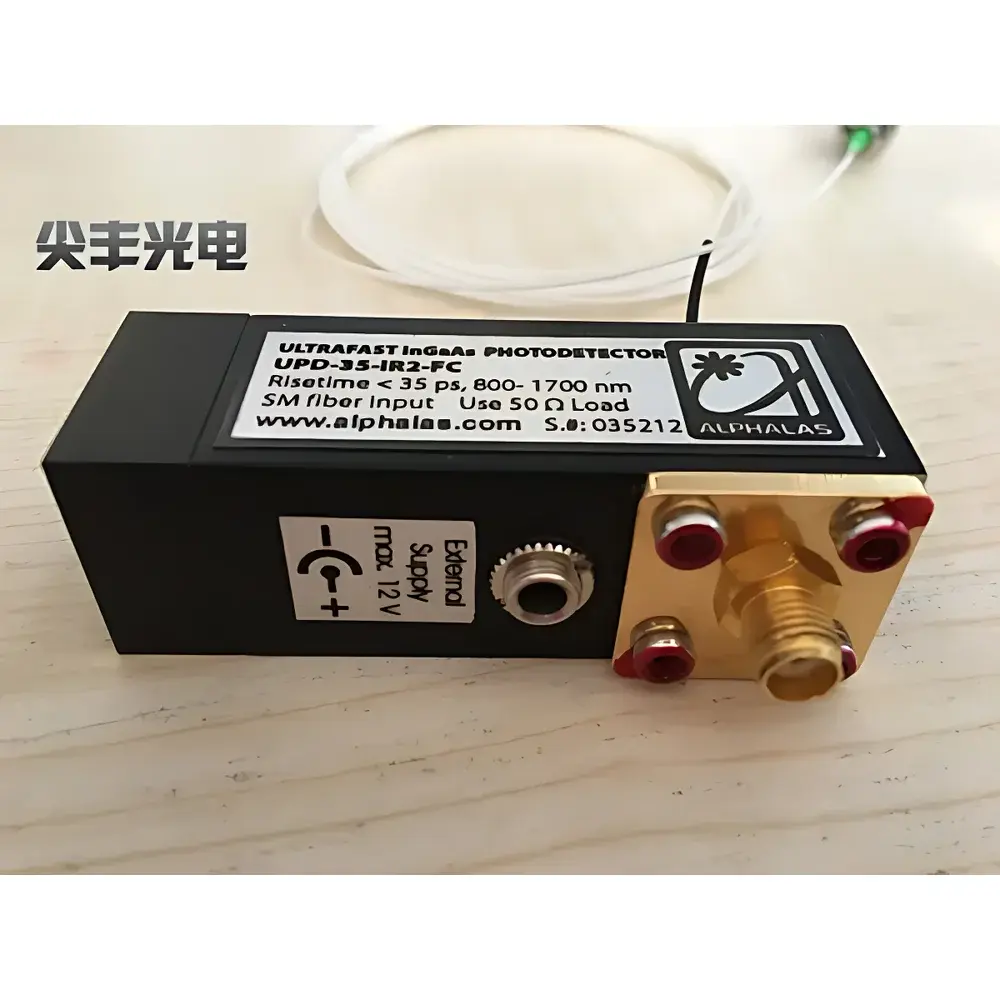
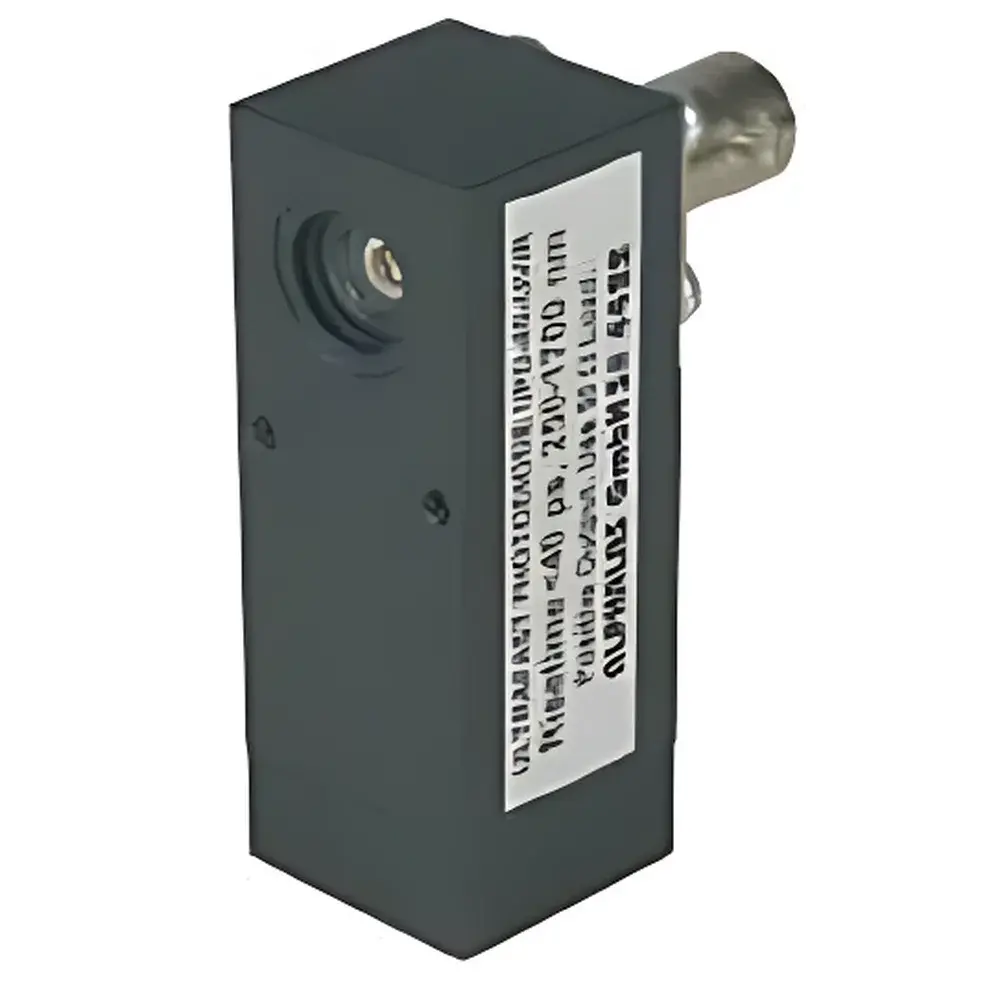
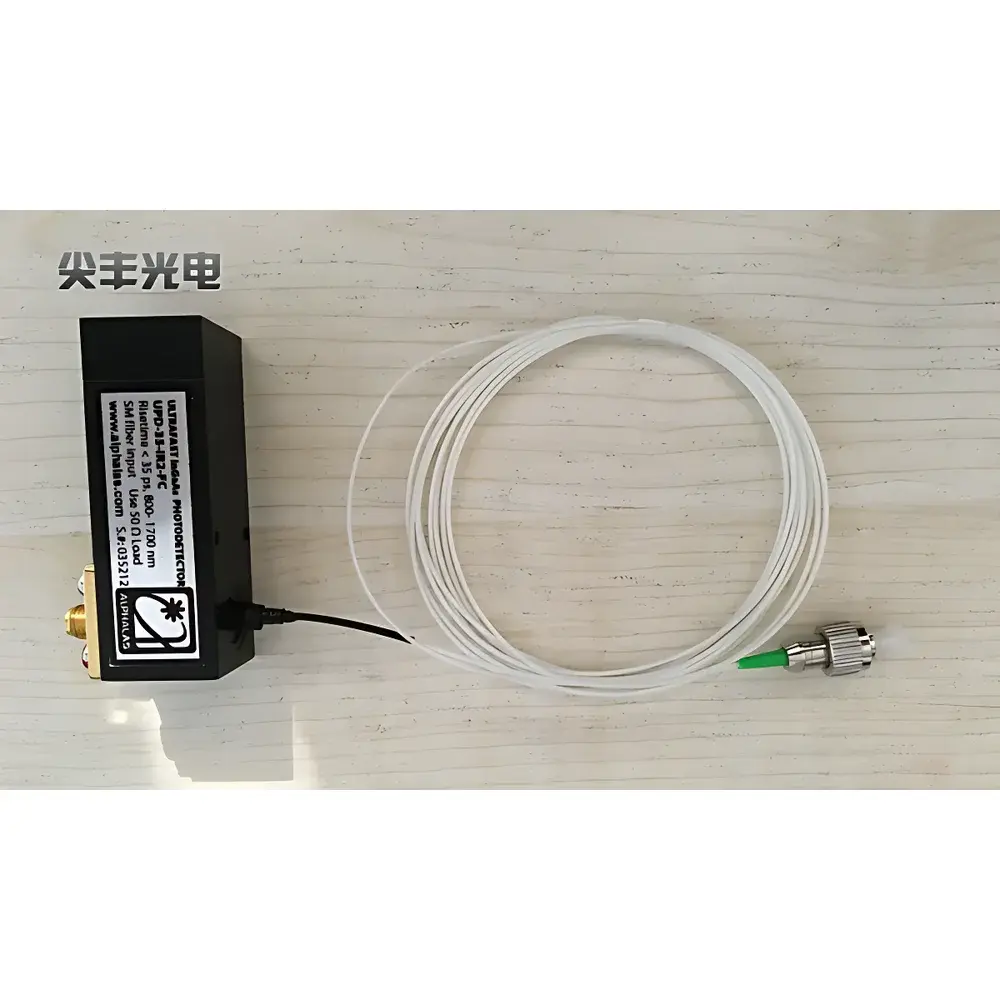
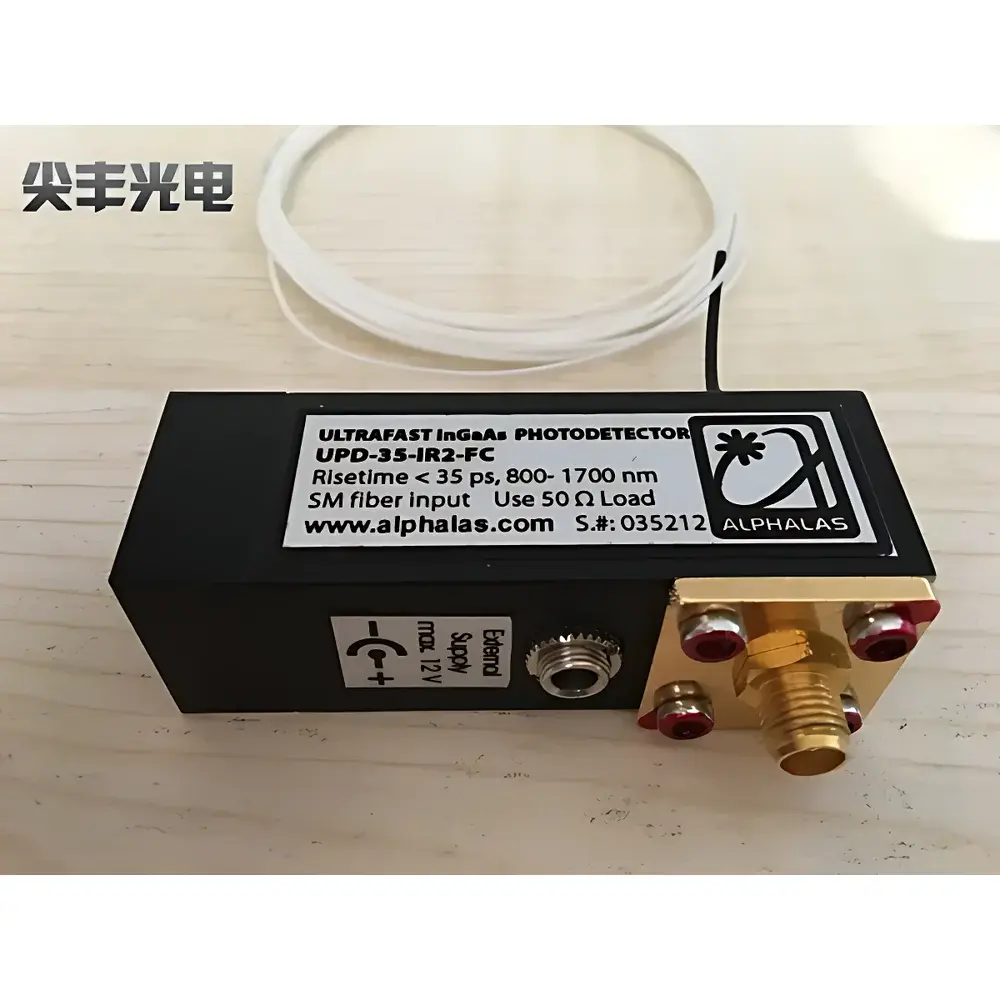
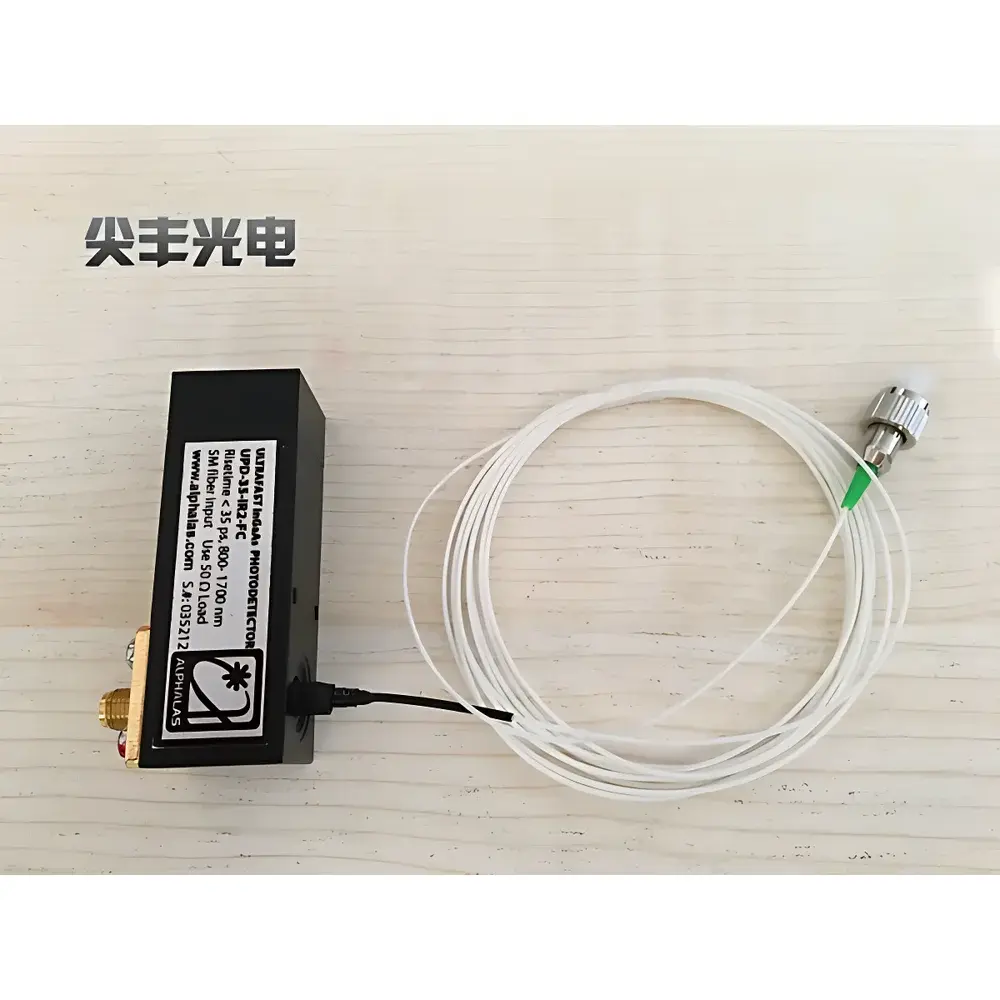
Alphalas UPD Series Ultrafast Photodetectors
| Brand | Alphalas |
|---|---|
| Origin | Germany |
| Model | UPD |
| Spectral Range | 170–2600 nm |
| Rise Time | 15–500 ps |
| Bandwidth | DC to 25 GHz |
| Detector Materials | Si, GaAs, InGaAs, Ge |
| Optical Input | Free-space (polished/diffuse MgF₂/quartz/glass windows), FC/PC, or fiber-coupled (9 µm SMF) |
| RF Output Connector | SMA or BNC |
| NEP | 1.0 × 10⁻¹⁵ – 7.0 × 10⁻¹³ W/√Hz |
| Dark Current | 0.001–2000 nA |
| Sensitive Area | 55–2000 µm diameter (0.0024–3.14 mm²) |
Overview
The Alphalas UPD Series Ultrafast Photodetectors are high-bandwidth, free-space and fiber-coupled photodiodes engineered for time-resolved optical measurement in laser physics, ultrafast spectroscopy, and photonic system characterization. Based on optimized PIN and MSM (Metal–Semiconductor–Metal) semiconductor architectures, these detectors operate across a broad spectral range—from deep ultraviolet (170 nm) to near-infrared (2600 nm)—with rise times as low as 15 ps and bandwidths extending to 25 GHz (–3 dB). The series leverages low-capacitance junction design, precision microwave packaging, and impedance-matched 50 Ω RF output to preserve pulse fidelity during transient optical signal acquisition. Each detector is hermetically sealed in a robust anodized aluminum housing, enabling stable operation in laboratory and industrial environments without active cooling. Unlike conventional photodiodes, the UPD family eliminates trade-offs between speed, responsivity, and spectral coverage—making it suitable for applications demanding both sub-20 ps temporal resolution and wideband spectral sensitivity.
Key Features
- Ultrafast response: Rise times from 15 ps (UPD-15-IR2-FC) to 500 ps (UPD-500-UD), supporting time-domain measurements of femtosecond-laser-compressed pulses.
- DC-coupled broadband operation: Flat frequency response from DC to 25 GHz ensures accurate capture of pulse envelopes, timing jitter, and low-frequency modulation components.
- Multi-material platform: Silicon (UV–NIR), GaAs (visible–NIR), InGaAs (NIR–SWIR), and Germanium (SWIR) variants enable application-specific spectral optimization.
- Flexible optical interface options: Free-space input with interchangeable window materials (MgF₂ for UV enhancement, quartz for diffuse scattering, BK7 for general use), plus FC/PC receptacles and single-mode fiber pigtails (9 µm core).
- Low-noise RF architecture: Integrated 50 Ω matched output minimizes reflections; optional high-impedance termination enables enhanced voltage signal amplitude for oscilloscope-based detection.
- Power versatility: Dual power supply compatibility—rechargeable battery pack for portable setups or regulated external DC source (±5 V typical) for long-term stability.
- Thermally stabilized variants: Select models (e.g., UPD-2M-IR2-P-1TEC) incorporate single-stage thermoelectric cooling to suppress dark current by >90%, critical for low-light, high-dynamic-range measurements.
Sample Compatibility & Compliance
The UPD series supports direct coupling to pulsed and CW laser sources including Ti:sapphire, Yb-fiber, Er-fiber, OPOs, and quantum cascade lasers. Its calibrated quantum efficiency (up to 90% for Si variants at 800 nm; 80% for InGaAs at 1550 nm) ensures traceable photometric performance across ISO 11146 and IEC 61228 standards. All detectors comply with CE marking requirements for electromagnetic compatibility (EMC Directive 2014/30/EU) and low-voltage safety (LVD Directive 2014/35/EU). For regulated environments—including ISO/IEC 17025-accredited calibration labs—the UPD’s stable gain, minimal drift ( 0.9999 over 60 dB dynamic range) support GLP/GMP-aligned validation protocols. Traceable NIST-calibrated responsivity data is available upon request for metrology-grade applications.
Software & Data Management
While the UPD operates as a standalone analog transducer, its RF output integrates seamlessly with industry-standard digitizers (e.g., Keysight Infiniium, Tektronix DPO70000SX) and time-domain analysis platforms. Alphalas provides comprehensive technical documentation—including S-parameter files (S11/S21 up to 40 GHz), SPICE models for circuit simulation, and MATLAB-compatible calibration datasets—to facilitate system-level modeling and error correction. When paired with the optional BBA-series broadband amplifiers, the UPD enables full waveform digitization without external bias tees or impedance-matching networks. For automated test systems, the detector’s mechanical consistency (repeatable mounting via M4 threaded holes) and electrical stability support integration into PXIe or LXI-compliant platforms compliant with IEEE 1671-2016 (ATML) for interoperable instrument control.
Applications
- Pulse shape and width characterization of mode-locked lasers and optical parametric amplifiers.
- Timing synchronization in pump–probe experiments and multi-channel optical delay lines.
- Mode-hop detection and cavity-length monitoring in tunable laser systems.
- Heterodyne and homodyne interferometry requiring phase-preserving, low-jitter photodetection.
- Optical time-domain reflectometry (OTDR) and dispersion measurement in fiber-optic networks.
- THz generation diagnostics via optical rectification and electro-optic sampling gating.
- Quantum optics experiments involving single-photon correlation (with appropriate attenuation) and intensity autocorrelation validation.
FAQ
What is the difference between UPD and MSM-series detectors?
The UPD series uses optimized PIN photodiode structures for highest responsivity and lowest NEP across broad wavelength bands, while the UltraFast MSM detectors prioritize maximal bandwidth (>35 GHz) and minimal pulse distortion via low-capacitance interdigitated electrodes—ideal for RF photonics and high-speed communications testing.
Can UPD detectors be used with femtosecond laser pulses?
Yes—models with ≤15 ps rise time (e.g., UPD-15-IR2-FC) resolve pulse widths down to ~35 ps FWHM. For sub-30 fs pulses, deconvolution with measured impulse response is recommended per ISO 13697 guidelines.
Is external bias required?
No—UPD detectors operate in photovoltaic mode; no reverse bias is needed. Optional bias (±2 V) may be applied to certain variants to fine-tune linearity or saturation threshold.
How is calibration traceability established?
Each detector ships with a factory-measured responsivity curve referenced to NIST-traceable standard lamps (FEL-type) and calibrated spectroradiometers, documented per ISO/IEC 17025 Annex A.3.
Are custom spectral filters or mounts available?
Alphalas offers OEM integration services including AR-coated windows, bandpass filter integration, kinematic mount adapters (e.g., Thorlabs KM100), and vacuum-compatible versions upon request.