
ALPhANOV Non-Cutoff Single-Mode Polarization-Maintaining Photonic Crystal Fiber
| Brand | ALPhANOV |
|---|---|
| Wavelength Range | UV (200–400 nm) to IR (up to 2000 nm) |
| Core Diameter | 5 µm / 10 µm / 15 µm / 20 µm (model-dependent) |
| Mode Field Diameter | 4–17 µm (wavelength- and model-specific) |
| Attenuation | <7 dB/km @ 1064 nm (PCF-PM-5) to <30 dB/km @ 1064 nm (PCF-PM-20) |
| Polarization Extinction Ratio | >20 dB (typical, over specified bandwidth) |
| End-Face Sealing | Capillary Fusion (End-Capping) or Controlled Collapse |
| Connector Options | FC/PC, FC/APC, SMA-2, SMA-6, SMA-AF |
| Jacketing | Optional Armored Sheath |
Overview
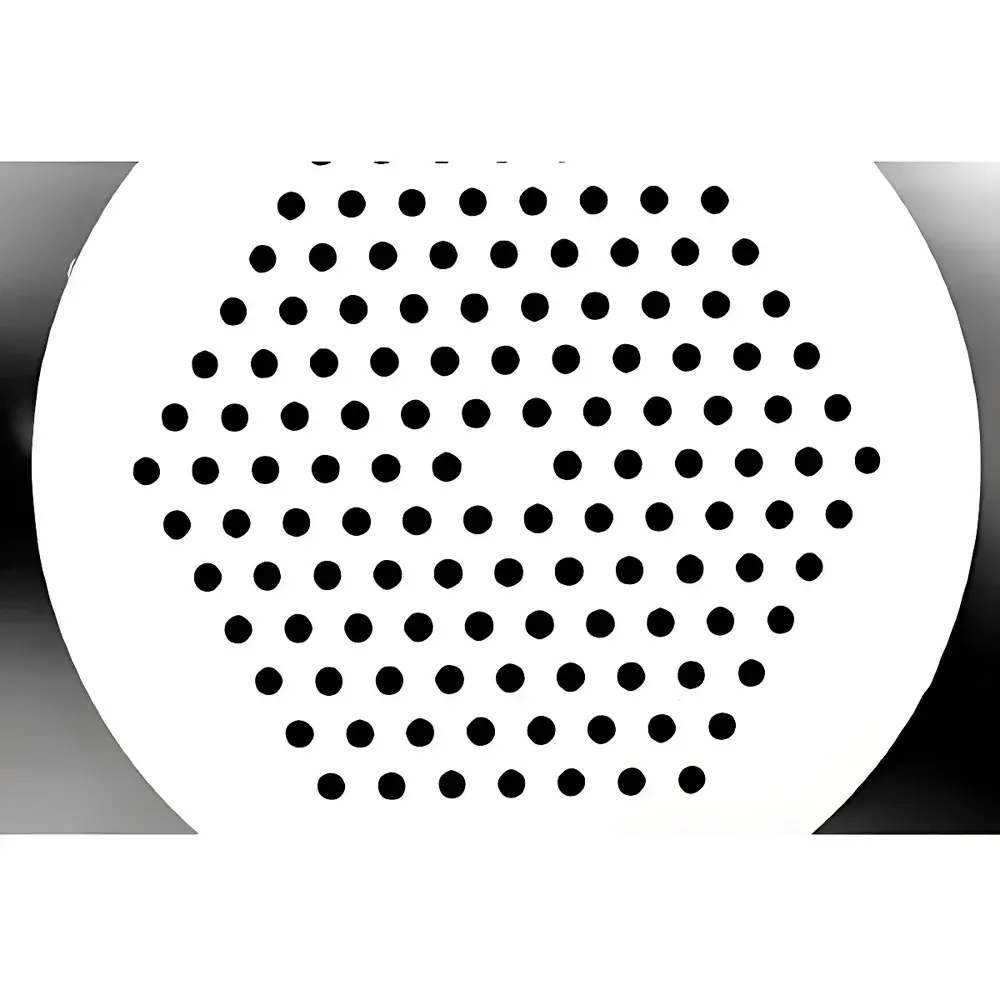
The ALPhANOV Non-Cutoff Single-Mode Polarization-Maintaining Photonic Crystal Fiber (PCF-PM) is an engineered waveguide designed for high-fidelity, polarization-stable guidance of single-frequency laser radiation across an exceptionally broad spectral range—from deep ultraviolet (200 nm) through visible and near-infrared (up to 2000 nm). Unlike conventional step-index or polarization-maintaining fibers, this PCF leverages a microstructured cladding composed of periodic air-hole arrays in fused silica to achieve true non-cutoff behavior: it supports only the fundamental LP01 mode across its entire operational bandwidth, eliminating higher-order mode coupling even at extremely short wavelengths or high launch powers. This intrinsic modal purity—combined with robust birefringence generated by asymmetric hole geometry—ensures stable linear polarization maintenance without external stress rods or elliptical cores. The fiber’s design is optimized for quantum optics applications demanding ultra-low phase noise, minimal back-reflection, and immunity to environmental perturbations—particularly atomic trapping, laser cooling, optical lattice clocks, and cavity-enhanced spectroscopy where polarization fidelity directly impacts coherence time and measurement repeatability.
Key Features
- True non-cutoff operation: No higher-order modes supported at any wavelength within the specified range, enabling unambiguous single-mode propagation under high-power or broadband conditions.
- Engineered polarization maintenance: High birefringence (>10−4) achieved via geometric asymmetry in the photonic crystal lattice—not mechanical stress—resulting in superior thermal and mechanical stability.
- UV-hardened variants available: Hydrogen-loading followed by controlled UV curing mitigates UV-induced photodarkening in the 200–400 nm band, extending operational lifetime and maintaining attenuation below 40 dB/km at 355 nm.
- Scalable core geometries: Four standardized models (PCF-PM-5, -10, -15, -20) provide tailored mode field diameters (4–17 µm) and numerical aperture profiles to balance beam quality, nonlinear threshold, and coupling efficiency with common laser sources (e.g., Ti:Sapphire, Nd:YAG, fiber lasers).
- High optical damage threshold: End-face sealing via either capillary fusion (end-capping, ≤100 µm thickness) or controlled thermal collapse (<50 µm collapsed zone) prevents contamination ingress and reduces surface power density—critical for kW-class CW or pulsed systems.
Sample Compatibility & Compliance
This fiber is compatible with standard fiber-optic handling protocols and integrates seamlessly into vacuum-compatible optical tables, UHV chambers, and cryogenic setups. All variants are fabricated from high-purity synthetic fused silica (OH⁻ < 1 ppm), ensuring low intrinsic absorption and minimal Rayleigh scattering. The hydrogen-loaded versions comply with ISO 10110-3 for surface quality and meet ASTM F2818 requirements for UV-transmitting optical fibers. For regulated environments—including GLP-compliant quantum metrology labs—the fiber’s traceable manufacturing history, batch-specific attenuation and PER characterization reports, and optional 21 CFR Part 11–compliant test documentation support audit readiness.
Software & Data Management
While the fiber itself is a passive component, ALPhANOV provides comprehensive technical documentation including wavelength-dependent dispersion curves, bend-loss simulations (based on full-vector finite-element modeling), and experimentally validated Brillouin threshold maps as downloadable CSV and MATLAB-compatible datasets. These resources enable users to model nonlinear thresholds (e.g., SBS onset at 1% backward power ratio), optimize splice loss budgets, and select appropriate connectorization schemes. Custom spectral attenuation profiles can be supplied upon request for integration into LabVIEW or Python-based instrument control frameworks.
Applications
- Atomic physics: Delivery of repumping and cooling beams to magneto-optical traps (MOTs) with preserved polarization extinction ratio (>20 dB) and minimal phase distortion.
- Frequency metrology: Low-noise transport of ultra-stable 1542 nm or 1064 nm reference beams in optical frequency combs and cavity ring-down spectrometers.
- Nonlinear photonics: Pump delivery for supercontinuum generation in UV–VIS–NIR bands, leveraging high peak-power tolerance and dispersion tailoring.
- Quantum communication: Polarization-encoded qubit transmission in free-space-to-fiber quantum key distribution (QKD) nodes requiring long-term polarization alignment stability.
- Biophotonics: UV-excited fluorescence microscopy light delivery where small mode field diameter and low autofluorescence are essential.
FAQ
What distinguishes non-cutoff PCF-PM from conventional Panda or Bow-tie PM fibers?
Conventional PM fibers rely on stress-induced birefringence and exhibit cutoff wavelengths below which higher-order modes propagate—limiting usable bandwidth. Non-cutoff PCF-PM eliminates this constraint via photonic bandgap confinement, supporting pure LP01 guidance down to 200 nm without mode degeneracy.
Can these fibers be spliced to standard SMF-28 or PM1550?
Yes—with mode-field adaptors or lensed fiber splices. ALPhANOV provides application-specific splicing recipes and loss budget calculators for each PCF-PM variant.
Is hydrogen loading permanent? Does it affect long-term reliability?
Hydrogen diffusion is kinetically inhibited after UV curing; accelerated aging tests (per Telcordia GR-1221) confirm stable performance over >10 years at 25°C and 50% RH.
What is the maximum continuous-wave power this fiber can handle?
Depends on wavelength, core size, and end-face treatment. For PCF-PM-10 at 1064 nm with end-capping, the practical limit is ~50 W (confined to core); for UV operation (355 nm), derating to <1 W is recommended unless actively cooled.
Do you offer custom lengths, coatings, or hermetic packaging?
Yes—custom cut lengths (±0.5 mm tolerance), acrylate or polyimide coatings, and stainless-steel armored jackets (with Kevlar reinforcement) are available under NRE-supported development agreements.





