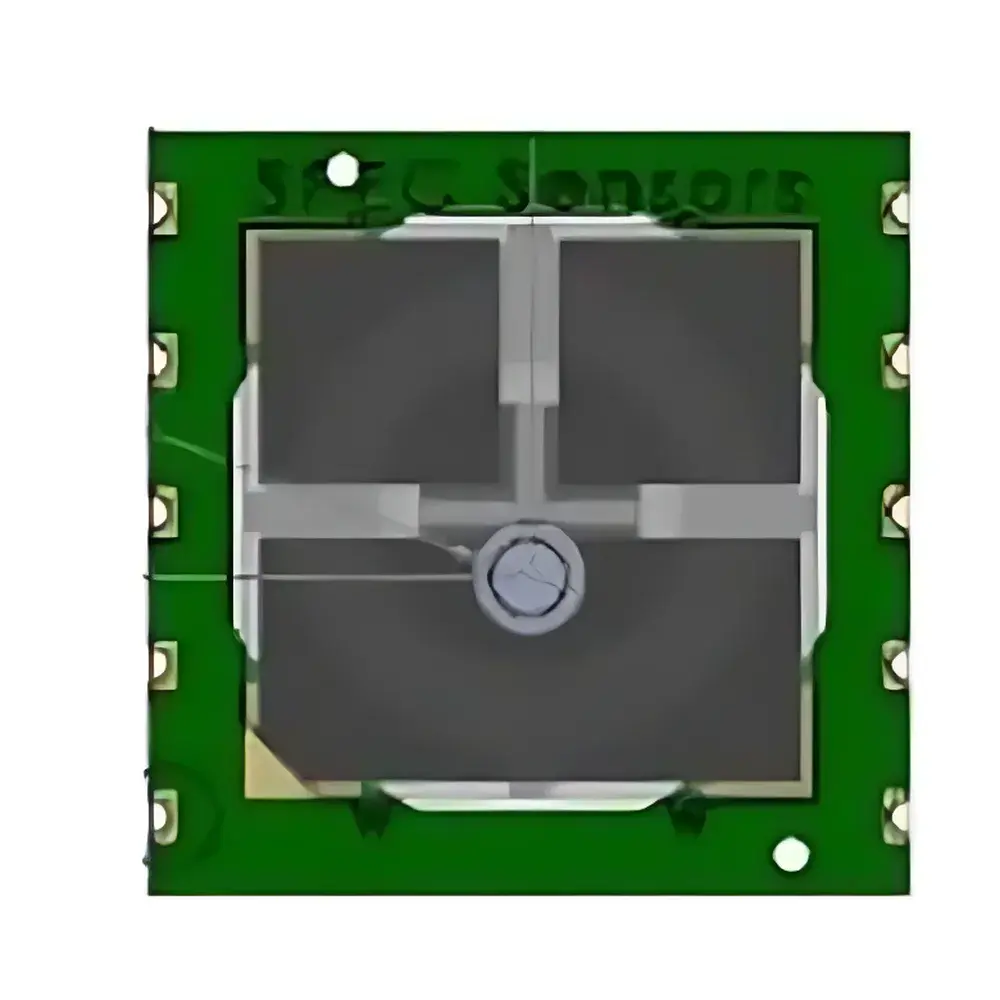
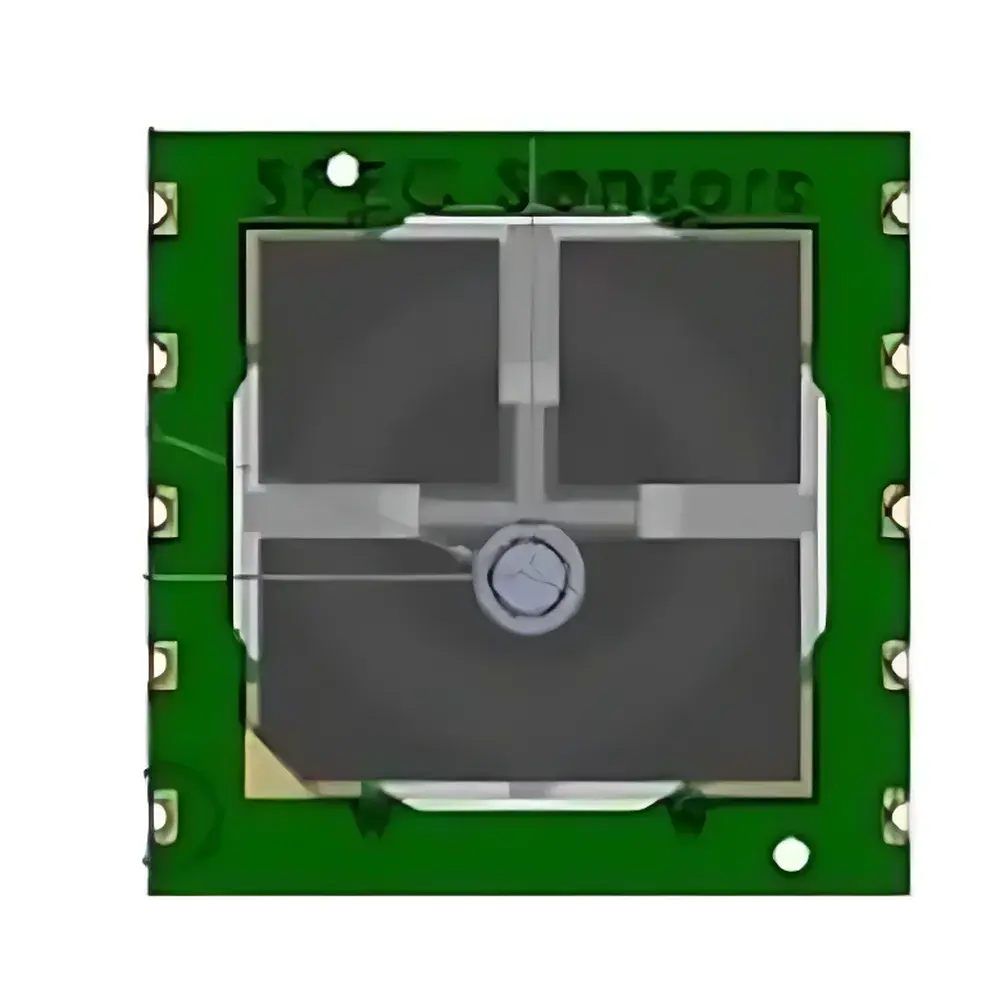
Alphasense 3SP_SO2_20 Electrochemical Sulfur Dioxide (SO₂) Gas Sensor
| Brand | Alphasense (UK) |
|---|---|
| Origin | United Kingdom |
| Model | 3SP_SO2_20 |
| Measurement Range | 0–20 ppm |
| Overload Capacity | 50 ppm |
| Response Time (t₉₀) | <30 s |
| Sensitivity | 30 ± 5 nA/ppm |
| Dimensions | 15 × 15 × 3.8 mm |
Overview
The Alphasense 3SP_SO2_20 is a compact, high-stability electrochemical gas sensor engineered for the selective detection of sulfur dioxide (SO₂) in ambient air and industrial environments. Based on a three-electrode amperometric cell architecture, it operates via controlled potential electrolysis: SO₂ diffuses through a hydrophobic PTFE membrane into an aqueous electrolyte, where it undergoes oxidation at the working electrode, generating a current linearly proportional to gas concentration. This principle ensures high specificity against common interferents such as NO₂, CO, H₂S, and O₃—critical for reliable operation in complex gas matrices. Designed for integration into portable monitors, fixed-site air quality stations, and process safety systems, the 3SP_SO2_20 delivers consistent performance across temperature ranges of −20 °C to +50 °C and relative humidity levels from 15% to 90% RH (non-condensing). Its low power consumption (24 months under continuous exposure make it suitable for battery-powered and space-constrained applications requiring long-term field deployment.
Key Features
- Three-electrode electrochemical design with integrated reference and counter electrodes for enhanced baseline stability and reduced drift
- PTFE diffusion barrier providing optimized response kinetics and protection against particulate contamination and condensation
- Linear output current (30 ± 5 nA/ppm) with excellent repeatability (±2% full-scale) and low zero-current drift (<±2 nA/month)
- RoHS-compliant construction with lead-free soldering and halogen-free PCB materials, meeting EU Directive 2011/65/EU
- Integrated thermal compensation circuitry enabling stable sensitivity across operating temperature gradients
- Pre-calibrated at factory using NIST-traceable SO₂ standards; optional user calibration support via standard gas exposure or electronic zero/span adjustment
Sample Compatibility & Compliance
The 3SP_SO2_20 is validated for use in clean, non-corrosive, non-explosive atmospheres with no significant aerosol loading or solvent vapors. It is not recommended for direct exposure to high concentrations of chlorine, ozone, or acidic mists, which may accelerate electrolyte depletion. The sensor meets EN 50104:2018 (warning devices for toxic gases), and its performance characteristics align with ISO 16000-27 (indoor air quality — determination of SO₂ using electrochemical sensors) and ASTM D5012-19 (standard practice for evaluating gas sensor response). When integrated into certified instruments, it supports compliance with occupational exposure limits defined by OSHA PEL (2 ppm TWA), ACGIH TLV (0.25 ppm TWA), and EU Directive 2017/164/EU (binding occupational limit value of 0.25 ppm). Device-level conformity with IEC 61000-6-3 (EMC emissions) and IEC 61000-6-2 (immunity) is achievable when paired with appropriate signal conditioning electronics.
Software & Data Management
While the 3SP_SO2_20 itself is an analog current-output sensor (typically interfaced via transimpedance amplifier), its integration into digital monitoring platforms enables full traceability and audit readiness. When deployed within systems compliant with FDA 21 CFR Part 11, the sensor’s raw output can be logged with time-stamped, user-authenticated records—including calibration history, span checks, and fault diagnostics. Alphasense provides technical documentation including sensitivity certificates, shelf-life data sheets, and cross-sensitivity matrices (available upon request), supporting GLP/GMP-aligned validation protocols. Firmware-enabled features such as automatic baseline correction, temperature-compensated concentration calculation, and diagnostic flagging (e.g., low electrolyte warning, membrane saturation alert) are implemented at the host controller level and require compatible signal processing architecture.
Applications
- Ambient air quality monitoring networks (urban, roadside, and rural sites) in accordance with EU Directive 2008/50/EC and US EPA AQI reporting requirements
- Occupational health and safety instrumentation for confined-space entry, refinery perimeter monitoring, and pulp & paper mill stack emission verification
- Indoor air quality (IAQ) systems in schools, hospitals, and commercial buildings where SO₂ may originate from combustion appliances or outdoor infiltration
- Mobile pollution mapping platforms and UAV-mounted environmental sensing payloads requiring low-mass, low-power gas detection
- Process control feedback loops in flue gas desulfurization (FGD) scrubber bypass lines and sulfur recovery unit off-gas streams
FAQ
What is the recommended operating temperature range for the 3SP_SO2_20?
The sensor is specified for continuous operation between −20 °C and +50 °C, with optimal accuracy maintained between 15 °C and 35 °C.
Does the 3SP_SO2_20 require external power supply or bias voltage?
Yes—it requires a stable bias voltage applied to the working electrode (typically +300 mV vs. reference electrode) and a powered transimpedance amplifier for current-to-voltage conversion.
Can this sensor be used in high-humidity environments?
It is rated for operation up to 90% RH (non-condensing); prolonged exposure to condensation or liquid water will damage the electrolyte and membrane.
How often should the sensor be calibrated in routine field use?
Field calibration is recommended every 3–6 months depending on exposure profile; zero calibration should be performed weekly in critical applications, and span checks with certified 10 ppm SO₂ gas are advised monthly.
Is the 3SP_SO2_20 compatible with printed circuit board (PCB) reflow soldering?
No—reflow soldering exceeds its thermal tolerance; hand-soldering with iron temperature ≤350 °C and dwell time <3 seconds per pad is required to prevent membrane degradation and electrolyte loss.