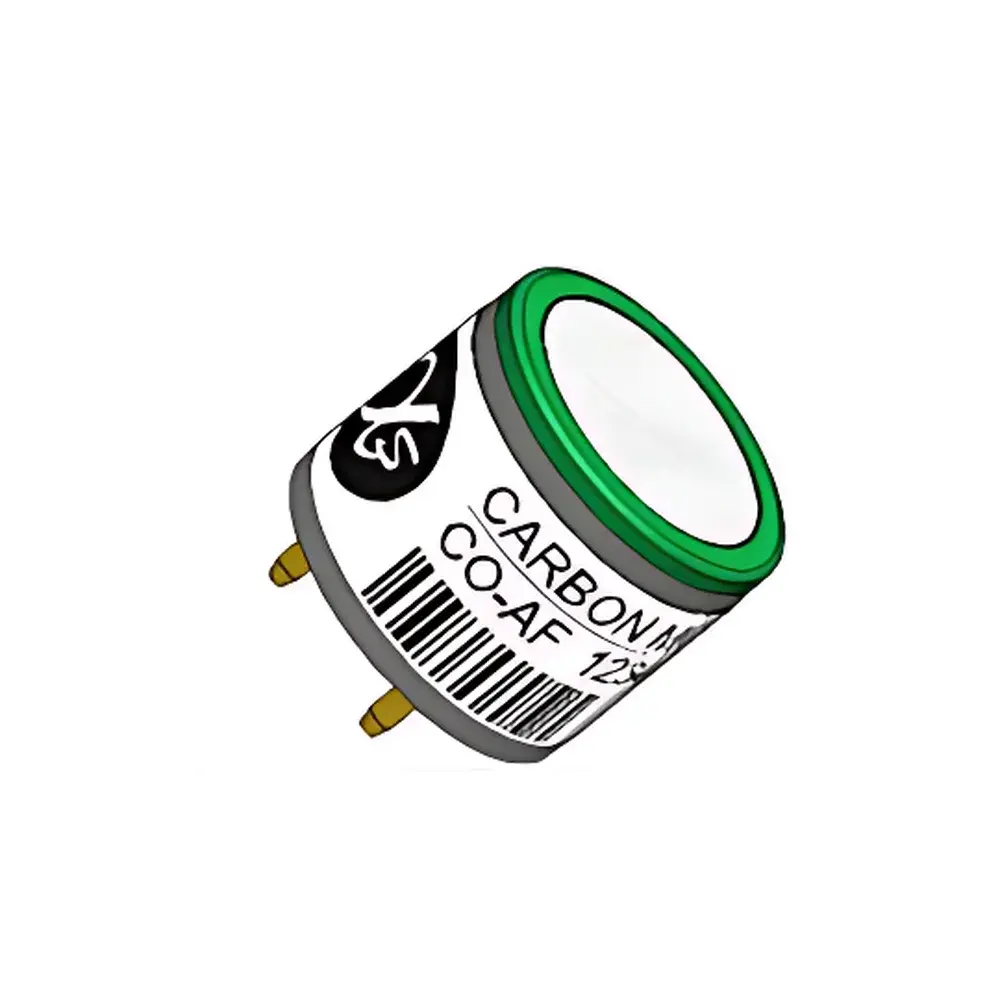
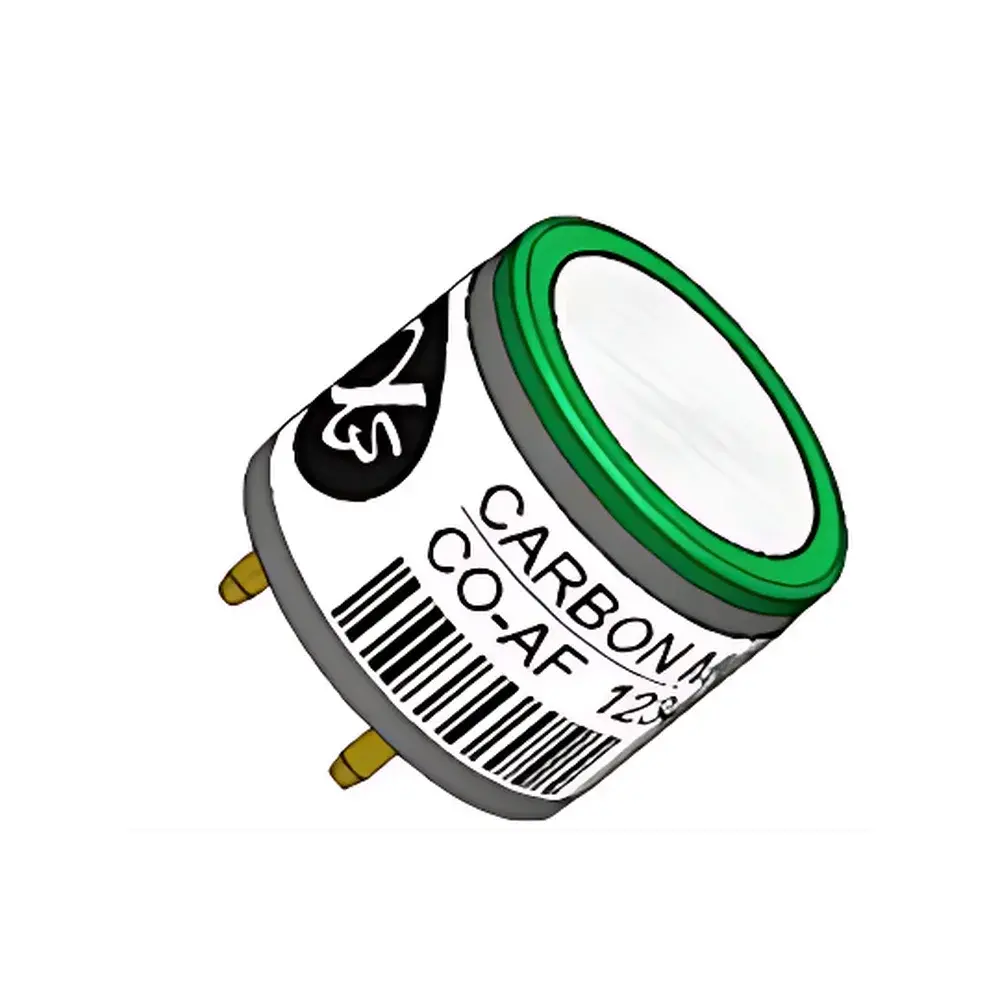
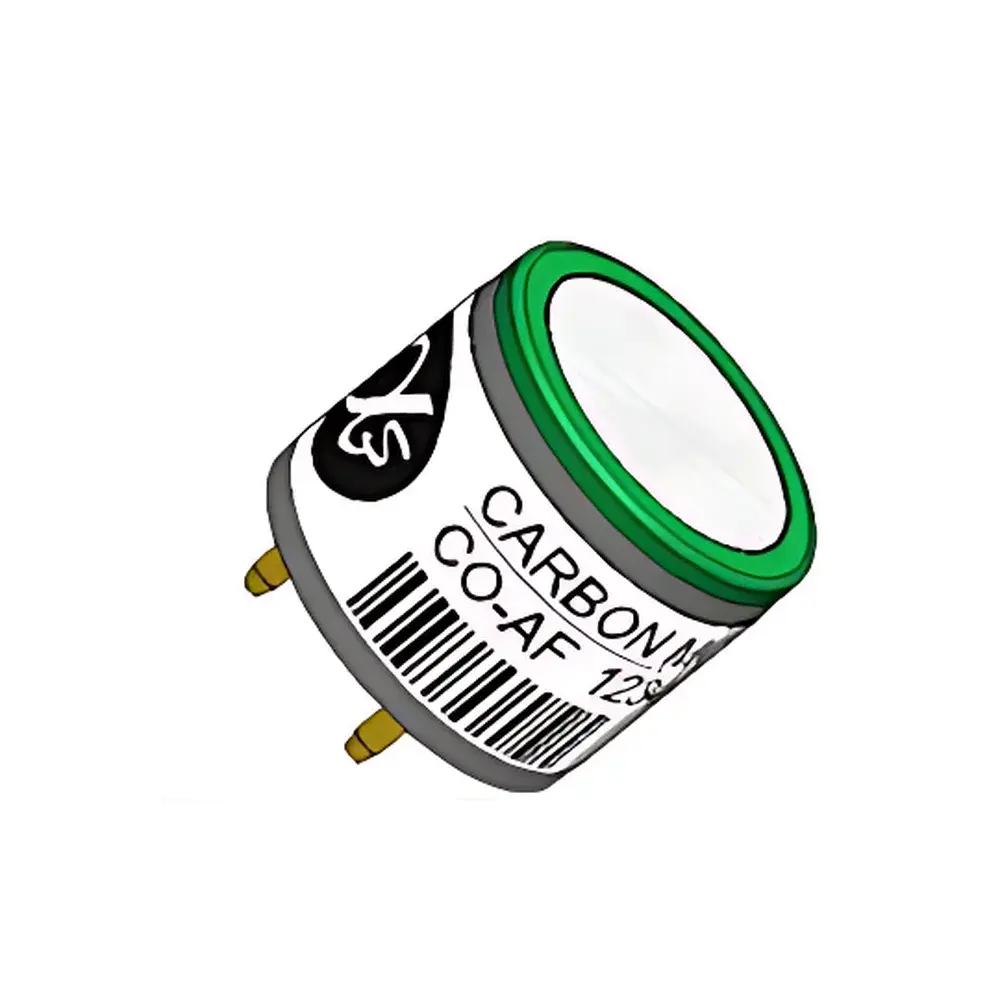
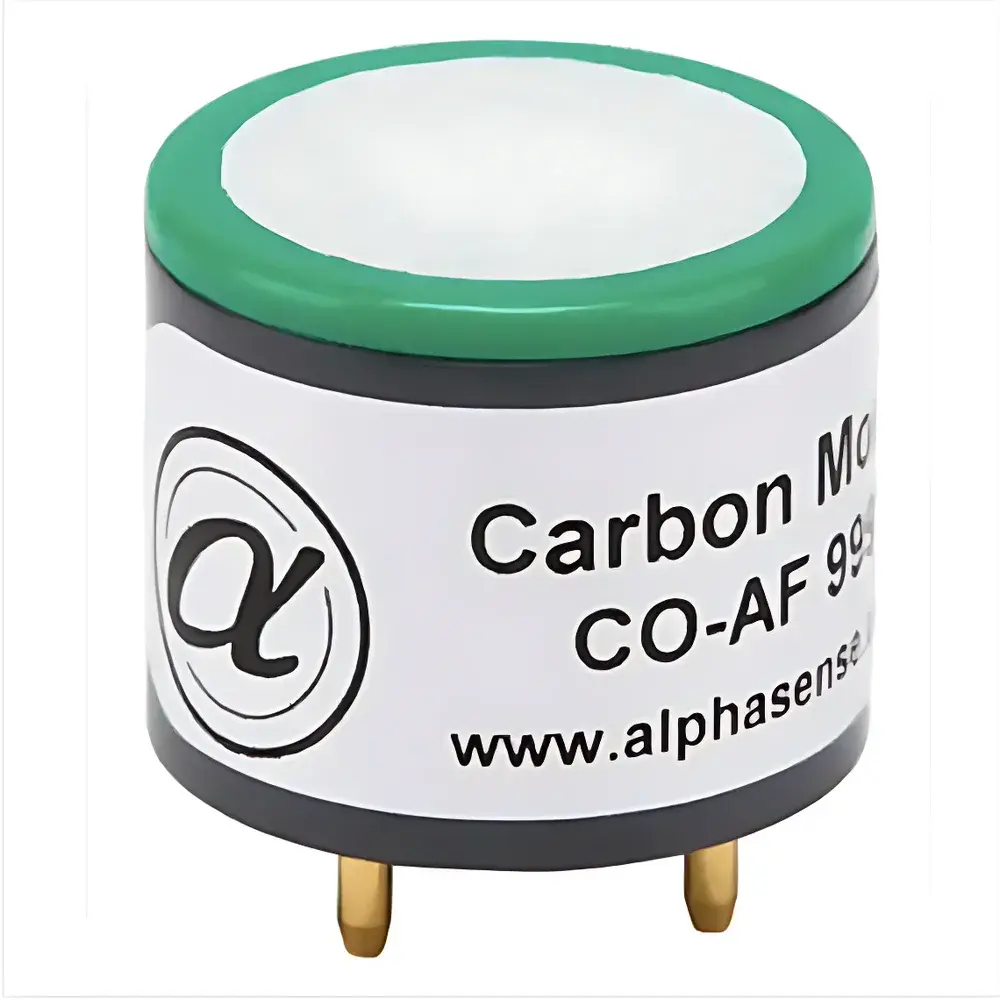
Alphasense CO-AF Miniature Electrochemical Carbon Monoxide Sensor with Integrated Filter Membrane
| Brand | Alphasense |
|---|---|
| Origin | UK |
| Model | CO-AF |
| Measurement Range | 0–5000 ppm CO |
| Sensitivity | 55–90 nA/ppm |
| Response Time (t₉₀) | <25 s |
| Full-Scale Linearity Error | ±15–25 ppm |
| Overload Capacity | 10,000 ppm |
| Resolution | <0.5 ppm |
| Dimensions | Ø20.2 × 16.5 mm |
| Operating Temperature | −30 to +50 °C |
| Operating Humidity | 15–90 %RH (non-condensing) |
| Load Resistance | 10–47 Ω |
| Expected Operational Lifetime | 2 years |
| Storage Stability | 6 months (unpowered, sealed) |
Overview
The Alphasense CO-AF is a miniature, high-stability electrochemical sensor engineered for the selective and quantitative detection of carbon monoxide (CO) in ambient air and industrial process streams. Based on three-electrode potentiostatic amperometry, the sensor operates via the oxidation of CO at a catalytic working electrode, generating a current proportional to gas concentration. Its integrated hydrophobic PTFE filter membrane provides robust protection against particulate contamination, moisture ingress, and interfering volatile organic compounds (VOCs), significantly enhancing long-term baseline stability and reducing false positives in humid or dusty environments. Designed for integration into portable gas detectors, fixed-point monitoring systems, and indoor air quality (IAQ) controllers, the CO-AF complies with fundamental performance requirements outlined in IEC 60079-29-1 (explosive atmospheres) and EN 45544-1 (electrochemical sensors for toxic gases), making it suitable for safety-critical applications across occupational health, HVAC optimization, and environmental compliance monitoring.
Key Features
- Miniaturized cylindrical form factor (Ø20.2 × 16.5 mm) enabling compact system integration and low-profile housing design
- Integrated hydrophobic PTFE membrane providing mechanical filtration and humidity buffering without compromising response kinetics
- Stable sensitivity range of 55–90 nA/ppm ensures consistent signal output across production batches and operating conditions
- Fast t₉₀ response time under 25 seconds supports real-time exposure assessment in dynamic environments
- Low-resolution capability (<0.5 ppm) enables reliable detection near occupational exposure limits (e.g., OSHA PEL = 50 ppm, ACGIH TLV = 25 ppm)
- Extended operational lifetime of up to 24 months under typical ambient conditions (23 °C, 50 %RH)
- Wide operating temperature range (−30 to +50 °C) and humidity tolerance (15–90 %RH, non-condensing) support deployment in uncontrolled field settings
- Optimized load resistance window (10–47 Ω) facilitates direct interfacing with standard analog front-end circuits and low-power microcontroller ADCs
Sample Compatibility & Compliance
The CO-AF sensor is calibrated and validated for use in clean, dry air matrices and exhibits minimal cross-sensitivity to common interferents including hydrogen (H₂), nitrogen dioxide (NO₂), sulfur dioxide (SO₂), and ethanol vapor—thanks to its proprietary electrode catalyst formulation and diffusion-limiting membrane. It is not intended for use in corrosive, high-H₂S, or high-ozone environments without additional external scrubbing. The device conforms to RoHS Directive 2011/65/EU and REACH Regulation (EC) No. 1907/2006. While not certified as intrinsically safe on its own, it is routinely deployed in Class I, Division 1 and ATEX Zone 1 compliant instruments when embedded within appropriately rated enclosures and circuit protection schemes. Sensor calibration traceability follows NIST-traceable reference gas standards per ISO 17025-accredited procedures.
Software & Data Management
As a transducer-level component, the CO-AF does not include onboard firmware or digital communication interfaces. It delivers a linear analog current output (nA range) requiring external signal conditioning—including low-noise transimpedance amplification, temperature compensation (via optional integrated thermistor), and analog-to-digital conversion. For regulatory data integrity, end-system implementations should incorporate audit-trail-capable calibration logging, zero/span verification timestamps, and drift correction algorithms aligned with ISO 14644-1 cleanroom monitoring protocols or EPA Method TO-15 QA/QC guidelines. When integrated into FDA-regulated medical or pharmaceutical ventilation systems, full electronic record retention—including sensor lot number, calibration date, and functional test results—must comply with 21 CFR Part 11 requirements.
Applications
- Portable personal CO monitors for fire service, mining, and confined-space entry teams
- Fixed-site industrial hygiene systems for boiler rooms, parking garages, and generator enclosures
- Indoor air quality (IAQ) modules in smart building management systems (BMS)
- Automotive cabin air quality feedback control in OEM HVAC subsystems
- Research-grade environmental monitoring networks measuring urban CO gradients and traffic-related pollution
- Calibration transfer standards in metrology laboratories supporting secondary gas analyzer validation
FAQ
What is the recommended calibration frequency for the CO-AF sensor?
For occupational safety applications, quarterly bump testing and semi-annual full calibration against traceable CO standards are advised; more frequent calibration may be required in high-humidity or high-pollutant environments.
Can the CO-AF operate continuously in condensing humidity?
No—operation must remain within 15–90 %RH non-condensing conditions. Prolonged exposure to condensation will irreversibly degrade the electrolyte and membrane integrity.
Does the sensor require a warm-up period before stable readings?
Yes—a minimum 24-hour stabilization period after initial power-on or storage is recommended to achieve thermal and electrochemical equilibrium.
Is the CO-AF compatible with printed circuit board (PCB) reflow soldering?
No—reflow soldering exceeds maximum thermal limits. Hand-soldering using ≤350 °C iron tip for <3 seconds per joint is permitted.
How is sensor lifetime defined—calendar time or operational hours?
Lifetime is specified as 2 years from date of manufacture under recommended storage and operating conditions, regardless of cumulative usage duration.