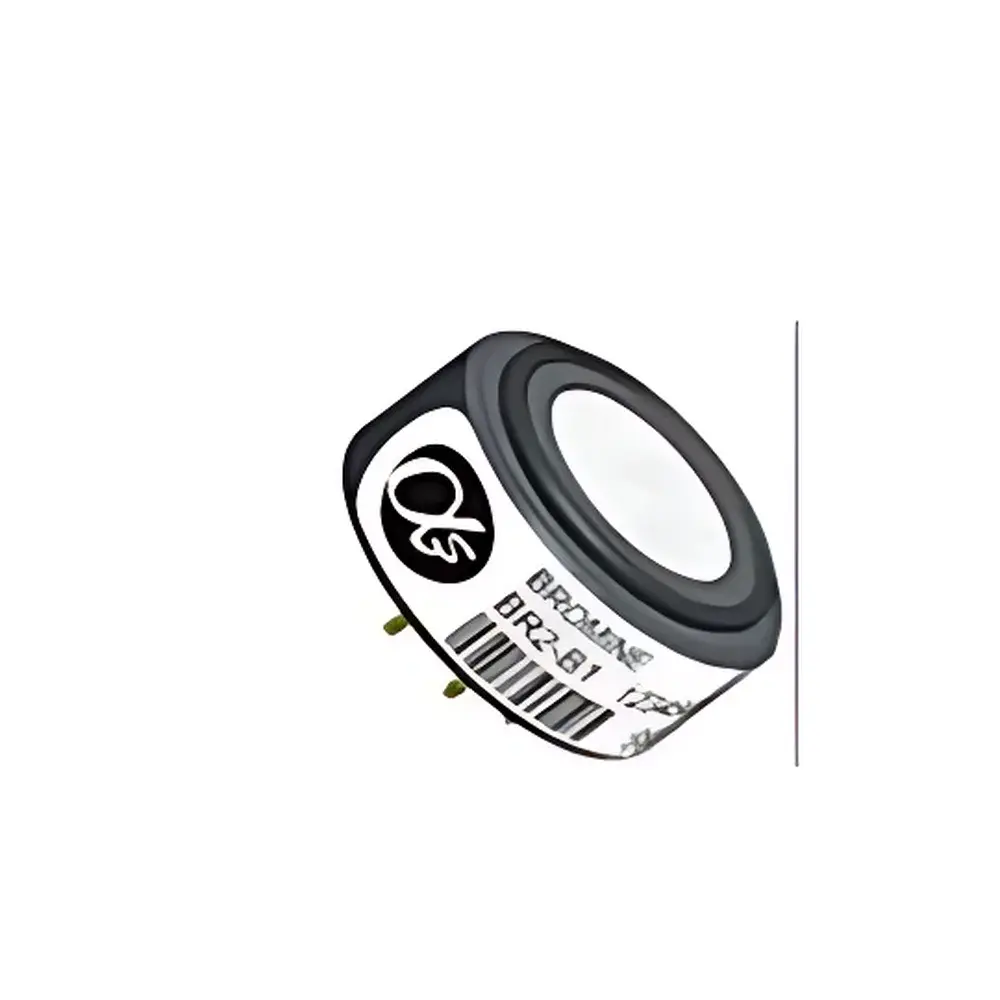
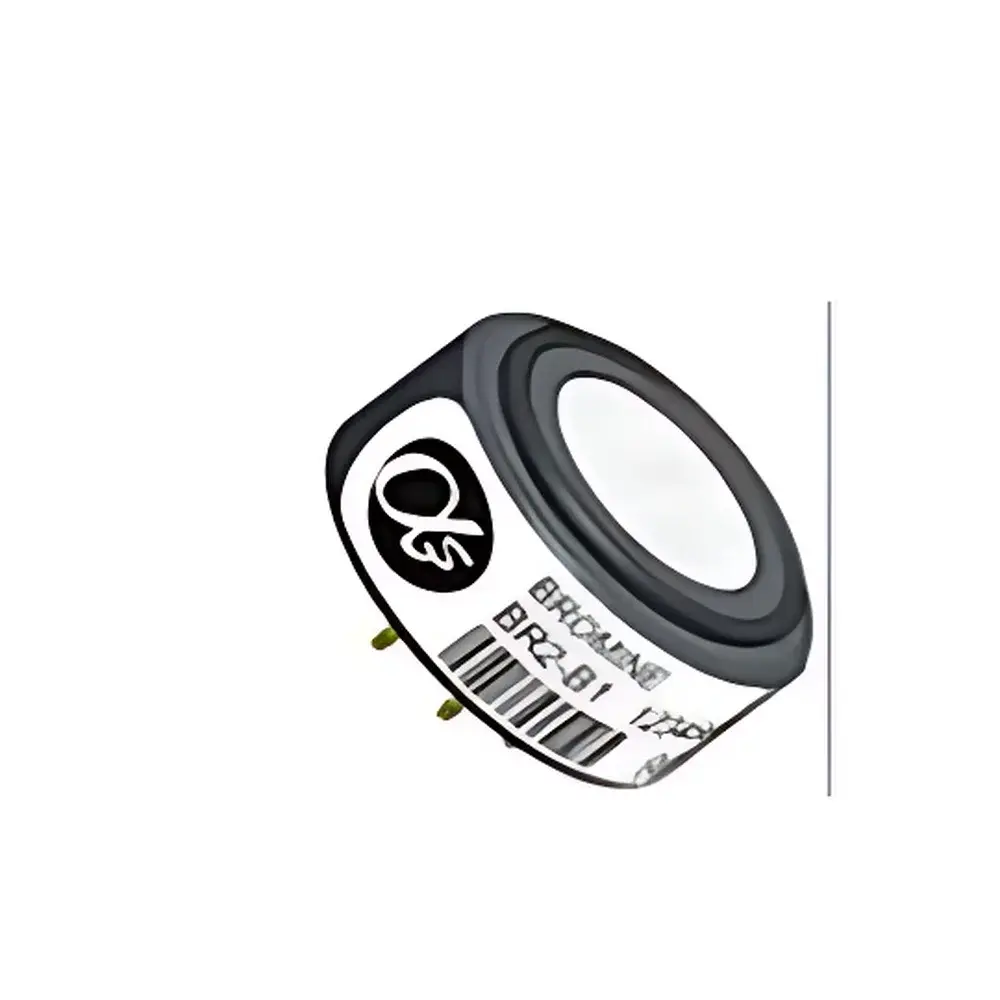
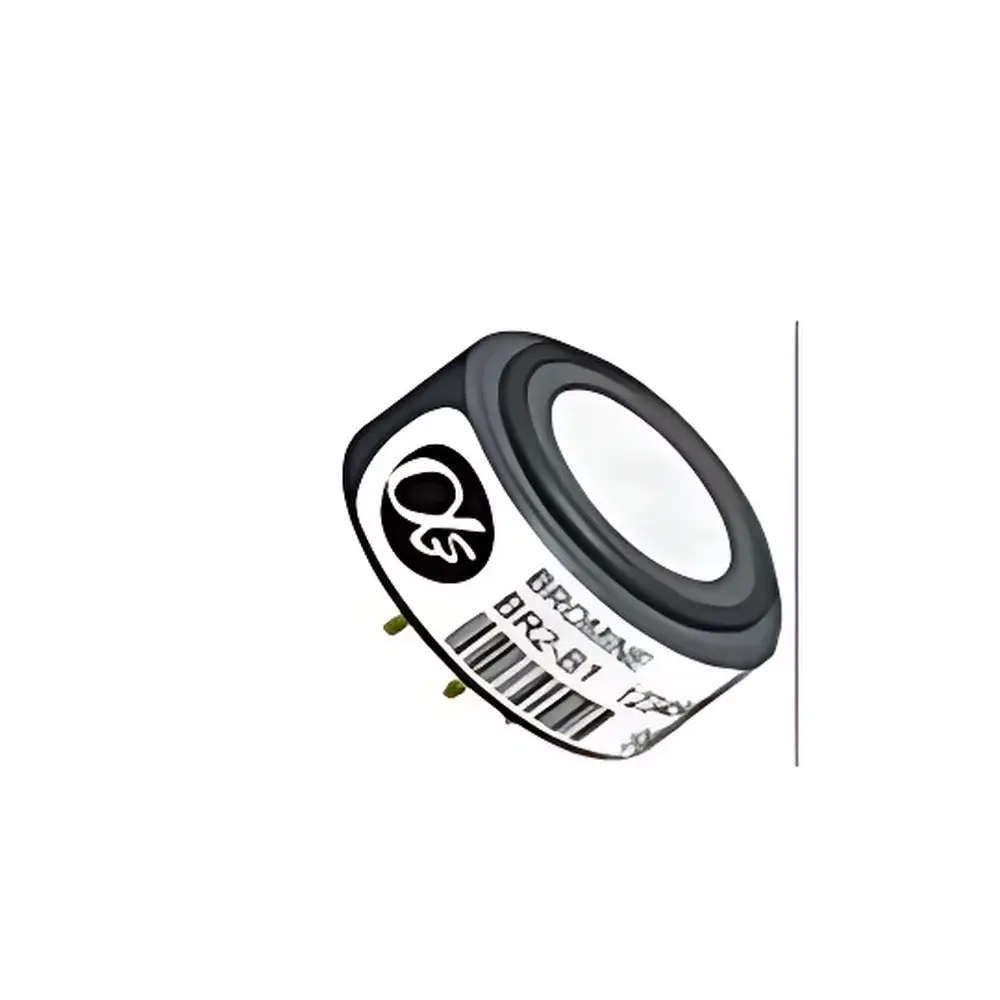
Alphasense Br2-B1 Electrochemical Bromine Gas Sensor
| Brand | Alphasense |
|---|---|
| Origin | United Kingdom |
| Model | Br2-B1 |
| Sensitivity | −600 to −950 nA/ppm |
| Measurement Range | 0–10 ppm |
| Response Time (t₉₀) | <60 s |
| Resolution | 0.02 ppm |
| Dimensions | Ø32.0 × 16.5 mm |
| Operating Temperature | −20 to +50 °C |
| Operating Humidity | 15–90 %RH (non-condensing) |
| Load Resistance | 10–33 Ω |
| Sensor Type | Three-electrode electrochemical cell |
| Target Gas | Bromine (Br₂) |
| Output Signal | Current (nA) proportional to Br₂ concentration |
Overview
The Alphasense Br2-B1 is a precision-engineered, three-electrode electrochemical gas sensor designed for the selective and stable detection of elemental bromine (Br₂) in ambient air and industrial process streams. Based on amperometric transduction, the sensor operates via controlled oxidation of Br₂ at the working electrode in an aqueous electrolyte, generating a current output linearly proportional to the partial pressure of bromine within its specified range. This principle ensures high specificity toward Br₂ while minimizing cross-sensitivity to common interferents such as chlorine (Cl₂), nitrogen dioxide (NO₂), and ozone (O₃), all of which are addressed through proprietary electrode catalysis and membrane diffusion barrier design. The Br2-B1 is optimized for continuous monitoring applications requiring long-term baseline stability, low power consumption, and compatibility with standard analog signal conditioning circuits — making it suitable for integration into fixed gas detection systems, portable safety monitors, and environmental compliance instrumentation deployed across chemical manufacturing, water treatment, and laboratory fume hood surveillance.
Key Features
- Three-electrode electrochemical architecture for enhanced zero stability and extended service life
- High sensitivity range of −600 to −950 nA/ppm enables reliable detection at sub-ppm levels
- Full-scale measurement range of 0–10 ppm Br₂ meets occupational exposure limit (OEL) monitoring requirements (e.g., OSHA PEL = 0.1 ppm; ACGIH TLV = 0.1 ppm)
- Fast t₉₀ response time of less than 60 seconds supports real-time hazard assessment and alarm triggering
- Resolution of 0.02 ppm facilitates precise quantification near regulatory thresholds
- Compact cylindrical form factor (Ø32.0 × 16.5 mm) allows seamless integration into space-constrained enclosures
- Operating temperature range of −20 to +50 °C and humidity tolerance up to 90 %RH (non-condensing) support deployment in diverse indoor and outdoor environments
- Optimized load resistance interface (10–33 Ω) ensures compatibility with industry-standard current-to-voltage conversion circuits
Sample Compatibility & Compliance
The Br2-B1 is intended for use in clean, non-corrosive air matrices. It is not recommended for direct exposure to high concentrations of acidic gases (e.g., HCl, SO₂), organic vapors, or condensing moisture without appropriate pre-conditioning (e.g., particulate filtration, hydrophobic membrane protection, or active humidity compensation). The sensor complies with RoHS Directive 2011/65/EU and is manufactured under ISO 9001-certified quality management systems. While the device itself does not carry CE marking as a standalone product, it is engineered to support final equipment compliance with EN 45544-1 (electrical apparatus for detection and measurement of toxic gases) when integrated into certified host instruments. Its performance characteristics align with methodologies referenced in ASTM D679–22 (Standard Test Method for Odor and Taste Thresholds of Water-Dissolved Chemicals) and ISO 16000-25 (Indoor air — Part 25: Determination of ozone, nitrogen dioxide, sulfur dioxide and bromine by passive samplers and subsequent analysis), where applicable.
Software & Data Management
As a raw analog transducer, the Br2-B1 outputs a current signal requiring external signal conditioning. When integrated into digital host platforms, it supports full audit-trail functionality when paired with firmware compliant with FDA 21 CFR Part 11 (for pharmaceutical or regulated lab use) or ISO/IEC 17025 data integrity requirements. Calibration data—including span gas date, concentration, and zero offset—can be stored in non-volatile memory alongside timestamped readings. Alphasense provides calibration certificates traceable to NPL (National Physical Laboratory, UK) upon request. Sensor diagnostics—including electrode health estimation and baseline drift trending—are accessible via compatible evaluation boards (e.g., Alphasense B4 Series Interface Boards) and supported by open-source Python libraries for automated data logging and QA/QC reporting.
Applications
- Occupational health monitoring in bromine-handling facilities (e.g., flame retardant synthesis, pharmaceutical intermediate production)
- Leak detection in bromine storage and transfer systems at chemical plants and ports
- Real-time air quality assessment in wastewater disinfection units utilizing bromine-based biocides
- Research-grade quantification of Br₂ emissions in atmospheric chemistry studies and halogen activation experiments
- Integration into multi-gas analyzers for EPA Method TO-15 or EU Directive 2008/50/EC supplementary monitoring networks
- Alarm-enabled ventilation control in laboratories handling brominated compounds
FAQ
What is the expected operational lifetime of the Br2-B1 sensor under typical conditions?
Under continuous operation at 23 °C and 50 %RH, the Br2-B1 typically delivers 24 months of functional stability before sensitivity decay exceeds ±15 % of initial value. Lifetime is reduced under elevated temperature, humidity, or exposure to high Br₂ concentrations (>5 ppm).
Does the Br2-B1 require periodic zero and span calibration?
Yes. Recommended calibration frequency is every 3–6 months depending on usage intensity and environmental conditions. Zero calibration should be performed using clean, dry air or nitrogen; span calibration requires certified Br₂-in-air standard gas (e.g., 5 ppm in N₂, traceable to NIST).
Can the Br2-B1 be used in oxygen-deficient environments?
No. As an electrochemical sensor, the Br2-B1 relies on ambient oxygen as the counter electrode reactant. Operation below 18 % O₂ vol/vol will result in non-linear response and accelerated baseline drift.
Is there a recommended interface circuit for signal conditioning?
Alphasense specifies a transimpedance amplifier with gain setting matched to the nominal sensitivity (e.g., 100 kΩ resistor for −800 nA/ppm yields −0.8 V/ppm). Detailed schematics and layout guidelines are provided in Application Note AN-202 (Rev. D), available from Alphasense Technical Support.