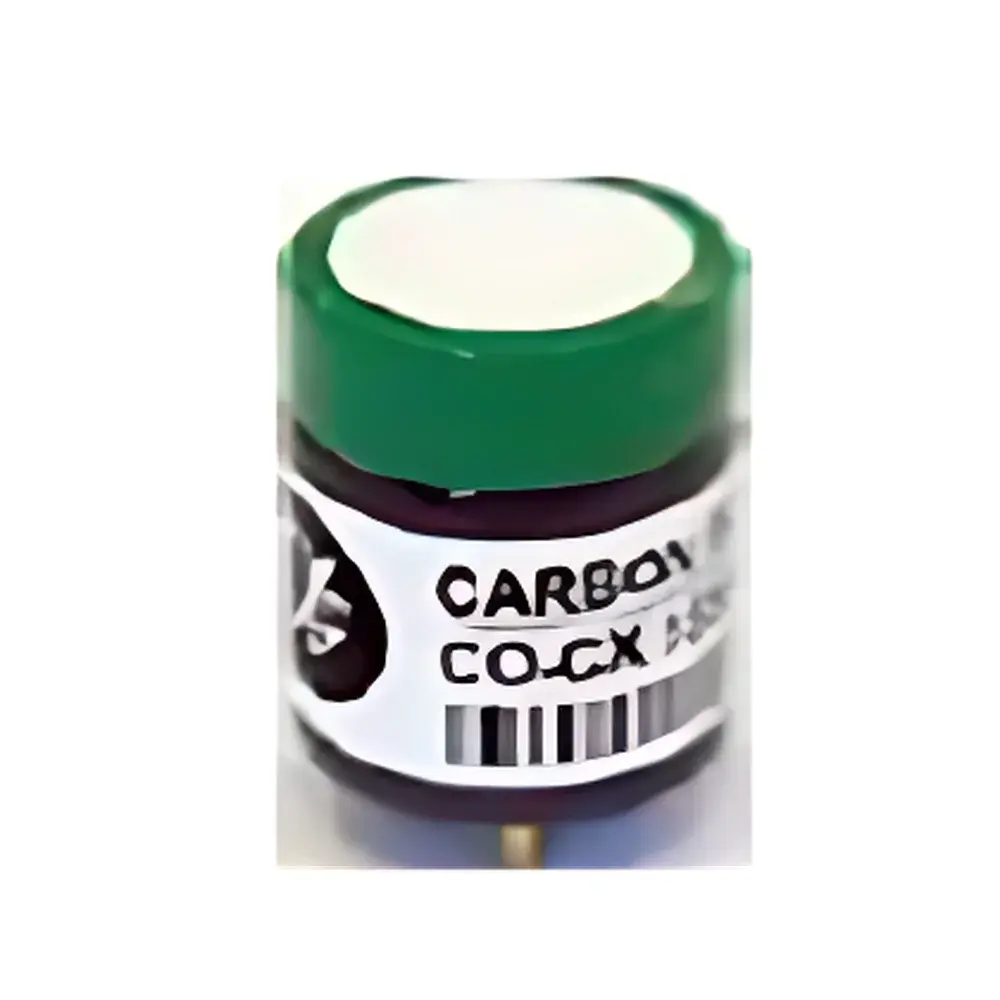
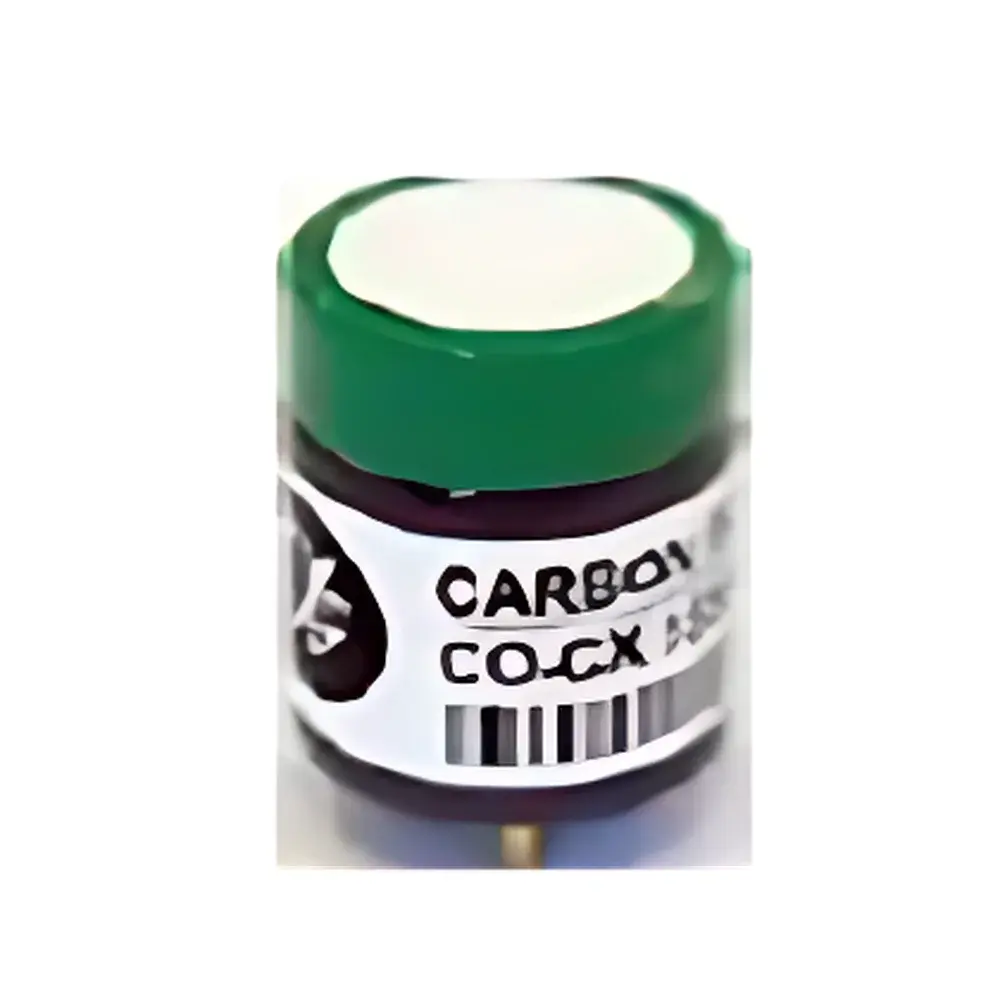
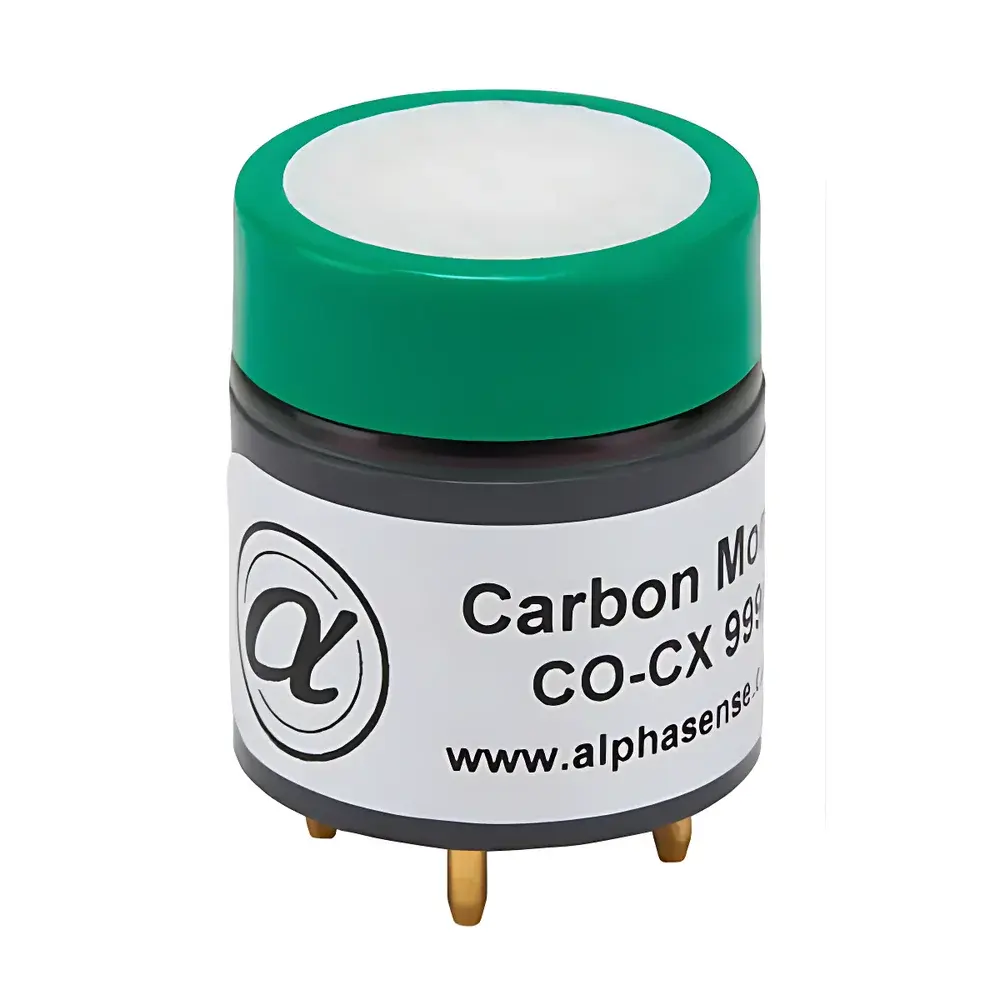
Alphasense CO-CX Electrochemical Carbon Monoxide Sensor (Smoke-Resistant & H₂-Compensated)
| Brand | Alphasense |
|---|---|
| Origin | United Kingdom |
| Model | CO-CX |
| Sensitivity | 55–90 nA/ppm |
| Response Time (t₉₀) | <30 s |
| Measurement Range | 0–2000 ppm |
| Overload Capacity | 4000 ppm |
| Linear Range | 0–40 ppm |
| Resolution | 0.5 ppm |
| Dimensions | Ø20.2 × 20.3 mm |
| Operating Temperature | −30 to +50 °C |
| Operating Humidity | 15–90 %RH (non-condensing) |
| Load Resistance | 10–47 Ω |
| Expected Operational Life | 24 months |
| Storage Shelf Life | 6 months |
Overview
The Alphasense CO-CX is a high-stability, electrochemical carbon monoxide (CO) sensor engineered for reliable detection in challenging industrial and environmental monitoring applications where cross-sensitivity to hydrogen (H₂) and interference from combustion-derived smoke particulates must be minimized. Unlike standard CO electrochemical sensors, the CO-CX incorporates proprietary electrode formulation and diffusion barrier design to suppress false-positive responses to H₂—common in fuel cell environments, boiler rooms, and confined-space maintenance—and to maintain signal integrity in smoky or soot-laden atmospheres such as flue gas ducts, waste incineration facilities, and diesel exhaust monitoring points. Its operation follows classic amperometric principles: CO diffuses through a hydrophobic membrane into an aqueous electrolyte, undergoes oxidation at the working electrode (typically Pt-based), generating a current proportional to gas concentration. The sensor outputs a linear current signal (nA) directly correlated to CO partial pressure, calibrated per ISO 12032 and compatible with standard 3-electrode gas sensing circuitry.
Key Features
- Engineered H₂ compensation: Reduced cross-sensitivity to hydrogen up to 1000 ppm, enabling stable CO measurement in mixed-gas environments without external software correction.
- Smoke-resistant membrane architecture: Hydrophobic PTFE diffusion layer minimizes fouling and signal drift during exposure to submicron carbonaceous aerosols typical of incomplete combustion.
- Wide operational envelope: Validated performance across −30 °C to +50 °C and 15–90 %RH (non-condensing), supporting deployment in unheated outdoor enclosures and high-humidity indoor settings.
- Precision metrology: Typical sensitivity of 72 nA/ppm (±15 %) with repeatability better than ±2 % of reading under controlled calibration conditions.
- Low-power compatibility: Designed for use with standard potentiostatic interfaces; operates optimally with load resistances between 10 Ω and 47 Ω, facilitating integration into battery-powered portable detectors and fixed-system controllers.
- Controlled shelf life management: Supplied with integrated desiccant cap and factory-sealed packaging; recommended storage at 20 °C/50 %RH for ≤6 months prior to installation to preserve baseline stability.
Sample Compatibility & Compliance
The CO-CX is intended for continuous or intermittent sampling of ambient air, ventilation ducts, and low-velocity process streams containing CO at concentrations up to 2000 ppm. It is not rated for direct insertion into high-temperature (>60 °C), high-pressure (>1.2 bar abs), or corrosive gas matrices (e.g., Cl₂, NO₂, SO₂ >10 ppm). The sensor complies with IEC 60079-29-1:2016 for gas detector performance requirements and meets the essential design criteria outlined in EN 50194-1 (domestic CO alarm systems) and UL 2034 (single- and multiple-station CO alarms). Its electrochemical cell construction adheres to RoHS Directive 2011/65/EU and REACH Annex XVII restrictions on hazardous substances. For regulated environments (e.g., occupational safety monitoring per OSHA 1910.1200 or EPA Method TO-11A), users must validate system-level accuracy via traceable span-gas verification at installation and at intervals defined by site-specific QA/QC protocols.
Software & Data Management
The CO-CX itself is an analog transducer and does not embed firmware or digital communication. Integration requires external signal conditioning—typically a low-noise transimpedance amplifier followed by ADC conversion—and calibration data management via host instrumentation. When deployed in systems compliant with FDA 21 CFR Part 11 or ISO/IEC 17025, the sensor’s calibration history, zero/span verification logs, and drift compensation coefficients must be maintained in an auditable electronic record. Alphasense provides NIST-traceable calibration certificates (upon request) and supports third-party validation using certified gas standards (e.g., NIST SRM 1683a). Firmware-level linearization is optional but recommended for applications requiring output in ppm units over the full 0–2000 ppm range; Alphasense supplies polynomial coefficients derived from multi-point gas exposure testing.
Applications
- Fixed-site industrial hygiene monitoring in boiler houses, parking garages, and generator enclosures where H₂ co-emission and smoke presence compromise conventional CO sensors.
- OEM integration into portable personal safety monitors used by firefighters, HVAC technicians, and utility workers entering combustion-affected zones.
- Indoor air quality (IAQ) systems in commercial buildings with attached mechanical rooms or adjacent to commercial kitchens.
- Environmental compliance monitoring near municipal solid waste incinerators and biomass power plants subject to EU Industrial Emissions Directive (IED) reporting requirements.
- Research-grade emission testing rigs requiring stable, low-drift CO detection under variable humidity and transient H₂ background conditions.
FAQ
What is the recommended calibration frequency for the CO-CX in continuous monitoring applications?
For critical safety systems, quarterly zero and span calibration using certified CO/N₂ standard gas (e.g., 100 ppm ±2 %) is advised; for non-safety-critical IAQ deployments, biannual verification suffices if baseline drift remains within ±5 % of initial sensitivity.
Can the CO-CX be exposed to condensing humidity?
No. Prolonged exposure to condensation causes electrolyte dilution and irreversible loss of sensitivity. Use only in non-condensing environments or with active sample-line heating/drying.
Is the CO-CX compatible with common gas detector platforms such as Honeywell Analytics or Draeger X-am series?
Yes—mechanically and electrically compatible with standard 3-electrode socket configurations and 0–100 mV or 4–20 mA transmitter modules when paired with appropriate signal conditioning.
Does the sensor require a warm-up period before achieving specified response time?
Yes. A minimum 24-hour stabilization period after removal from sealed storage is required to reach thermal and electrochemical equilibrium; t₉₀ <30 s applies only after this preconditioning.
How should end-of-life be determined for the CO-CX?
Monitor sensitivity drift against initial calibration; replacement is indicated when output falls below 60 % of original nA/ppm value or when zero current exceeds ±15 nA in clean air.