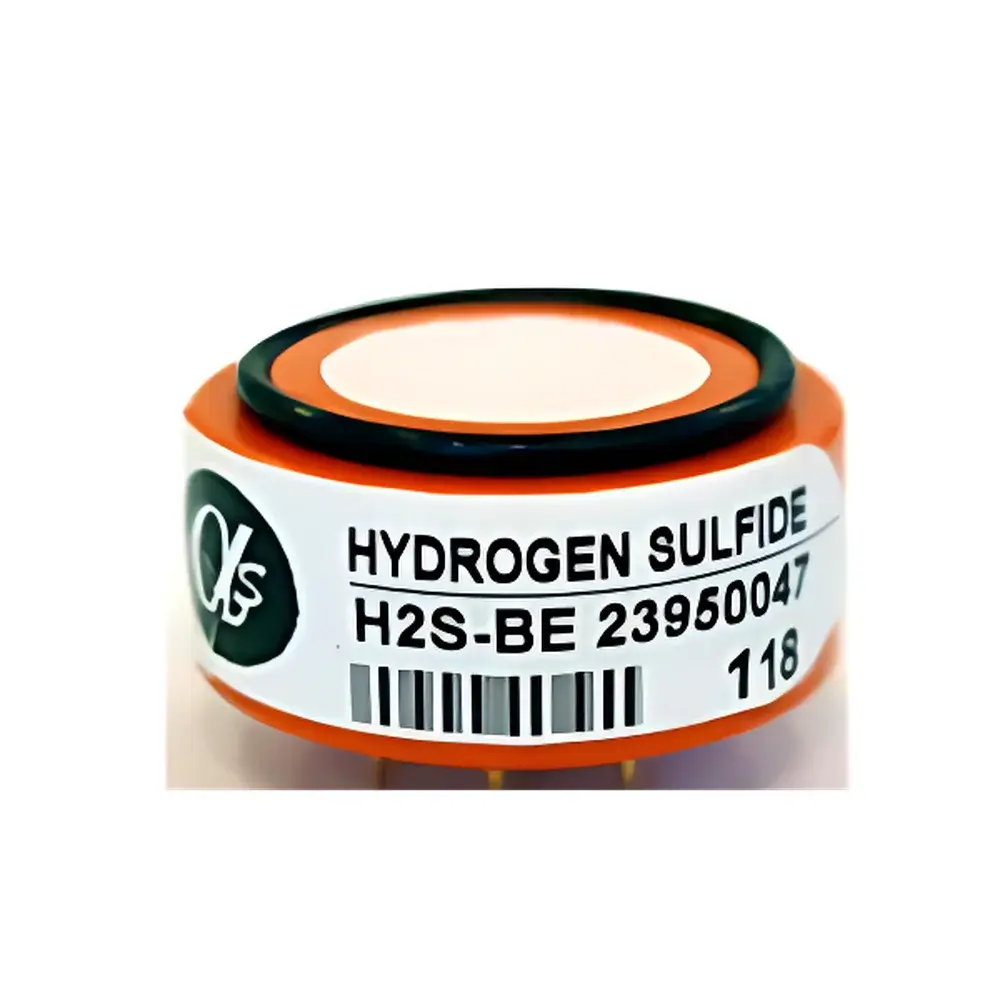
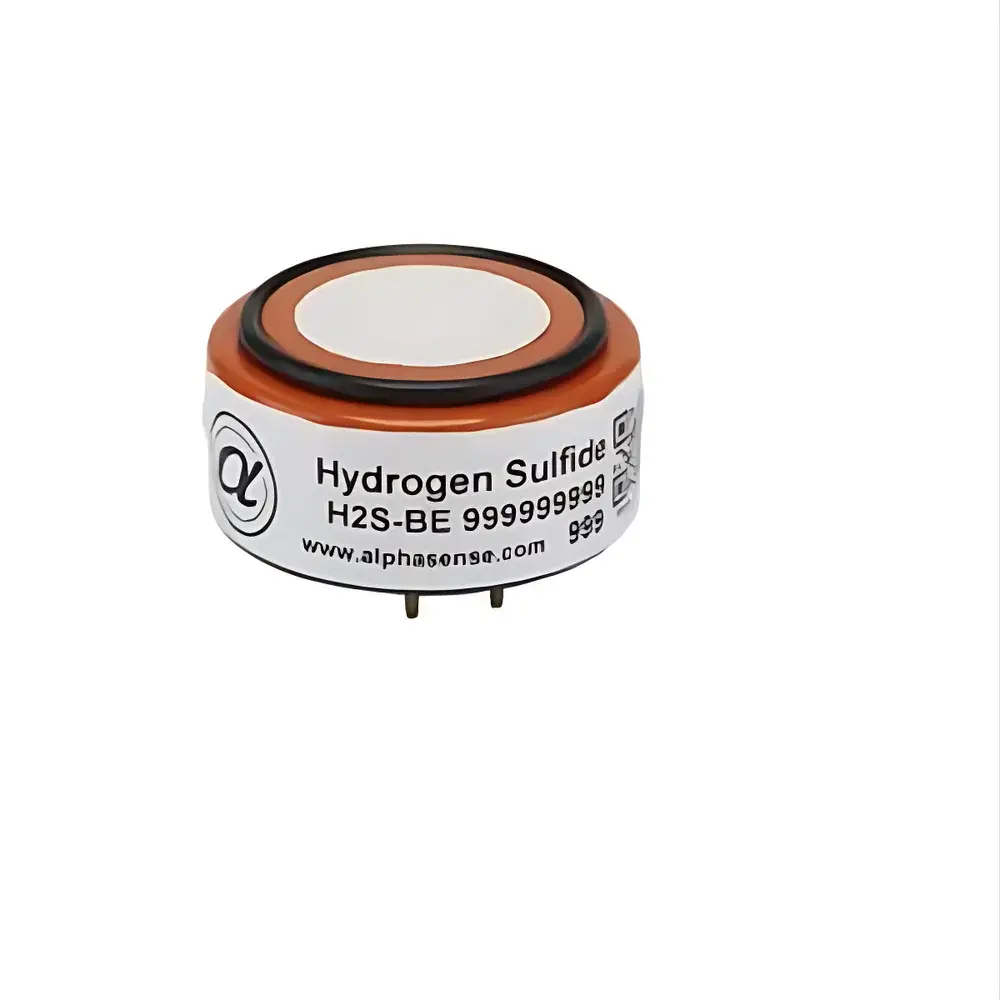
Alphasense H2S-BE High-Range Electrochemical Hydrogen Sulfide Sensor
| Brand | Alphasense (UK) |
|---|---|
| Origin | United Kingdom |
| Model | H2S-BE |
| Measurement Range | 0–2000 ppm |
| Sensitivity | 80–140 nA/ppm |
| Response Time (t₉₀) | <50 s |
| Linear Range | 0–400 ppm (linearity error < ±30 ppm) |
| Overload Capacity | 10,000 ppm |
| Resolution | <0.5 ppm |
| Operating Temperature | −30 to +50 °C |
| Operating Humidity | 15–90 % RH (non-condensing) |
| Load Resistance | 10–47 Ω |
| Dimensions | Ø32.3 × 16.5 mm |
| Expected Service Life | 24 months |
| Storage Stability | 6 months (unpowered, 20–25 °C) |
Overview
The Alphasense H2S-BE is a high-range, diffusion-type electrochemical sensor engineered for the selective and stable detection of hydrogen sulfide (H₂S) in ambient air and industrial process streams. Based on a three-electrode amperometric cell architecture with acid electrolyte and proprietary catalyst formulation, the sensor operates via oxidation of H₂S at the working electrode, generating a current proportional to gas concentration. Its design prioritizes robustness under variable environmental conditions while maintaining metrological integrity across extended deployment cycles. Unlike standard low-range H₂S sensors (e.g., 0–50 ppm), the H2S-BE is specifically calibrated for applications requiring quantification up to 2000 ppm — making it suitable for sour gas monitoring, biogas upgrading facilities, landfill off-gas analysis, and emergency response instrumentation where exposure risk spans multiple orders of magnitude.
Key Features
- Extended measurement range of 0–2000 ppm H₂S, with overload tolerance up to 10,000 ppm without permanent performance degradation
- High intrinsic sensitivity (80–140 nA/ppm), enabling reliable signal resolution below 0.5 ppm even at upper-range concentrations
- Fast electrochemical response: t₉₀ < 50 seconds under standard test conditions (23 °C, 50 % RH)
- Linear output over 0–400 ppm with linearity error bounded within ±30 ppm — facilitating accurate analog or digital signal interpretation without complex polynomial compensation
- Stable baseline and low zero drift (<2 ppm equivalent over 30 days at 25 °C), reducing calibration frequency in fixed-installation systems
- Compact cylindrical form factor (Ø32.3 × 16.5 mm) compatible with OEM gas detection modules, portable analyzers, and continuous emission monitoring systems (CEMS)
- Rated service life of 24 months under continuous operation at 20–30 °C; storage stability maintained for up to 6 months when sealed and stored at 20–25 °C
Sample Compatibility & Compliance
The H2S-BE exhibits high selectivity against common interferents including CO, NO₂, SO₂, Cl₂, and HCN — validated per IEC 60079-29-1 and EN 45544-2 interference testing protocols. Cross-sensitivity to SO₂ is limited to <3 % relative response at 50 ppm SO₂; no significant response observed to CH₄, NH₃, or VOCs below 1000 ppm. The sensor complies with RoHS 2011/65/EU and REACH SVHC requirements. While not intrinsically safe as a standalone component, it is widely integrated into ATEX-certified (Zone 1/21) and IECEx-approved gas detection platforms. Its operational specifications align with ISO 16000-25 (indoor air quality) and EPA Method TO-15 (ambient H₂S screening) sampling constraints when used with appropriate diffusion barriers and temperature-compensated signal conditioning.
Software & Data Management
The H2S-BE outputs a linear current signal (nA) that interfaces directly with industry-standard analog input circuits (e.g., 0–20 mA or 0–5 V transmitters) or microcontroller-based ADCs. Alphasense provides comprehensive calibration documentation, including batch-specific sensitivity coefficients and temperature compensation curves (−30 to +50 °C). When deployed in regulated environments (e.g., wastewater treatment plants under EPA NPDES permits or pharmaceutical cleanroom HVAC monitoring), the sensor supports audit-ready data logging when paired with firmware-compliant host systems implementing FDA 21 CFR Part 11 electronic signature and audit trail functionality. Raw signal stability enables long-term trending analysis without recalibration drift correction algorithms.
Applications
- Fixed-site H₂S monitoring in biogas desulfurization units and anaerobic digesters
- Portable multi-gas detectors for oil & gas upstream operations, refinery turnaround teams, and confined-space entry verification
- Continuous emission monitoring systems (CEMS) for sulfur recovery units (SRUs) and Claus plant tail gas streams
- Landfill gas collection and flaring control systems requiring wide-dynamic-range H₂S feedback
- Research-grade atmospheric chemistry instrumentation studying reduced sulfur compound fluxes in soil-atmosphere exchange studies
- OEM integration into smart ventilation controllers for sewer networks and pumping stations
FAQ
What is the recommended operating temperature range for optimal accuracy?
The sensor delivers specified performance between −30 °C and +50 °C. For highest long-term stability, sustained operation above 40 °C should be accompanied by active thermal management to avoid accelerated electrolyte evaporation.
Does the H2S-BE require external filtering for use in high-humidity environments?
A hydrophobic PTFE membrane is factory-installed; however, in environments with condensing humidity (>90 % RH) or particulate-laden airstreams (e.g., raw biogas), an additional sintered stainless-steel filter or heated sample line is advised.
Can the sensor be zero-calibrated in-field without span gas?
Yes — zero calibration using certified nitrogen or synthetic air is supported; however, span calibration at ≥500 ppm H₂S is required every 3–6 months depending on exposure history and regulatory requirements (e.g., EN 14181 QAL2).
Is the H2S-BE compatible with PID or NDIR-based multi-sensor platforms?
It is electrically and mechanically interoperable with most modular gas detection architectures, though electrical isolation and dedicated current-to-voltage conversion are necessary to prevent crosstalk in mixed-technology arrays.
How does storage duration affect post-storage performance?
Unpowered storage beyond 6 months may result in elevated initial zero current and reduced sensitivity; Alphasense recommends functional verification and optional reconditioning (24 h at 23 °C in clean air) prior to deployment after extended storage.