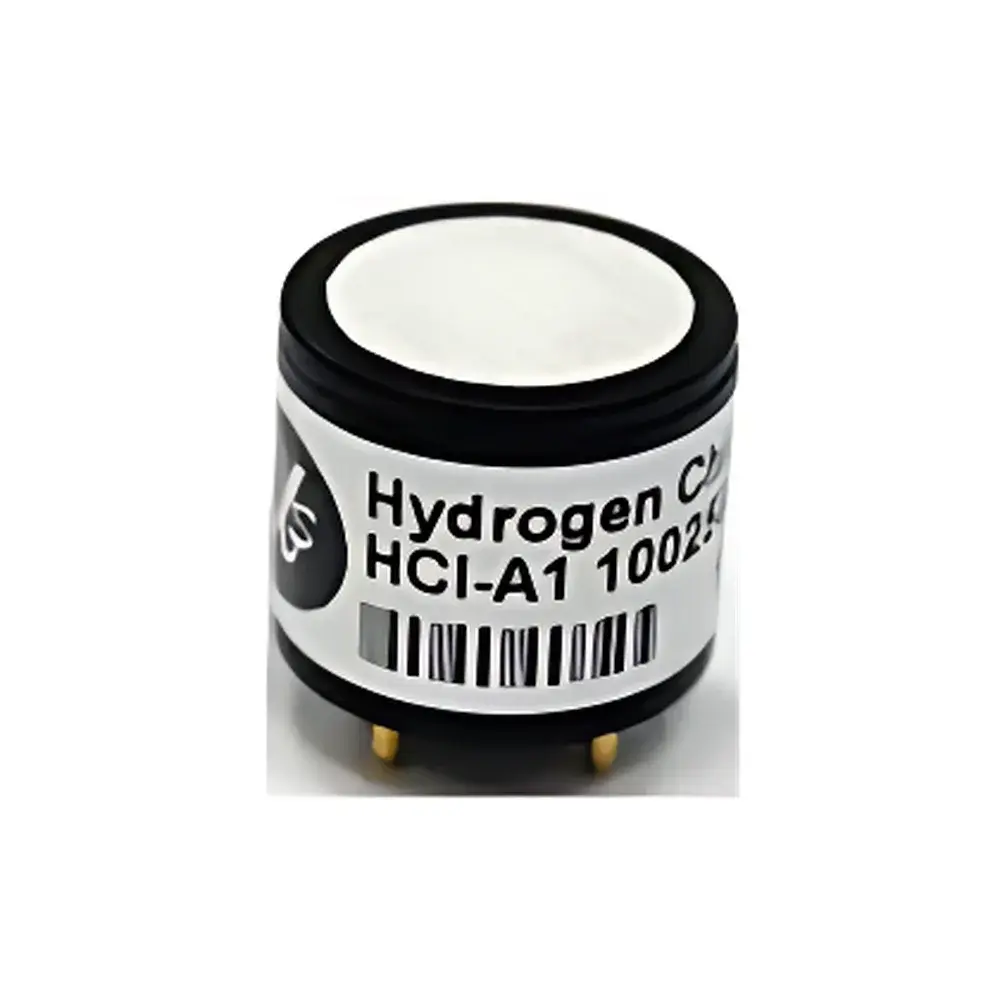
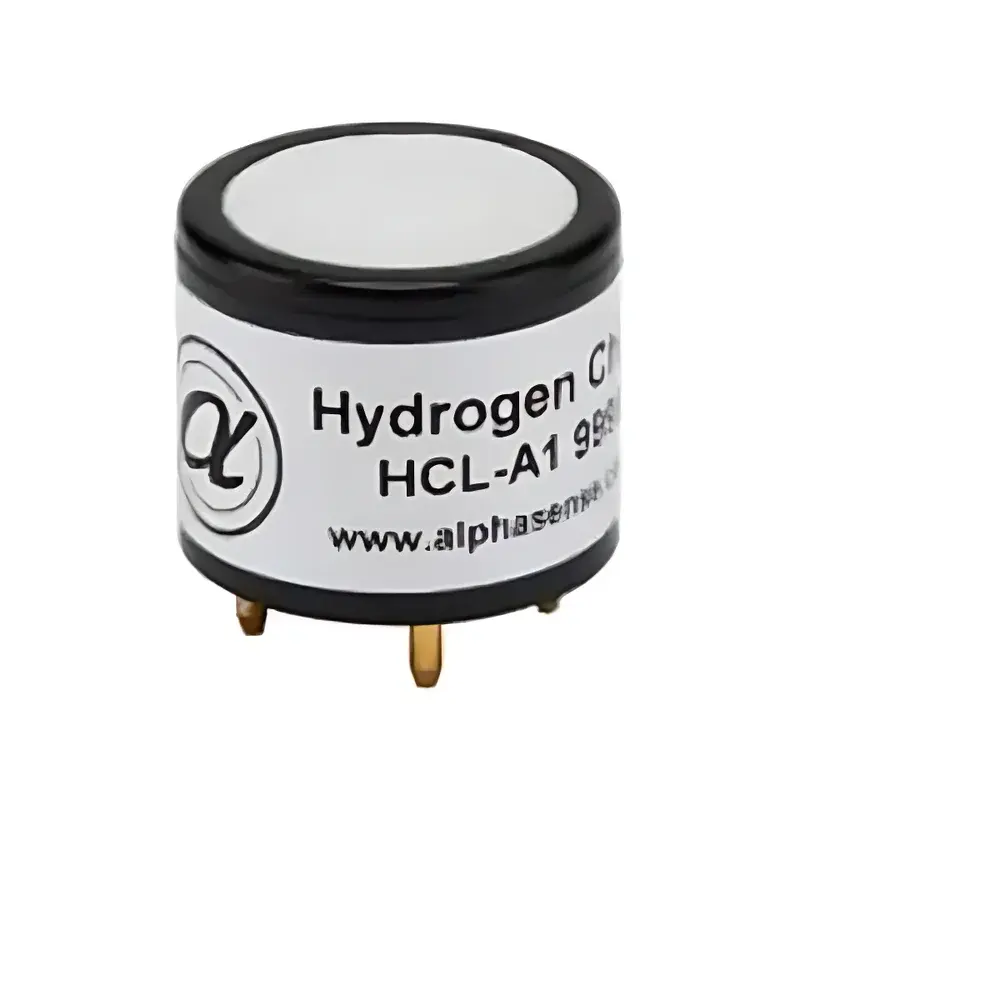
Alphasense HCL-A1 Electrochemical Hydrogen Chloride (HCl) Gas Sensor
| Brand | Alphasense (UK) |
|---|---|
| Origin | United Kingdom |
| Model | HCL-A1 |
| Sensitivity | 50–140 nA/ppm |
| Response Time (t₉₀) | <300 s |
| Resolution | 1 ppm |
| Dimensions | Ø20.2 × 16.5 mm |
| Operating Temperature | −30 to +50 °C |
| Operating Humidity | 15–90 %RH (non-condensing) |
| Load Resistance | 10–33 Ω |
| Sensor Type | Three-electrode electrochemical cell |
| Target Gas | Hydrogen chloride (HCl) |
| Lifetime (typical) | ≥24 months (in ambient air, 23 °C, 50 %RH) |
Overview
The Alphasense HCL-A1 is a precision-engineered, three-electrode electrochemical gas sensor designed for the selective and stable detection of hydrogen chloride (HCl) in ambient air and industrial process environments. Based on amperometric transduction, the sensor operates via diffusion-controlled oxidation of HCl at the working electrode, generating a current proportional to gas concentration. Its robust electrochemical architecture ensures high specificity toward HCl while minimizing cross-sensitivity to common interferents such as Cl₂, SO₂, NO₂, and H₂S—critical for reliable operation in complex emission monitoring or workplace safety applications. The HCL-A1 complies with internationally recognized design principles for fixed and portable gas detection systems, including IEC 60079-29-1 (explosive atmospheres) and EN 45544-1 (electrochemical sensors for toxic gases). It is intended for integration into certified gas analyzers, multi-gas monitors, and continuous emissions monitoring systems (CEMS) deployed in compliance with EPA Method 26A, ISO 10397, or EN 14181.
Key Features
- Three-electrode electrochemical configuration for enhanced baseline stability and reduced zero drift
- Optimized catalytic layer and hydrophobic membrane for consistent performance across variable humidity (15–90 %RH, non-condensing)
- Compact cylindrical form factor (Ø20.2 × 16.5 mm) enabling seamless integration into space-constrained analyzer modules
- Wide operational temperature range (−30 to +50 °C), supporting deployment in outdoor, industrial, and cold-chain environments
- Typical functional lifetime exceeding 24 months under standard storage and operating conditions (23 °C, 50 %RH)
- Factory-calibrated with traceable NIST-traceable reference standards; supports field calibration using certified HCl span gas
- Low-power analog output (current loop compatible) with linear response over 0–100 ppm HCl range
Sample Compatibility & Compliance
The HCL-A1 is validated for use in clean, dry, and moderately humid air matrices. It is not recommended for direct exposure to condensing moisture, acidic aerosols, or high particulate loads without appropriate inlet filtration (e.g., PTFE membrane filters rated ≤0.2 µm). For regulatory compliance, the sensor meets the essential requirements of the EU’s Measuring Instruments Directive (MID) Annex MI-005 when integrated into approved measuring systems. Its electrochemical response characteristics align with the performance criteria defined in ISO/IEC 17025 for accredited gas testing laboratories. When deployed in occupational health monitoring systems, it supports adherence to OSHA PEL (1 ppm TWA) and ACGIH TLV (1 ppm STEL) thresholds for HCl exposure assessment.
Software & Data Management
The HCL-A1 delivers a raw analog current output (nA), requiring external signal conditioning—including temperature compensation, load resistance selection (10–33 Ω), and analog-to-digital conversion. Integration with data acquisition platforms must implement linearization algorithms based on the sensor’s documented sensitivity range (50–140 nA/ppm) and temperature-dependent correction coefficients provided in the Alphasense Technical Datasheet Rev. 5.2. For audit-ready applications, systems incorporating the HCL-A1 should maintain full electronic records of calibration events, zero/span verification logs, and sensor replacement history in accordance with FDA 21 CFR Part 11 and ISO/IEC 17025 documentation requirements. Alphasense provides calibration certificates with uncertainty budgets traceable to UKAS-accredited reference standards.
Applications
- Continuous emission monitoring (CEMS) of HCl from waste incineration, cement kilns, and chemical manufacturing stacks
- Workplace air quality monitoring in pharmaceutical synthesis, semiconductor etching, and PVC production facilities
- Portable personal exposure monitors (PEMs) used by industrial hygienists conducting OEL compliance surveys
- Indoor air quality (IAQ) assessment in laboratories handling hydrochloric acid or chlorine-based reagents
- Leak detection and fence-line monitoring around HCl storage and transfer points in petrochemical sites
- Research-grade environmental studies quantifying HCl deposition fluxes in coastal or volcanic regions
FAQ
What is the recommended load resistance for optimal linearity?
A load resistance of 22 Ω is recommended for most applications to balance signal amplitude and thermal noise; values between 10 Ω and 33 Ω are acceptable depending on system gain architecture.
Does the HCL-A1 require periodic zero calibration?
Yes—zero calibration using certified zero air (hydrocarbon-free, CO₂ scrubbed) is recommended every 30 days in continuous operation, or prior to each critical measurement campaign.
Can the sensor be exposed to high concentrations of HCl for extended periods?
Prolonged exposure above 50 ppm may accelerate electrolyte depletion and reduce service life; intermittent exposure up to 100 ppm is permissible if followed by recovery in clean air.
Is the HCL-A1 compatible with PID or MOS-based multi-gas platforms?
No—it is an analog electrochemical sensor and requires dedicated current-measurement circuitry; it is not plug-compatible with PID or metal-oxide semiconductor (MOS) signal chains.
How is sensor aging accounted for in long-term deployments?
Alphasense specifies a typical sensitivity drift of ≤0.5 %/month; users must implement scheduled recalibration intervals aligned with risk-based validation protocols per ISO 14644 or ICH Q2(R2).