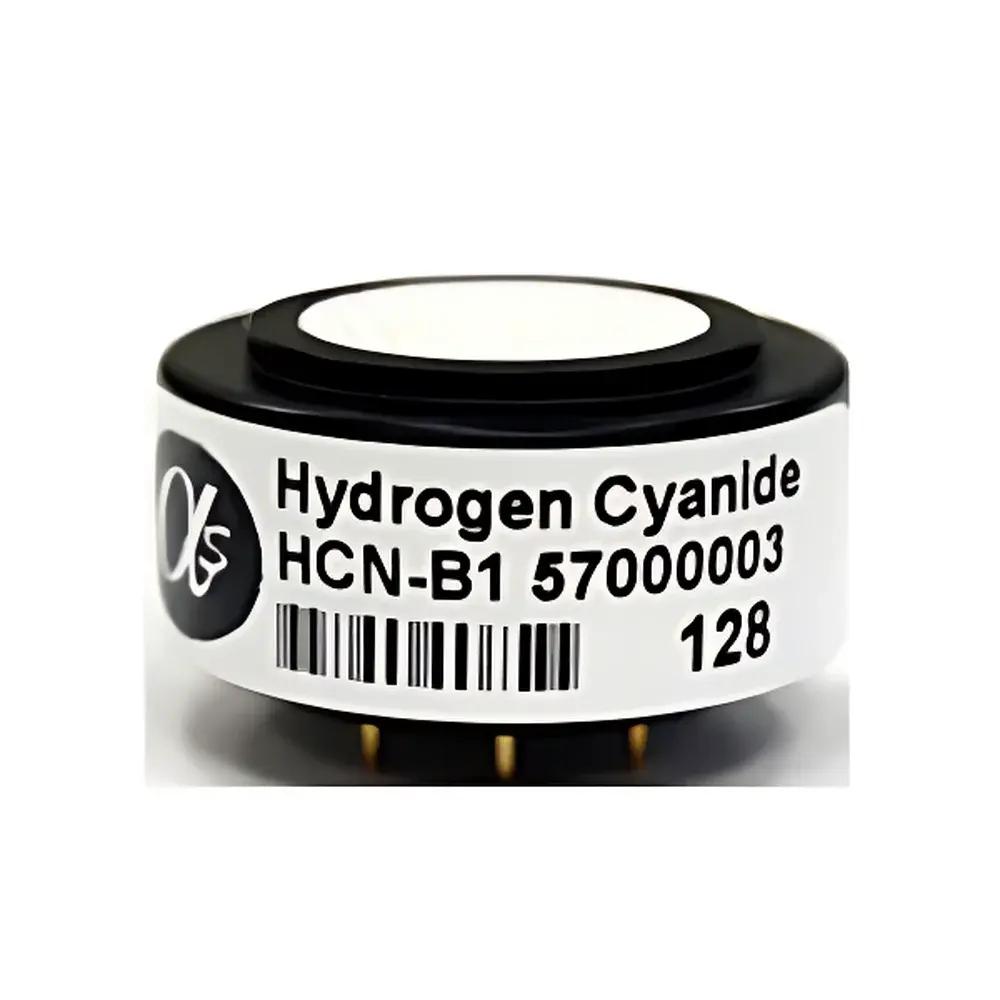
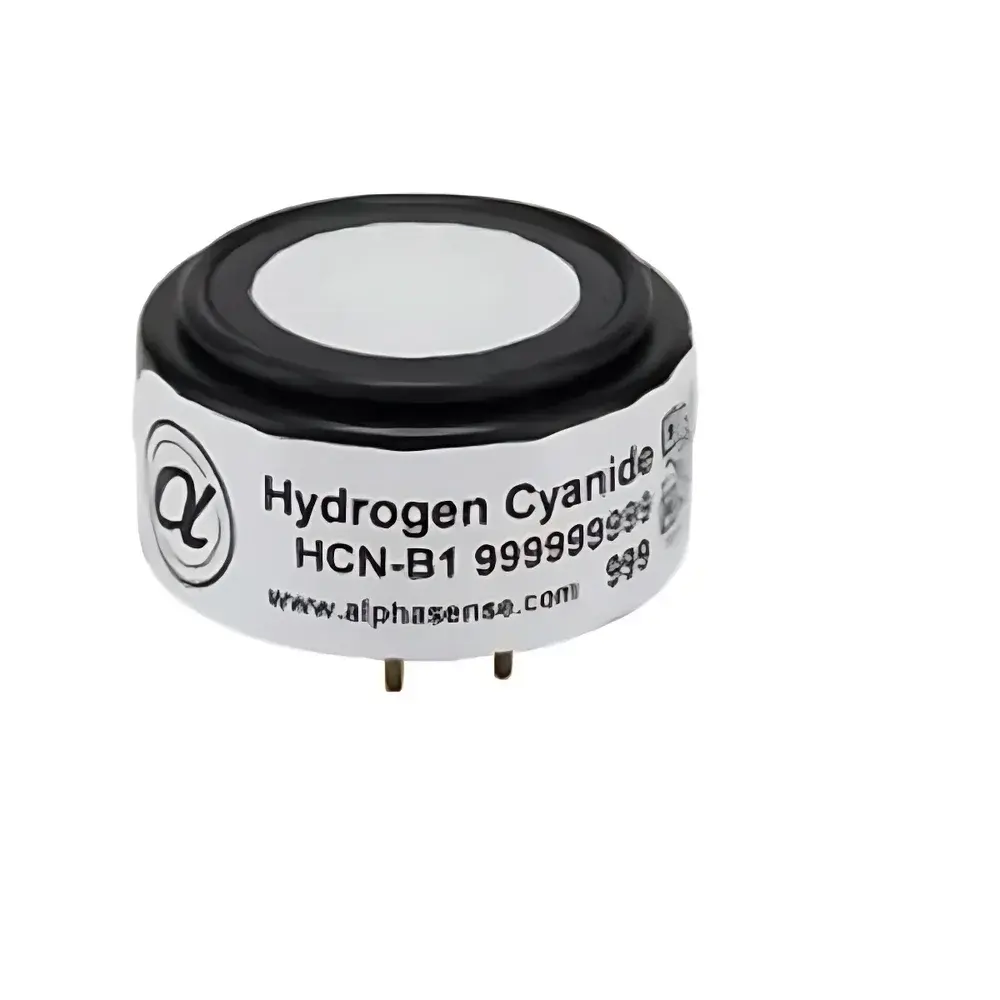
Alphasense HCN-B1 Electrochemical Hydrogen Cyanide (HCN) Gas Sensor
| Brand | Alphasense (UK) |
|---|---|
| Origin | United Kingdom |
| Model | HCN-B1 |
| Measurement Principle | Amperometric Electrochemistry |
| Detection Range | 0–100 ppm |
| Sensitivity | 65–140 nA/ppm |
| Response Time (t₉₀) | <120 s |
| Linearity Range | 0–40 ppm (full-scale linearity error ≤ ±5% of reading in 0–4 ppm range) |
| Overload Capacity | 200 ppm |
| Resolution | <0.05 ppm |
| Dimensions | Ø32.3 × 16.5 mm |
| Operating Temperature | −30 to +50 °C |
| Operating Humidity | 15–90 % RH (non-condensing) |
| Load Resistance | 10–33 Ω |
| Expected Operational Lifetime | 12 months (typical, under standard ambient conditions) |
| Storage Shelf Life | 6 months (at 20 °C, sealed in original packaging) |
Overview
The Alphasense HCN-B1 is a precision-engineered electrochemical gas sensor designed for the selective and stable detection of hydrogen cyanide (HCN) in ambient air and industrial process environments. Based on three-electrode amperometric electrochemistry, the sensor operates via diffusion-controlled oxidation of HCN at the working electrode, generating a current proportional to gas concentration. Its robust cell architecture—featuring a PTFE hydrophobic membrane, acidified electrolyte, and optimized catalyst layer—ensures high specificity against common interferents including CO, NO₂, SO₂, and H₂S (cross-sensitivity < 3% relative to HCN response under typical test conditions). The HCN-B1 is calibrated at factory for operation within standard atmospheric pressure and temperature ranges, and is intended for integration into fixed or portable gas detection systems requiring compliance with occupational exposure limit (OEL) monitoring—particularly where adherence to OSHA PEL (10 ppm TWA), ACGIH TLV (4.7 ppm TWA), or EU STEL (10 ppm/15 min) thresholds is mandated.
Key Features
- High-sensitivity amperometric detection with nominal sensitivity of 65–140 nA/ppm, enabling reliable quantification down to sub-ppm levels
- Rapid t₉₀ response time of less than 120 seconds—critical for real-time alarm triggering in confined-space entry or emergency response applications
- Stable baseline performance over its rated 12-month operational lifetime, supported by integrated reference electrode drift compensation design
- Compact cylindrical form factor (Ø32.3 × 16.5 mm) optimized for OEM integration into multi-gas transmitters, personal monitors, and area surveillance units
- Wide environmental operating envelope: functional from −30 °C to +50 °C and 15–90 % RH (non-condensing), validated per IEC 60068-2 environmental stress testing protocols
- Controlled load resistance interface (10–33 Ω) ensures compatibility with standard analog signal conditioning circuits and 4–20 mA transmitter modules
Sample Compatibility & Compliance
The HCN-B1 is validated for use in clean, non-corrosive air matrices. It is not recommended for direct exposure to high-concentration acidic vapors, chlorine, or strong oxidizing agents that may degrade the PTFE membrane or electrolyte integrity. The sensor complies with RoHS Directive 2011/65/EU and REACH Annex XIV restrictions. While the device itself is not CE-marked as a standalone product, it is widely deployed in final equipment certified to EN 45544-1:2017 (electrochemical gas detectors for workplace protection) and meets component-level requirements referenced in ISO 16000-25 for indoor air quality monitoring instrumentation. For regulated environments—including pharmaceutical cleanrooms, chemical manufacturing facilities, and wastewater treatment plants—the sensor supports audit-ready data traceability when paired with firmware-enabled calibration logging and zero/span verification records.
Software & Data Management
As a hardware-level sensing element, the HCN-B1 does not incorporate embedded firmware or digital communication interfaces. However, it is fully compatible with industry-standard analog signal acquisition platforms supporting 0–5 V or 4–20 mA output scaling. When integrated into systems compliant with FDA 21 CFR Part 11, the sensor’s linear output enables secure, timestamped concentration logging with electronic signature support for calibration events. Alphasense provides comprehensive technical documentation—including full calibration certificates, interference test reports, and accelerated life-cycle validation data—for inclusion in IQ/OQ/PQ protocols during instrument qualification. All batch-specific performance data are traceable to UKAS-accredited reference standards.
Applications
- Fixed-point toxic gas monitoring in chemical production facilities, fumigation chambers, and metal plating operations
- Portable multi-gas detectors used by HAZMAT teams, fire services, and industrial hygienists conducting site surveys
- Real-time emission monitoring at incineration plants where HCN is a known thermal decomposition byproduct
- Indoor air quality (IAQ) assessment in laboratories handling cyanide-based reagents or electroplating baths
- Process safety interlock systems requiring SIL-2 capable input devices (when integrated into certified safety instrumented systems)
FAQ
What is the recommended calibration frequency for the HCN-B1?
Alphasense recommends initial calibration upon installation, followed by bump testing every 30 days and full two-point (zero/span) calibration every 90 days—or more frequently in high-humidity or high-pollutant environments.
Can the HCN-B1 be exposed to condensation or sub-zero temperatures during operation?
Continuous operation below −30 °C is not advised; prolonged exposure to condensing humidity may cause electrolyte dilution and irreversible sensitivity loss. Use only in non-condensing conditions within the specified RH range.
Is the HCN-B1 compatible with PID or MOS-based detector platforms?
No—the HCN-B1 is an electrochemical transducer requiring dedicated potentiostatic circuitry. It is incompatible with photoionization or metal-oxide semiconductor signal chains without appropriate analog interface redesign.
Does Alphasense provide NIST-traceable calibration gases for HCN-B1 verification?
Yes—Alphasense supplies certified HCN calibration gas mixtures (in nitrogen, traceable to NPL/UKAS standards) with concentrations of 5 ppm, 20 ppm, and 50 ppm, each accompanied by uncertainty budgets and expiry-dated certificates.
How should expired or end-of-life HCN-B1 sensors be disposed?
Units must be treated as hazardous electronic waste due to trace quantities of lead and mercury in the electrode assembly; disposal must follow local regulations for WEEE-compliant recycling pathways.