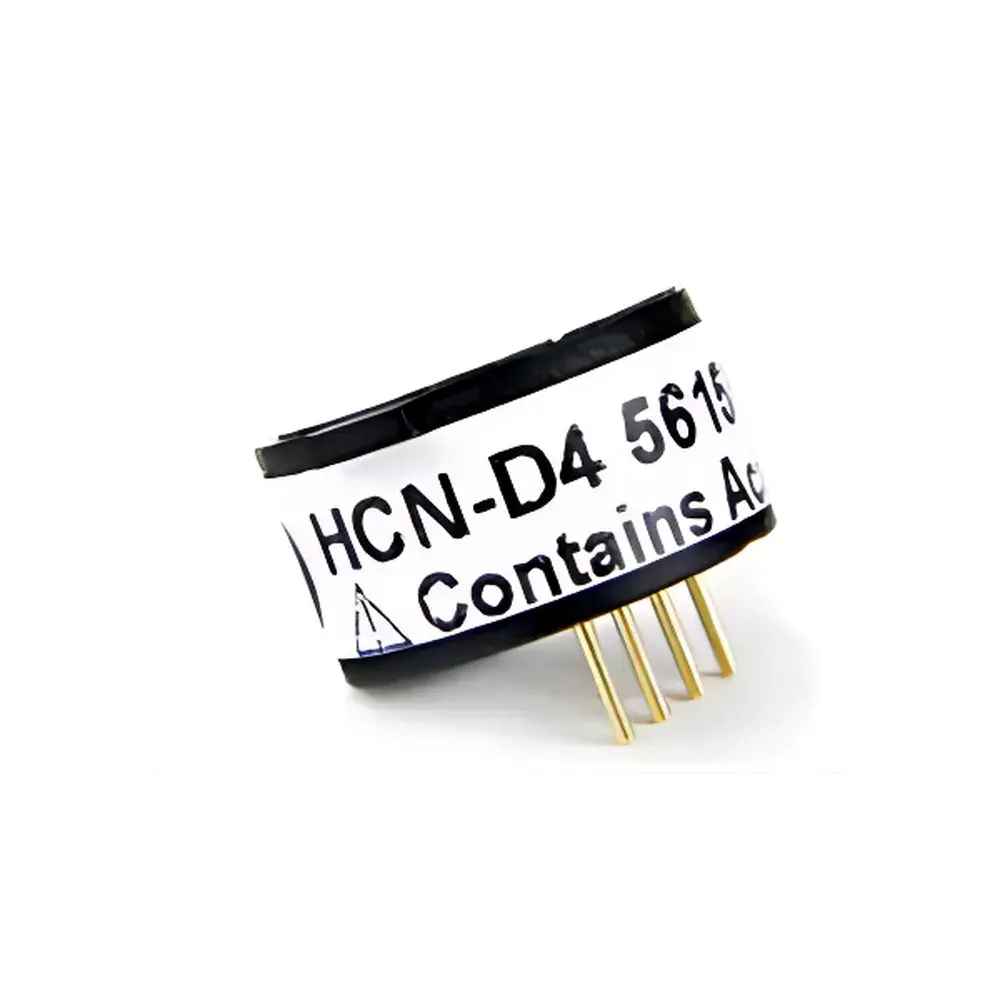
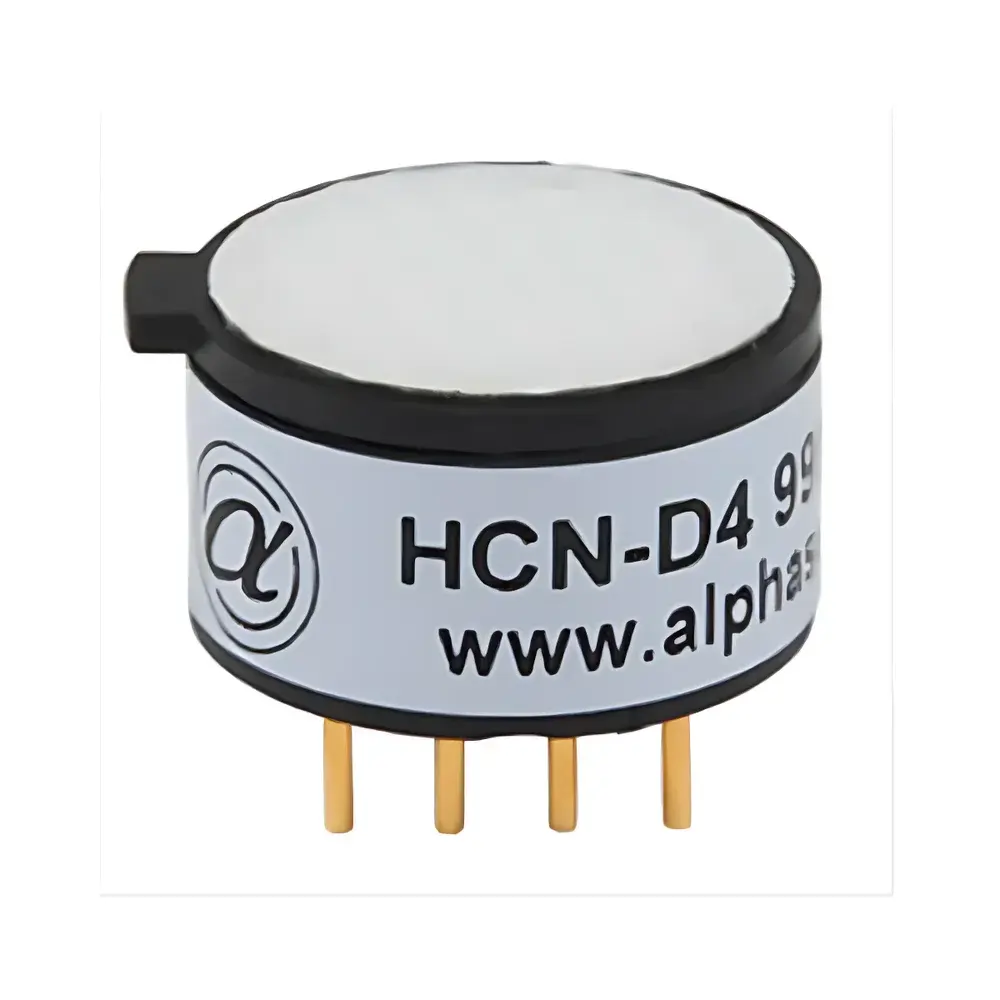
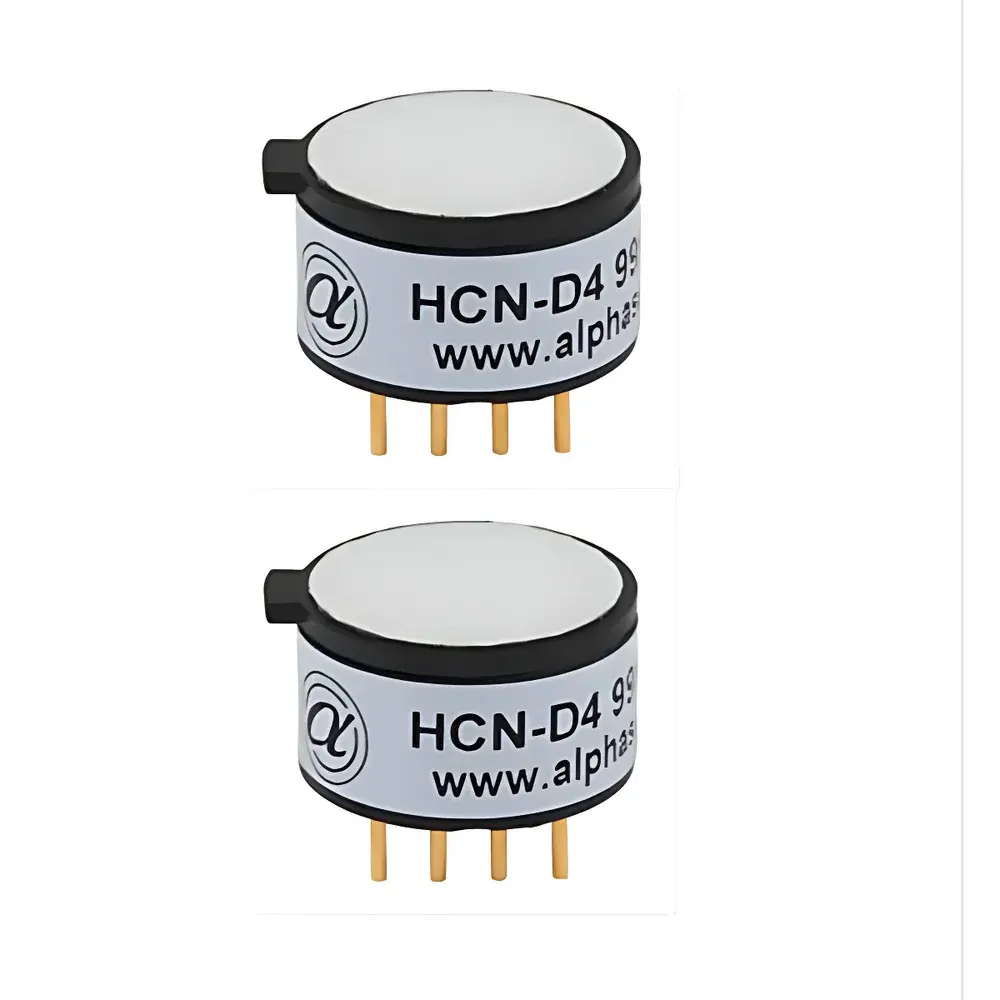
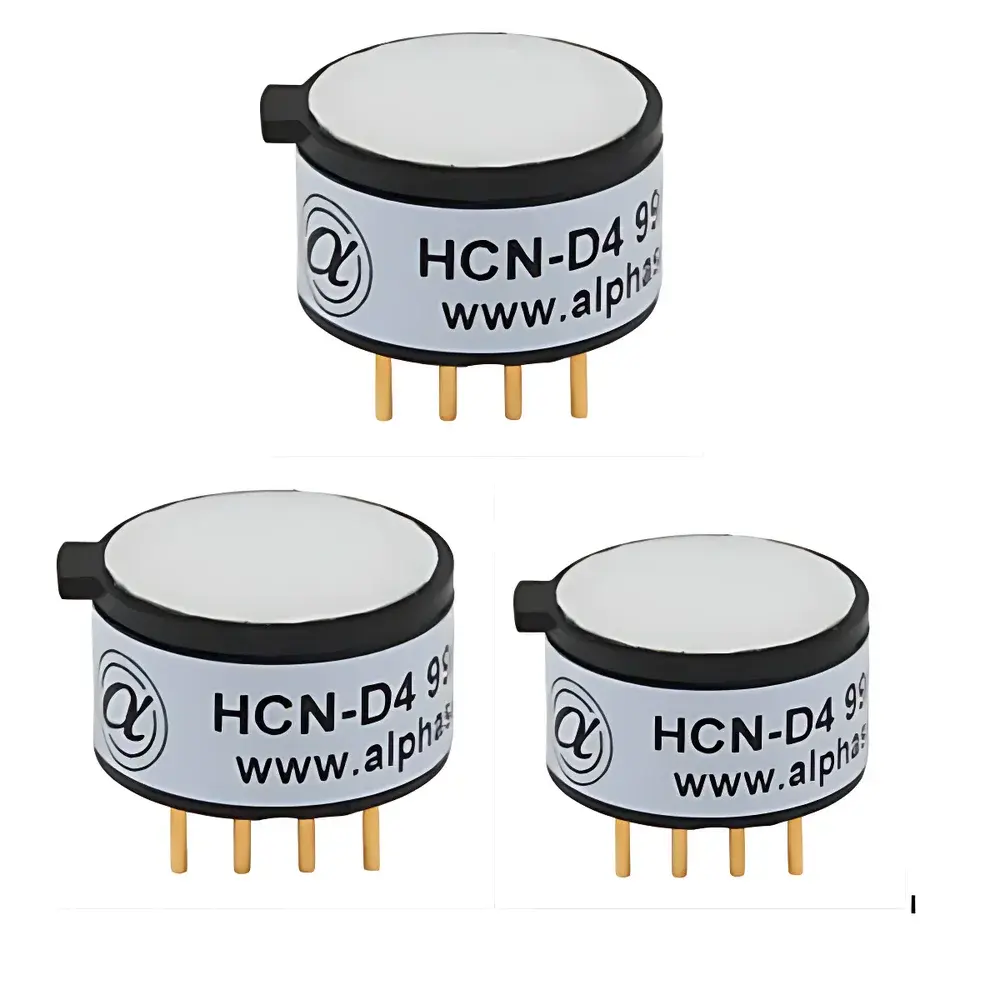
Alphasense HCN-D4 Electrochemical Hydrogen Cyanide (HCN) Gas Sensor
| Brand | Alphasense (UK) |
|---|---|
| Origin | United Kingdom |
| Model | HCN-D4 |
| Measurement Principle | Amperometric Electrochemistry |
| Range | 0–50 ppm |
| Sensitivity | 30–50 nA/ppm |
| Response Time (t₉₀) | <50 s |
| Overload Capacity | 250 ppm |
| Resolution | <0.3 ppm |
| Operating Temperature | –20 to +50 °C |
| Operating Humidity | 15–90 % RH (non-condensing) |
| Load Resistance | 10–47 Ω |
| Expected Operational Lifetime | 12 months |
| Storage Life (unmounted, sealed) | 6 months |
| Dimensions | Ø14.5 × 8.3 mm |
Overview
The Alphasense HCN-D4 is a precision-engineered electrochemical gas sensor designed for the selective and stable detection of hydrogen cyanide (HCN) in ambient air. Based on three-electrode amperometric transduction, the sensor operates via diffusion-controlled oxidation of HCN at the working electrode, generating a current proportional to gas concentration. Its robust cell architecture—featuring a proprietary acid electrolyte, PTFE hydrophobic membrane, and integrated temperature-compensated reference electrode—ensures high selectivity against common interferents including CO, NO₂, SO₂, and H₂S. The HCN-D4 is calibrated and tested per IEC 60079-29-1 and EN 45544-1 standards for use in fixed and portable gas detection systems deployed in industrial hygiene, chemical manufacturing, wastewater treatment, and emergency response environments.
Key Features
- High-sensitivity amperometric detection with linear output across the full 0–50 ppm measurement range
- Fast t₉₀ response time of under 50 seconds, enabling real-time exposure monitoring in dynamic environments
- Optimized membrane design minimizes cross-sensitivity to humidity and temperature fluctuations
- Integrated thermal compensation circuitry maintains signal stability across –20 °C to +50 °C operating conditions
- Compact cylindrical form factor (Ø14.5 × 8.3 mm) facilitates integration into space-constrained detector housings
- Factory-calibrated with NIST-traceable HCN standard gas; calibration certificate provided with each batch
- Compliant with RoHS 2011/65/EU and REACH Annex XIV restrictions on hazardous substances
Sample Compatibility & Compliance
The HCN-D4 is intended for continuous or intermittent sampling of ambient air in non-explosive or ATEX Zone 2 / IECEx Zone 2 certified enclosures when integrated into compliant host instrumentation. It is not suitable for direct immersion, high-particulate, or corrosive vapor-laden streams without upstream filtration (e.g., sintered stainless steel particulate filter + activated carbon scrubber). The sensor meets the performance requirements of ISO 16000-23 for indoor air quality monitoring and supports compliance with OSHA PEL (5 ppm TWA), NIOSH REL (4.7 ppm STEL), and EU Directive 2017/164 (indicative occupational exposure limit of 4.7 ppm). For regulated applications requiring audit-ready documentation, the sensor’s traceable calibration data and batch-specific shelf-life validation support GLP-aligned instrument qualification protocols.
Software & Data Management
While the HCN-D4 is an analog-output (current loop) sensor requiring external signal conditioning, it is fully compatible with Alphasense’s ASC-2 evaluation board and third-party gas detection platforms supporting 4–20 mA or 0–5 V analog inputs. When paired with compliant host firmware (e.g., Modbus RTU or CANopen-enabled controllers), raw sensor output can be logged with timestamped metadata, enabling retrospective trend analysis and exposure dose calculation (ppm·min). For regulatory reporting, the sensor’s documented linearity (±3% FS), zero drift (<0.2 ppm/month), and span stability (<5% over 6 months) satisfy data integrity requirements under ISO/IEC 17025 and FDA 21 CFR Part 11 when implemented within validated system architectures.
Applications
- Fixed-point HCN monitoring in fumigation chambers and pesticide application facilities
- Portable personal exposure monitors used by hazmat teams during chemical incident response
- Continuous emission monitoring (CEM) at electroplating and metal finishing plants
- Process safety interlocks in acrylonitrile and adiponitrile production units
- Ambient air quality networks near landfills and combustion facilities where cyanide compounds may volatilize
- Research-grade toxicology exposure chambers requiring trace-level HCN quantification
FAQ
What is the recommended load resistance for optimal signal linearity?
A load resistance between 10 Ω and 47 Ω is specified to maintain voltage compliance and minimize current sink error; 33 Ω is commonly used in reference designs.
Can the HCN-D4 be operated outside its stated temperature range?
Operation below –20 °C or above +50 °C is not recommended, as electrolyte viscosity changes and membrane permeability shifts degrade response time and sensitivity reproducibility.
Does the sensor require periodic zero/span calibration in field use?
Yes—routine verification against certified HCN standard gas (e.g., 10 ppm in nitrogen) every 3–6 months is required for occupational health compliance; frequency increases under high-humidity or high-pollutant conditions.
Is the HCN-D4 compatible with PID or MOS-based detector platforms?
No—the HCN-D4 is exclusively an electrochemical transducer and requires dedicated potentiostatic circuitry; it cannot be substituted for photoionization or metal oxide semiconductor sensors without hardware redesign.
How should unused sensors be stored to preserve shelf life?
Unopened sensors must be stored at 5–25 °C in original sealed foil pouches; once opened, they should be installed within 48 hours or resealed with desiccant to prevent electrolyte drying.