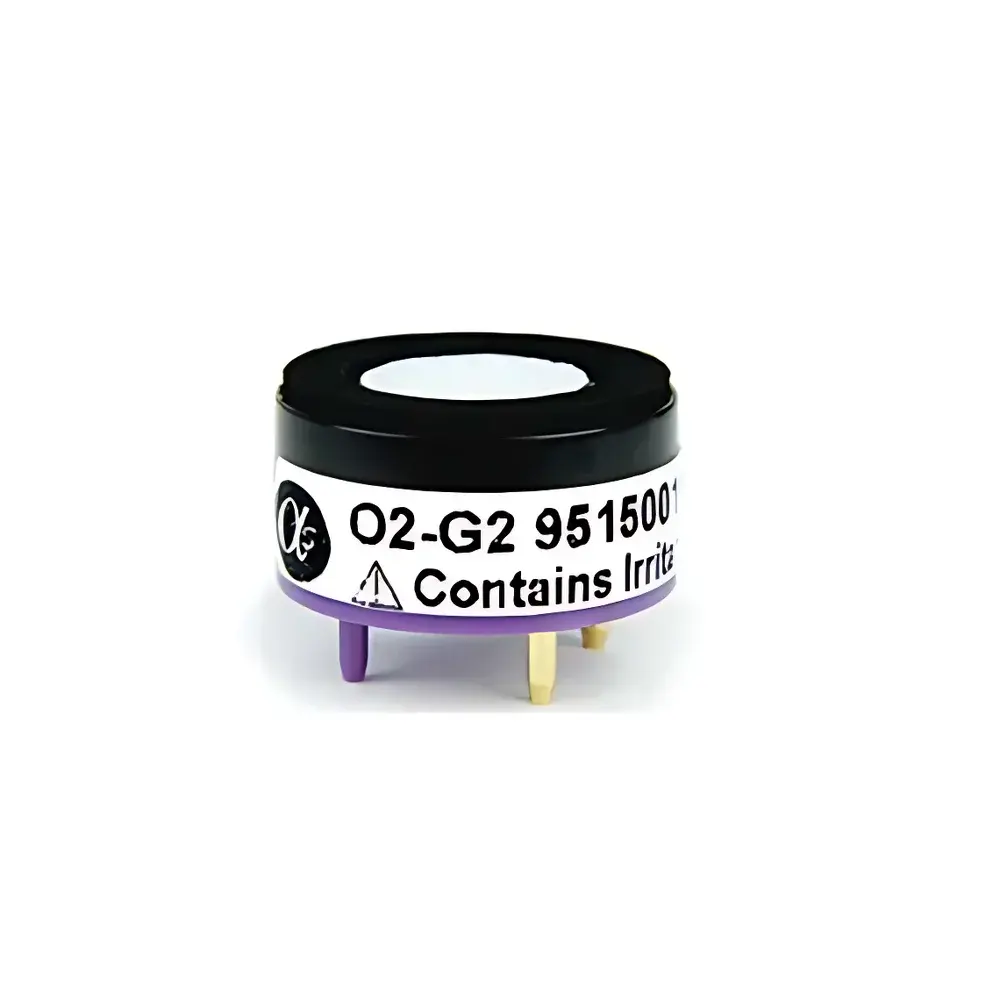
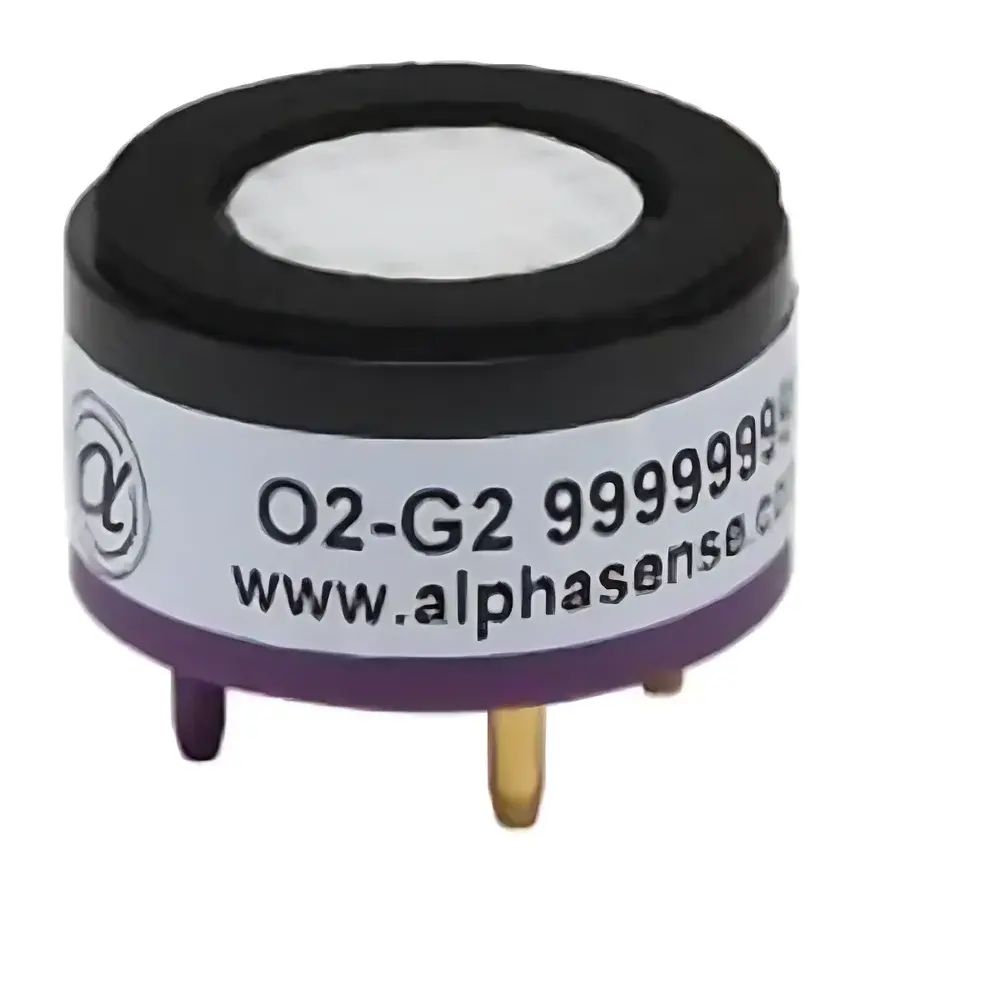
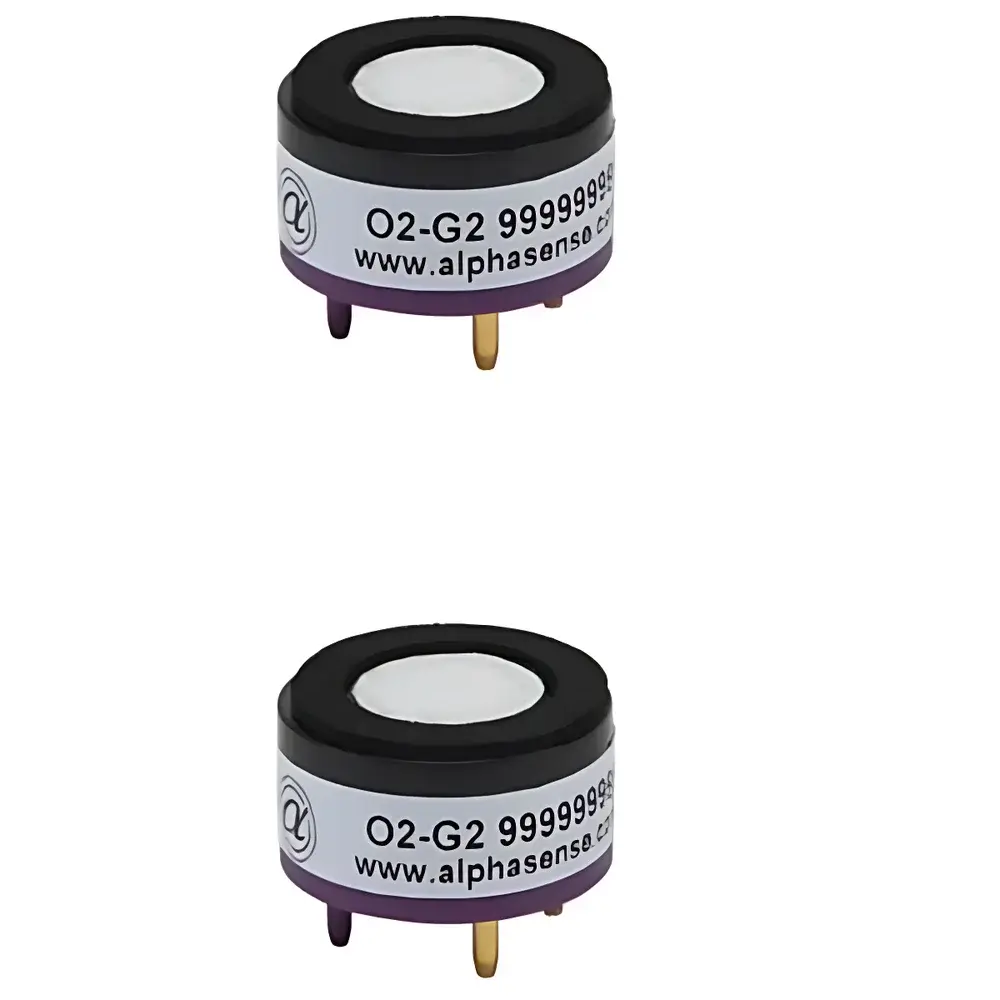
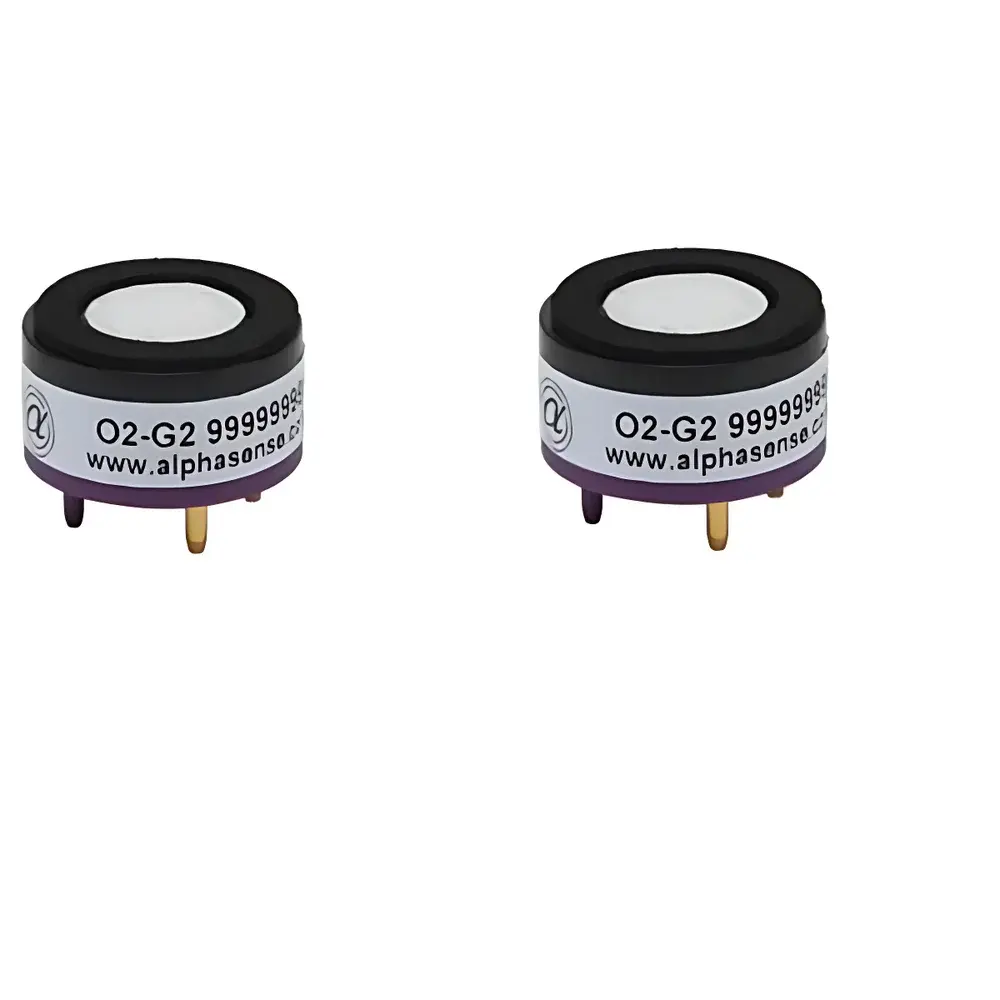
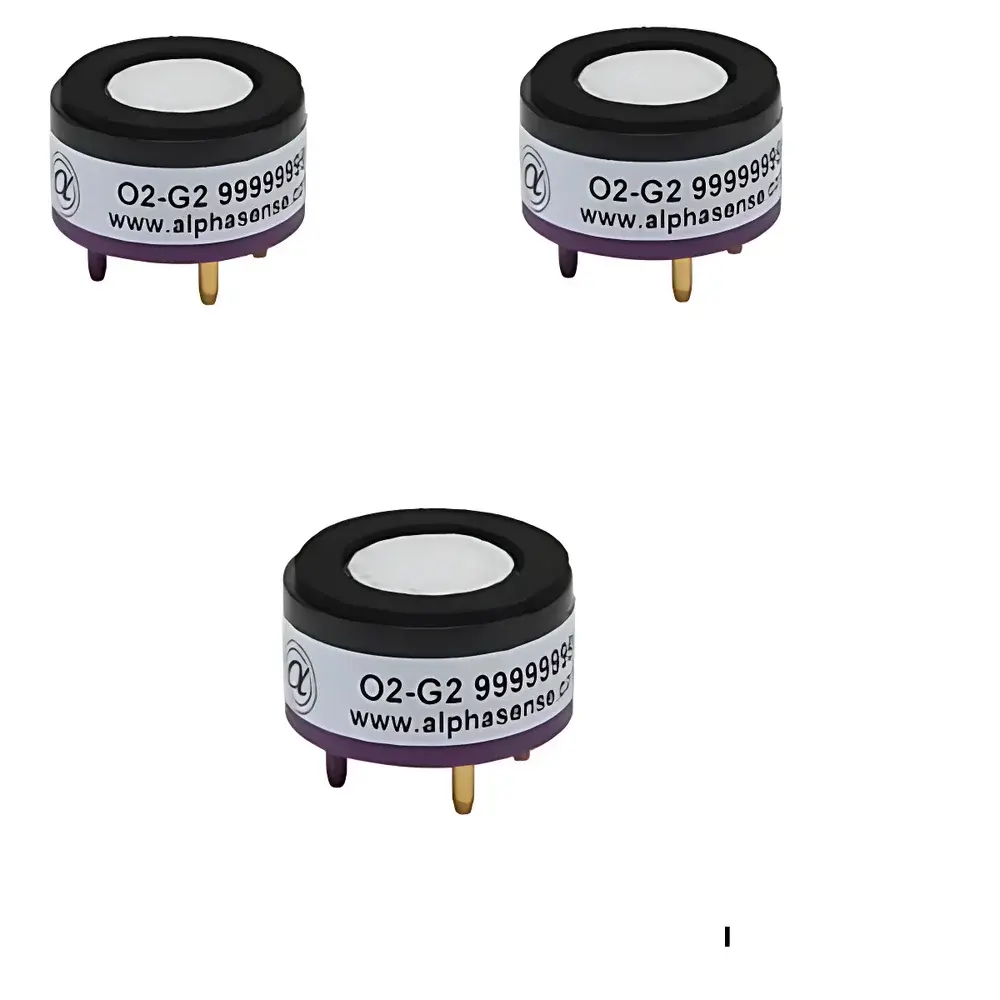
Alphasense O2-G2 Miniature Electrochemical Oxygen Sensor
| Brand | Alphasense (UK) |
|---|---|
| Origin | United Kingdom |
| Model | O2-G2 |
| Operating Life | >2 years |
| Dimensions | Ø20.3 × 10.2 mm |
| Output Current | 30–42 nA @ 22°C, 20.9% O₂ |
| Response Time (t₉₀) | <18 s |
| Weight | <7 g |
| Operating Temperature Range | −30 to +55 °C |
| Pressure Range | 80–120 kPa |
| Humidity Range | 5–95 %RH (non-condensing) |
| Storage Stability | 6 months |
| Load Resistance | 47–100 Ω |
| Sensor Type | Galvanic Electrochemical |
| Compliance | CE-marked, RoHS-compliant, ATEX/IECEx-ready (with appropriate housing) |
Overview
The Alphasense O2-G2 is a miniature galvanic electrochemical oxygen sensor engineered for reliable, maintenance-free detection of ambient or process oxygen concentrations in portable, fixed, and OEM gas monitoring systems. Unlike polarographic or optical sensors, the O2-G2 operates on a self-powered galvanic principle—requiring no external bias voltage—where molecular oxygen diffuses through a hydrophobic membrane and undergoes reduction at the cathode, generating a linear current output proportional to O₂ partial pressure. This architecture delivers inherent stability, low power consumption, and high long-term reproducibility without electrolyte replenishment. Designed specifically for integration into space-constrained instrumentation—including personal safety monitors, medical ventilator feedback loops, inerting control systems, and laboratory atmosphere analyzers—the O2-G2 maintains metrological integrity across wide environmental gradients, making it suitable for both industrial and regulated healthcare applications.
Key Features
- Miniaturized cylindrical form factor (Ø20.3 × 10.2 mm) optimized for PCB-mounting and compact enclosure integration
- Galvanic cell design with proprietary Teflon®-based diffusion barrier ensures consistent response and eliminates zero drift under stable conditions
- Typical output signal of 30–42 nA in air (20.9% O₂ at 22°C), enabling direct interfacing with low-noise transimpedance amplifiers
- Fast t₉₀ response time of less than 18 seconds—critical for real-time alarm triggering in confined-space entry and fire suppression verification
- Extended operational life exceeding 24 months under continuous exposure to ambient air, validated per Alphasense accelerated aging protocols
- Robust environmental tolerance: functional across −30 to +55°C and 80–120 kPa absolute pressure, with non-condensing humidity range of 5–95% RH
- Low mass (<7 g) and passive operation reduce thermal loading and power budget requirements in battery-powered devices
Sample Compatibility & Compliance
The O2-G2 is calibrated for oxygen measurement in clean, non-corrosive gas matrices—including ambient air, nitrogen-based inert atmospheres, and medical-grade breathing gases. It is not recommended for use in reducing or acidic environments (e.g., high H₂S, SO₂, or Cl₂ concentrations) without protective filtration. The sensor complies with EU Directive 2014/30/EU (EMC), 2011/65/EU (RoHS), and carries CE marking for incorporation into Class I equipment. When integrated into certified host instruments, it supports compliance with IEC 61000-6-2/6-3 (immunity/emission), EN 45544-1 (toxic and oxygen gas detectors), and ISO 8573-7 (compressed air purity testing). For applications subject to FDA 21 CFR Part 11 or ISO 13485, full traceability documentation—including individual calibration certificates and manufacturing lot records—is available upon request.
Software & Data Management
As a transducer-level component, the O2-G2 does not include embedded firmware or digital communication interfaces. Its analog current output is intended for conditioning via external circuitry—typically a precision transimpedance amplifier followed by ADC conversion in the host system’s microcontroller. Alphasense provides comprehensive application notes covering signal conditioning, temperature compensation algorithms (using optional integrated NTC thermistor variants), and linearization coefficients for extended-range O₂ quantification (0–25% and 0–100%). Host software must implement baseline correction, span validation routines, and periodic bump-test logging to satisfy GLP/GMP data integrity requirements. Raw output data is compatible with standard SCADA, LabVIEW, and MQTT-based IIoT architectures when paired with appropriate signal acquisition modules.
Applications
- Portable multi-gas detectors for mining, petrochemical, and wastewater treatment personnel safety
- Oxygen deficiency/enrichment monitoring in gloveboxes, fumigation chambers, and controlled-atmosphere storage
- Feedback control in medical respiratory devices, anesthesia machines, and hyperbaric oxygen therapy systems
- Process verification in nitrogen purging, laser cutting assist gas monitoring, and food packaging headspace analysis
- Environmental chamber validation and HVAC commissioning where O₂ deviation indicates leakage or ventilation failure
- OEM integration into handheld air quality analyzers and academic research platforms requiring sub-20 mm footprint
FAQ
What is the recommended load resistance for optimal linearity?
A load resistance between 47 Ω and 100 Ω is specified to maintain output linearity within ±2% across the full operating range; values outside this range may introduce nonlinearity or excessive voltage drop.
Does the O2-G2 require external power or polarization voltage?
No—the O2-G2 is a true galvanic sensor and generates its own current signal without external bias; only signal conditioning electronics require power.
Can the sensor be used at altitudes above 2,500 m?
Yes, provided total barometric pressure remains within the 80–120 kPa specification; users must apply pressure compensation in firmware if operating below 80 kPa.
Is cross-sensitivity to CO₂ or water vapor compensated internally?
The O2-G2 exhibits negligible interference from CO₂, CH₄, or H₂O vapor under normal conditions; however, prolonged exposure to condensing humidity requires external hydrophobic filter protection.
How is calibration performed, and what reference standards are traceable?
Two-point calibration (zero in N₂ and span in certified air or O₂/N₂ mixtures) is standard; Alphasense certifies traceability to NPL (UK) and NIST (USA) primary standards for all factory-calibrated units.