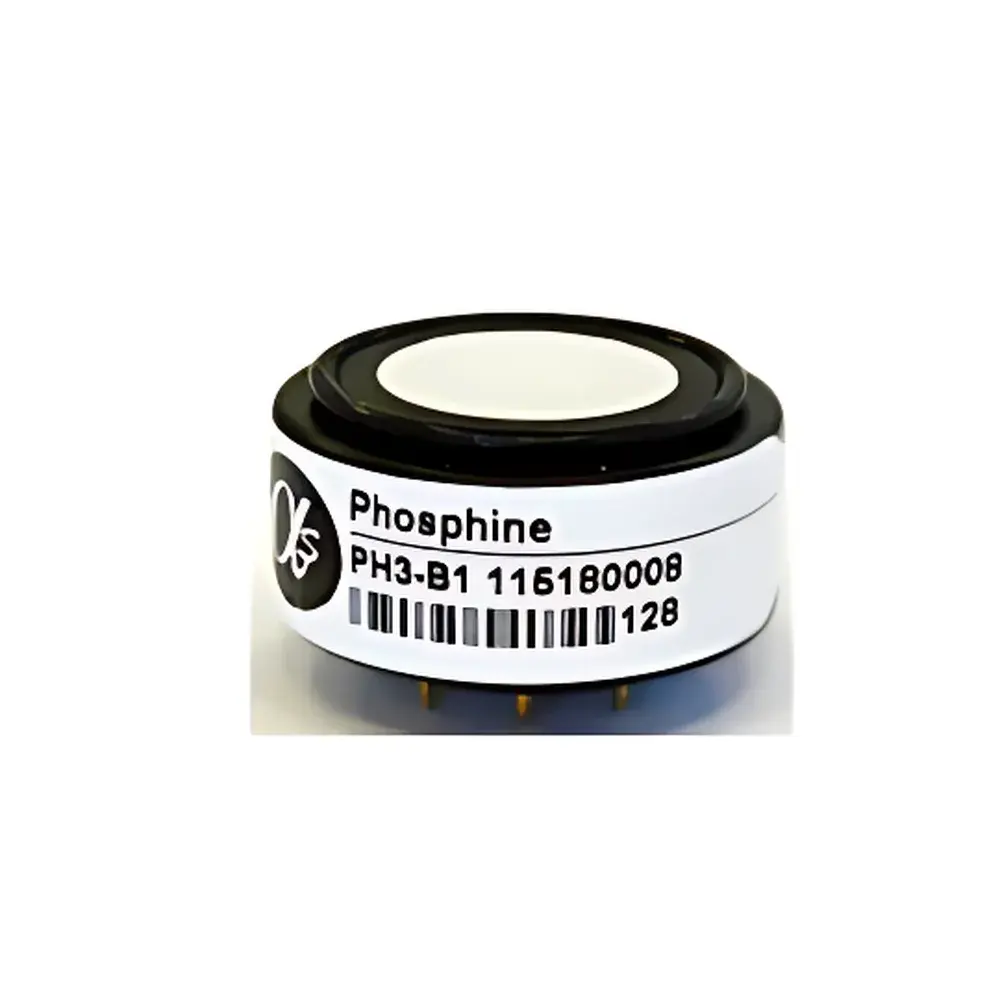
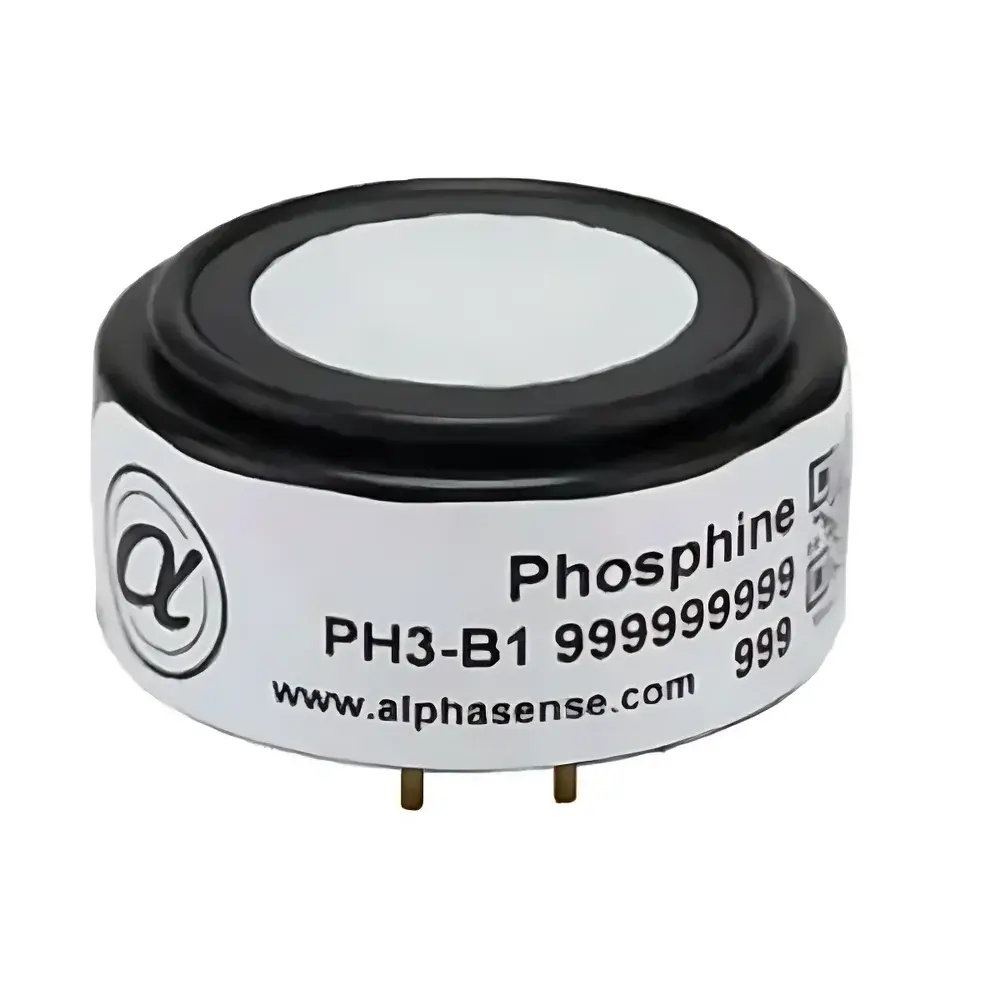
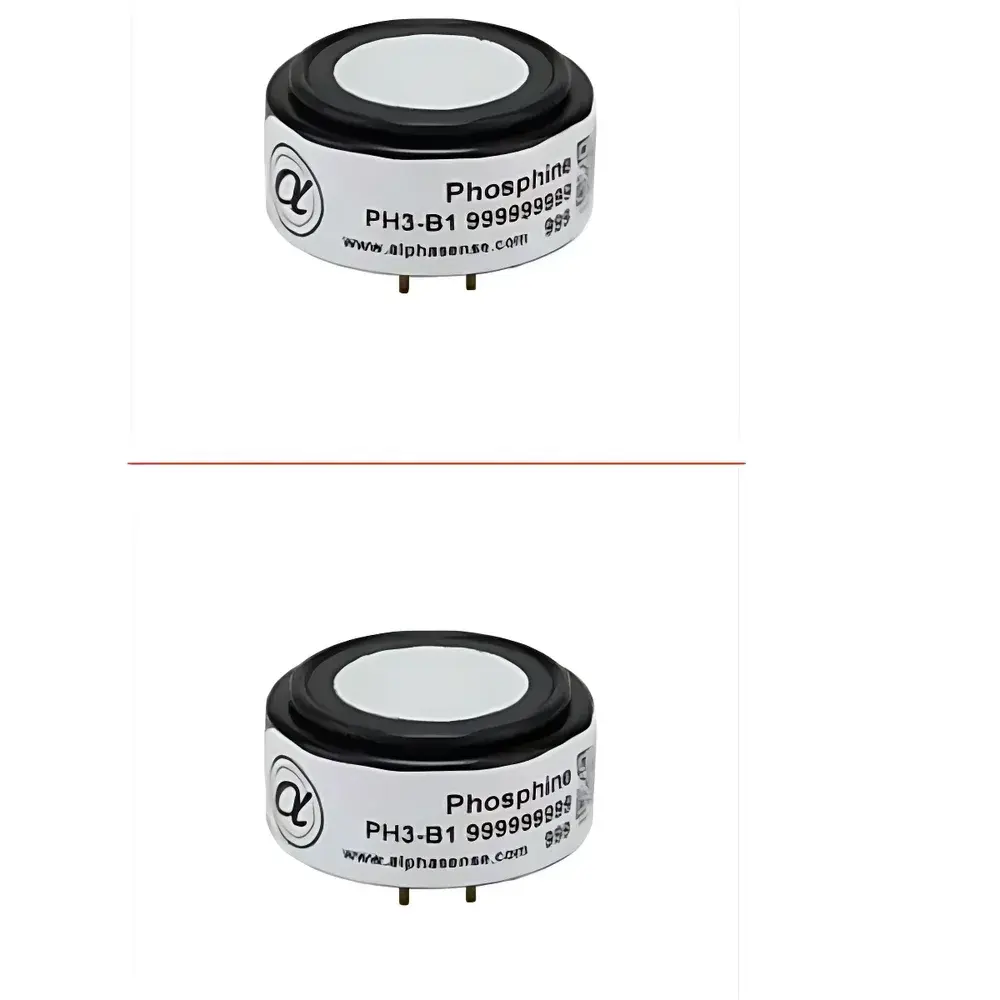
Alphasense PH3-B1 Electrochemical Phosphine (PH₃) Gas Sensor
| Brand | Alphasense |
|---|---|
| Origin | United Kingdom |
| Model | PH3-B1 |
| Measurement Principle | Amperometric Electrochemistry |
| Detection Range | 0–10 ppm |
| Sensitivity | 600–1,000 nA/ppm |
| Response Time (t₉₀) | <15 s |
| Linear Range | 0–4 ppm |
| Linearity Error | ±1.0 to ±1.8 ppm across full scale |
| Overload Capacity | 150 ppm |
| Resolution | 0.05 ppm |
| Dimensions | Ø32.3 × 16.5 mm |
| Operating Temperature | −30 to +50 °C |
| Operating Humidity | 15–90 %RH (non-condensing) |
| Expected Service Life | 24 months |
| Storage Shelf Life | 6 months |
| Electrolyte Type | Aqueous acid-based |
| Working Electrode | Lead (Pb) or Tin (Sn) alloy |
| Counter Electrode | Stainless steel |
| Reference Electrode | Ag/AgCl |
Overview
The Alphasense PH3-B1 is a high-performance, diffusion-type electrochemical gas sensor engineered for the selective and stable detection of phosphine (PH₃) in ambient air. Designed using amperometric three-electrode architecture, it operates on the principle of controlled potential electrolysis: PH₃ molecules diffuse through a hydrophobic PTFE membrane into an aqueous acidic electrolyte, where they undergo oxidation at the working electrode (typically Pb or Sn alloy), generating a current proportional to gas concentration. This transduction mechanism ensures reliable low-concentration measurement with minimal cross-sensitivity to common interferents such as CO, H₂S, NO₂, and SO₂—critical for applications demanding regulatory-grade fidelity in fumigation monitoring, grain storage safety, semiconductor fabrication environments, and confined-space entry protocols.
Key Features
- Stable amperometric output with factory-calibrated sensitivity (600–1,000 nA/ppm) traceable to NIST-certified reference standards
- Fast t₉₀ response time of under 15 seconds enables real-time exposure assessment in dynamic environments
- Linear measurement range from 0 to 4 ppm supports accurate quantification within occupational exposure limits (e.g., OSHA PEL = 0.3 ppm TWA; ACGIH TLV = 0.4 ppm TWA)
- Robust mechanical design: stainless-steel casing with integrated PTFE diffusion barrier ensures consistent mass transport and long-term zero stability
- Wide operational envelope: functional across −30 °C to +50 °C and 15–90 %RH (non-condensing), validated per IEC 60079-29-1 for use in hazardous area instrumentation
- Low-power operation compatible with battery-powered portable detectors and fixed-gas monitoring systems
Sample Compatibility & Compliance
The PH3-B1 is optimized for gaseous-phase phosphine detection in clean, non-corrosive air matrices. It is not intended for direct immersion, high-particulate, or highly acidic/volatile organic compound (VOC)-rich environments without appropriate pre-conditioning (e.g., particulate filters, activated carbon scrubbers). The sensor complies with key international performance benchmarks including EN 45544-1:2019 (electrochemical sensors for toxic gases), ISO 16000-25:2022 (indoor air—determination of phosphine), and meets functional safety requirements for SIL-2 capable subsystems when integrated into certified control architectures. Its construction adheres to RoHS Directive 2011/65/EU and REACH Annex XVII restrictions on lead content, with full material declarations available upon request.
Software & Data Management
While the PH3-B1 itself is an analog current-output device (typically 0–200 nA for 0–10 ppm), its integration into modern gas detection platforms supports digital signal conditioning via industry-standard interfaces (e.g., 4–20 mA loop, UART/I²C with onboard ADC). When paired with Alphasense’s recommended evaluation boards (e.g., B4C or A4 series), users gain access to temperature-compensated linearization algorithms, zero/span drift diagnostics, and lifetime estimation models embedded in firmware. Full calibration logs, sensor health metrics, and audit-ready calibration history are exportable in CSV or XML formats—enabling compliance with GLP, GMP, and FDA 21 CFR Part 11 requirements when deployed in regulated facilities.
Applications
- Grain silo and post-harvest fumigation monitoring per FAO/WHO guidelines and national phytosanitary regulations
- Real-time leak detection in phosphine-based pest control systems used in food processing plants
- Occupational health surveillance in semiconductor wafer fabrication cleanrooms (PH₃ used in epitaxial doping)
- Confined space entry verification prior to maintenance in wastewater treatment infrastructure
- OEM integration into portable multi-gas detectors (e.g., 4-gas monitors with LEL, O₂, CO, and PH₃ channels)
- Environmental compliance monitoring near landfill gas collection points where phosphine may form under anaerobic conditions
FAQ
What is the recommended calibration frequency for the PH3-B1 sensor?
Calibration should be performed before each day’s use in critical safety applications, or at minimum every 30 days for general industrial monitoring—using certified 1.0 ppm PH₃ span gas and zero air per ISO 12039:2021.
Can the PH3-B1 be exposed to high humidity for extended periods?
Continuous operation above 90 %RH is not recommended due to risk of electrolyte dilution and membrane saturation; condensation must be prevented using hydrophobic particulate filters and thermal management.
Does the sensor require a warm-up period before stable readings?
Yes—a minimum 120-second stabilization period is required after power-on to achieve thermal equilibrium and baseline settling, especially below 10 °C.
Is the PH3-B1 suitable for use in explosive atmospheres?
The bare sensor element is intrinsically safe when operated within specified voltage/current limits; final certification (e.g., ATEX, IECEx) depends on the host instrument’s enclosure and circuit design.
How does temperature affect measurement accuracy?
Output sensitivity varies by approximately −0.3 %/°C; integrated temperature compensation (via onboard thermistor or external RTD) is essential for sub-ppm accuracy across the full operating range.