
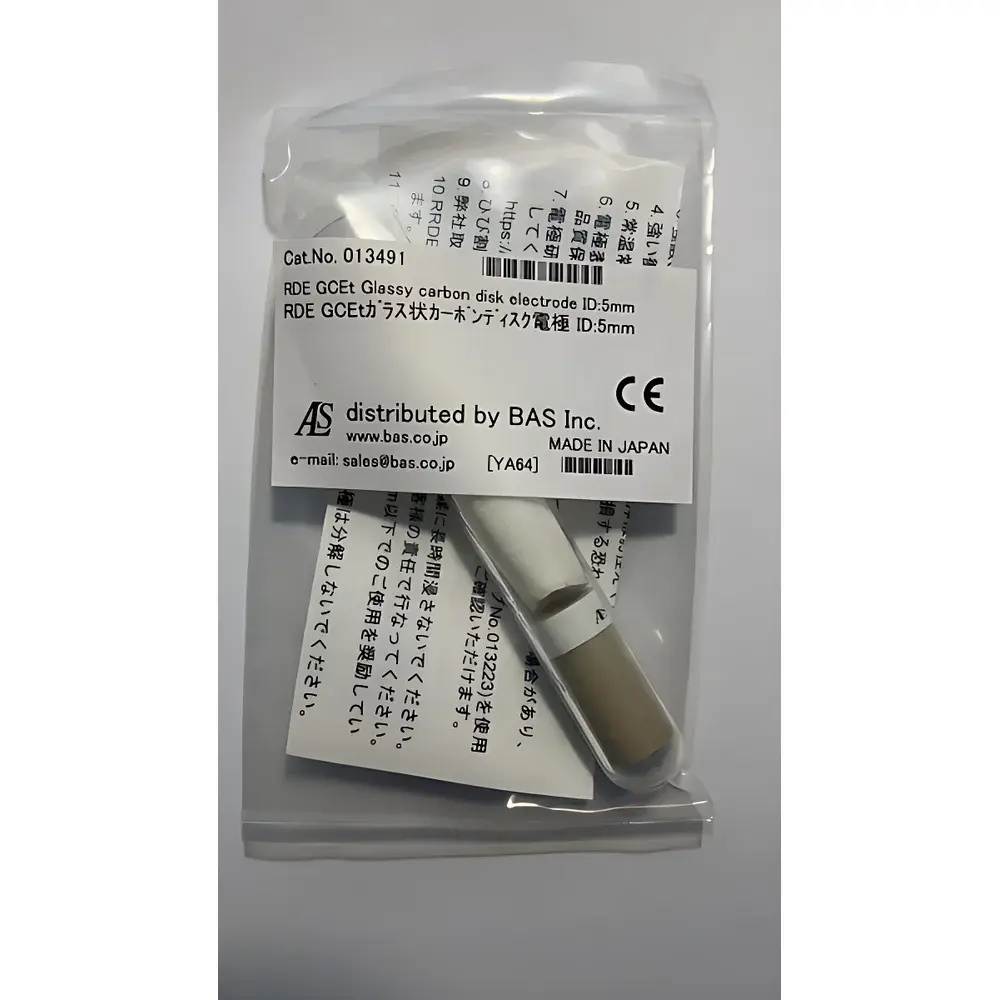
ALS GC5mm Glassy Carbon Rotating Disk Electrode (RDE)
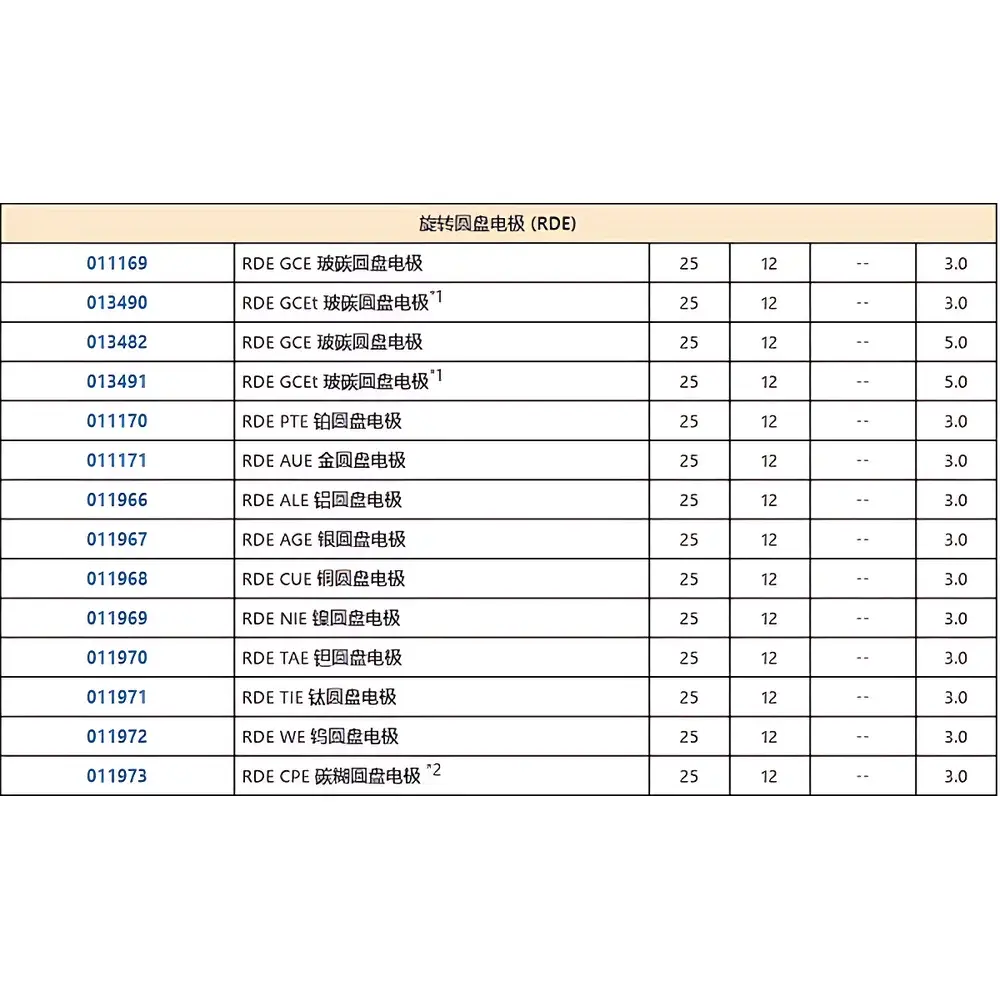
| Brand | ALS |
|---|---|
| Origin | Japan |
| Model No. | 013491 |
| Disk Material | Glassy Carbon |
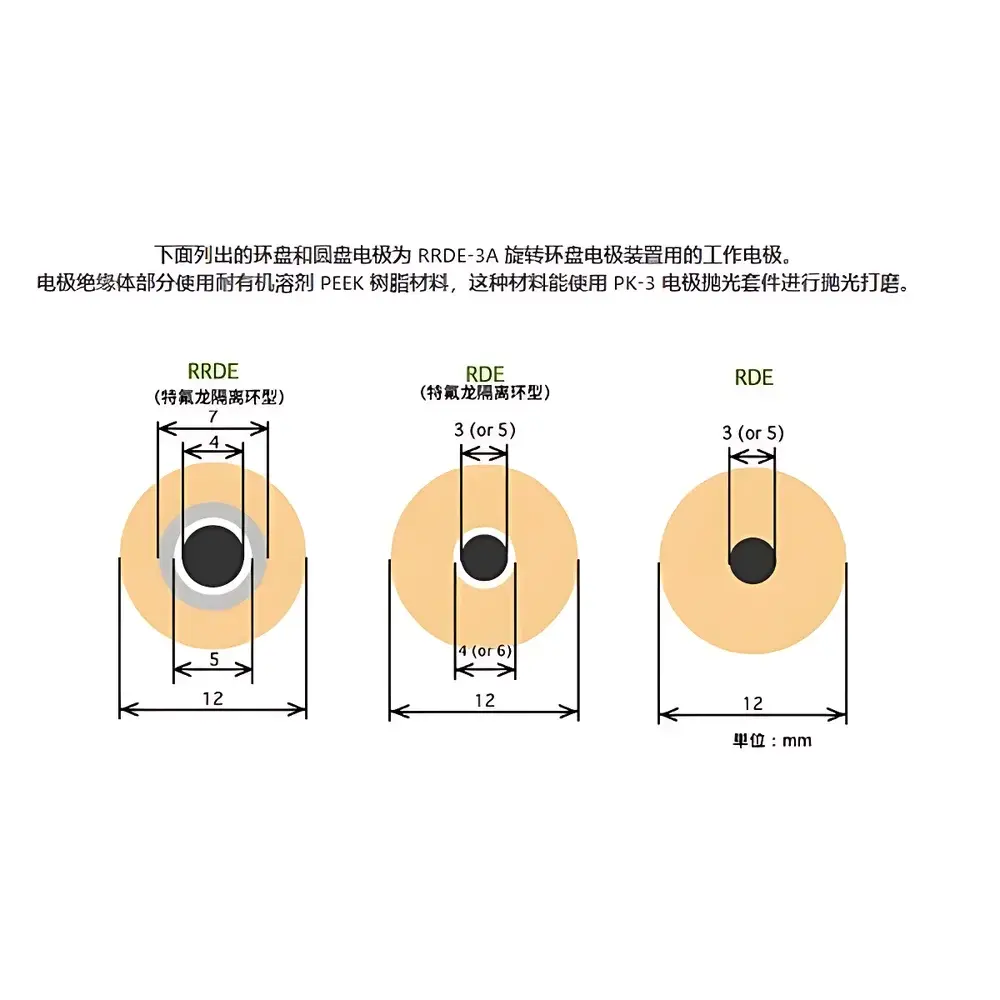
| Disk Diameter | 5 mm |
| Insulator Diameter | 12 mm |
| Total Length | 25 mm |
| Insulation | PTFE (Teflon) Sleeve |
Overview
The ALS GC5mm Glassy Carbon Rotating Disk Electrode (RDE) is a precision-engineered electrochemical working electrode designed for controlled hydrodynamic voltammetry and kinetic studies in fundamental and applied electrochemistry. Based on the classical Levich theory, this RDE enables quantitative mass-transport-controlled current measurements by imposing well-defined laminar flow conditions at the electrode surface through precise mechanical rotation. The electrode employs a high-purity glassy carbon (GC) disk—characterized by low background current, wide electrochemical potential window (–1.0 V to +1.2 V vs. Ag/AgCl in aqueous media), excellent chemical inertness, and reproducible surface renewability—mounted concentrically within a chemically resistant PTFE (polytetrafluoroethylene) insulator body. Its standardized geometry ensures compatibility with commercial rotator assemblies (e.g., Pine Research, BASi, or ALS AFMSRX series) and facilitates direct correlation of experimental data with theoretical diffusion-limited current equations.
Key Features
- High-purity glassy carbon active disk (5 mm diameter) with polished, defect-free surface for consistent electron transfer kinetics and minimal capacitive interference
- Robust PTFE (Teflon) isolation sleeve providing full electrical insulation, thermal stability up to 260 °C, and resistance to strong acids, bases, and organic solvents
- Precision-machined stainless steel or titanium shaft (25 mm total length) ensuring mechanical rigidity and minimal runout during high-speed rotation (up to 10,000 rpm)
- Optimized insulator geometry (12 mm outer diameter) enabling secure mounting in standard RDE holders while minimizing edge effects and radial current distortion
- Traceable manufacturing under ISO 9001-certified processes; each unit undergoes continuity testing and visual inspection prior to shipment
Sample Compatibility & Compliance
This RDE is compatible with aqueous, non-aqueous, and mixed-solvent electrolyte systems—including KCl, H2SO4, LiPF6/EC:DMC, and acetonitrile-based supporting electrolytes. It supports standard three-electrode configurations with common reference electrodes (e.g., Ag/AgCl, SCE, or non-aqueous Fc/Fc+) and counter electrodes (Pt wire or mesh). The device complies with ASTM D7212–18 (standard practice for rotating disk electrode voltammetry) and aligns with ISO/IEC 17025 requirements for measurement traceability when used in accredited electrochemical testing laboratories. Its inert surface and absence of metallic contaminants make it suitable for GLP-compliant corrosion studies, catalyst evaluation, and battery electrode reaction mechanism analysis per USP <621> and ICH Q5C guidelines.
Software & Data Management
While the electrode itself is hardware-only, it integrates seamlessly with industry-standard potentiostats (e.g., BioLogic SP-300, Metrohm Autolab PGSTAT302N, or CH Instruments 760E) and associated electrochemical software platforms (EC-Lab®, NOVA, GPES). These tools support automated rotation speed ramping, Levich and Koutecký–Levich analysis, Tafel slope extraction, and diffusion coefficient calculation. All acquired chronoamperometric and voltammetric datasets retain full metadata (rotation speed, temperature, electrolyte composition), enabling audit-ready reporting compliant with FDA 21 CFR Part 11 when configured with electronic signatures and instrument calibration logs.
Applications
- Kinetic analysis of oxygen reduction reaction (ORR) and hydrogen evolution reaction (HER) for fuel cell and electrolyzer catalyst screening
- Determination of diffusion coefficients and heterogeneous rate constants in redox-active species (e.g., Fe(CN)63−/4−, Ru(NH3)63+/2+)
- Electrocatalytic activity assessment of transition metal oxides, single-atom catalysts, and carbon-supported nanomaterials
- Corrosion rate quantification via polarization resistance and mass-transport-limited current modeling
- Method development and validation for pharmaceutical impurity detection using redox cycling amplification
FAQ
What rotation speeds are supported with this RDE?
The GC5mm RDE is mechanically rated for stable operation from 100 rpm to 10,000 rpm when mounted on a calibrated rotator with ≤ 0.02 mm runout tolerance.
Can the glassy carbon disk be repolished in-house?
Yes—standard alumina slurry (0.3 µm followed by 0.05 µm) on microcloth pads restores electrochemically active surface area; avoid diamond paste unless validated for GC-specific abrasion rates.
Is this electrode compatible with acidic perchloric acid electrolytes?
Yes—the PTFE sleeve and glassy carbon disk exhibit full compatibility with ≤ 1 M HClO4; however, avoid prolonged exposure above 60 °C to prevent gradual PTFE creep.
Does ALS provide calibration certificates for this model?
No—this is a passive electrode component; users perform electrochemical validation using reversible redox couples (e.g., 5 mM K3Fe(CN)6 in 1 M KCl) and compare measured Levich currents against theoretical values.
How should the electrode be stored between experiments?
Rinse thoroughly with ultrapure water and ethanol, then store vertically in a desiccator with silica gel; never immerse in solvent long-term or allow PTFE sleeve to contact sharp objects.




