
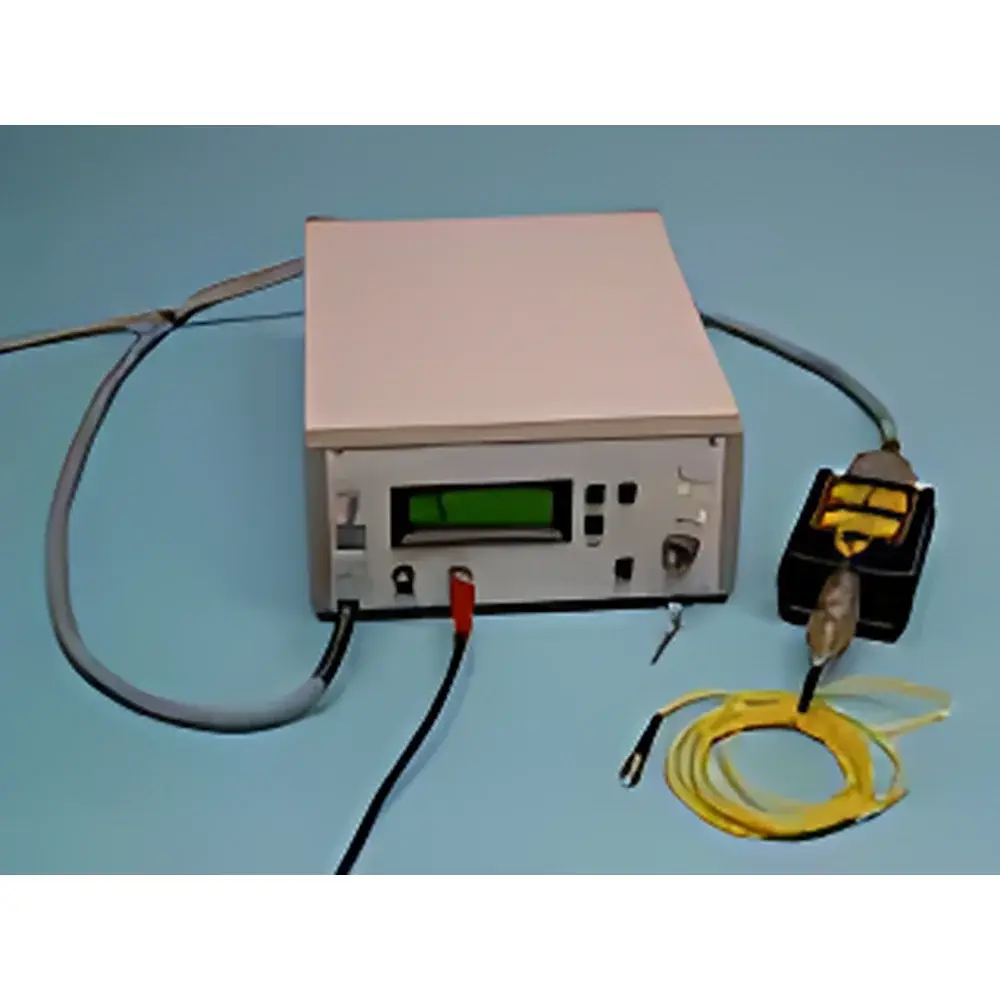
ALS PiLas Series Picosecond Semiconductor Laser System
| Brand | A.L.S. GmbH / Advanced Laser Diode Systems |
|---|---|
| Origin | Germany |
| Model | PiLas Series |
| Wavelength Range | 375–2000 nm |
| Pulse Width | 20 ps – 1 ns (variable) |
| Peak Power | 20–1000 mW |
| Repetition Rate | Single-shot to 120 MHz |
| Output | Free-space or fiber-coupled (SMF/MMF) |
| Polarization Extinction Ratio | >23 dB |
| Timing Jitter | <3 ps RMS |
| Warm-up Time | <5 min |
| Laser Head Dimensions | 95 × 31 × 147 mm³ |
| Control Unit Dimensions | 235 × 88 × 326 mm³ |
| Options | DFB narrow-linewidth variants, TTL/NIM trigger conversion, thermal wavelength tuning, OEM single-box integration |
Overview
The ALS PiLas Series is a modular, turnkey picosecond semiconductor laser system engineered for high-temporal-resolution photonics applications requiring precise, stable, and wavelength-flexible ultrafast pulses. Based on gain-switched or mode-locked semiconductor laser diode technology, the system delivers transform-limited optical pulses with durations tunable from 20 picoseconds to 1 nanosecond—enabling time-resolved spectroscopy, fluorescence lifetime imaging (FLIM), time-of-flight (ToF) measurements, pump-probe experiments, and quantum optics characterization. Unlike bulk solid-state or fiber-based picosecond sources, the PiLas architecture leverages monolithic semiconductor gain media, offering rapid thermal stabilization (<5 min warm-up), compact form factor, and inherent compatibility with electronic synchronization via low-jitter (<3 ps RMS) trigger outputs. Its design adheres to fundamental principles of carrier dynamics in III–V heterostructures, ensuring reproducible pulse formation across its broad spectral coverage—from deep UV-visible (375 nm) through near-infrared (2000 nm)—with discrete models optimized for specific absorption bands or nonlinear conversion requirements.
Key Features
- Wavelength-selectable platform covering 375–2000 nm, including standard and DFB variants with spectral linewidths down to <0.5 nm (FWHM)
- Digitally adjustable pulse width (20 ps–1 ns) and repetition rate (single-shot to 120 MHz) via front-panel interface or remote command
- Integrated temperature-controlled laser head and precision current driver ensure long-term power stability (<±1.5% over 8 h) and wavelength repeatability
- Flexible output configuration: free-space collimated beam or fiber-coupled delivery (single-mode or multimode, with optional micro-focus collimators)
- Low timing jitter (<3 ps RMS) and sub-nanosecond trigger delay accuracy support synchronization with streak cameras, TCSPC modules, or RF-driven modulators
- OEM-ready architecture with compact laser head (95 × 31 × 147 mm³) and separate control unit (235 × 88 × 326 mm³); optional single-box integration available
- Comprehensive safety compliance: IEC 60825-1:2014 Class 4 laser product certification, interlock-enabled housing, and embedded emission monitoring
Sample Compatibility & Compliance
The PiLas Series is designed for laboratory and industrial environments demanding traceable performance under regulated workflows. All units are manufactured in accordance with ISO 9001-certified processes at A.L.S. GmbH’s facility in Berlin, Germany. The system supports alignment and calibration protocols compliant with ISO/IEC 17025 for metrological traceability of pulse duration (verified via autocorrelation or FROG), average power (NIST-traceable thermopile sensors), and wavelength (calibrated grating spectrometer). For pharmaceutical or clinical research applications, the laser controller logs timestamped operational parameters—including drive current, TEC setpoint, and output power—with audit trail capability suitable for GLP and GMP documentation. While not a medical device per se, the system meets essential requirements of IEC 61000-6-3 (EMC emissions) and IEC 61000-6-2 (immunity), facilitating integration into FDA 21 CFR Part 11-compliant data acquisition ecosystems when paired with validated software.
Software & Data Management
Control and monitoring are executed via ALS LaserControl™ GUI (Windows/Linux), supporting USB 2.0 and Ethernet interfaces. The software provides real-time visualization of pulse train statistics, thermal feedback loops, and interlock status; it also enables scripting (Python/LabVIEW APIs) for automated parameter sweeps in lifetime decay fitting or spectral scanning routines. All measurement metadata—including timestamps, hardware configuration, and environmental sensor readings (head temperature, ambient humidity)—are embedded in HDF5-formatted output files, ensuring FAIR (Findable, Accessible, Interoperable, Reusable) data principles. Optional firmware upgrades introduce enhanced trigger routing logic and multi-channel synchronization modes for multi-laser pump-dump experiments. No cloud connectivity or proprietary dongles are required; local data sovereignty is preserved by default.
Applications
- Time-correlated single-photon counting (TCSPC) for fluorescence lifetime mapping in biological tissues and polymer films
- Pump-probe transient absorption spectroscopy of charge-carrier dynamics in perovskite photovoltaic materials
- LIDAR and time-of-flight 3D imaging with sub-millimeter depth resolution
- Optical clock distribution and photonic sampling in high-speed analog-to-digital converter validation
- Seed source for optical parametric amplifiers (OPAs) and supercontinuum generation in mid-IR spectroscopy
- Calibration of ultrafast photodetectors and streak camera response functions
- Quantum key distribution (QKD) testbeds requiring deterministic, low-jitter photon emission
FAQ
Is the PiLas Series compatible with third-party TCSPC hardware?
Yes—standard TTL/NIM trigger outputs and <3 ps RMS jitter enable seamless integration with Becker & Hickl, PicoQuant, and ID Quantique TCSPC systems.
Can pulse width be adjusted during operation without hardware reconfiguration?
Yes—pulse width is software-tunable in real time across the full 20 ps–1 ns range via the LaserControl™ interface or SCPI commands.
What is the typical spectral stability over 24 hours?
DFB models exhibit <±5 pm wavelength drift at constant TEC setpoint; broadband models show <±15 pm under identical conditions.
Does the system include beam delivery optics?
Standard configurations include collimation optics; fiber coupling, focusing assemblies, and polarization-maintaining options are available as configurable add-ons.
Is remote operation supported over network infrastructure?
Yes—Ethernet-based control supports secure SSH access and RESTful API endpoints for integration into centralized lab automation platforms.





