
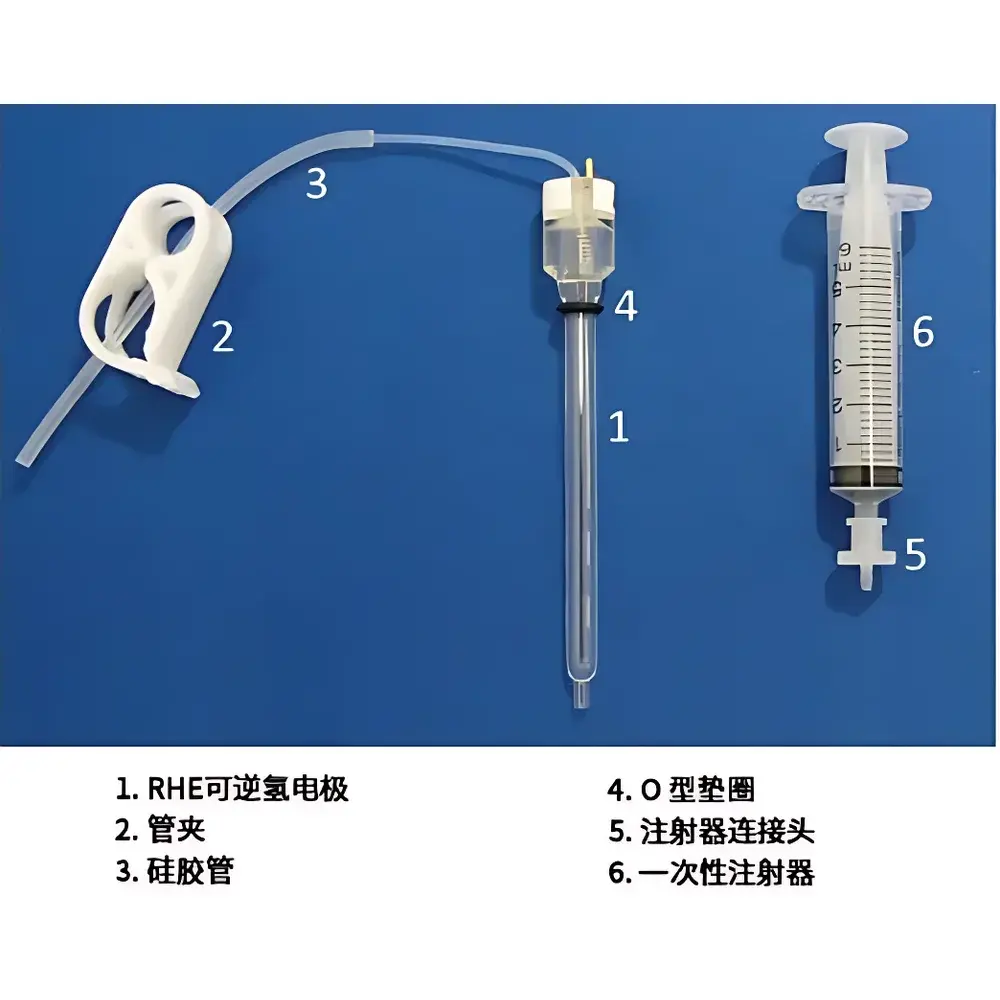
ALS RHEK/013597 Reversible Hydrogen Electrode (RHE) Kit
| Brand | ALS |
|---|---|
| Origin | Japan |
| Manufacturer Type | Authorized Distributor |
| Origin Category | Imported |
| Model | RHEK/013597 |
| Instrument Type | Reference Electrode for Electrochemical Measurements |
| Electrolyte Compatibility | 1.2 mol/L HCl (pH ≈ 0, [H⁺] ≈ 1 M) |
| Reference Scale | Defined vs. Standard Hydrogen Electrode (SHE) |
Overview
The ALS RHEK/013597 Reversible Hydrogen Electrode (RHE) Kit is a precision-engineered reference electrode system designed for rigorous electrochemical research and calibration applications requiring thermodynamically anchored potential referencing. Unlike conventional Ag/AgCl or saturated calomel electrodes (SCE), the RHE operates under equilibrium conditions governed by the Nernst equation for the 2H⁺ + 2e⁻ ⇌ H₂(g) redox couple, establishing a potential directly traceable to the Standard Hydrogen Electrode (SHE) at defined hydrogen ion activity (aH⁺ ≈ 1) and unit H₂ fugacity (fH₂ = 1 bar). This kit enables in-situ assembly of a stable, reproducible RHE in 1.2 mol/L HCl electrolyte—selected to approximate unity activity of H⁺ while maintaining practical conductivity and low junction potential drift. The electrode’s reversible behavior is validated through time-resolved potential stability monitoring and cross-comparison against certified Ag/AgCl (sat. KCl) reference systems, ensuring metrological consistency across multi-day experiments and inter-laboratory studies.
Key Features
- Pre-qualified platinum-black catalytic surface optimized for rapid H⁺/H₂ equilibration and minimal overpotential
- Gas-tight, corrosion-resistant PTFE body with integrated H₂ inlet/outlet port for continuous purging or closed-loop gas management
- Standardized geometry and electrode surface area (10 mm² active Pt area) enabling quantitative comparison across labs
- Calibration-ready design: includes detailed protocol for RHE potential verification via open-circuit potential (OCP) tracking versus Ag/AgCl (sat. KCl)
- Compatible with standard electrochemical workstations (e.g., BioLogic, Gamry, PalmSens) using standard alligator clip or Luggin capillary interfaces
- Robust architecture suitable for long-term immersion in acidic media (pH ≤ 0.1) without Pt dissolution or membrane degradation
Sample Compatibility & Compliance
The RHEK/013597 is specifically formulated for use in aqueous hydrochloric acid solutions at 1.2 mol/L concentration, where H⁺ activity approximates unity under controlled temperature (25 ± 0.5 °C) and atmospheric H₂ partial pressure. It is not intended for non-aqueous solvents, strongly oxidizing media (e.g., concentrated HNO₃), or chloride-free electrolytes where surface passivation may occur. The electrode conforms to ISO 80000-9:2019 (quantities and units – physical chemistry) definitions for reference electrode potential reporting and supports traceability to SI-derived electrochemical quantities. When operated per ALS technical bulletin TB-RHE-2023, it meets requirements for GLP-compliant potential calibration in corrosion testing (ASTM G59, G102) and fundamental electrocatalysis studies (IEC 62044-2).
Software & Data Management
No proprietary software is required; the RHE functions as a passive, analog reference source compatible with any potentiostat supporting two-electrode or three-electrode configurations. Potential data acquired relative to the RHE are inherently referenced to SHE (ERHE = Emeas − 0.059 × pH at 25 °C), enabling direct conversion to universal scales without post-acquisition correction. For audit-trail compliance in regulated environments (e.g., pharmaceutical QC or battery R&D under FDA 21 CFR Part 11), users may log RHE validation records—including OCP stability (±0.3 mV over 4 h), H₂ flow rate (5–10 mL/min), and electrolyte batch traceability—within existing LIMS or ELN platforms.
Applications
- Calibration and verification of working electrode potentials in HER/OER catalysis studies
- Quantitative assessment of hydrogen storage capacity and surface hydride formation kinetics on metal alloys
- Intercomparison of reference electrode performance across multiple labs (e.g., PEM electrolyzer benchmarking)
- Validation of potentiostat offset errors and cable-induced IR drop in low-resistance cells
- Teaching laboratories demonstrating thermodynamic reference scale derivation and Nernstian behavior
- Supporting ASTM D1148 (rubber discoloration) and ISO 15730 (electrochemical noise analysis) test protocols
FAQ
What is the recommended H₂ gas purity for stable RHE operation?
Use ≥99.999% (5N) hydrogen gas to prevent Pt poisoning from CO or O₂ impurities.
Can the RHE be used in alkaline electrolytes?
No—this kit is optimized for 1.2 mol/L HCl only. Alkaline RHE variants require different catalyst support and junction design.
How often must the RHE be reconditioned?
Reconditioning (electrochemical activation in 0.5 M H₂SO₄, +0.1 V vs. RHE for 30 s) is recommended before each experimental session or after >24 h of idle storage.
Is the RHEK/013597 compliant with ISO/IEC 17025 for accredited testing?
Yes—when used with documented calibration procedures, traceable gas supply, and temperature-controlled cells, it satisfies clause 6.4.10 (reference material control) and 6.5.2 (measurement uncertainty estimation).





