
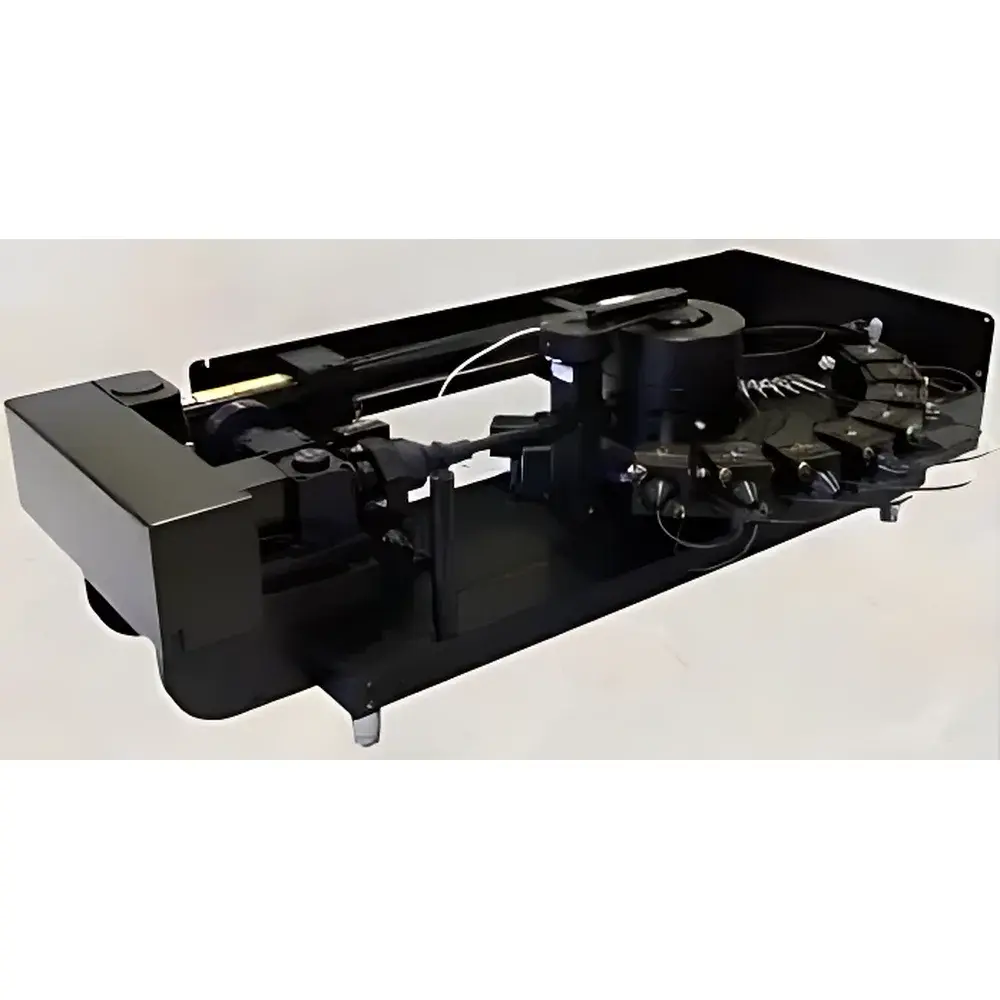
ALV CGS-3 MD Multi-Detector Goniometer Light Scattering System
| Brand | ALV |
|---|---|
| Origin | Germany |
| Model | CGS-3 MD |
| Laser Wavelength Options | 660 nm (50 mW DPSS) or 532 nm (50 mW Nd:YAG) |
| Detector Configuration | 4 or 8 parallel APD/PMT detectors |
| Angular Spacing | 16° between adjacent detectors (8-detector mode) |
| Correlator | One or two ALV-7004 multi-tau digital autocorrelators (supporting 4- or 8-channel operation) |
| Application Focus | Time-resolved static and dynamic light scattering (SLS/DLS) of rapidly evolving colloidal, polymeric, and biomolecular systems |
Overview
The ALV CGS-3 MD Multi-Detector Goniometer Light Scattering System is a high-precision, research-grade instrument engineered for simultaneous angular-resolved static light scattering (SLS) and dynamic light scattering (DLS) measurements. Built upon ALV’s decades of expertise in coherent light scattering instrumentation, the CGS-3 MD employs a motorized rotating arm architecture to enable rapid, synchronized acquisition across multiple scattering angles—without mechanical repositioning delays. This design is specifically optimized for kinetic studies of fast-evolving systems, including polymerization reactions, protein aggregation, nanoparticle nucleation, and stimuli-responsive hydrogel formation. The system operates on the fundamental principles of Rayleigh–Gans–Debye scattering theory for size and molecular weight determination (via SLS), and intensity autocorrelation analysis (via DLS) to extract translational diffusion coefficients, hydrodynamic radii, and polydispersity indices. Its modular optical layout supports rigorous validation against ISO 22412 (DLS) and ISO 13321 (photon correlation spectroscopy), ensuring metrological traceability in regulated and academic laboratories.
Key Features
- Modular multi-angle detection: Configurable with either four or eight high-sensitivity photodetectors mounted on a precision goniometric arm, each spaced at fixed 16° intervals (in 8-detector mode) to cover scattering angles from 20° to 164°.
- Stable dual-wavelength excitation: Interchangeable 50 mW solid-state lasers—660 nm DPSS or 532 nm Nd:YAG—selected based on sample absorption profile, refractive index contrast, and fluorescence background requirements.
- Low-noise detection options: Choice between silicon avalanche photodiodes (APDs) for high quantum efficiency in visible range or photomultiplier tubes (PMTs) for ultra-low dark current and extended dynamic range.
- Dedicated digital correlation architecture: Integration of one or two ALV-7004 multi-tau digital autocorrelators, each capable of real-time processing of up to four independent intensity channels with sub-microsecond time resolution and >10¹² dynamic range.
- Thermostatted sample compartment: Compatible with standard quartz cuvettes (10 mm path length) and temperature-controlled cells (±0.1 °C stability) for isothermal or ramped kinetic experiments.
- Robust mechanical design: Precision-ground stainless-steel goniometer with backlash-free stepper motor drive, calibrated angular accuracy ±0.05°, and long-term positional repeatability <0.02°.
Sample Compatibility & Compliance
The CGS-3 MD accommodates a broad spectrum of transparent or semi-transparent colloidal dispersions, macromolecular solutions, micellar systems, and biological macromolecules—including proteins, polysaccharides, synthetic polymers, and lipid nanoparticles—in aqueous or organic solvents. Sample volume requirements range from 250 µL to 3 mL depending on cuvette geometry. The system complies with core international standards for light scattering instrumentation: ISO 22412:2017 (DLS), ISO 13321:1996 (photon correlation spectroscopy), and ASTM E2490-20 (light scattering particle sizing). Data acquisition and storage workflows support audit-trail generation aligned with GLP and GMP documentation requirements; raw correlator output files (binary .COR format) are timestamped, detector-labeled, and fully exportable for third-party analysis.
Software & Data Management
Control and analysis are performed using ALV’s proprietary SALS/DLS software suite (v8.x), which provides integrated instrument control, real-time correlation curve monitoring, batch angular data reduction, and advanced modeling modules—including CONTIN, NNLS, and cumulant analysis for polydisperse systems. All raw and processed datasets are stored in hierarchical HDF5 containers with embedded metadata (laser power, temperature, viscosity, refractive index, detector gain), enabling FAIR (Findable, Accessible, Interoperable, Reusable) data practices. The software supports automated report generation compliant with internal SOPs and external regulatory submissions. Optional integration with LabArchives ELN or direct Python API access (via PyALV) enables custom scripting for high-throughput screening and machine learning–driven parameter extraction.
Applications
- Kinetic monitoring of rapid self-assembly processes, such as block copolymer micellization or virus-like particle formation.
- Real-time tracking of polymer chain growth during free-radical or RAFT polymerization.
- Early-stage aggregation analysis of therapeutic monoclonal antibodies under thermal or pH stress.
- Determination of second virial coefficient (A₂) and conformational parameters (ρ, ν) for synthetic and natural polymers.
- Size distribution profiling of nanocarriers (e.g., LNPs, polymeric NPs) before and after functionalization or serum exposure.
- Cross-validation of DLS-derived hydrodynamic radius against SEC-MALS or TEM for method transfer studies.
FAQ
What is the minimum detectable concentration for proteins using the CGS-3 MD?
Typical detection limits range from 0.1–1 mg/mL for globular proteins (e.g., BSA) under optimal optical contrast conditions; lower concentrations may be accessible using larger-volume cells or signal averaging.
Can the system perform electrophoretic light scattering (ELS)?
No—the CGS-3 MD is configured exclusively for SLS and DLS. ELS capability requires a separate ALV-ZS or ALV-LSA instrument with integrated electrodes and high-voltage control.
Is the ALV-7004 correlator compatible with third-party software?
Yes—raw correlator data streams can be exported in ASCII or binary formats; ALV provides documented APIs and MATLAB/Python wrappers for custom integration.
Does the system meet FDA 21 CFR Part 11 requirements?
While the hardware and firmware support electronic signatures and audit trails, full Part 11 compliance depends on site-specific validation protocols, user access controls, and backup procedures implemented at the laboratory level.
How is angular calibration verified?
Calibration is performed using certified polystyrene latex standards (e.g., NIST SRM 1963) and verified via He–Ne laser interference fringe alignment prior to each measurement series.



