
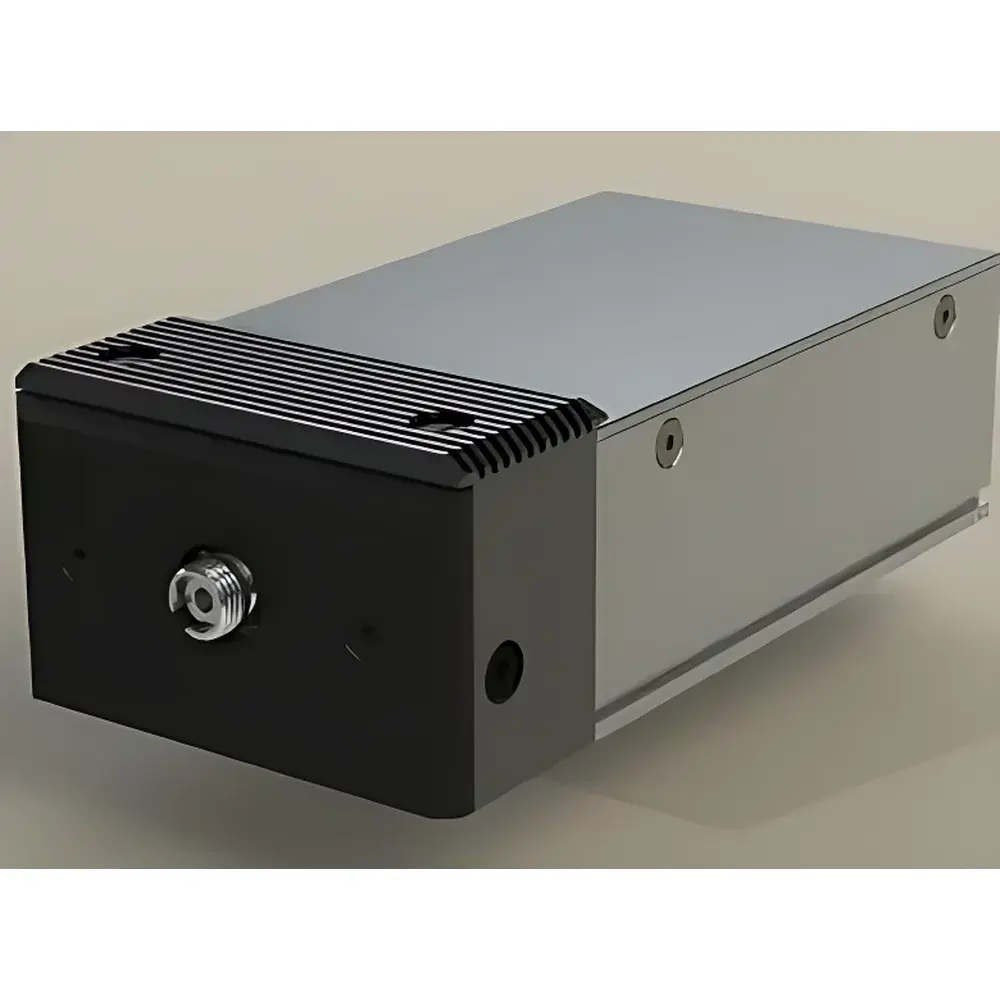
ALV-CorrTector-II Detection Unit
| Brand | ALV |
|---|---|
| Origin | Germany |
| Model | ALV-CorrTector-II |
| Detector Type | Integrated Avalanche Photodiode (APD) with Multi-τ Digital Correlator |
| Count Rate | >80 Mcps |
| Dark Count Rate | ~250 cps |
| Afterpulsing | Minimized with Embedded Correction Algorithm |
| Peak Quantum Efficiency | 60% |
| QE at 488 nm | 53% |
| QE at 532 nm | 40% |
| Operating Temperature Range | 15–35 °C |
| Dimensions | 120 × 58 × 30 mm |
| Weight | 250 g |
| Interface | Mini-USB 2.0 |
| OS Compatibility | Windows 10 (64-bit) |
| Power Consumption | <2 W |
Overview
The ALV-CorrTector-II Detection Unit is a high-performance, compact photodetection module engineered for precision photon correlation spectroscopy (PCS), dynamic light scattering (DLS), static light scattering (SLS), diffusion wave spectroscopy (DWS), and fluorescence correlation spectroscopy (FCS). Developed by ALV-Laser Vertriebsgesellschaft mbH in Germany, this unit integrates a custom-designed silicon avalanche photodiode (APD) with a multi-τ digital autocorrelator into a single, thermally stable housing. Unlike conventional photomultiplier tube (PMT)-based systems, the ALV-CorrTector-II leverages solid-state APD technology to deliver superior quantum efficiency across the visible-to-near-infrared spectrum (400–900 nm), particularly optimized for common laser wavelengths including 488 nm and 532 nm. Its measurement principle relies on intensity autocorrelation of scattered photons to extract diffusion coefficients, hydrodynamic radii, and particle size distributions under Brownian motion assumptions—fully compliant with ISO 22412:2017 for DLS-based particle sizing. The unit operates as a core optical detection front-end within a full ALV light-scattering system, interfacing directly with ALV-700X/USB correlators or third-party data acquisition platforms supporting TTL-synchronized photon stream input.
Key Features
- Integrated APD detector with peak quantum efficiency of 60%, 53% at 488 nm, and 40% at 532 nm—enabling high signal-to-noise ratio in low-flux scattering experiments
- Multi-τ digital correlator architecture supporting lag-time resolution from sub-microsecond (≥0.1 µs) to seconds, matching the dynamic range of quasi-interferometric setups without requiring dual-detector configurations
- Ultra-low dark count rate (~250 cps) and minimized afterpulsing, enhanced by real-time hardware-level afterpulse correction firmware
- Thermally robust design with low thermal drift; operational stability maintained between 15 °C and 35 °C ambient conditions
- Onboard overload protection circuitry safeguards the APD against accidental laser exposure or electrical transients
- Mini-USB 2.0 interface enables plug-and-play connectivity with Windows 10–based control PCs; driver-free operation via standard HID protocols
- Compact footprint (120 × 58 × 30 mm) and low power draw (<2 W) facilitate integration into benchtop, microfluidic, or OEM light-scattering platforms
Sample Compatibility & Compliance
The ALV-CorrTector-II is compatible with colloidal dispersions, polymer solutions, protein formulations, liposomal suspensions, and other optically transparent or semi-transparent media suitable for classical light-scattering measurements. It supports sample cells ranging from standard 10-mm-path quartz cuvettes to capillary flow cells and micro-volume chambers (≥10 µL). When deployed in regulated environments—including pharmaceutical QC labs or contract research organizations—the unit supports audit-ready workflows when paired with ALV’s GLP-compliant software suite (e.g., ALV-Soft v5.x), which includes electronic signatures, 21 CFR Part 11–compliant user access controls, and immutable raw correlation function logging. All optical components comply with IEC 61000-6-3 (EMC emissions) and IEC 61000-6-2 (immunity) standards; the APD sensor meets RoHS Directive 2011/65/EU requirements.
Software & Data Management
The detection unit streams time-stamped photon events directly to ALV-Soft or third-party analysis packages (e.g., MATLAB, Python-based PyCorr, or OriginLab) via USB. Raw autocorrelation functions are computed in real time using the embedded correlator and exported in ASCII or HDF5 format. ALV-Soft provides batch processing, cumulant and CONTIN analysis for polydisperse systems, refractive index correction, viscosity temperature compensation, and ISO 22412–aligned reporting templates. Audit trails record detector gain settings, temperature logs, correlator configuration parameters, and operator metadata—ensuring traceability for GMP/GLP validation. Exported datasets retain full bit-depth fidelity for post-acquisition reprocessing without loss of statistical resolution.
Applications
- Sub-10 nm nanoparticle sizing in biopharmaceutical formulations (e.g., mRNA-LNPs, viral vectors)
- Aggregation kinetics monitoring of monoclonal antibodies under thermal or pH stress
- Rheological characterization of soft glassy materials via diffusion wave spectroscopy (DWS)
- Single-molecule FCS studies of binding affinity and diffusion dynamics in live-cell lysates
- Quality control of industrial colloids, pigment dispersions, and ceramic slurries
- Validation of microfluidic mixing efficiency through temporal cross-correlation analysis
FAQ
Is the ALV-CorrTector-II compatible with non-ALV lasers or third-party correlators?
Yes—it accepts TTL-synchronized photon pulses from any pulsed or CW laser source (with appropriate filtering), and outputs standard NIM/TTL correlation data compatible with industry-standard correlators (e.g., Brookhaven BI-9000AT, Malvern Panalytical Zetasizer Ultra optional modules).
What is the maximum sustainable count rate before dead-time distortion occurs?
The APD maintains linearity up to >80 Mcps under typical operating bias; deviation from Poisson statistics is actively corrected via built-in dead-time modeling in ALV-Soft.
Can the unit operate continuously at 40 °C ambient temperature?
While short-term operation above 35 °C is possible, sustained use beyond the specified 15–35 °C range may increase dark counts and reduce long-term APD gain stability; active cooling or environmental chamber integration is recommended for extended high-temperature protocols.
Does the device support time-resolved FCS with dual-channel cross-correlation?
No—the ALV-CorrTector-II is a single-channel autocorrelator; for cross-correlation applications (e.g., dual-color FCS), two synchronized units or an ALV-CorrTector-Dual configuration is required.
Is firmware upgradable in the field?
Yes—ALV provides signed firmware updates via USB using ALV-Soft; all updates preserve calibration constants and maintain traceable revision history per ISO/IEC 17025 requirements.



