
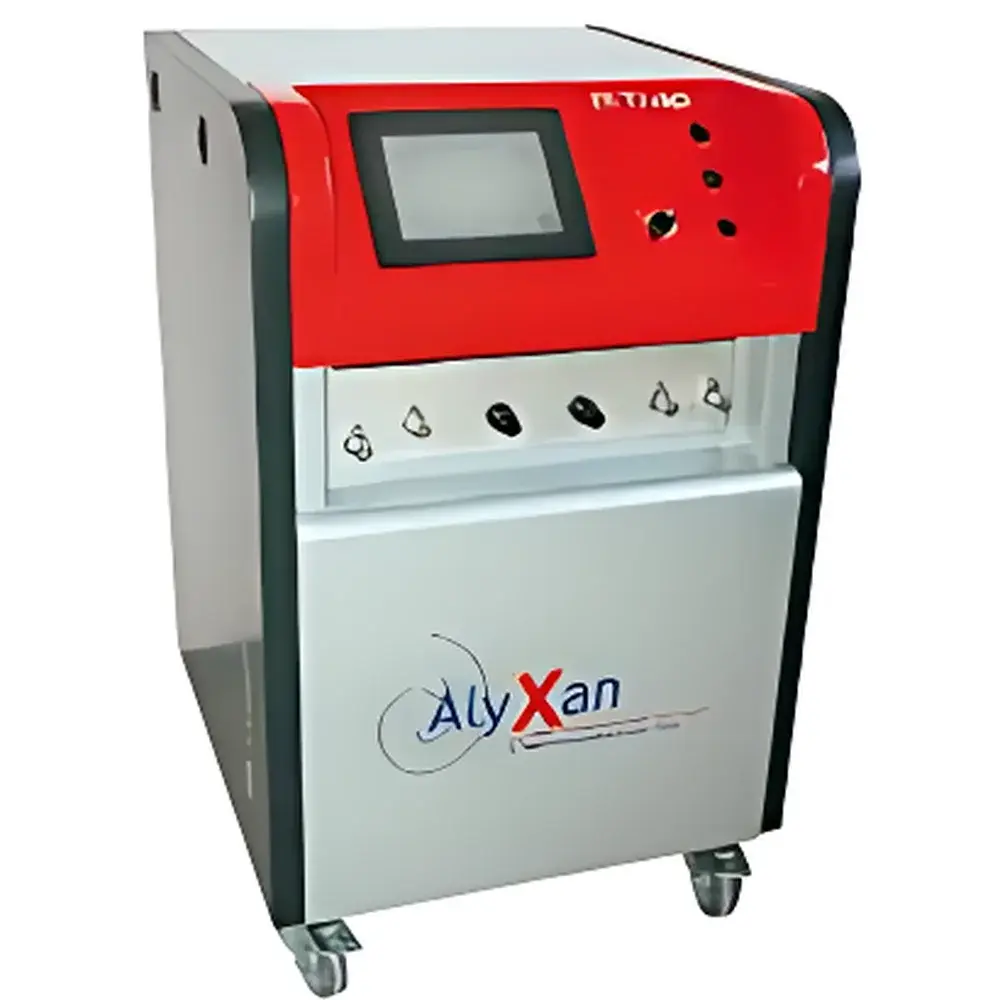
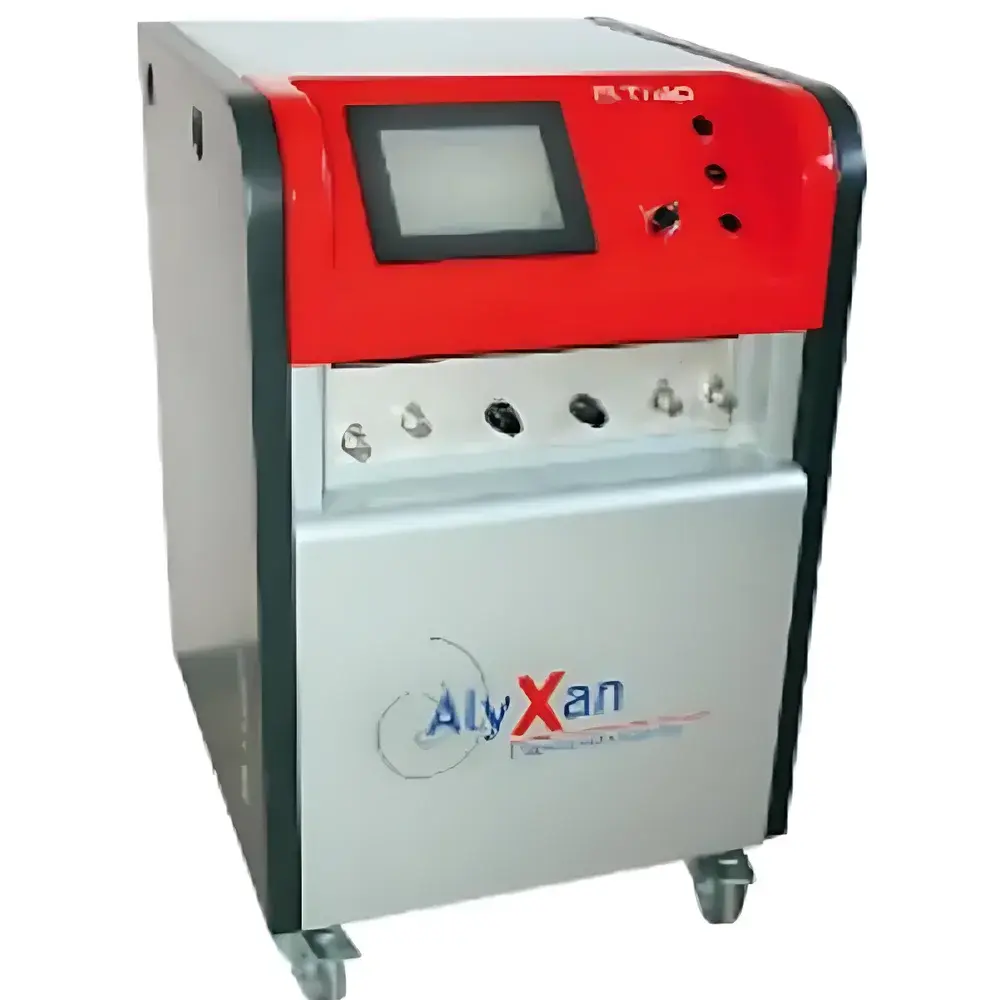
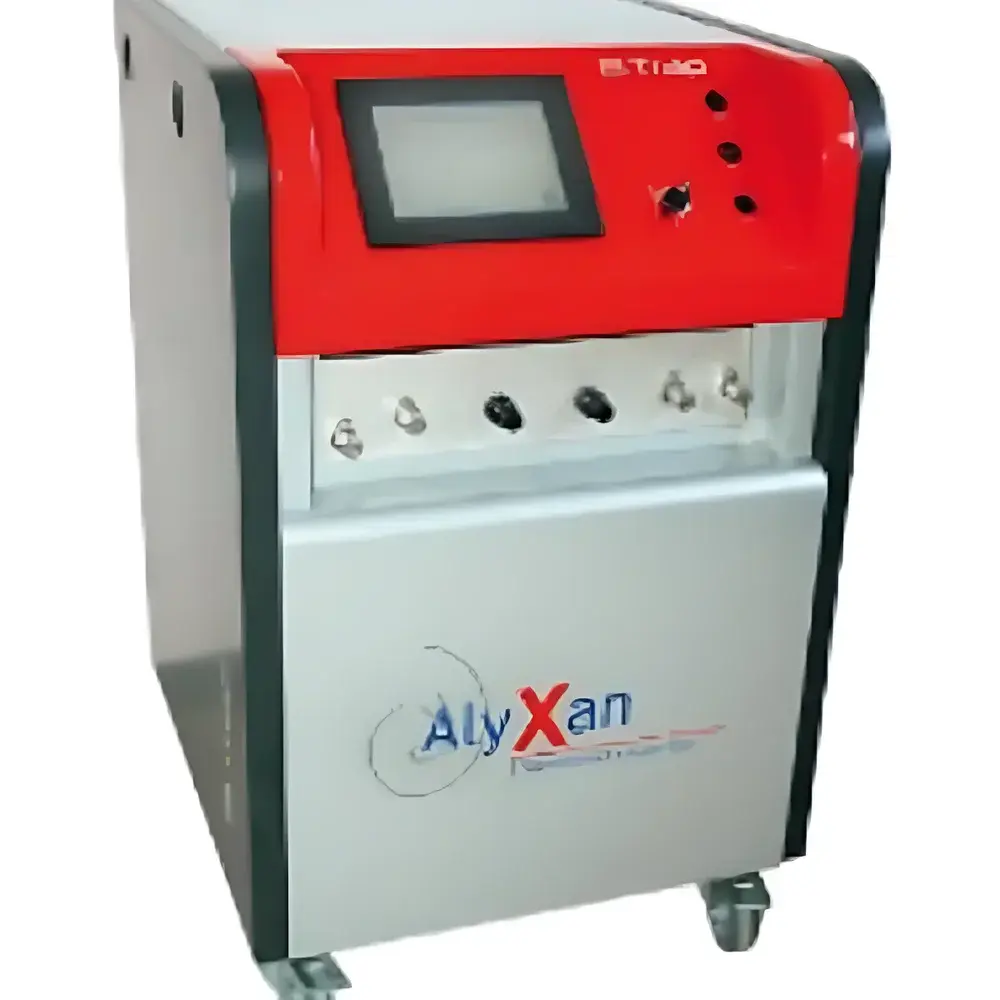
Alyxan BTrap PTR-FTICR Mass Spectrometer
| Brand | Alyxan |
|---|---|
| Origin | France |
| Model | PTR-FTICR MS |
| Mass Resolution | ≥10,000 (m/Δm, 50% valley) |
| Mass Accuracy | ≤0.015 u |
| Detection Limit | 100 ppt (v/v) for selected VOCs |
| Mass Range | 4–300 u |
| Magnetic Field Strength | 1.5 T |
| Vacuum Requirement | ≤1×10⁻⁹ Torr |
| Operating Temperature | 5–45 °C |
| Dynamic Range | 10⁴ |
| Dimensions | 65 × 72 × 104 cm |
| Weight | 150 kg |
| Ion Sources | H₃O⁺, O₂⁺, O⁻, CF₃⁺ (switchable proton-transfer reagent ions) |
| Sample Introduction | Membrane Inlet (MI), Headspace (solid/liquid) |
| Ionization Mode | Proton Transfer Reaction (PTR), optional EI/CI capability |
Overview
The Alyxan BTrap PTR-FTICR Mass Spectrometer is a compact, high-performance hybrid analytical platform engineered for real-time, ultra-high-resolution analysis of volatile organic compounds (VOCs) in gas-phase samples. It integrates two foundational mass spectrometry technologies: Proton Transfer Reaction (PTR) ionization—a soft, non-fragmenting chemical ionization method—and Fourier Transform Ion Cyclotron Resonance (FT-ICR) mass analysis, renowned for its exceptional mass resolving power and long-term mass stability. Unlike conventional electron ionization (EI) or even quadrupole time-of-flight (Q-TOF) systems, the BTrap achieves mass resolution exceeding 10,000 (m/Δm, 50% valley definition) at m/z 200 while maintaining sub-15 milli-Dalton mass accuracy—enabling unambiguous elemental composition assignment for complex mixtures without chromatographic separation. Its membrane inlet system enables direct, continuous sampling from ambient air, headspace above solids or liquids, or process streams—making it suitable for field-deployable atmospheric monitoring, laboratory-based reaction kinetics studies, and industrial emission profiling.
Key Features
- Ultra-High Mass Resolution & Accuracy: FT-ICR detection delivers ≥10,000 resolving power (50% valley) and mass accuracy ≤0.015 u—critical for distinguishing isobaric species (e.g., C₆H₁₂ vs. C₅H₈O) and confirming molecular formulas in complex VOC matrices.
- Multi-Reagent PTR Ionization: Switchable chemical ionization sources—including H₃O⁺ (optimal for oxygenates, aromatics), O₂⁺ (for alkanes), O⁻ (for acidic compounds), and CF₃⁺ (for halogenated VOCs)—enable selective, tunable ion chemistry to enhance sensitivity and reduce spectral overlap.
- Sub-Part-Per-Trillion Detection Sensitivity: Achieves detection limits of 100 ppt (v/v) for key VOCs (e.g., formaldehyde, isoprene, acetaldehyde) with 1-second duty cycle—supporting rapid transient event capture and time-resolved atmospheric chemistry studies.
- Membrane Inlet Architecture: A heated, chemically inert silicone membrane interface allows efficient, pressure-stabilized transfer of analytes from ambient or headspace environments into the high-vacuum ion source—eliminating need for carrier gases, cryogenic trapping, or pre-concentration.
- Compact, Ruggedized Design: Engineered for operational robustness across variable environmental conditions (5–45 °C ambient); no external cooling water or liquid nitrogen required; integrated vacuum system maintains ≤1×10⁻⁹ Torr base pressure without turbomolecular pump maintenance cycles.
- Modular Integration Capability: Designed with standardized electrical, pneumatic, and data interfaces to synchronize with complementary techniques—including FTIR for functional group validation, TGA/DSC for thermal desorption coupling, and GC pre-separation modules where needed.
Sample Compatibility & Compliance
The BTrap accepts gaseous samples directly via membrane inlet or headspace vapor from solid/liquid matrices (e.g., polymers, soils, biological tissues, beverages). It complies with ISO/IEC 17025 requirements for method validation in accredited laboratories and supports audit-ready data acquisition under GLP and GMP frameworks. All raw spectral data, calibration logs, and instrument parameter histories are timestamped and stored with SHA-256 hashing to satisfy FDA 21 CFR Part 11 electronic record integrity requirements. Quantitative workflows are traceable to NIST-traceable VOC standards (e.g., TO-15, EPA Method 8021B), and software includes built-in uncertainty propagation per ISO/IEC Guide 98-3 (GUM).
Software & Data Management
Control and data processing are managed through Alyxan’s proprietary BTrap Control Suite, a Windows-based application compliant with IEC 62443-3-3 for industrial cybersecurity. The suite provides real-time spectral visualization, automated peak deconvolution using iterative least-squares fitting, and formula generation via ChemCalc-integrated elemental constraint algorithms. All datasets are saved in open HDF5 format with embedded metadata (instrument configuration, calibration status, environmental sensor readings). Batch processing supports ASTM D7622-compliant VOC quantification without internal standards via response factor libraries calibrated against certified reference materials. Audit trails log every user action—including parameter changes, calibration events, and report exports—with role-based access control (RBAC) and session timeout enforcement.
Applications
- Real-time atmospheric chemistry monitoring (urban air quality, forest emissions, boundary layer VOC fluxes)
- In-process monitoring of polymer off-gassing, battery electrolyte decomposition, and catalytic reactor effluents
- Non-invasive headspace analysis of pharmaceutical stability testing, food spoilage markers, and forensic volatile residue screening
- Reaction mechanism studies involving short-lived intermediates (e.g., carbonyl oxides, Criegee intermediates)
- Validation of sensor networks and low-cost VOC monitors via reference-grade speciation
- Regulatory compliance testing for REACH, RoHS, and California Proposition 65 volatile contaminants
FAQ
Does the BTrap require liquid nitrogen or superconducting magnet service?
No. The 1.5 T permanent magnet is passively stabilized and requires no cryogens or active shimming—reducing operational overhead and enabling deployment in mobile labs or remote stations.
Can quantitative analysis be performed without internal standards?
Yes. Absolute quantification is supported via reagent-ion-specific response factors derived from primary calibration gases traceable to NIST SRMs, validated per ISO 80000-9 and EURACHEM/CITAC guidelines.
Is the system compatible with existing laboratory information management systems (LIMS)?
Yes. The BTrap Control Suite provides OPC UA and RESTful API interfaces for bidirectional data exchange with major LIMS platforms (e.g., LabWare, Thermo Fisher SampleManager, Agilent OpenLab) including sample ID propagation, result auto-import, and QC flagging.
What maintenance intervals are recommended for routine operation?
Ion source cleaning every 6 months (or after 500 hours of operation); membrane replacement annually; vacuum system oil change every 2 years. No recalibration is required between scheduled maintenance if ambient temperature drift remains within ±2 °C.
How is data integrity ensured during long-term unattended operation?
Continuous checksum verification of all acquired transients; automatic backup to redundant SSD + network-attached storage (NAS); hardware watchdog timer triggers safe shutdown upon communication loss or power anomaly—meeting IEC 61508 SIL-2 functional safety criteria.
Related Products





