
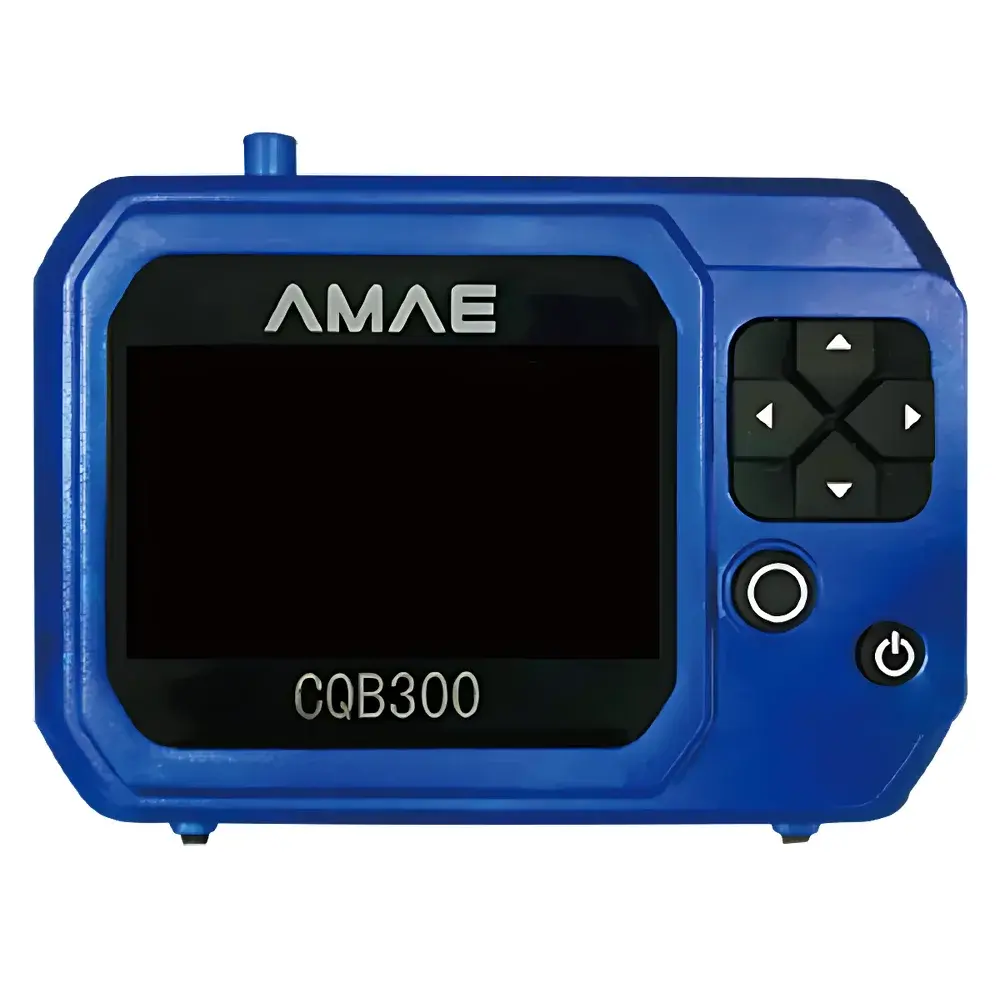
AMAE CQB300 Intrinsically Safe Personal Air Sampler
| Brand | AMAE |
|---|---|
| Model | CQB300 |
| Type | Intrinsically Safe Personal Air Sampler for Hazardous Environments |
| Origin | Shenzhen, China |
| Flow Range | 10–300 mL/min |
| Flow Resolution | 1 mL/min |
| Explosion Protection | Certified for Class I and Class II hazardous locations |
| Compliance | GBZ 159-2004, GBZ/T 160 series, GBZ/T 300 series, GBZ 2.1-2019 |
| Power | Rechargeable high-capacity lithium battery |
| Sampling Modes | Manual, Timed, Volume-Controlled, Cyclic |
| Environmental Compensation | Integrated barometric pressure & ambient temperature sensing with automatic standard-condition (STP: 25 °C, 101.325 kPa) volume calculation |
| Data Handling | Onboard memory, USB data export, optional thermal printer support |
| Accessories | Anti-static shoulder strap, wall-mount charger, dual/quad sampler rack case, sorbent tube adapters |
Overview
The AMAE CQB300 Intrinsically Safe Personal Air Sampler is an engineered solution for quantitative, worker-worn air sampling in explosively hazardous environments—particularly underground coal mines, chemical processing facilities, and confined industrial workspaces. Designed to meet stringent occupational hygiene requirements, it operates on a precision-controlled volumetric flow principle, utilizing a calibrated diaphragm pump with closed-loop feedback regulation to maintain stable flow rates across variable backpressure conditions (e.g., loaded sorbent tubes or filters). Its core function is to draw representative air samples at user-defined flow rates—spanning 10 to 300 mL/min—through collection media such as activated charcoal tubes, silica gel cartridges, or polycarbonate membrane filters. The device automatically compensates for real-time ambient temperature and barometric pressure, computing and logging sampled volumes corrected to standard temperature and pressure (STP: 25 °C, 101.325 kPa), ensuring traceability and regulatory alignment with ISO 8518 and OSHA Method 001 compliance frameworks.
Key Features
- Precision constant-flow operation: Maintains setpoint accuracy within ±3% of full scale across voltage fluctuations (7–12 V DC) and dynamic load resistance (up to 25 kPa backpressure), eliminating manual recalibration during extended shifts.
- Intrinsically safe architecture: Certified to GB 3836.1–2010 and GB 3836.4–2010 for Class I (methane/coal dust) and Class II (flammable dusts) hazardous locations—fully compliant for deployment in Zone 0/10 and Zone 1/11 environments without external barriers.
- Extended operational autonomy: Equipped with a 12,000 mAh Li-ion battery pack supporting continuous sampling at 100 mL/min for ≥12 hours, or intermittent use over 48+ hours per charge cycle.
- Multi-mode sampling logic: Supports manual start/stop, programmable timed cycles (1–999 min), fixed-volume termination (1–9999 L), and repeating sequences—enabling alignment with NIOSH 5515, OSHA ID-121, and ISO 16000-2 protocols.
- Integrated environmental metrology: Onboard MEMS-based pressure sensor (±0.1 kPa accuracy) and digital thermistor (±0.3 °C) enable real-time STP correction and automatic adjustment of flow calibration coefficients per GBZ/T 160.1.
- Robust field interface: IP65-rated housing, anti-static shoulder strap (surface resistivity <1×10⁹ Ω), tactile keypad with lockout function, and visual/audible fault alerts (low battery, blockage, timeout).
Sample Compatibility & Compliance
The CQB300 interfaces seamlessly with standard 37-mm and 44-mm diameter filter cassettes, stainless steel sorbent tubes (e.g., Carbopack™ X, Tenax® TA), and impingers used in volatile organic compound (VOC), aldehyde, and inorganic acid vapor analysis. All firmware and calibration procedures adhere to the metrological traceability chain defined in JJF 1001–2011 (General Terminology and Definitions for Metrology) and are validated against national reference standards maintained by CNAS-accredited laboratories. It satisfies mandatory requirements of China’s occupational exposure monitoring regime—including GBZ 159-2004 (sampling methodology), GBZ/T 160 (analytical methods for >300 toxicants), and GBZ 2.1-2019 (MAC/PC-TWA limits)—and supports audit-ready data logs required under GLP-aligned laboratory quality systems.
Software & Data Management
Data acquisition and reporting are managed via AMAE SAM-Link v3.2 PC software (Windows 10/11 compatible), which imports time-stamped CSV files containing flow history, pressure/temperature profiles, error flags, and STP-corrected volumes. The software generates compliant reports aligned with GBZ/T 300.1–2017 Annex A, including uncertainty estimation per GUM (JCGM 100:2008) and configurable metadata fields (operator ID, location tag, sampler ID, medium lot number). Audit trails comply with basic ALCOA+ principles; while not FDA 21 CFR Part 11-certified out-of-box, the system supports third-party electronic signature integration for regulated QA/QC workflows.
Applications
Primary deployment includes personal exposure monitoring for miners assessing CO, NO₂, H₂S, benzene, and respirable crystalline silica; occupational hygienists conducting shift-long TWA measurements in petrochemical refineries; public health teams evaluating indoor formaldehyde levels in schools; and third-party testing labs performing accredited analyses per CNAS-CL01:2018. Secondary applications span academic inhalation toxicology studies, HVAC system validation, and emergency response screening during chemical incidents—where intrinsic safety and portability are non-negotiable.
FAQ
What certifications verify its suitability for underground mining use?
The CQB300 holds dual certification to GB 3836.1–2010 (general explosion protection) and GB 3836.4–2010 (intrinsic safety ‘ia’ level), permitting use in gassy coal mines (Category I) and combustible dust zones (Category II). Test reports are issued by Shanghai Institute of Industrial Automation (SIIA), certificate no. SHEx2023xxxxx.
Does it support automatic STP conversion for all flow rates?
Yes—real-time pressure and temperature readings are applied continuously during sampling; STP volume is calculated and stored per sample event using the ideal gas law with compressibility correction per ISO 10780:2019 Annex B.
Can it be integrated into a centralized fleet management system?
Via optional RS-485 Modbus RTU interface (add-on module), enabling remote status polling, batch configuration, and alarm forwarding to SCADA or CMMS platforms.
Is calibration traceable to national standards?
Factory calibration uses NIM-traceable primary flow standards (NIST SRM-equivalent); users receive a calibration certificate with uncertainty budget (<0.8% k=2) and recommended annual recalibration interval.
What maintenance is required between sampling campaigns?
Routine checks include pump diaphragm integrity verification, inlet filter cleaning, battery capacity validation, and leak testing with certified test gas (e.g., 5% CO in air) at 100 mL/min—per GBZ/T 160.1 Section 7.3.







