
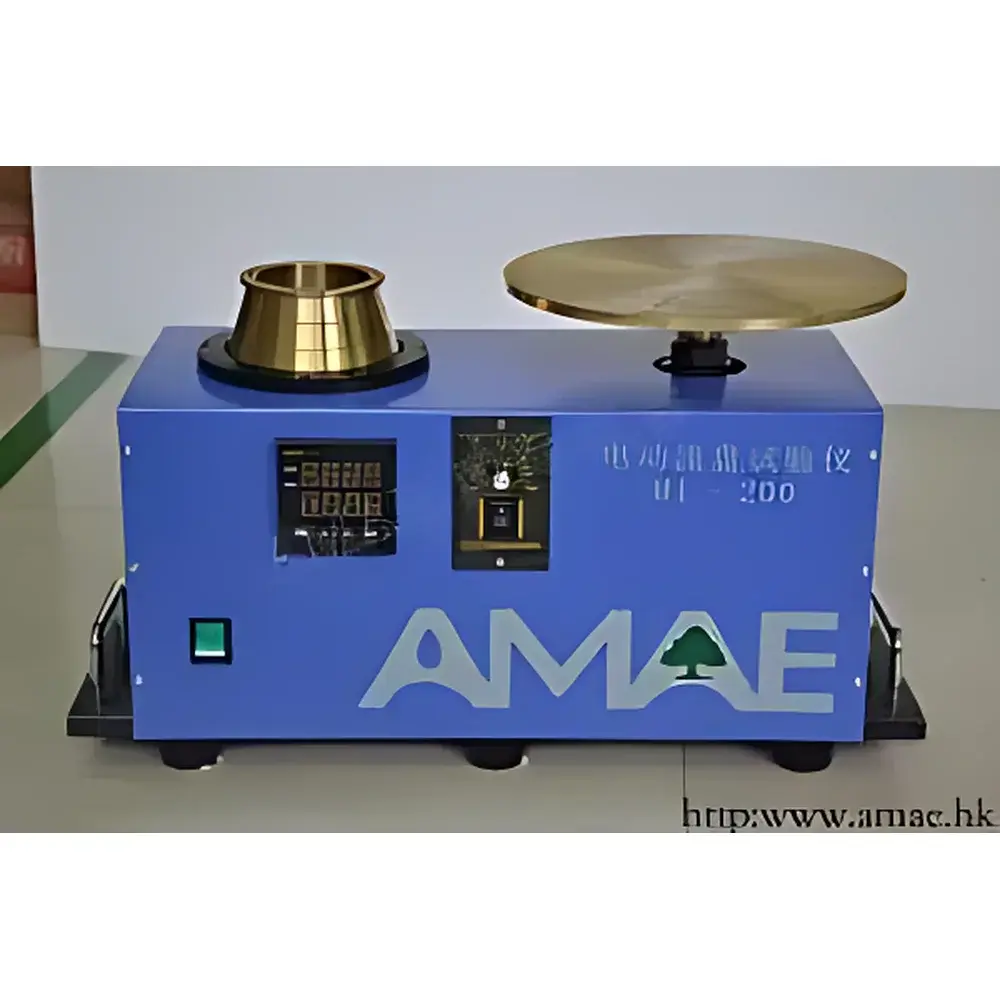
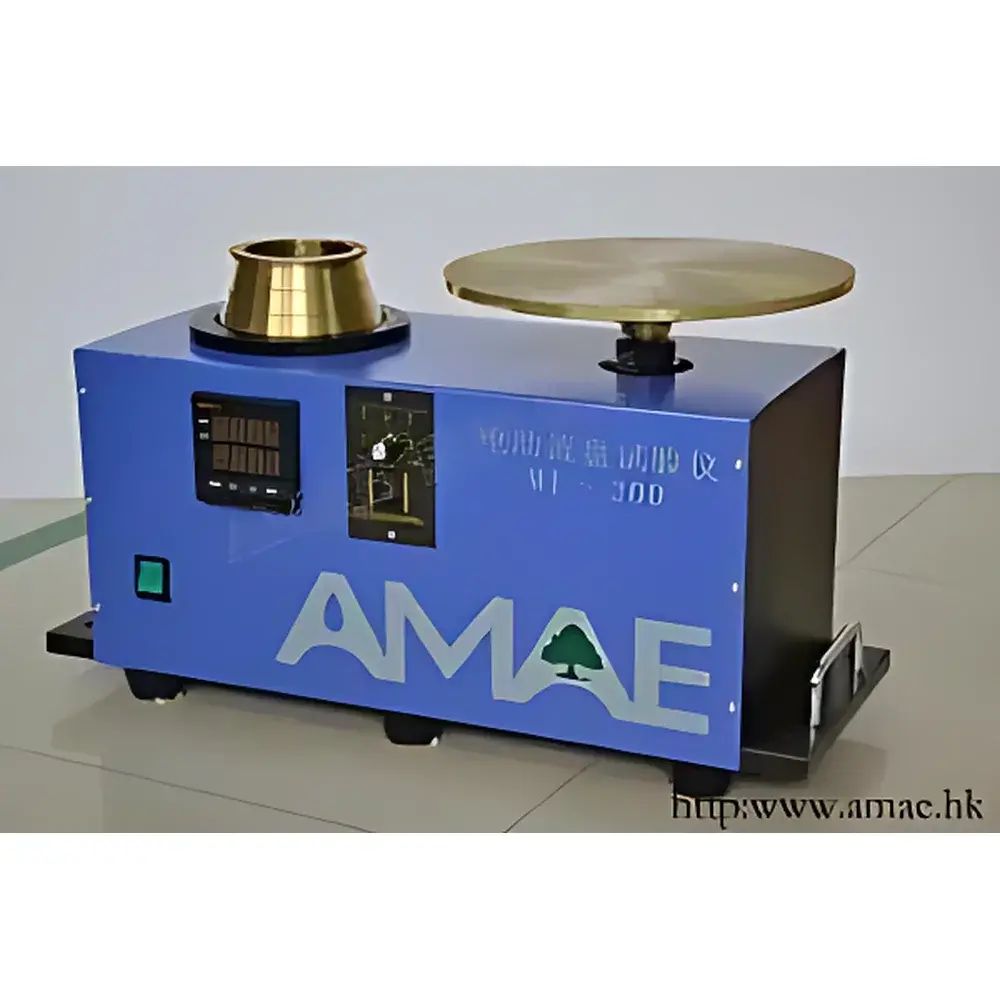
AMAE MI-200 Electric Flow Table Tester
| Brand | AMAE |
|---|---|
| Model | MI-200 |
| Flow Table Diameter | 254 mm ± 2.5 mm |
| Flow Table Thickness | 8 mm ± 0.1 mm |
| Drop Height | 12.5 mm ± 0.13 mm |
| Vibration Frequency | 25 Hz |
| Stroke Count Range | 1–9999 cycles (programmable) |
| Material | Brass flow table (Rockwell hardness ≥ HRB 25) |
| Compliance | ASTM C230-68, IMSBC Code Annex 1 (Moisture Content Testing for Flow Potential Assessment) |
| Sample Size Range | 1 mm ≤ particle size ≤ 7 mm |
| Environmental Requirement | Controlled temperature & humidity chamber, draft-free operation |
Overview
The AMAE MI-200 Electric Flow Table Tester is a precision-engineered instrument designed specifically for determining the Flow Moisture Point (FMP) and Transportable Moisture Limit (TML) of fine-grained solid bulk cargoes—primarily iron ore fines, nickel laterite, bauxite, coal fines, and other mineral concentrates susceptible to liquefaction during maritime transport. It operates on the principle of controlled mechanical vibration-induced consolidation and subsequent flow initiation under standardized drop impact, as defined in the International Maritime Solid Bulk Cargoes (IMSBC) Code and aligned with ASTM C230-68 (Standard Specification for Flow Tables for Use in Testing Hydraulic Cement). The device replicates the dynamic compaction and shear stress conditions experienced by cargo in ship holds during voyage, enabling laboratories to quantitatively assess moisture-related flow potential prior to loading. Its fully electric actuation system eliminates manual operator variability, ensuring high reproducibility across repeated tests required for regulatory compliance documentation.
Key Features
- Programmable stroke counter (1–9999 cycles) with digital display and memory retention, allowing precise replication of test sequences per IMSBC sampling protocols.
- Brass flow table manufactured from high-purity copper alloy meeting Rockwell B-scale hardness ≥ HRB 25—ensuring dimensional stability, wear resistance, and consistent energy transmission during repeated impacts.
- Fixed vertical drop height of 12.5 mm ± 0.13 mm and calibrated 25 Hz sinusoidal oscillation frequency, both traceable to national metrology standards.
- Integrated electromechanical drive system with low-inertia cam mechanism, delivering uniform acceleration profile and eliminating mechanical backlash or timing drift over extended operation.
- Modular design facilitates rapid installation and alignment verification using standard calibration gauges (e.g., depth micrometers, dial indicators); no specialized tools required.
- Dedicated conical brass mold (included) and spring-loaded tamping rod enable layer-wise compaction at defined pressure gradients—mimicking in-situ cargo packing density profiles observed in vessel hold stowage.
Sample Compatibility & Compliance
The MI-200 is validated for use with granular materials having particle sizes between 1 mm and 7 mm, including but not limited to processed iron ores, chromite fines, manganese concentrates, phosphate sands, and industrial slags. It complies with mandatory testing requirements outlined in Section 4.2.1 of the IMSBC Code (2023 edition), which mandates FMP/TML determination via flow table methodology for Group A cargoes. Test reports generated using this instrument support SOLAS Chapter VI/Regulation 5 compliance declarations and are accepted by classification societies (e.g., LR, DNV, ABS) and port state control authorities. All operational parameters—including ambient temperature (20 ± 2°C), relative humidity (50 ± 5%), and air velocity (<0.2 m/s)—must be monitored and recorded per ISO/IEC 17025:2017 clause 7.2.1 for accredited testing laboratories.
Software & Data Management
While the MI-200 operates as a standalone electromechanical tester without embedded firmware or touchscreen interface, it is fully compatible with external laboratory information management systems (LIMS) via RS-232 or USB-to-serial interface (optional adapter). Raw stroke count, elapsed time, and operator ID can be logged externally using compliant data acquisition software that supports audit trail functionality, electronic signatures, and 21 CFR Part 11–compliant user access controls. Calibration certificates—including traceability to NIM (National Institute of Metrology, China) or equivalent NMI—must be maintained and reviewed annually. Instrument performance verification checks (e.g., drop height verification, frequency measurement) are documented per GLP Annex 5 requirements.
Applications
- Determination of Flow Moisture Point (FMP) for pre-shipment cargo certification under IMSBC Code Schedule 1.
- Derivation of Transportable Moisture Limit (TML) through interpolation of multiple FMP tests conducted at varying moisture contents (per IMSBC Appendix 2).
- Quality assurance testing for mining and processing facilities exporting bulk minerals subject to IMO regulatory oversight.
- Research into moisture migration behavior and pore pressure development in unsaturated granular media under cyclic loading.
- Validation of dewatering efficiency in tailings management and concentrate drying processes.
FAQ
What standards does the MI-200 comply with?
ASTM C230-68, IMSBC Code Annex 1 (Flow Table Test Method), and ISO 8502-1 for environmental conditioning of test specimens.
Is the flow table surface replaceable?
Yes—the brass flow table is a field-replaceable component with documented hardness certification and dimensional verification report supplied with each unit.
Can the MI-200 be used for non-mineral samples such as biomass pellets or recycled construction aggregates?
Only if particle size distribution falls within 1–7 mm and material exhibits cohesive–frictional behavior analogous to Group A cargoes; validation per IMSBC Appendix 3 is required prior to regulatory submission.
Does the instrument include calibration tools?
A certified depth gauge and digital frequency meter are recommended accessories but not included; AMAE provides calibration procedure documentation and traceable reference standards upon request.
What auxiliary equipment is mandatory for full TML determination?
Analytical balance (0.01 g resolution), forced-air drying oven (±1°C uniformity), stainless steel mixing bowl, volumetric cylinder (100 mL), 1 mm and 7 mm test sieves, and brass tamping rod—all specified in IMSBC Appendix 2.



