
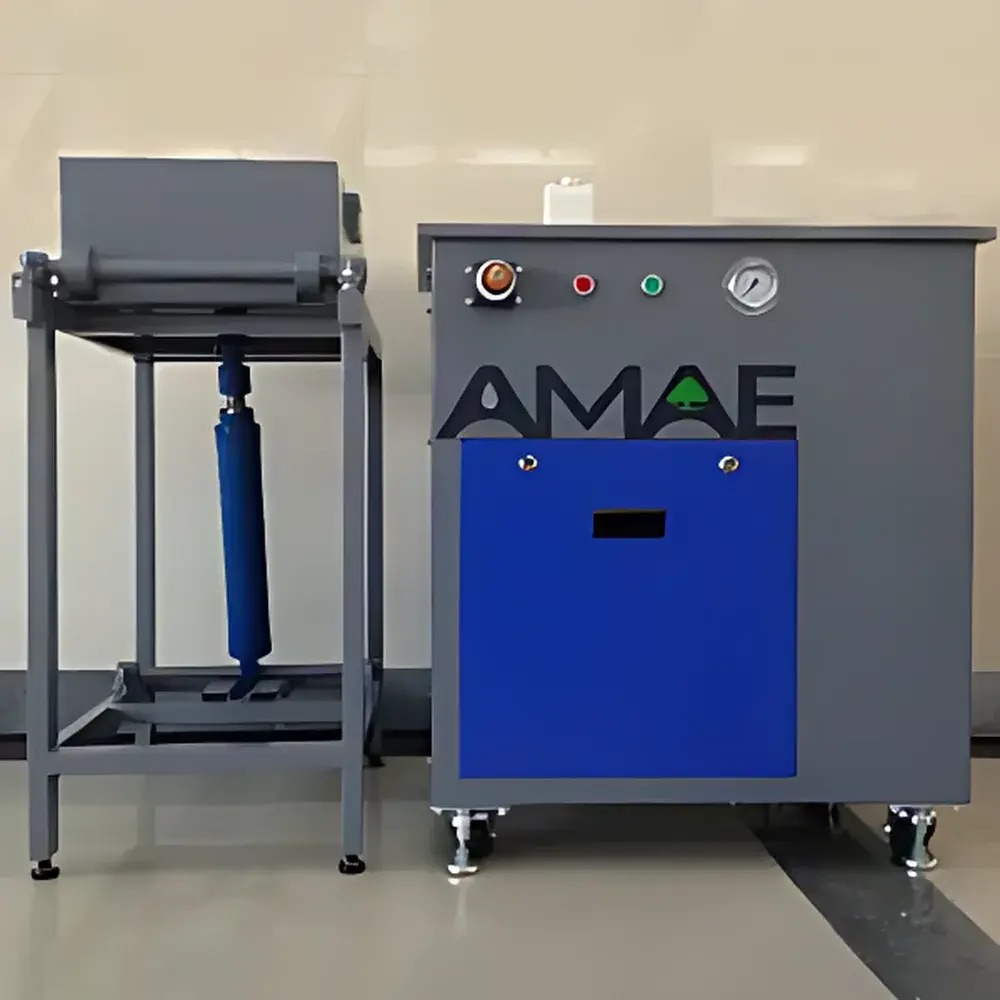
AMAE MI-600 Static Angle of Repose Tilt Box Tester
| Brand | AMAE |
|---|---|
| Model | MI-600 |
| Origin | Guangdong, China |
| Drive System | Hydraulic Accumulator |
| Tilt Range | 0–50° |
| Tilt Speed | Adjustable ≤ 0.3°/s |
| Angular Resolution | ≤ 0.5° |
| Test Chamber Dimensions | 600 × 400 × 200 mm (L×W×H) |
| Hydraulic Accumulator Dimensions | 500 × 500 × 450 mm (L×W×H) |
| Weight | 150 kg |
| Max Hydraulic Pressure | < 50 kPa/cm² |
| Sample Type | Non-cohesive granular solids ≤ 10 mm particle size |
Overview
The AMAE MI-600 Static Angle of Repose Tilt Box Tester is a precision-engineered instrument designed to determine the static angle of repose for non-cohesive, free-flowing granular materials in accordance with the International Maritime Solid Bulk Cargoes (IMSBC) Code. Unlike pneumatic or motor-driven tilt mechanisms—prone to inconsistent angular acceleration and uncontrolled deceleration—the MI-600 employs a hydraulic accumulator-based actuation system that delivers smooth, vibration-free, and fully controllable tilting motion. This architecture eliminates transitional overshoot and dynamic inertia effects during the critical transition from static to incipient flow, thereby ensuring high reproducibility in identifying the exact onset of bulk material slippage. The static angle of repose is defined as the maximum stable inclination angle at which a granular pile remains stationary before initiating continuous downslope movement; it serves as a fundamental physical parameter for assessing flowability, segregation tendency, and handling safety in bulk solid transportation, storage, and processing.
Key Features
- Hydraulic accumulator-driven tilt mechanism enabling stepless, low-inertia angular control with adjustable speed ≤ 0.3°/s—optimized to prevent mechanical disturbance during the threshold detection phase.
- Precision angular positioning system with resolution ≤ 0.5°, verified via calibrated optical encoder feedback and traceable to national metrological standards.
- Rigid aluminum alloy test chamber (600 × 400 × 200 mm) featuring removable, flat-bottomed base plate and optically transparent front panel for real-time visual observation and synchronized high-speed imaging.
- Integrated hydraulic pressure regulation module with digital setpoint interface, maintaining system pressure below 50 kPa/cm² to ensure safe, repeatable force application without fluid compressibility artifacts.
- Zero-vibration tilt profile achieved through passive damping and rigid frame mounting—critical for eliminating false triggering caused by substrate resonance or transient inertial forces.
- Compliance-ready mechanical architecture supporting audit trails, calibration logs, and operator authentication protocols required under GLP and ISO/IEC 17025 environments.
Sample Compatibility & Compliance
The MI-600 is validated for use with dry, non-adhesive granular solids having particle diameters ≤ 10 mm—including mineral ores, coal fines, fertilizers, plastic pellets, and pharmaceutical excipients. It strictly adheres to IMSBC Code Section 4.2.1 for determination of angle of repose in maritime bulk cargo risk assessment. The methodology aligns with ASTM D6393–22 “Standard Test Method for Flowability of Powders Using the Angle of Repose”, and supports supplementary evaluation per ISO 4427-2 (plastics pipes) and USP <1174> (powder flow characterization). All structural components comply with RoHS Directive 2011/65/EU and CE machinery directive 2006/42/EC requirements.
Software & Data Management
While the MI-600 operates as a stand-alone hardware platform, its analog angular output signal (0–10 V DC) and digital trigger interface are compatible with third-party data acquisition systems (e.g., LabVIEW, MATLAB, or custom SCADA). Optional firmware upgrade enables timestamped angle logging at 10 Hz sampling rate, with CSV export support for post-test analysis. Calibration certificates include uncertainty budgets compliant with ISO/IEC 17025:2017 Annex A.2, and all measurement records may be integrated into LIMS environments supporting 21 CFR Part 11 electronic signature and audit trail functionality when paired with validated software layers.
Applications
- Maritime safety assessment of bulk cargoes prior to vessel loading, per IMSBC Code mandatory testing requirements.
- Quality control of industrial granules in cement, mining, and agrochemical manufacturing where flow consistency impacts silo discharge reliability.
- R&D screening of powder formulation modifications—e.g., surface treatment, moisture content variation, or particle size distribution shifts—to quantify flow behavior trends.
- Validation of computational discrete element method (DEM) models used in hopper design and conveyor chute optimization.
- Regulatory submission support for FDA, EMA, or PMDA filings requiring documented flow property characterization of solid dosage forms.
FAQ
What standards does the MI-600 comply with for angle of repose measurement?
The instrument implements test procedures aligned with IMSBC Code, ASTM D6393–22, and ISO 4427-2. Its mechanical performance is traceable to national calibration standards.
Can the MI-600 be used for cohesive or moistened powders?
No—it is specifically engineered for non-cohesive, dry granular solids ≤ 10 mm. Cohesive or hygroscopic samples require complementary methods such as shear cell or compressibility testing.
Is external power required for the hydraulic accumulator?
Yes—a standard 220 V AC / 50 Hz supply powers the electric hydraulic pump; the accumulator maintains pressure independently during tilt cycles to eliminate servo-induced torque fluctuations.
How is angular accuracy verified and maintained?
Each unit ships with a NIST-traceable angular calibration certificate. Field verification uses an optical inclinometer with ±0.1° uncertainty, and routine checks are recommended every 100 test cycles or quarterly.
Does the system support automated data capture and reporting?
Native automation requires integration with external DAQ hardware and software. Optional OEM firmware add-ons provide basic USB-serial logging and PDF report generation with configurable metadata fields.
Related Products



