
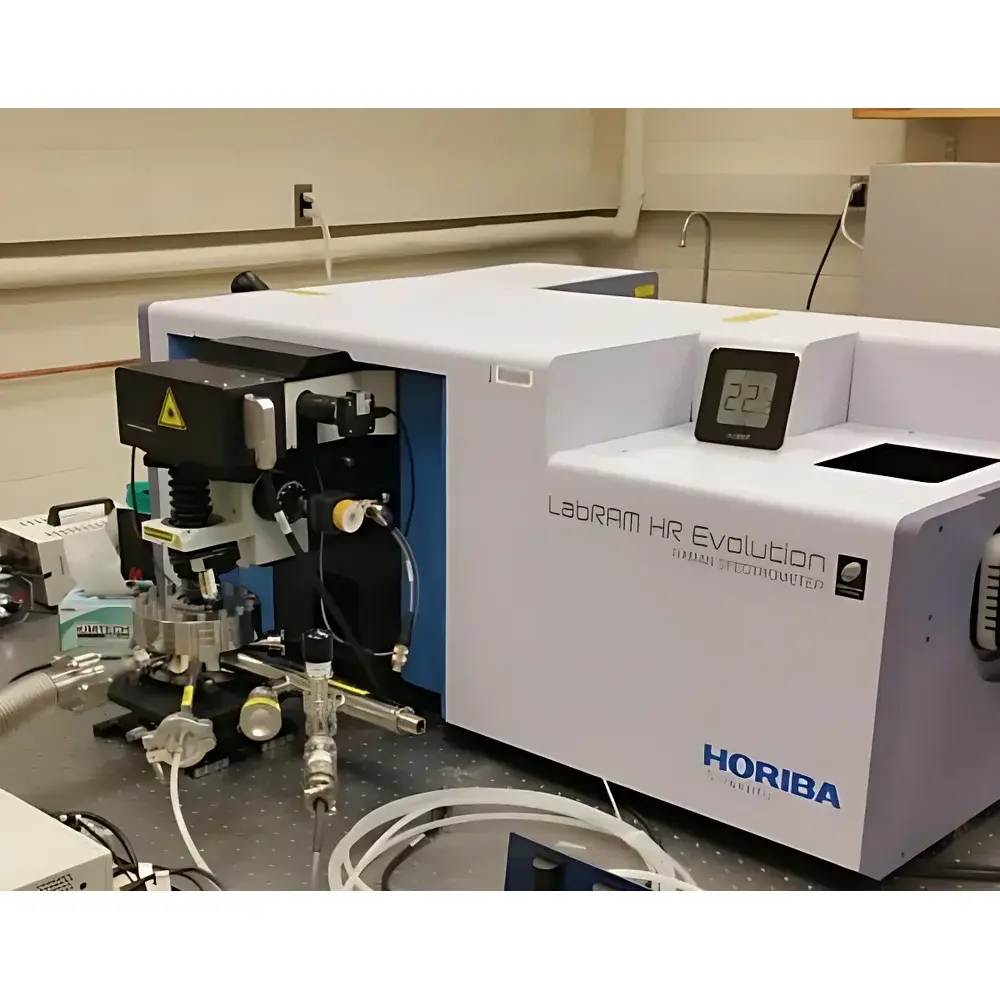
American Research Systems LT3B-OM Ultra-High Vacuum Microscope-Compatible Continuous-Flow Cryogenic Thermostat
| Brand | ARS |
|---|---|
| Origin | USA |
| Model | LT3B-OM |
| Operating Temperature Range | 1.7 K (pumped He) to 300 K |
| Base Temperature (liquid helium) | 4.2 K |
| Helium Consumption | 0.7 L/hr at 4.2 K |
| Compatible Cryogens | Liquid helium (4.2 K), pumped helium (1.7 K), liquid nitrogen (77 K) |
| Vibration Level | Nanoscale (sub-10 nm RMS, isolated from cryogen flow) |
| Bakeable to | 150 °C |
| Sealing | Oxygen-free copper gaskets on all UHV flanges |
| Optical Access | Interchangeable windows with customizable materials (e.g., fused silica, CaF₂, sapphire) |
| Sample Stage | Flat, electrically isolated, height-adjustable (±1.52″ range) |
| Temperature Sensing | Calibrated silicon diode (±12 mK accuracy, 4-ft lead), control-grade silicon diode (±0.5 K), 36 Ω foil heater |
| Electrical Feedthrough | 10-pin hermetic connector |
| Radiation Shield | Nickel-plated OFHC copper |
| Included | LT3-OM cold stage, coaxial flow helium transfer line, stainless-steel instrument panel, dewar adapter, flow control board, radiation shield |
Overview
The American Research Systems (ARS) LT3B-OM is a purpose-engineered ultra-high vacuum (UHV) compatible continuous-flow cryogenic thermostat designed specifically for integration with high-resolution optical microscopes and Raman spectrometers operating under stringent vacuum and vibration-sensitive conditions. Based on the proven coaxial laminar-flow cooling architecture, the LT3B-OM delivers stable, low-vibration thermal environments from 1.7 K (under pumped liquid helium) to 300 K, with base operation at 4.2 K using standard liquid helium supply. Its core thermal design employs matrix heat exchange between the incoming helium vapor and outgoing cold helium gas, significantly improving thermal efficiency while minimizing mechanical perturbation. All UHV-compatible flanges utilize oxygen-free copper (OFHC) gasket seals and are rated for in-situ baking up to 150 °C—ensuring compatibility with rigorous UHV chamber conditioning protocols. The system’s optical path is optimized through a modular, field-replaceable window assembly, enabling rapid adaptation to varying spectral transmission requirements across UV–IR regimes.
Key Features
- Nanoscale mechanical stability: Engineered with coaxial laminar-flow helium delivery and a nickel-plated OFHC copper radiation shield to suppress acoustic and thermal-induced vibrations below 10 nm RMS—critical for confocal microscopy, tip-enhanced Raman spectroscopy (TERS), and single-photon emission measurements.
- UHV-integrated mechanical architecture: All external and internal interfaces conform to ISO-KF and CF flange standards; copper gasket sealing enables bake-out to 150 °C without compromising vacuum integrity (<1×10⁻¹⁰ mbar typical after bake).
- Height-adjustable sample platform: Precision-machined vertical translation mechanism provides ±1.52″ (±38.6 mm) of fine sample positioning—facilitating precise alignment with microscope objectives or laser foci without breaking vacuum.
- Dual-cryogen flexibility: Fully compatible with liquid helium (4.2 K), pumped helium (1.7 K), and liquid nitrogen (77 K) operation—enabling both quantum-limited and ambient-cryo investigations within a single platform.
- Modular electrical and thermal instrumentation: Includes a 10-pin hermetic feedthrough, calibrated silicon diode sensors (±12 mK for sample measurement, ±0.5 K for PID control), and a 36 Ω surface-mount heater for active temperature stabilization with <50 mK stability over 24 h.
Sample Compatibility & Compliance
The LT3B-OM supports a broad spectrum of solid-state and thin-film samples—including quantum dots, 2D materials (e.g., MoS₂, WSe₂), superconducting heterostructures, and magneto-optical crystals—mounted on its flat, electrically isolated sample stage. Its UHV-rated construction complies with ISO 10110-7 (optical component cleanliness), ASTM E595 (outgassing testing), and meets material traceability requirements per ASME B31.3 for cryogenic service. The system is routinely deployed in laboratories adhering to GLP and GMP-aligned instrumentation management frameworks, with full documentation support for FDA 21 CFR Part 11-compliant temperature logging when paired with optional ARS TC-2000 series controllers.
Software & Data Management
While the LT3B-OM operates as a hardware-integrated subsystem, it is fully compatible with third-party temperature control platforms including Lakeshore 336/350, Mercury iTC, and custom LabVIEW-based DAQ systems. All temperature sensors output analog voltage signals (0–10 V) with NIST-traceable calibration certificates provided for each diode. Optional firmware upgrades enable audit-trail-enabled logging, multi-zone PID tuning, and synchronized triggering with spectrometer acquisition software (e.g., Horiba LabSpec, Witec Project). Data export formats include CSV, HDF5, and TDMS—supporting seamless ingestion into Python (NumPy/Pandas), MATLAB, or commercial statistical analysis suites.
Applications
- Micro-Raman spectroscopy under UHV: Enables phonon-mode mapping of strain and doping in monolayer TMDs with sub-μm spatial resolution at 4 K.
- Cryogenic photoluminescence (PL) and time-resolved PL: Supports picosecond-resolved carrier lifetime studies in perovskite nanocrystals and III–V quantum wells.
- Magneto-optical Kerr effect (MOKE) and Faraday rotation measurements: Stable thermal anchoring allows long-duration magnetic field sweeps (up to ±9 T with split-pair magnets) without thermal drift.
- Scanning probe microscopy (SPM) coupling: Integrated mounting interface accommodates commercial AFM/STM heads with minimal modification; verified compatibility with RHK R9 controller and Scienta Omicron qPlus platforms.
- Quantum emitter characterization: Used in MIT’s Comin Lab for correlating lattice symmetry breaking with polarization-resolved emission from hBN defects at 2 K.
FAQ
What vacuum level is the LT3B-OM rated for, and what outgassing mitigation features does it include?
The LT3B-OM is certified for continuous operation at ≤1×10⁻¹⁰ mbar after 150 °C bake-out. Internal surfaces are electropolished stainless steel; all elastomers are eliminated; OFHC copper gaskets and gold-plated OFHC components minimize hydrogen permeation and water desorption.
Can the LT3B-OM be retrofitted with additional electrical feedthroughs or customized window materials?
Yes—ARS offers factory-configurable options including ZnSe (for mid-IR), MgF₂ (deep UV), or custom AR-coated sapphire windows, alongside 24-pin or coaxial RF feedthrough variants. Lead times apply for non-standard configurations.
Is remote temperature control and monitoring supported?
All sensor outputs are accessible via rear-panel BNC connectors. Ethernet- or USB-enabled temperature controllers (e.g., ARS TC-2000, Lakeshore 350) provide full remote setpoint programming, real-time trending, and alarm-triggered shutdown—fully scriptable via SCPI or Modbus TCP.
How is helium flow optimized to minimize thermal drift during long-duration experiments?
The integrated flow control board implements laminar-flow regulation with pressure-compensated mass flow elements. Combined with the coaxial counterflow heat exchanger, this reduces thermal transients to <5 mK/min during ramping and maintains <±20 mK stability over 72-hour acquisitions.
Does ARS provide installation support and application-specific validation data?
Yes—ARS Field Applications Engineers perform on-site commissioning, including vacuum leak checking, thermal gradient mapping, and vibration spectrum analysis (per ISO 20816-1). Application notes and raw validation datasets (e.g., Raman linewidth vs. temperature, PL intensity decay vs. hold time) are available under NDA.



