
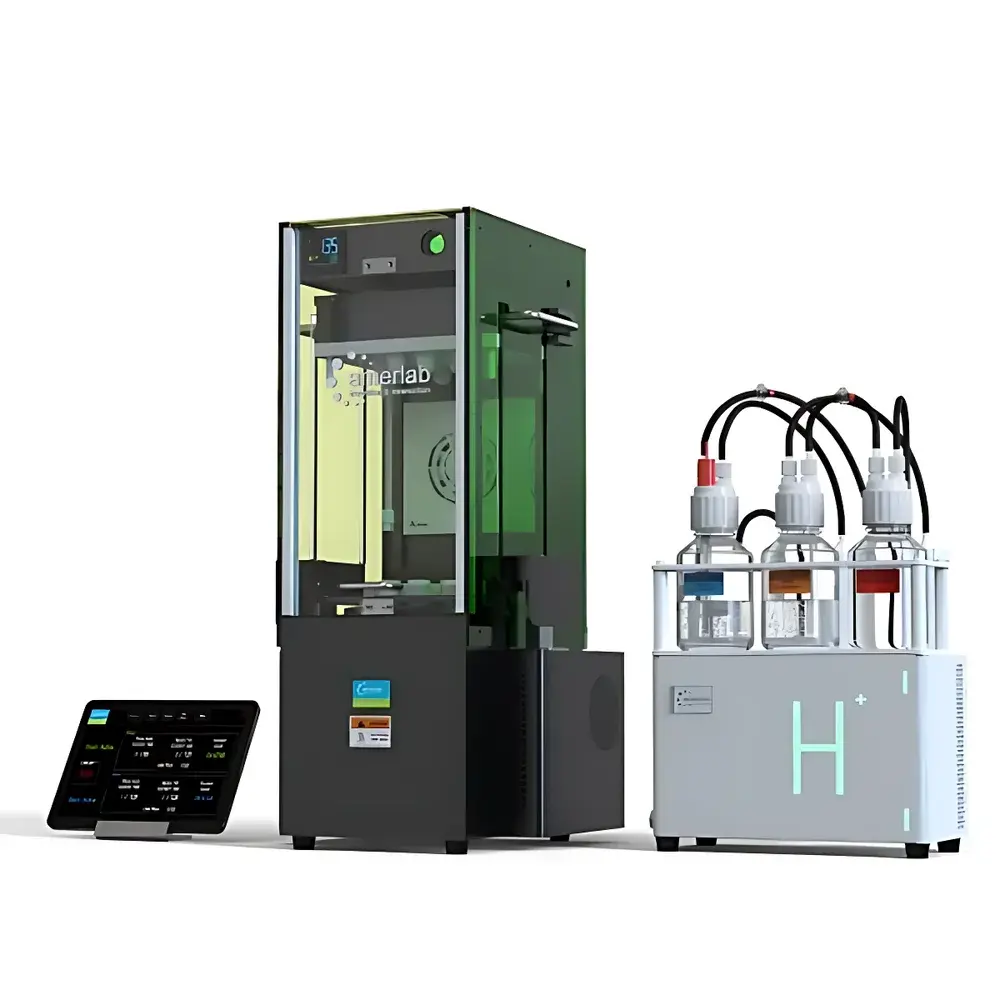
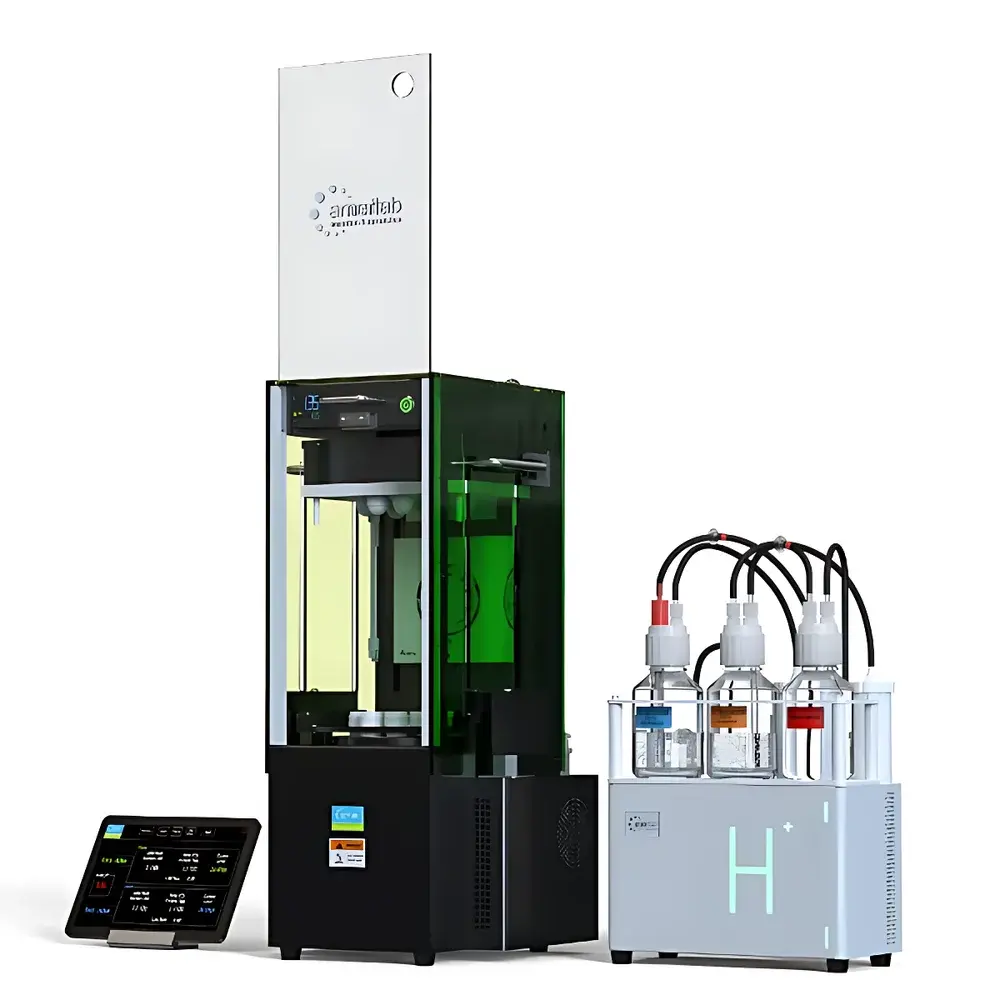
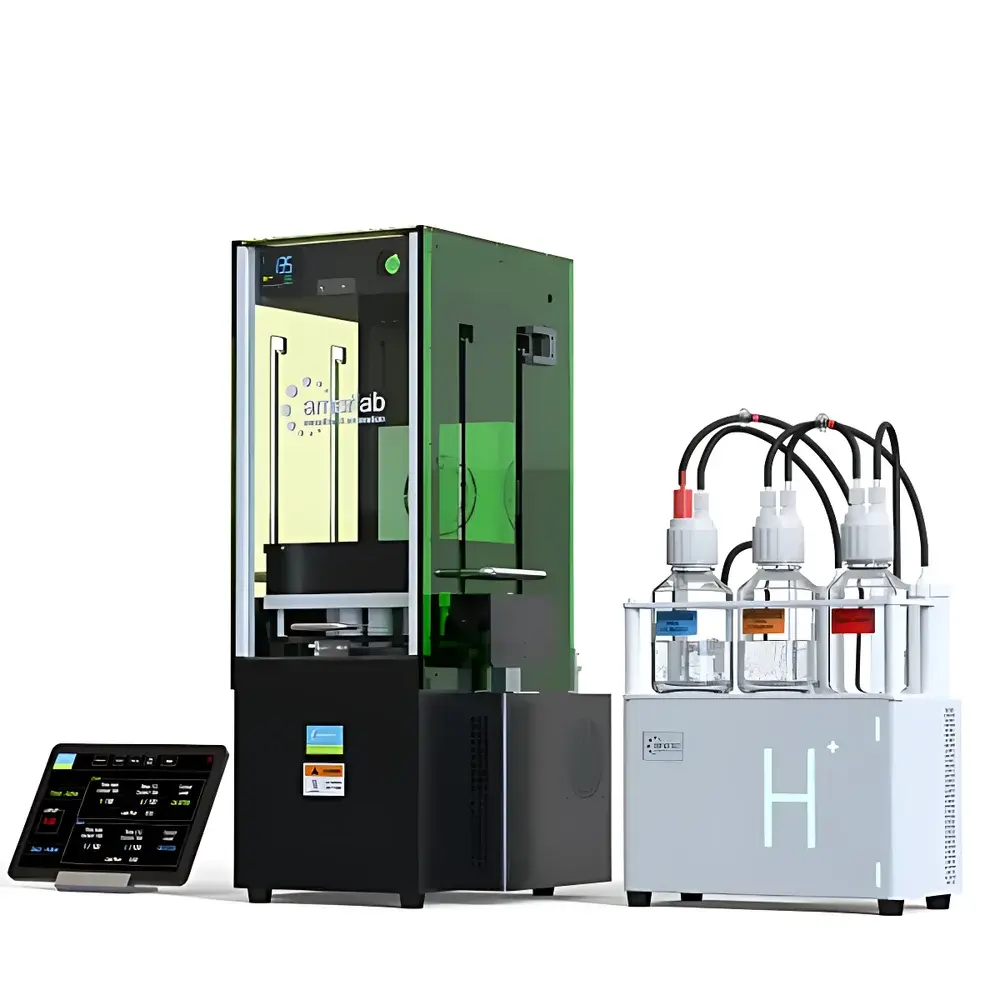
Amerlab AE100 Fully Automated Vacuum Acid Digestion and Concentration System
| Brand | Amerlab |
|---|---|
| Origin | Guangdong, China |
| Manufacturer Type | Direct Manufacturer |
| Country of Origin | China |
| Model | AE100 |
| Instrument Type | Automated Quantitative Concentrator |
| Temperature Range | Ambient to 250 °C |
| Temperature Control Accuracy | ±1 °C |
| Maximum Sample Capacity per Vial | 100 mL |
Overview
The Amerlab AE100 Fully Automated Vacuum Acid Digestion and Concentration System is an engineered solution for trace-element sample preparation in environmental, geological, food safety, and clinical laboratories. It operates on the principle of controlled vacuum-assisted evaporation under programmable thermal conditions—enabling precise removal of excess mineral acids (e.g., HNO₃, HCl, HF, and aqua regia) from microwave-digested or hot-block–digested samples. Unlike open-vessel hotplate evaporation, the AE100 maintains a sealed, negative-pressure environment where volatile acid vapors are continuously drawn through a proprietary multi-stage acid gas abatement module. This design eliminates reliance on fume hoods, prevents cross-contamination of lab ventilation systems, and safeguards analytical instrumentation—including ICP-MS, ICP-OES, and AAS—from acid-induced corrosion. The system integrates real-time micro-volume sensing technology capable of detecting residual liquid levels down to ≤0.2 mL under high-temperature, high-acidity conditions—enabling autonomous endpoint recognition without manual intervention.
Key Features
- Fully automated operation with integrated lid-sealing module: one-step loading/unloading of up to 20 digestion vessels (e.g., 50 mL or 100 mL quartz or PFA vials)
- Precision temperature control (±1 °C) across a wide range (ambient to 250 °C), optimized for both rapid acid removal and gentle analyte preservation
- Proprietary sub-milliliter level-sensing technology—patented PTFE/PFA-compatible capacitive sensor—operational under concentrated HNO₃ at >180 °C
- Intelligent endpoint logic: automatically terminates heating upon reaching user-defined final volume (e.g., 1.0 mL), lifts vials from heating zone, and initiates forced-air cooling
- Corrosion-resistant architecture: all fluid-contact surfaces constructed from PFA or PTFE; electronics housed in sealed top compartment with conformal coating; chassis fabricated from 304 stainless steel with black PFA coating
- Modular configuration support: single-unit or dual-unit mode sharing one central acid abatement system and unified software interface
Sample Compatibility & Compliance
The AE100 accommodates standard digestion vessels including borosilicate glass, quartz, and fluoropolymer (PFA/PTFE) tubes up to 100 mL capacity. It supports common acid matrices used in EPA Method 3050B, 3051A, 3052; ISO 11466; and GB/T 22105 (Chinese national standard for soil heavy metal analysis). Its closed-loop acid management system meets local occupational health requirements for acid vapor exposure (OSHA PEL, NIOSH REL) and aligns with laboratory safety best practices outlined in ANSI Z9.5 and CLSI GP31-A5. While not certified to GLP or GMP out-of-the-box, its audit-ready data logs—including timestamped temperature profiles, vacuum pressure traces, endpoint detection events, and acid trap pH monitoring—support validation under 21 CFR Part 11 when deployed with appropriate IT governance controls.
Software & Data Management
The AE100 is operated via a tablet-based graphical user interface connected wirelessly (Wi-Fi 802.11n) at distances up to 30 meters. The software features guided workflow navigation, customizable method templates, and real-time visualization of process parameters (temperature, vacuum level, elapsed time, estimated remaining volume). All operational data—including start/stop timestamps, sensor readings, alarm events, and acid trap neutralization status—are logged in CSV and SQLite formats with immutable timestamps. Remote monitoring and method deployment are supported without requiring continuous network connectivity—the instrument executes preloaded protocols autonomously after initiation. Data export complies with LIMS integration standards via secure FTP or USB transfer.
Applications
- Pre-concentration of environmental digests (soil, sediment, sludge) prior to ICP-MS quantification of As, Cd, Pb, Hg, and U
- Acid matrix adjustment for biological tissue digests to match calibration standard acidity—critical for minimizing polyatomic interferences in quadrupole ICP-MS
- Routine preparation of reference materials (e.g., NIST SRM 1573a Tomato Leaves, GBW07605 Citrus Leaves) with demonstrated >95% recovery for volatile elements including mercury
- High-throughput QC/QA workflows in contract testing labs processing >100 samples per day
- Radiochemical sample preparation where containment of volatile radionuclides (e.g., 210Po) is required
FAQ
What types of acids can the AE100 safely handle?
The system is validated for nitric acid (HNO₃), hydrochloric acid (HCl), hydrofluoric acid (HF), and aqua regia—provided vessels and seals are chemically compatible (e.g., PFA vials for HF).
Does the AE100 require connection to a fume hood?
No. Its integrated acid gas abatement system—comprising condensation, liquid-phase neutralization, real-time pH monitoring, and solid-phase scavenging—eliminates need for external ventilation.
How is method reproducibility ensured across multiple runs?
Through uniform thermal distribution, calibrated vacuum regulation, and vessel-lift timing synchronized to endpoint detection—reducing inter-vial CV to <3.5% for final volume (n=20, target 1.0 mL).
Can the AE100 be validated for regulated environments?
Yes. Full electronic records, configurable audit trails, and deterministic endpoint logic support IQ/OQ/PQ documentation per ISO/IEC 17025 and internal SOP requirements.
Is remote software update supported?
Firmware updates are performed locally via USB drive; no cloud dependency or automatic OTA updates are implemented to ensure data sovereignty and regulatory compliance.



