
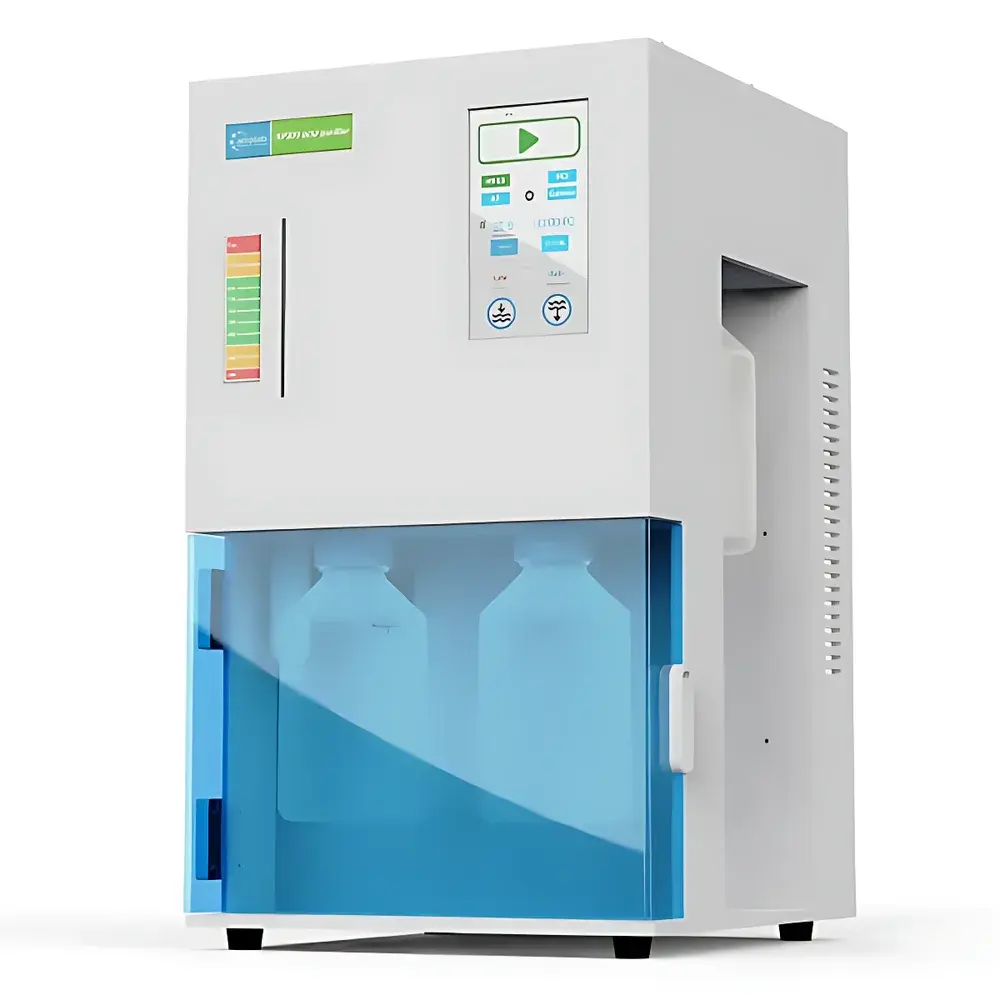
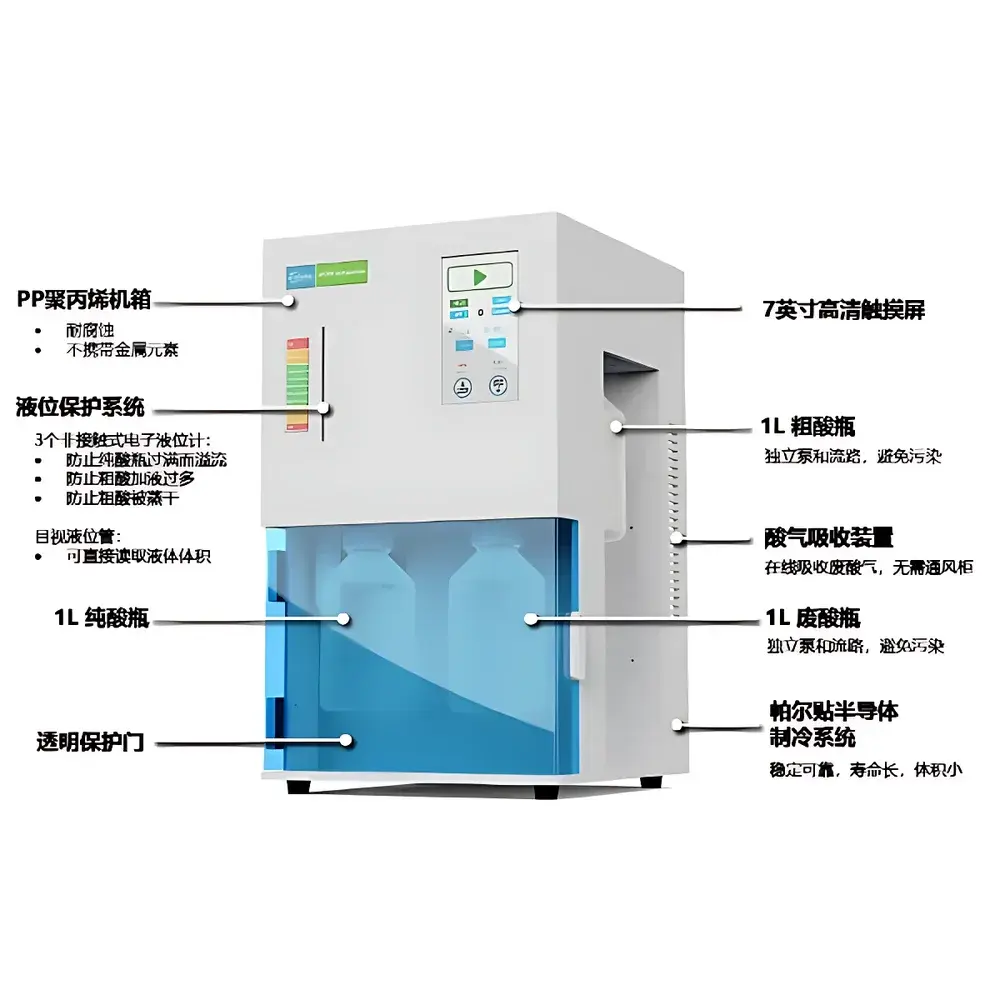
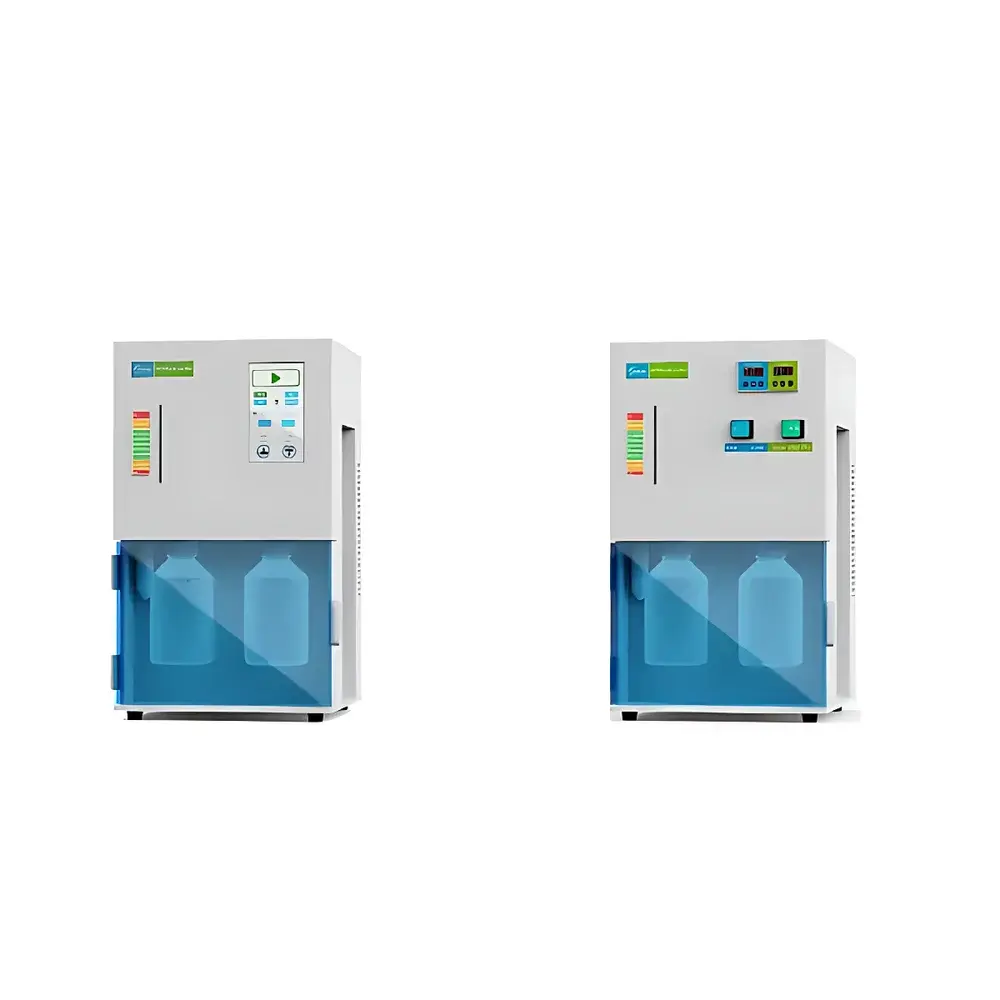
Amerlab AP300 Fully Automated Sub-Boiling Acid Purifier
| Brand | Amerlab |
|---|---|
| Origin | Guangdong, China |
| Manufacturer Type | Direct Manufacturer |
| Country of Origin | China |
| Model | AP300 |
| Instrument Type | Fluoropolymer Distillation System |
| Heating Method | PTC Semiconductor Heating |
| Cooling Method | Integrated Closed-Loop Cooler (No External Chiller Required) |
| Distillation Rate | 70 mL/h (for 65% HNO₃) |
| Ramp Time | 60 min (25°C to 110°C) |
| Endpoint Control | Precision Photoelectric Liquid-Level Sensor |
| Heating Element | PTC Semiconductor Heater |
| Material Construction | PFA/PTFE-lined Chamber & Fluid Pathways |
| Safety Features | Dual Liquid-Level Monitoring (Feed/Pure Acid), Dry-Run & Overflow Prevention, Redundant Temperature Sensing, Onboard Acid Gas Neutralization System (99% Efficiency) |
| Dimensions | 38 × 35 × 60 cm (W × D × H) |
Overview
The Amerlab AP300 Fully Automated Sub-Boiling Acid Purifier is an engineered solution for laboratories requiring ultra-high-purity mineral acids—specifically for trace and ultra-trace elemental analysis by ICP-MS, ICP-OES, AAS, and HG-AFS. It operates on the principle of sub-boiling distillation: heating acid solutions below their atmospheric boiling point to minimize volatile impurity carryover while maximizing condensation efficiency of purified vapor. Unlike conventional boiling distillation, sub-boiling conditions suppress splashing, foaming, and aerosol formation—critical for preserving low ng/L background integrity in analytical blanks. The AP300 achieves this through real-time liquid-phase temperature monitoring via a chemically resistant RTC (Real-Temperature Calibration) probe immersed directly in the acid bath—not merely measuring heater surface temperature—ensuring precise thermal control within ±0.5°C across the operational range (25–110°C). This guarantees consistent sub-boiling operation regardless of ambient fluctuations or acid composition variability.
Key Features
- Fully automated dual-pump, dual-path fluid handling: independent feed and waste circuits prevent cross-contamination between crude acid input and purified acid output.
- Integrated closed-loop cooling system eliminates dependency on external chillers or tap water, enabling deployment in labs with limited infrastructure.
- Photoelectric liquid-level sensors monitor feed reservoir, distillation chamber, and collection vessel in real time—triggering automatic shutdown upon low-feed, overfill, or overflow conditions.
- Onboard acid gas abatement module uses layered neutralization (alkaline scrubbing + activated carbon adsorption) to capture >99% of emitted HNO₃, HCl, and HF vapors—permitting safe operation outside fume hoods.
- Graphical touchscreen interface with preloaded methods for HNO₃, HCl, and HF; supports user-defined protocols with password-protected administrator access.
- PTC semiconductor heating elements provide self-regulating thermal stability—no external thermostat required—and inherently limit maximum temperature under fault conditions.
- Entire wetted path constructed from high-purity PFA and PTFE, compliant with ASTM D5127 and ISO 15195 requirements for ultratrace metal analysis.
Sample Compatibility & Compliance
The AP300 is validated for purification of nitric acid (up to 65%), hydrochloric acid (up to 37%), and hydrofluoric acid (up to 49%). All contact surfaces meet USP Class VI biocompatibility standards and are certified free of detectable metals (As, Cd, Cr, Cu, Fe, Pb, Ni, Zn < 0.1 ppt by ICP-MS). The system supports GLP/GMP-aligned workflows through built-in audit trail logging (user actions, method parameters, run timestamps, temperature/level curves) compliant with FDA 21 CFR Part 11 requirements when paired with validated LIMS integration. It conforms to ISO/IEC 17025 clause 5.5.2 for equipment suitability verification and satisfies ASTM D5127 Annex A1 criteria for blank acid purity in environmental and clinical trace metal testing.
Software & Data Management
The embedded control software records full process metadata—including real-time temperature profiles, liquid-level trajectories, pump actuation cycles, and endpoint detection events—for each purification run. Data export is supported via USB 2.0 in CSV and PDF formats. Optional Ethernet connectivity enables remote monitoring and centralized data aggregation into laboratory information management systems (LIMS). Audit trails are cryptographically timestamped and non-erasable; modifications require dual-factor authentication. Software updates are delivered via secure OTA (Over-The-Air) protocol with SHA-256 signature verification.
Applications
- Preparation of matrix-matched calibration standards and procedural blanks for ICP-MS quantification at sub-pg/g levels.
- Generation of high-purity reagents for EPA Method 200.8, ISO 17294-2, and CLSI EP21-A validation studies.
- Supporting cleanroom-grade acid supply in semiconductor wafer cleaning process development.
- Enabling long-term stability studies of trace element reference materials (e.g., NIST SRM 3100 series).
- Facilitating multi-laboratory intercomparisons where acid batch homogeneity and transport-induced contamination must be excluded.
FAQ
What acid concentrations can the AP300 purify?
The AP300 is optimized for 65% HNO₃, 37% HCl, and 49% HF. Other acids—including perchloric and sulfuric—may be processed with prior validation and material compatibility assessment.
Does the system require connection to a fume hood or external ventilation?
No. Its integrated acid gas neutralization system meets OSHA PEL and ACGIH TLV thresholds for HNO₃ and HCl exposure without auxiliary exhaust.
How is temperature accuracy verified during operation?
The RTC probe is calibrated against NIST-traceable reference thermometers before shipment and retains calibration stability for ≥12 months under normal use.
Can the AP300 be integrated into automated sample preparation lines?
Yes—via RS-232 or Modbus TCP interfaces for synchronization with robotic liquid handlers and autosamplers.
What maintenance intervals are recommended?
PFA condenser cleaning every 200 hours; PTFE gasket replacement every 12 months; annual full-system performance verification per ASTM E2915.



