
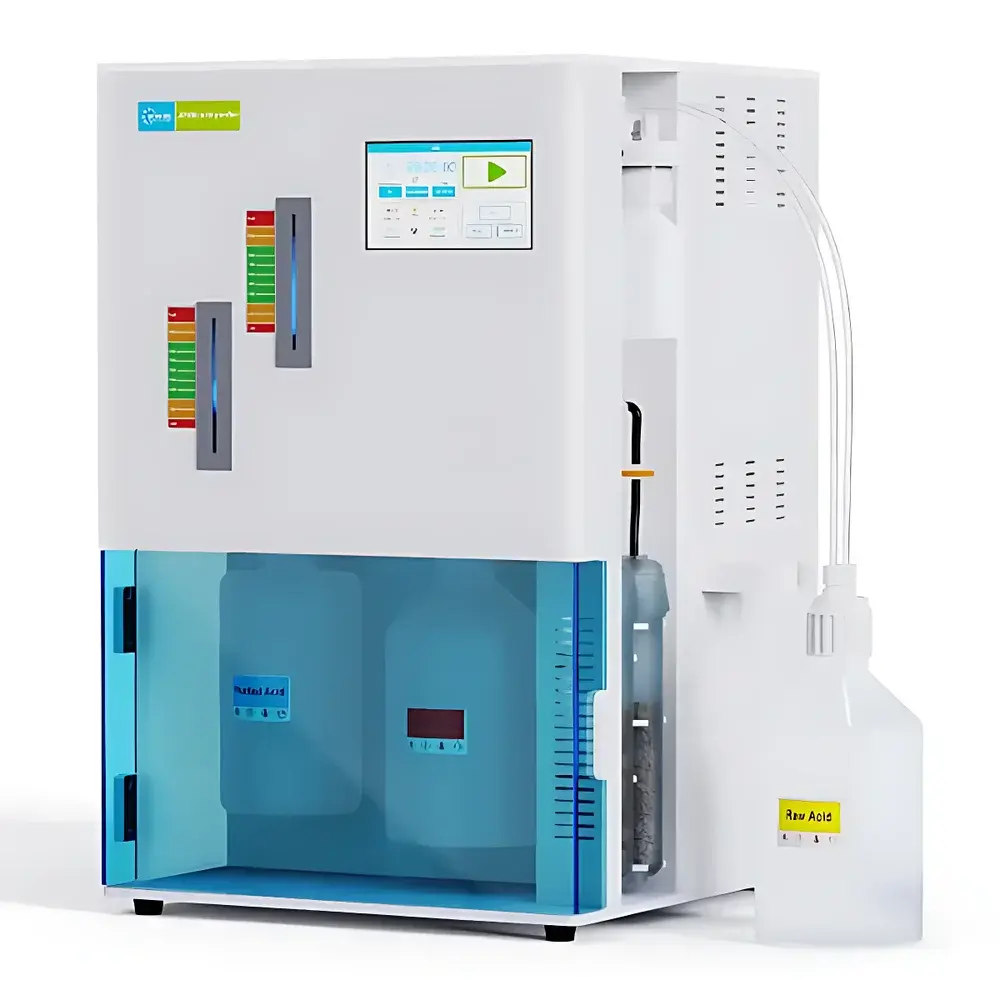
Amerlab AP400 Fully Automated Sub-Boiling Cascade Acid Purification System
| Brand | Amerlab |
|---|---|
| Origin | Guangdong, China |
| Manufacturer Type | Direct Manufacturer |
| Product Category | Domestic |
| Model | AP400 |
| Instrument Type | Fluoropolymer Distillation System |
| Heating Method | PTC Semiconductor Heating |
| Cooling Method | Integrated Closed-Circuit Cooler (No External Chiller Required) |
| Distillation Rate | 45 mL/h |
| Ramp Time | 60 min (Room Temperature to 110 °C) |
| Endpoint Control | Precision Photoelectric Liquid-Level Sensor |
| Heating Element | PTC Semiconductor Heater |
| Compliance | Designed for ISO/IEC 17025-compliant laboratories |
Overview
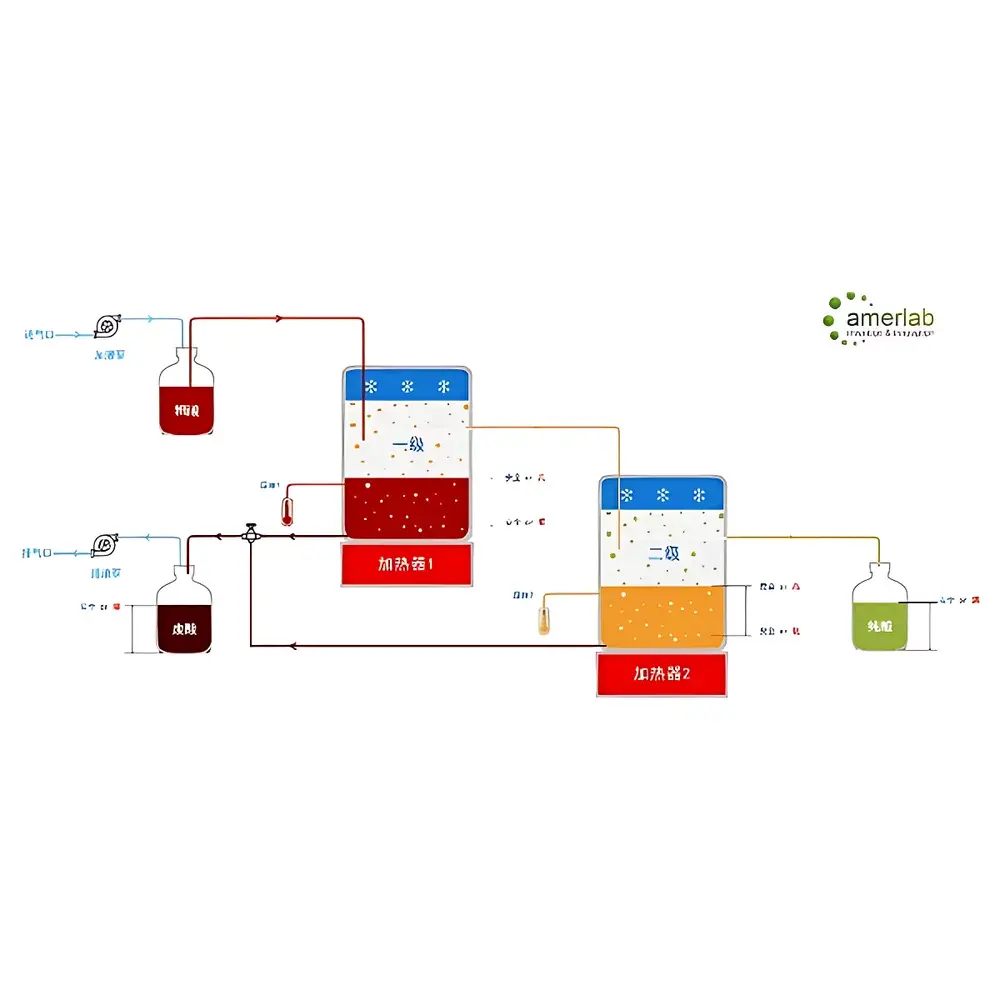
The Amerlab AP400 Fully Automated Sub-Boiling Cascade Acid Purification System is an engineered solution for laboratories requiring ultra-high-purity acids in trace and ultratrace elemental analysis—particularly for ICP-MS, HG-AFS, and semiconductor-grade sample preparation. Unlike conventional single-stage sub-boiling distillers, the AP400 implements a proprietary cascade distillation architecture: two thermally isolated, sequentially coupled fluoropolymer distillation chambers operate under precisely controlled sub-boiling conditions (typically 80–110 °C), enabling sequential volatilization, condensation, and re-distillation without atmospheric exposure. This dual-stage process eliminates residual metal contaminants—including Na, K, Ca, Fe, Cr, Ni, Cu, Zn, Cd, Pb, and rare earth elements—that persist after single-pass purification. The system operates on the principle of fractional volatility separation under inert, low-pressure vapor-phase transport, ensuring reproducible removal of non-volatile and semi-volatile impurities down to single-digit ppt (ng/L) levels in final HNO₃, HCl, HF, and H₂O outputs.
Key Features
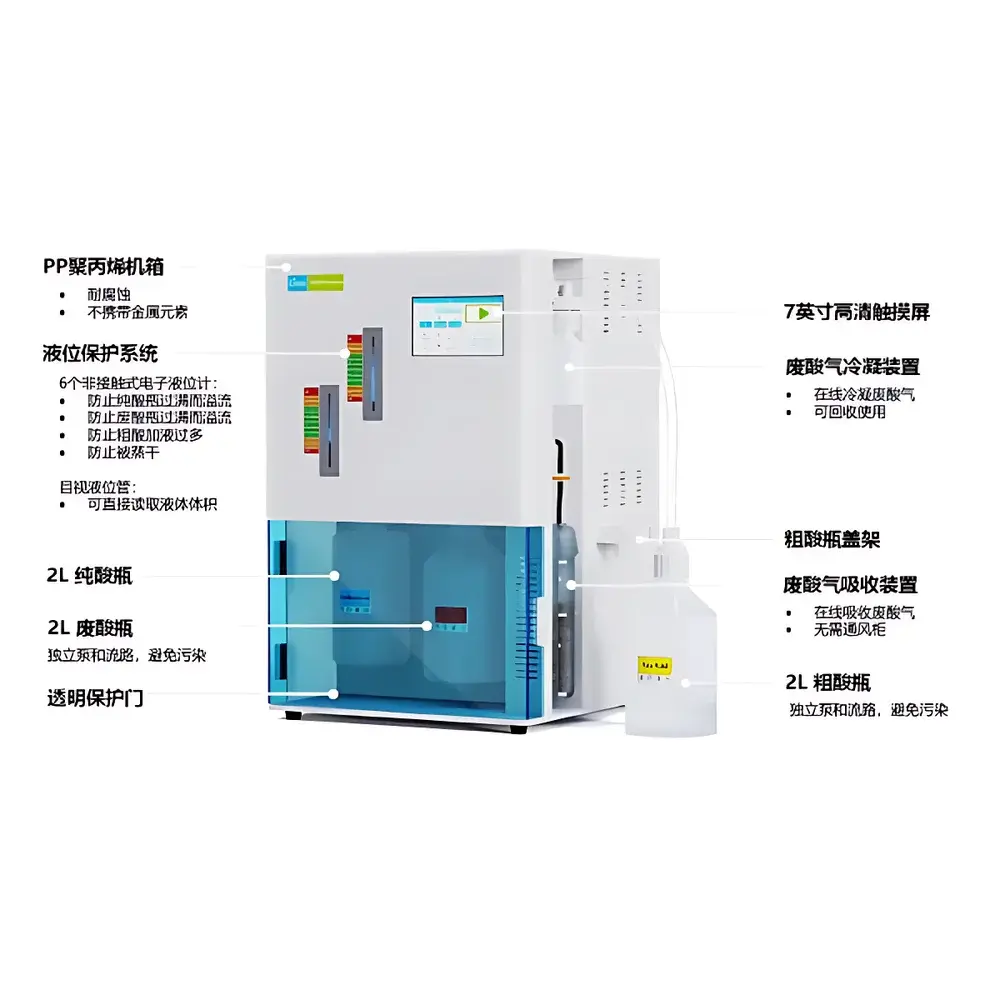
- Fully automated cascade operation: integrated dual-pump, dual-flow-path architecture enables autonomous acid loading, inter-stage transfer, and waste discharge—no manual intervention required.
- PTC semiconductor heating with embedded thermal cutoff: self-regulating heaters maintain stable sub-boiling temperatures up to 110 °C; maximum fail-safe limit capped at 250 °C (482 °F) to prevent dry-run damage or fire hazard.
- Self-contained cooling: high-efficiency closed-loop condenser eliminates dependency on external chillers or tap water—ideal for labs with limited utility infrastructure.
- Six non-contact photoelectric level sensors: monitor raw acid volume, purified acid accumulation, and waste reservoir status in real time; trigger automatic shutdown upon low feed or overflow conditions.
- Zero-air-contact transfer: all liquid movement occurs through sealed fluoropolymer tubing and peristaltic pumps—preventing airborne particulate ingress, metal adsorption, or CO₂-induced carbonate formation.
- Acid vapor abatement: integrated high-efficiency acid gas scrubber achieves >99% neutralization of volatile acid vapors—enabling safe operation without fume hood ventilation.
- Corrosion-resistant construction: welded polypropylene (PP) chassis and fluoropolymer wetted parts ensure zero metallic leaching; compliant with ASTM D5127 and USP background requirements.
- Intuitive 7-inch HD touchscreen interface: pre-programmed methods for HNO₃, HCl, HF, H₂O, and user-defined protocols; real-time dual-chamber temperature, level, and cycle status monitoring.
Sample Compatibility & Compliance
The AP400 is validated for purification of nitric acid (HNO₃), hydrochloric acid (HCl), hydrofluoric acid (HF), and deionized water (H₂O). All wetted components—including distillation vessels, condensers, transfer lines, and collection flasks—are fabricated from high-purity fluoropolymers (PFA, FEP) and polypropylene, certified to meet ASTM D4327 (ion chromatography grade) and ISO 3696 (Grade 1 water) specifications. The system’s design adheres to principles outlined in ISO/IEC 17025:2017 Clause 5.5.2 (equipment suitability) and supports GLP-compliant data integrity when paired with optional timestamped event logging. While not FDA 21 CFR Part 11–certified out-of-the-box, audit-ready operational logs (start/stop times, temperature profiles, sensor events) can be exported in CSV format for regulatory review.
Software & Data Management
The AP400 operates via embedded firmware with no external PC dependency. All operational parameters—including ramp rate, hold time, target temperature, and endpoint volume—are configurable per method. Cycle history (date/time stamp, acid type, volume processed, error codes) is stored locally for ≥12 months. Optional USB export enables integration into LIMS or QA documentation workflows. For laboratories requiring electronic records compliance, third-party 21 CFR Part 11–compliant software modules are available as add-ons, providing role-based access control, electronic signatures, and immutable audit trails.
Applications
- Preparation of matrix-matched calibration standards for ICP-MS quantitation at sub-ppt detection limits.
- Blank reduction in environmental water, soil digestates, and biological tissue extracts.
- Etchant and rinse solution generation for semiconductor wafer cleaning (SEMI F57-0302 compliant).
- Ultra-trace metal analysis in pharmaceutical excipients per ICH Q3D guidelines.
- Reference material certification workflows requiring ≤5 ng/L background for 22 elements (e.g., CRMs NIST SRM 3100 series).
- High-throughput QC labs processing >200 samples/week where commercial ultrapure acid costs exceed $3,500/L.
FAQ
What acid types are compatible with the AP400?
HNO₃, HCl, HF, and H₂O are fully supported. Other mineral acids (e.g., H₃PO₄, H₂SO₄) are not recommended due to thermal instability and corrosion risk at sub-boiling temperatures.
Does the AP400 require a fume hood?
No—integrated acid vapor scrubber ensures >99% capture efficiency; installation outside ventilated enclosures is permitted per local EHS assessment.
How often does the system require maintenance?
Annual inspection of PTFE seals, pump tubing, and sensor calibration is recommended; average mean time between failures exceeds 12,000 operating hours.
Can the AP400 be integrated into a laboratory automation network?
Yes—RS-232 and optional Ethernet interfaces support basic remote start/stop and status polling; full SCADA integration requires custom API development.
Is validation documentation provided?
Factory acceptance test (FAT) reports, material certifications (RoHS, REACH), and IQ/OQ templates are included; PQ support is available upon request.



