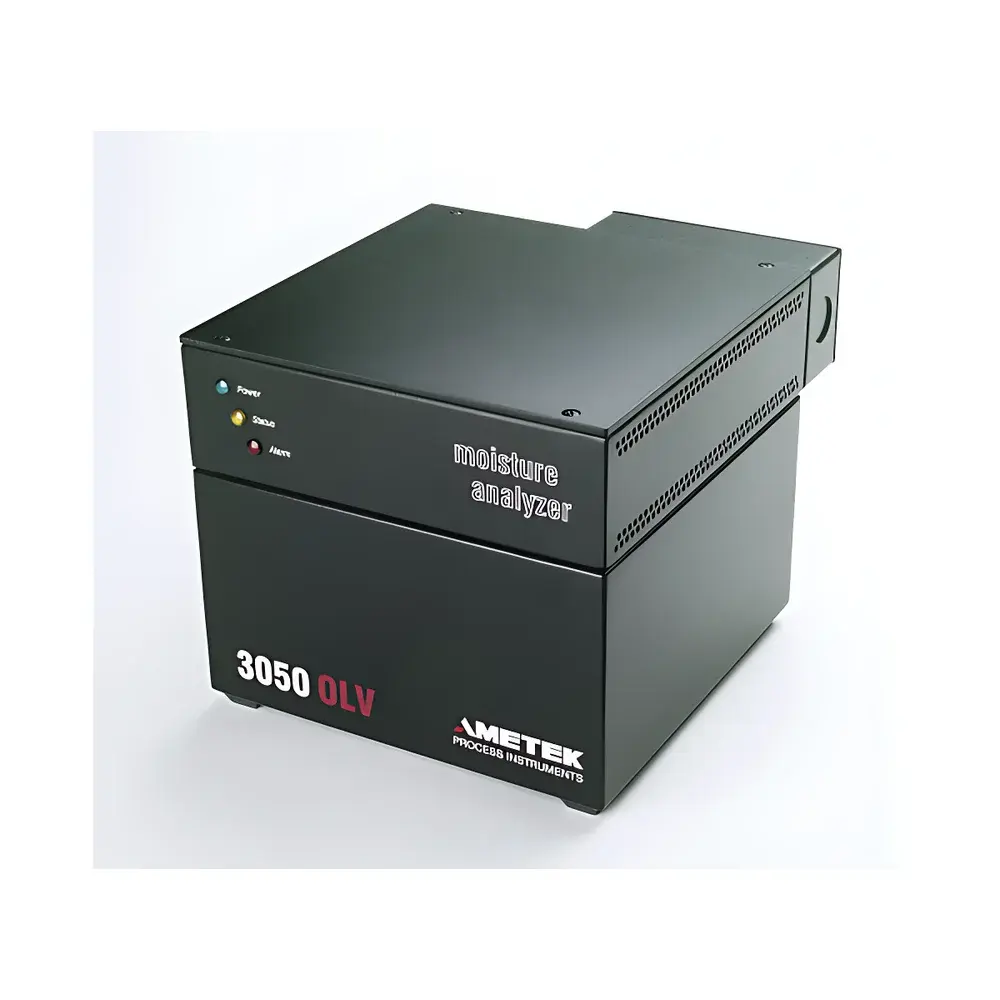
AMETEK 3050-OLV Quartz Crystal Microbalance Moisture Analyzer
| Brand | AMETEK |
|---|---|
| Origin | USA |
| Model | 3050-OLV |
| Measurement Principle | Quartz Crystal Oscillation (QCM) |
| Output Units | ppmv H₂O, °C露点 (Dew Point Temperature at Specified Pressure) |
| Compliance | Suitable for Class I, Div 1 Hazardous Areas (with optional enclosure) |
| Certifications | ATEX, IECEx (optional), UL/cUL Listed |
| Typical Pressure Range | 0.1–10 MPa (user-configurable compensation) |
| Response Time (t₉₀) | < 60 s |
| Detection Limit | < 1 ppmv H₂O in gas streams |
Overview
The AMETEK 3050-OLV is a high-stability, trace moisture analyzer engineered for continuous, real-time quantification of water vapor concentration in pressurized industrial gas streams. It employs the fundamental principle of quartz crystal microbalance (QCM) sensing: a precisely calibrated AT-cut quartz crystal oscillator whose resonant frequency decreases linearly with mass loading—here, water molecules selectively adsorbed onto a hydrophilic, gold-coated sensing surface. This gravimetric measurement is inherently absolute and requires no carrier gas or calibration drift correction over time. The instrument internally compensates for process temperature and pressure to compute and report both volumetric water concentration (ppmv H₂O) and equivalent dew point temperature at user-defined reference pressures—critical for pipeline integrity, hydrate risk assessment, and specification compliance in natural gas transmission, LNG liquefaction, and petrochemical feedstock handling.
Key Features
- Quartz crystal microbalance (QCM) sensor with gold-coated active surface ensures selective, reversible adsorption of water vapor without chemical interference from H₂S, CO₂, hydrocarbons, or common process contaminants.
- Integrated temperature and pressure transducers enable dynamic compensation for process conditions, delivering accurate dew point values referenced to standard or operational pressures (e.g., 7 MPa pipeline pressure or 0.101 MPa ambient).
- Rugged, modular design rated for continuous operation in harsh industrial environments; optional explosion-proof enclosures comply with ATEX Zone 1 and IECEx Ex d IIB+H₂ T4 Gb standards.
- Dual-output digital interface (RS-485 Modbus RTU and 4–20 mA analog) supports seamless integration into DCS, SCADA, and PLC-based control systems for closed-loop drying system monitoring or alarm triggering.
- Onboard data logging (non-volatile memory) retains up to 30 days of 1-minute interval measurements, including raw frequency shift, compensated ppmv, dew point, sensor temperature, and line pressure—enabling retrospective analysis and audit readiness.
Sample Compatibility & Compliance
The 3050-OLV is validated for use with dry-to-moist non-corrosive gases including natural gas (pipeline quality, sour gas with ≤ 500 ppmv H₂S), nitrogen, hydrogen, argon, helium, ethylene, propylene, and syngas. It is incompatible with condensing vapors, aerosols, particulates > 0.3 µm, or strongly oxidizing agents (e.g., chlorine, NOₓ). Sample conditioning is mandatory: inlet stream must be filtered to ISO 8573-1 Class 2 (≤ 0.1 µm particles), pressure-regulated, and maintained above dew point to prevent condensation upstream of the sensor. The analyzer meets requirements for trace moisture monitoring under ISO 8573-8 (compressed air), ASTM D7443 (natural gas water content), and GPA 2172 (hydrocarbon dew point correlation). Data integrity conforms to FDA 21 CFR Part 11 when operated with validated software and electronic signature protocols.
Software & Data Management
Configuration, diagnostics, and historical data retrieval are performed via AMETEK’s proprietary PC-based configuration utility (3050 ConfigTool v3.x), which supports firmware updates, sensor zeroing routines, pressure/temperature coefficient validation, and alarm threshold setup. All operational parameters—including sensor ID, calibration date, pressure compensation settings, and alarm hysteresis—are stored with timestamped audit trails. Export formats include CSV and XML for import into LIMS or enterprise analytics platforms. When integrated with AMETEK’s optional Process Analytics Gateway (PAG-1), the device supports OPC UA server functionality, enabling secure, encrypted data exchange compliant with ISA-95 and NIST SP 800-82 guidelines.
Applications
- Natural gas custody transfer and pipeline dehydration monitoring—ensuring compliance with ≤ 7 lb/MMscf (≈ 3.5 ppmv) water specifications per AGA Report No. 8.
- LNG plant feed gas conditioning—verifying moisture removal prior to cryogenic heat exchangers to prevent ice and hydrate formation.
- Refinery fuel gas and hydrogen purification loops—detecting breakthrough in desiccant beds or membrane dryers.
- Polyolefin reactor purge gas monitoring—controlling catalyst poisoning risk in Ziegler–Natta and metallocene processes.
- Electronics-grade nitrogen blanketing systems—maintaining < 1 ppmv H₂O for semiconductor wafer fabrication environments.
FAQ
How does the QCM principle differ from aluminum oxide or tunable diode laser (TDL) moisture analyzers?
Unlike capacitive aluminum oxide sensors—susceptible to hysteresis and drift—the QCM method provides direct mass-based measurement with no baseline drift. Compared to TDL, it offers superior sensitivity below 10 ppmv and immunity to optical interference from particulates or window fouling, though it requires periodic zeroing in ultra-dry gas.
Is field calibration required?
No routine calibration is needed; the sensor operates on a fundamental physical constant (mass–frequency relationship). Zero verification using certified dry nitrogen (≤ 0.1 ppmv H₂O) is recommended every 6 months or after maintenance.
Can the 3050-OLV measure liquid-phase water?
No—it is strictly a gas-phase analyzer. Liquid water contact will damage the quartz crystal and invalidate measurement integrity.
What maintenance intervals apply?
Filter elements require replacement every 3–6 months depending on particulate load; the QCM sensor typically operates > 24 months between factory recalibration under stable operating conditions.
Does it support SIL2 functional safety certification?
The base unit is not SIL-certified; however, it may be incorporated into a SIL2 loop when paired with certified logic solvers and configured per IEC 61511 requirements for moisture-related shutdown triggers.
Related Products