
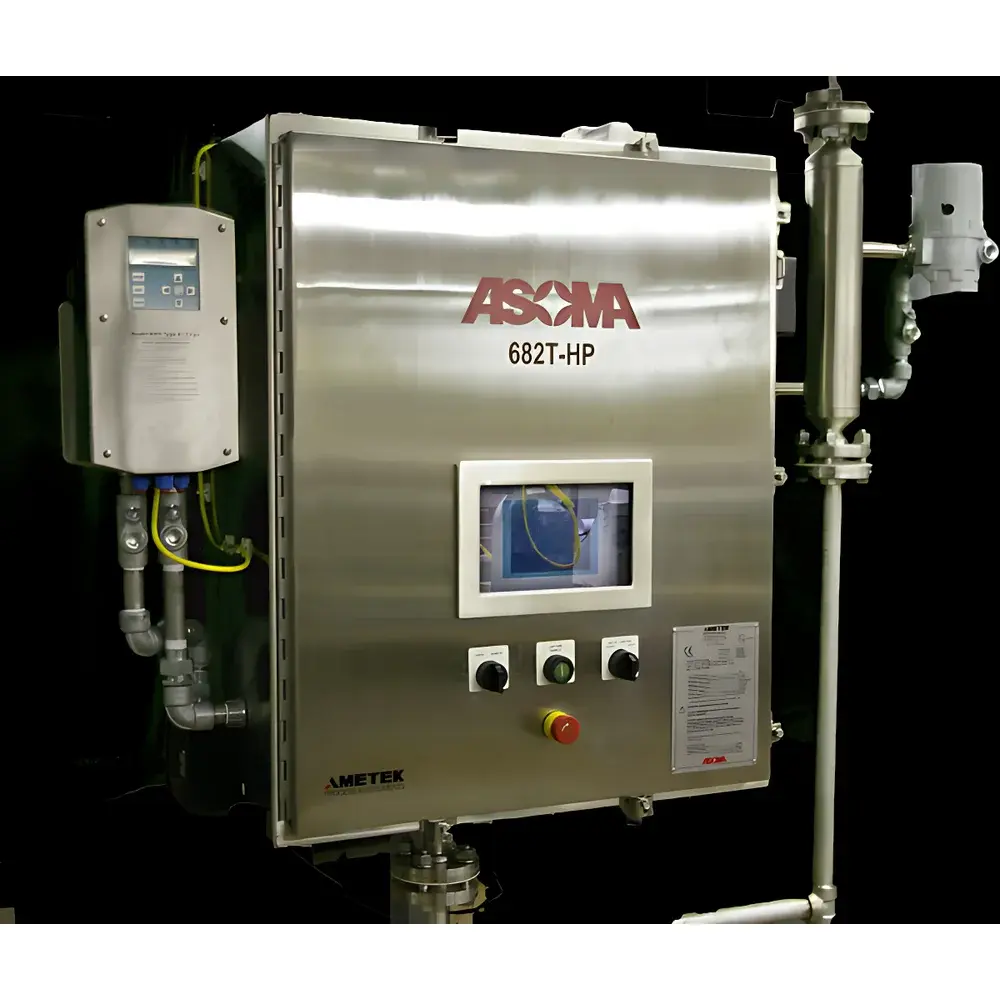
AMETEK 682T-HP High-Pressure Total Sulfur Analyzer
| Brand | AMETEK |
|---|---|
| Origin | USA |
| Model | 682T-HP |
| Sample Temperature Range | Up to 200°C (392°F) |
| Maximum Sample Pressure | >1500 psig |
| Optical Path Window Diameter | 5 cm |
| Sulfur Detection Range | 0.02–6.0 wt% |
| Application Focus | Crude Oil, Heavy Hydrocarbons, Pipeline Streams, Refinery Blending Processes |
| Compliance | Designed to meet internal industry specifications for refinery and midstream process monitoring |
Overview
The AMETEK 682T-HP High-Pressure Total Sulfur Analyzer is an ultraviolet fluorescence (UVF)-based analytical instrument engineered for continuous, real-time quantification of total sulfur content in high-viscosity hydrocarbon streams under elevated pressure and temperature conditions. It operates on the principle of oxidative combustion followed by UV fluorescence detection: sample hydrocarbons are atomized, combusted in a high-efficiency quartz furnace at controlled stoichiometric oxygen levels, and converted quantitatively to sulfur dioxide (SO₂). The SO₂ is then carried into a reaction chamber where it is excited by pulsed UV light; the resulting fluorescence emission at 320–380 nm is measured with a photomultiplier tube (PMT), enabling highly selective and linear response across the specified range. Unlike conventional benchtop analyzers, the 682T-HP integrates a robust, thermally stabilized optical cell with a large-diameter (5 cm) sapphire window engineered to resist fouling from paraffinic deposits, asphaltene carryover, or wax precipitation—common challenges in crude oil, heavy fuel oil, and pipeline transfer applications.
Key Features
- High-pressure optical cell rated for sustained operation above 1500 psig, eliminating need for external pressure reduction or sample dilution.
- Integrated high-temperature sample conditioning system supporting inlet temperatures up to 200°C (392°F), minimizing condensation and phase separation in viscous feedstocks.
- Large-diameter (5 cm) sapphire optical window with anti-fouling geometry and optional thermal purge gas manifold to extend maintenance intervals in paraffin-prone environments.
- UV fluorescence detection with dual-stage PMT amplification and digital signal processing, delivering stable baseline performance and low drift (<0.5% RSD over 72 h).
- Modular combustion furnace with ceramic insulation and precision-controlled air/oxygen mixing, ensuring complete sulfur oxidation even for refractory organosulfur compounds (e.g., dibenzothiophenes).
- Self-diagnostic firmware with real-time fault logging, lamp intensity monitoring, and automatic zero/span validation triggers aligned with ASTM D5453 and ISO 20846 compliance workflows.
Sample Compatibility & Compliance
The 682T-HP is validated for direct analysis of undiluted, unfiltered liquid hydrocarbon samples including crude oils, vacuum residua, heavy fuel oils, and multiphase pipeline blends. Its pressure-tolerant flow path accommodates variable viscosity (up to 500 cSt at 40°C) without pump cavitation or metering error. The analyzer meets functional requirements referenced in ASTM D5453 (Standard Test Method for Determination of Total Sulfur in Light Hydrocarbons, Spark Ignition Engine Fuels, and Motor Fuels by Ultraviolet Fluorescence), and its architecture supports traceability frameworks required under refinery-specific quality management systems (QMS). While not certified to GLP or FDA 21 CFR Part 11 out-of-the-box, the system’s data acquisition module provides audit-ready timestamped logs, user-access control flags, and configurable electronic signature fields—enabling integration into GMP-aligned laboratory information management systems (LIMS) upon site-specific validation.
Software & Data Management
The 682T-HP runs on AMETEK’s proprietary Analytical Control Suite (ACS) v4.x firmware, accessible via Ethernet-connected HMI or remote OPC UA interface. ACS delivers real-time sulfur concentration trending, automatic calibration curve generation (linear and quadratic), and integrated QC flagging for outlier detection (e.g., signal saturation, pressure deviation >±50 psig, furnace temperature excursion >±5°C). All raw spectral data, event logs, and calibration records are stored in encrypted SQLite databases with daily auto-backup to network shares. Export formats include CSV, XML, and ASTM E1382-compliant analytical data interchange (ADI) files. Optional Modbus TCP and DCS integration kits support seamless incorporation into distributed control environments for closed-loop blending optimization.
Applications
- Crude assay laboratories requiring rapid, repeatable total sulfur profiling across diverse geographical sources prior to desalting and distillation.
- Refinery crude unit charge monitoring to enforce feedstock sulfur caps and optimize hydrotreater hydrogen consumption.
- Midstream custody transfer points where real-time sulfur verification supports contractual compliance and pipeline specification adherence (e.g., API RP 1172).
- Blending operations involving sour crudes, synthetic crudes, or bio-oil co-feeds where heterogeneous sulfur distribution demands high-frequency sampling.
- Research applications investigating sulfur speciation kinetics under thermal stress, when coupled with offline GC-SCD or XANES validation protocols.
FAQ
What sample preparation is required prior to analysis?
None—samples are introduced directly without filtration, dilution, or solvent addition. Viscosity compensation is handled internally via pressure-regulated flow control and heated transport lines.
Can the 682T-HP measure sulfur in gaseous or two-phase streams?
It is designed exclusively for liquid-phase hydrocarbons. Gas-phase or vapor-liquid mixtures require upstream phase separation or dedicated gas-phase analyzers (e.g., AMETEK 906G).
How frequently must the optical window be cleaned?
Under typical crude oil service, cleaning intervals exceed 1,000 operating hours; extended intervals (>3,000 h) are achievable with thermal purge gas and optimized sample temperature control.
Is method validation support available?
Yes—AMETEK provides application notes, ASTM D5453 alignment documentation, and on-site method transfer assistance for regulatory or internal QA/QC validation programs.
Does the system support remote diagnostics and firmware updates?
Yes—via secure TLS-enabled web interface and AMETEK Remote Support Portal (RSP), with version-controlled firmware patches released quarterly.





