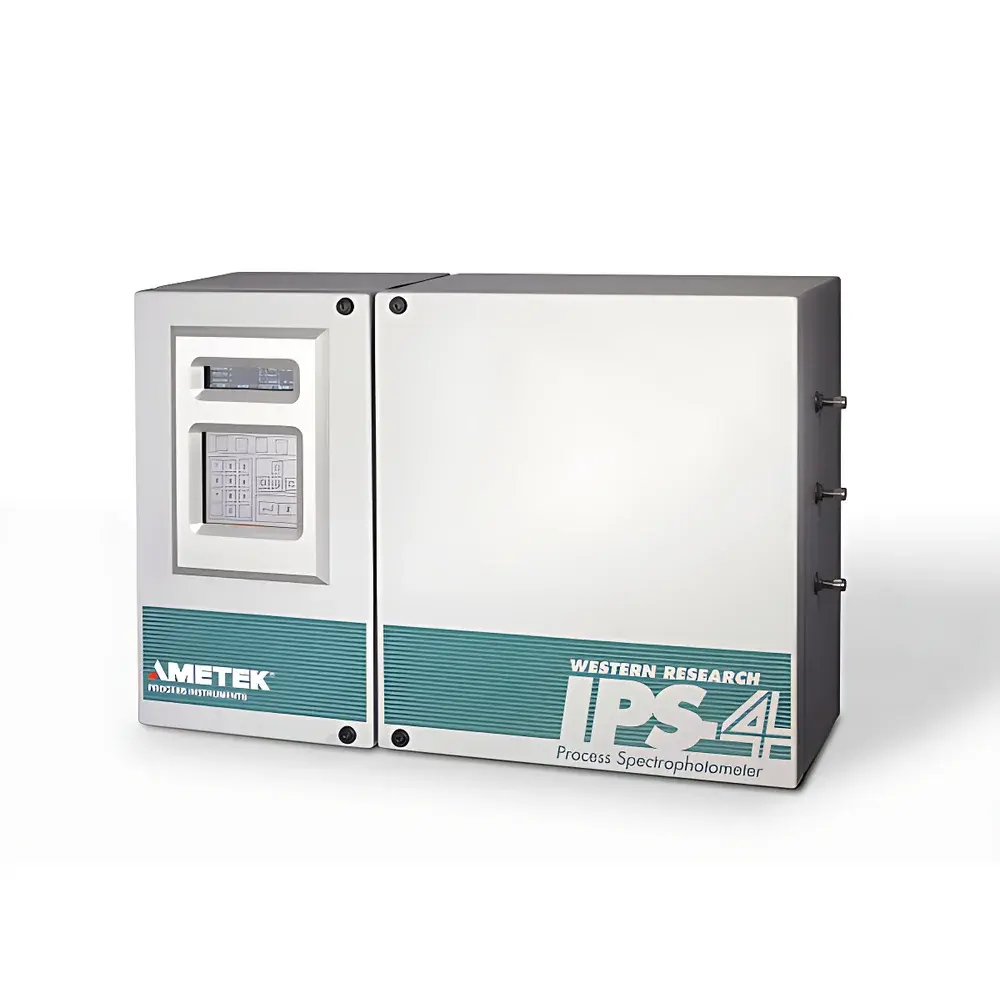
AMETEK IPS-4 UV/IR In-Situ Process Analyzer
| Brand | AMETEK |
|---|---|
| Origin | Canada |
| Model | IPS-4 |
| Measurement Principle | Dual-Wavelength Ultraviolet and Infrared Absorption Spectroscopy |
| Compliance | Designed for hazardous area installation (Class I, Div 1/Zone 1 optional), CE, RoHS, ATEX/IECEx certification available per configuration |
| Sample Interface | In-situ probe or extractive gas cell (standard 1–5 m pathlength) |
| Output | 4–20 mA analog + Modbus RTU/TCP digital interface |
| Environmental Rating | IP66/NEMA 4X enclosure |
Overview
The AMETEK IPS-4 UV/IR In-Situ Process Analyzer is an industrial-grade, dual-spectrum optical analyzer engineered for real-time, continuous measurement of reactive and toxic gases in demanding chemical process environments. Utilizing simultaneous ultraviolet (UV) and infrared (IR) absorption spectroscopy, the IPS-4 enables selective, interference-resistant quantification of multiple analytes—including SO₂, H₂S, NH₃, phosgene (COCl₂), elemental mercury vapor (Hg⁰), fluorine (F₂), chlorine (Cl₂), hydrogen bromide (HBr), hydrogen iodide (HI), chlorine dioxide (ClO₂), bisphenol A (in vapor-phase thermal degradation monitoring), and colorimetric indices—without sample extraction or chemical reagents. Its in-situ probe design eliminates transport delays and condensation artifacts common in extractive systems, delivering sub-second response times and high reproducibility under dynamic process conditions. The analyzer operates on Beer-Lambert law principles, with wavelength-specific photodiodes and thermoelectrically stabilized light sources ensuring long-term photometric stability across temperature fluctuations typical in refinery, chlor-alkali, sulfuric acid, and specialty chemical production facilities.
Key Features
- In-situ or extractive configuration flexibility: Standardized flanged probe (DN50/DN80) for direct pipeline mounting or heated extractive cell for particulate-laden or high-dew-point streams.
- Dual-spectrum optical engine: Independent UV (190–250 nm) and IR (2.5–4.0 µm) channels with precision narrowband interference filters and low-noise detectors, enabling simultaneous multi-analyte detection with minimal cross-sensitivity.
- Robust industrial architecture: Stainless steel (316L) wetted parts, IP66/NEMA 4X-rated enclosure, and optional ATEX/IECEx Zone 1 certification for installation in classified hazardous locations.
- Thermal management system: Integrated Peltier-based temperature stabilization for optical bench and detector array, maintaining spectral calibration integrity over ambient ranges from –20 °C to +55 °C.
- Self-diagnostic capability: Real-time monitoring of lamp intensity, detector signal-to-noise ratio, optical path contamination (via reference beam attenuation), and internal temperature gradients—logged with timestamps for predictive maintenance.
- Field-configurable measurement ranges: Software-defined span settings for each analyte; default factory calibrations traceable to NIST-certified gas standards (e.g., SO₂: 0–100 ppm, Cl₂: 0–50 ppm, NH₃: 0–200 ppm).
Sample Compatibility & Compliance
The IPS-4 is validated for use with corrosive, humid, and particulate-containing process streams typical of sulfur recovery units (SRUs), tail-gas treating (TGT) systems, ammonia synthesis purge gas loops, and halogen-based disinfection processes. It complies with ISO 14644-1 (cleanroom air classification support), ASTM D6348 (standard test method for gaseous pollutants by FTIR—adapted for fixed-wavelength implementation), and supports audit-ready data handling per FDA 21 CFR Part 11 when integrated with AMETEK’s optional SecureLog software module. All firmware and calibration records adhere to GLP/GMP documentation requirements, including electronic signature enforcement and immutable audit trails.
Software & Data Management
The analyzer interfaces via native 4–20 mA outputs (per analyte) and dual-protocol digital communication (Modbus RTU over RS-485 and Modbus TCP over Ethernet). Configuration, calibration, and diagnostics are performed using AMETEK’s web-based IPS Manager application, accessible via secure HTTPS connection. Historical concentration data, diagnostic logs, and calibration event records are exportable in CSV or XML format. Optional integration with DeltaV, Emerson DCS, or Siemens PCS7 systems is supported through certified EDDL and FDT/DTM device packages. Data encryption (TLS 1.2), role-based user access control, and automatic firmware update scheduling ensure cybersecurity alignment with ISA/IEC 62443-3-3 Level 2 requirements.
Applications
- Real-time SO₂ and H₂S monitoring in Claus plant inlet and tail gas streams for optimized catalyst bed control.
- Ammonia slip detection downstream of selective catalytic reduction (SCR) units in nitric acid production.
- Phosgene and ClO₂ concentration verification in pharmaceutical intermediate synthesis reactors.
- Elemental mercury vapor tracking in coal-fired flue gas desulfurization (FGD) bypass ducts.
- Color index trending in polymerization effluent streams containing residual phenolic compounds (e.g., bisphenol A derivatives).
- Halogens (F₂, Cl₂, HBr, HI) quantification in semiconductor etch gas delivery lines and waste abatement scrubbers.
FAQ
Can the IPS-4 measure multiple gases simultaneously without cross-interference?
Yes—the dual UV/IR optical architecture employs spectrally resolved detection at analyte-specific absorption peaks, and proprietary multivariate correction algorithms compensate for known spectral overlaps (e.g., H₂S and SO₂ in UV region; NH₃ and H₂O in IR region).
Is field recalibration required after installation?
No routine recalibration is needed for stable process conditions; however, a zero/span verification using certified span gases is recommended every 3–6 months per ISO 14064-3 and EPA Method 205 guidelines.
What maintenance intervals apply to the optical probe?
The sapphire window requires visual inspection every 90 days; cleaning with IPA-soaked lint-free swab is sufficient unless exposed to heavy fouling (e.g., tar-laden syngas). Lamp lifetime exceeds 24,000 hours.
Does the IPS-4 support SIL2 functional safety certification?
While the base unit is not SIL2-certified, it may be deployed in SIL2 loops when integrated with third-party safety instrumented systems (SIS) meeting IEC 61511 requirements, using its 4–20 mA safety output channel.
Can the analyzer operate in high-humidity or condensing environments?
Yes—when configured with heated probe housing (optional +60 °C maintenance) and purge air collar, the IPS-4 maintains optical clarity and measurement accuracy in relative humidity up to 95% non-condensing or transient condensation scenarios.