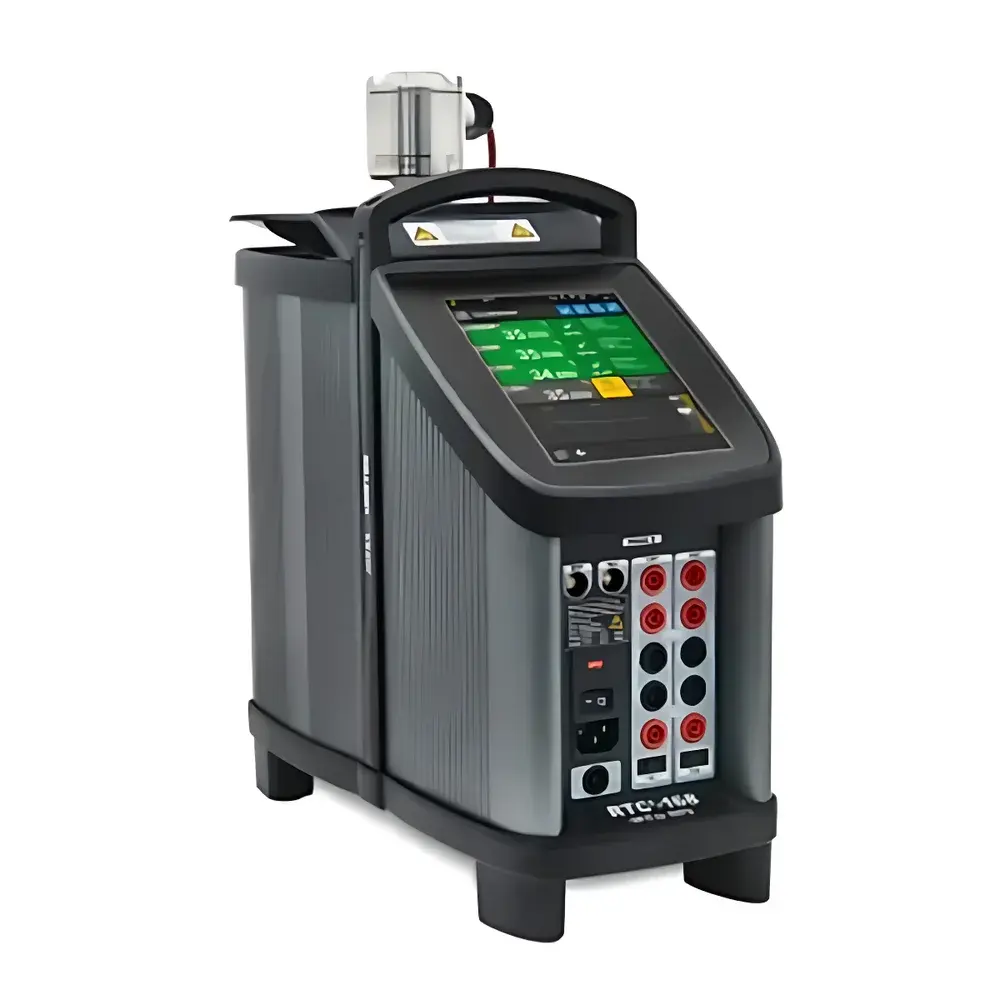
Ametek JOFRA RTCt Series Reference-Grade Dry-Block Calibrator
| Brand | Ametek JOFRA |
|---|---|
| Origin | Denmark |
| Product Type | Reference-Grade Dry-Block Temperature Calibrator |
| Model | RTCt Series |
| Temperature Range | –35 °C to 125 °C (standard block), –35 °C to 660 °C (with optional high-temp block) |
| Display | 7-inch full-color capacitive touchscreen with customizable UI |
| Connectivity | USB, Ethernet, Wi-Fi (IEEE 802.11 b/g/n) |
| Dual Sensor Inputs | Yes (simultaneous dual-channel reference and UUT monitoring) |
| Auto Ramp/Soak Control | Full rate control across all operating modes (ramp, soak, switch, multi-step) |
| Preset Temperatures | Up to 6 user-defined setpoints with nameable calibration profiles |
| Graphical Stability Monitoring | Real-time dual-mode visualization (absolute temperature vs. stability threshold → automatic transition to delta-T relative mode upon stabilization) |
| Multi-Step Switch Calibration | Up to 5 sequential temperature switches per automated sequence |
| Compliance | Designed for ISO/IEC 17025 accredited labs |
Overview
The Ametek JOFRA RTCt Series is a reference-grade dry-block calibrator engineered for metrology laboratories, calibration service providers, and industrial quality assurance teams requiring traceable, high-stability temperature source performance under demanding operational conditions. Unlike conventional dry-well calibrators, the RTCt employs a precision-machined, thermally optimized aluminum or stainless-steel block assembly coupled with a multi-zone PID-controlled heating/cooling system—enabling rapid thermal equilibration and exceptional axial/radial uniformity (< ±0.01 °C over 60 mm depth). Its core measurement architecture integrates dual platinum resistance thermometer (PRT) references (typically 4-wire 100 Ω or 1000 Ω Class A or AA) with real-time cold-junction compensation and self-diagnostic thermal drift correction. The device operates on the principle of thermal equilibrium between the block and inserted sensors, delivering traceable temperature output compliant with ITS-90 via NIST-traceable calibration certificates. With an extended low-temperature capability down to –35 °C—enabled by integrated thermoelectric (Peltier) cooling—the RTCt meets critical requirements for cryogenic sensor verification in pharmaceutical cold-chain validation, aerospace component testing, and environmental chamber qualification.
Key Features
- 7-inch capacitive touchscreen interface with fully configurable layout, multi-language support (EN/DE/FR/ES/CH), and intuitive drag-and-drop calibration workflow builder.
- Dual independent sensor input channels, supporting simultaneous monitoring of reference standard and unit-under-test (UUT), with automatic channel switching and differential error calculation.
- Full-spectrum connectivity suite: native USB host/device, 10/100BASE-T Ethernet with DHCP/static IP, and IEEE 802.11 b/g/n Wi-Fi—enabling remote operation via web browser or JOFRA Cal Software without local PC dependency.
- Intelligent graphical stability engine: automatically transitions display from absolute temperature trend (vs. target ±0.02 °C band) to high-resolution delta-T mode (±0.001 °C resolution) upon detection of thermal equilibrium—eliminating manual interpretation of stability criteria.
- Multi-step automated switch calibration: executes up to five discrete temperature points in sequence—including ramp, soak, and dwell phases—with programmable rates (0.1–10 °C/min), soak durations (1–9999 s), and pass/fail tolerances per step.
- Comprehensive rate control architecture: unlike legacy RTC models limited to ramp control in switch mode, RTCt applies precise rate limiting in all operational modes—including manual setpoint changes and profile-based sequences.
- User-definable calibration presets: store up to six named temperature setpoints with associated ramp rates, soak times, and tolerance bands—reducing setup time for recurring tasks such as RTD verification at 0 °C, 100 °C, and 200 °C.
Sample Compatibility & Compliance
The RTCt accommodates a broad range of temperature sensors including PRTs (2-, 3-, and 4-wire), thermistors (NTC/PTC), thermocouples (J, K, T, E, R, S, B, N, C), and digital sensors with analog outputs. Standard well diameters (6.5 mm, 9.5 mm, 13 mm) ensure compatibility with probe sheaths from Ø3 mm to Ø12.7 mm. Optional high-temperature blocks (up to 660 °C) and low-temperature inserts extend application coverage across HVAC, power generation, and semiconductor manufacturing. The RTCt is designed and validated in accordance with ISO/IEC 17025:2017 clause 6.4.10 (equipment verification), ASTM E644 (Standard Test Methods for Testing Industrial Resistance Thermometers), and IEC 60751 (Industrial Platinum Resistance Thermometers). When used with JOFRA Cal Software and enabled audit-trail licensing, it satisfies FDA 21 CFR Part 11 requirements for electronic records and signatures—including user authentication, change tracking, and immutable log export.
Software & Data Management
JOFRA Cal Software (v5.0+) provides full instrument control, automated calibration procedure execution, and GLP/GMP-compliant reporting. It supports customizable certificate templates aligned with ISO 17025 Annex A.5, automatic uncertainty budgeting per GUM (Guide to the Expression of Uncertainty in Measurement), and integration with LIMS via CSV, XML, or direct ODBC connection. All calibration sessions are timestamped, digitally signed, and stored with full metadata—including ambient conditions, operator ID, equipment IDs, and raw sensor readings at each stability checkpoint. Internal non-volatile memory retains ≥1000 calibration logs; external storage via USB drive enables offline archiving and regulatory submission preparation.
Applications
- Primary and secondary temperature calibration in ISO/IEC 17025-accredited laboratories
- Field verification of process thermometers in pharmaceutical cleanrooms and bioreactor systems
- Validation of temperature mapping studies for stability chambers and autoclaves
- Traceable calibration of reference thermometers used in national metrology institutes (NMIs)
- Quality control testing of thermocouple assemblies in turbine and boiler instrumentation
- Research-grade thermal characterization of novel sensor materials under sub-zero conditions
FAQ
What is the lowest temperature achievable with the standard RTCt configuration?
The base RTCt model achieves –35 °C using integrated thermoelectric cooling—no external chiller required.
Does RTCt support thermocouple calibration with internal reference junction compensation?
Yes. It features built-in CJC (cold-junction compensation) via multiple high-accuracy thermistors mounted at the well head, meeting ASTM E220 requirements.
Can RTCt generate ISO 17025-compliant calibration certificates?
When operated with JOFRA Cal Software and properly configured uncertainty budgets, it produces certificates containing all mandatory clauses per ISO/IEC 17025:2017 section 7.8.2.
Is remote firmware update supported over Wi-Fi?
Yes—secure OTA (over-the-air) updates are available via authenticated HTTPS connection to Ametek’s calibration portal.
How does RTCt handle sensor-specific nonlinearity corrections?
Users may import custom polynomial coefficients (e.g., Callendar-Van Dusen for PRTs) directly into calibration profiles, enabling real-time linearization during UUT comparison.