
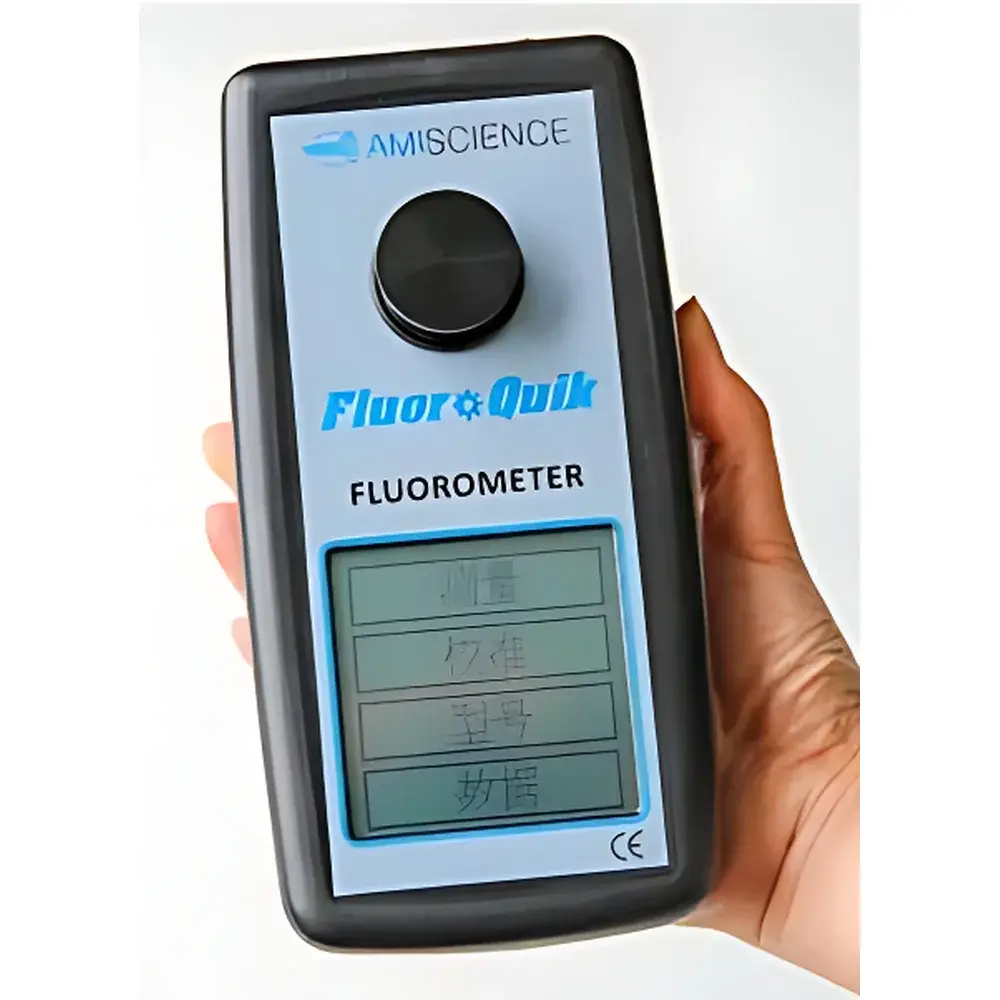
AmiScience FluoroQuik Handheld Dual-Channel Fluorometer
| Origin | USA |
|---|---|
| Model | FluoroQuik |
| Excitation Wavelength (Chl a) | 440 nm |
| Emission Wavelength (Chl a) | 670 nm |
| Excitation Wavelength (PC) | 600 nm |
| Emission Wavelength (PC) | 650 nm |
| Sample Volume | 0.5 mL (standard microcentrifuge tube) |
| Live Chl a Range | 0.25–200 ppb |
| Extracted Chl a Range | 0.25–2,500 ppb |
| Live Phycocyanin (PC) Range | 10–1,000 ppb |
| Extracted PC Range | 10–100,000 ppb |
| Detection Output | ppb or Relative Fluorescence Units (RFU) |
| Data Storage | 2 × 400 measurements (per channel) |
| Power Supply | 4 × AA alkaline batteries or 5 V DC / 2 A adapter |
| Dimensions | 5 × 9 × 3.5 cm |
| Weight | 280 g |
| Warm-up Time | < 10 s |
| Interface | LCD touchscreen with bilingual (English/Chinese) firmware |
| Data Transfer | USB port |
Overview
The AmiScience FluoroQuik Handheld Dual-Channel Fluorometer is an engineered field-deployable instrument designed for simultaneous, quantitative measurement of chlorophyll a and phycocyanin (PC) in natural and treated water matrices. Unlike single-channel fluorometers that rely exclusively on chlorophyll a fluorescence — a metric insufficient for accurate cyanobacterial biomass estimation — the FluoroQuik employs dual-wavelength excitation and emission optics to independently resolve signals from both pigments. This capability addresses a well-documented analytical gap in aquatic monitoring: the systematic underestimation of cyanobacterial abundance when using chlorophyll a-only assays, due to the dominance of phycobiliproteins (particularly PC) in cyanobacteria photosynthetic antennae. The instrument operates on the principle of controlled photonic excitation (440 nm for Chl a, 600 nm for PC), followed by high-sensitivity detection of emitted fluorescence at 670 nm and 650 nm respectively. Its optical architecture minimizes cross-talk between channels through spectral bandpass filtering and time-gated signal acquisition, ensuring robust discrimination even in optically complex samples such as eutrophic lake water or wastewater effluent.
Key Features
- Dual independent optical channels calibrated for chlorophyll a and phycocyanin, enabling concurrent quantification without sample splitting or sequential reconfiguration
- Compact, handheld form factor (280 g) with ergonomic design optimized for extended field use and one-handed operation
- Standardized 0.5 mL microcentrifuge tube compatibility — eliminates need for custom cuvettes and supports rapid, contamination-minimized sampling
- Sub-5-second measurement cycle per channel, with automatic blank subtraction and real-time RFU-to-concentration conversion using preloaded calibration curves
- Integrated touchscreen interface supporting English and Chinese firmware; intuitive navigation via context-sensitive soft keys and tactile feedback
- On-device calibration routine with user-definable standard concentrations (100, 1,000, or 10,000 ppb); no external software or PC required for routine recalibration
- USB data export functionality compatible with common spreadsheet and LIMS platforms; stored datasets include timestamp, channel identifier, raw RFU, and calculated concentration
- Low-power architecture: >12 hours continuous operation on four AA alkaline cells; optional 5 V DC input for lab-based or vehicle-mounted deployment
Sample Compatibility & Compliance
The FluoroQuik is validated for direct analysis of unfiltered or membrane-filtered (≤0.45 µm) aqueous samples across diverse environmental matrices, including marine coastal waters, freshwater lakes and reservoirs, aquaculture systems, drinking water source intakes, agricultural runoff, and ballast water. It accommodates both live (in vivo) and acetone/methanol-extracted pigment fractions, supporting method flexibility aligned with ASTM D3731 (chlorophyll a in water) and EPA Method 445.0 (phycocyanin as a cyanobacterial proxy). While not a regulatory compliance device per se, its measurement traceability — based on NIST-traceable pigment standards and documented linearity (R² ≥ 0.998 over specified ranges) — supports data defensibility in GLP-aligned monitoring programs. Instrument firmware logs all calibration events and user-initiated measurements with timestamps, satisfying basic audit trail requirements under ISO/IEC 17025 and US EPA QA/G-5 guidance.
Software & Data Management
The embedded firmware implements a deterministic state machine for measurement workflow control, minimizing operator-induced error. All calibration parameters, user-defined units (ppb or RFU), and language selection are stored in non-volatile memory. Data files are saved in plain-text CSV format with headers: “Timestamp”, “Channel”, “RFU”, “Conc_ppb”, “Sample_ID”. No proprietary drivers or cloud dependencies are required for data retrieval. USB connectivity enables drag-and-drop file transfer to Windows, macOS, or Linux hosts. For laboratories operating under 21 CFR Part 11, optional firmware upgrade (v3.2+) provides electronic signature prompts and encrypted session logging — though full Part 11 compliance requires site-specific validation per organizational SOPs. Batch export tools and Excel-compatible templates are available via AmiScience’s technical support portal.
Applications
- Early-warning monitoring of cyanobacterial blooms in drinking water reservoirs and recreational lakes
- Quantitative assessment of phytoplankton community structure shifts during eutrophication studies
- Validation of satellite-derived chlorophyll a products (e.g., Sentinel-3 OLCI, MODIS Aqua) through in situ ground-truthing
- Routine QC of algal culture health in biotechnology and biofuel research facilities
- Ballast water management compliance screening per IMO G8 guidelines (cyanobacteria as indicator organisms)
- Long-term ecological monitoring under national programs (e.g., USGS NAWQA, EU WFD Article 8 reporting)
- Field pedagogy in limnology and environmental microbiology courses
FAQ
Can the FluoroQuik distinguish between different cyanobacterial genera?
No. It quantifies total phycocyanin as a group-specific biomarker for cyanobacteria; species-level identification requires complementary methods (e.g., microscopy, qPCR, or flow cytometry).
Is filtration mandatory before measurement?
Filtration (0.45 µm) is recommended for highly turbid samples (>50 NTU) to reduce scattering interference, but not required for clear or moderately colored waters.
How often must calibration be performed?
Initial calibration is required before first use. Subsequent recalibration is advised every 3 months under routine use, or after exposure to extreme temperatures (>40°C or <0°C), mechanical shock, or prolonged storage (>6 months).
Does the instrument correct for inner-filter effects?
No. Users must dilute samples exhibiting absorbance >0.5 AU at excitation wavelengths; the manual provides stepwise dilution protocols with recovery validation guidance.
What is the shelf life of extracted pigment standards?
When stored in amber vials at –20°C under inert gas, lyophilized phycocyanin and chlorophyll a standards retain stability for ≥12 months; working solutions should be prepared fresh daily and kept in darkness at 4°C.
Related Products







