
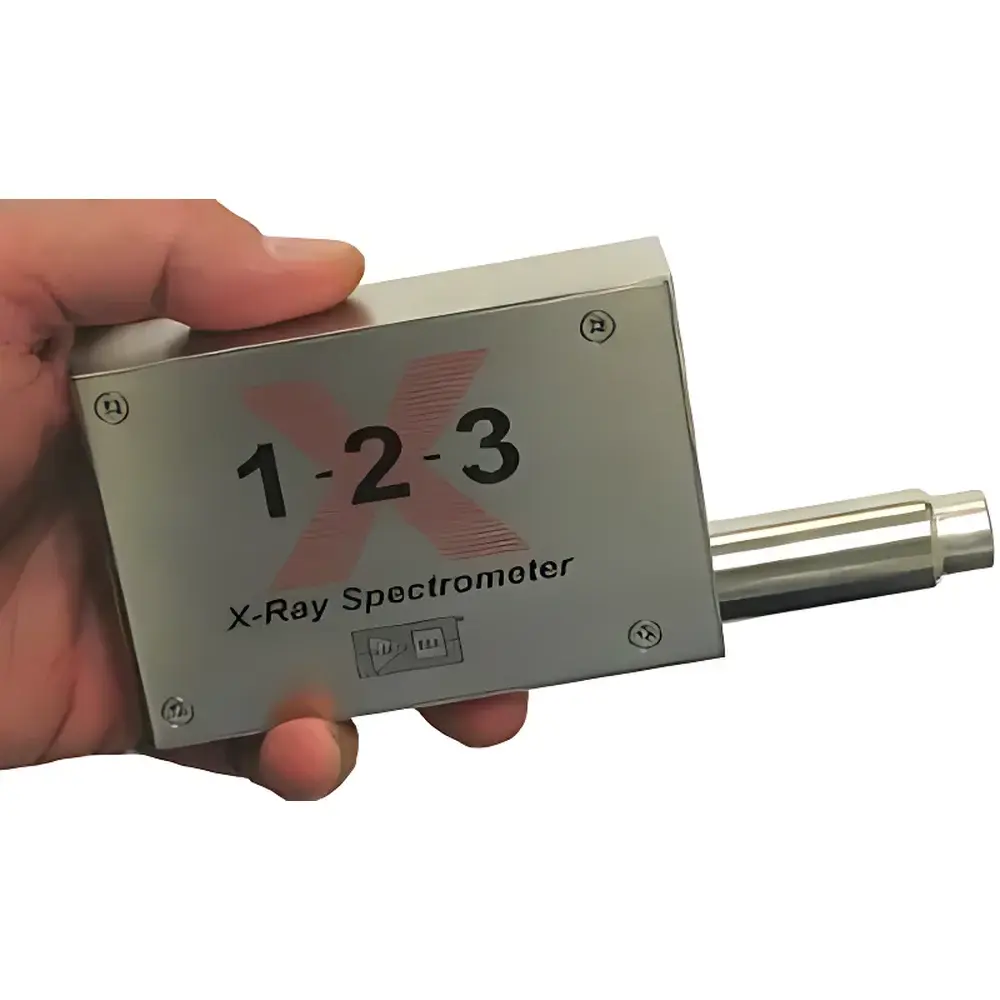
Amptek X-123 Energy Dispersive X-Ray Fluorescence (EDXRF) Spectrometer System
| Brand | Amptek |
|---|---|
| Origin | USA |
| Model | X-123 |
| Form Factor | Benchtop/Portable |
| Element Range | Na (11) – U (92) |
| Detection Limit | 1 ppm – 99.99% |
| Energy Resolution | 139–260 eV @ 5.9 keV |
| Repeatability | 0.1% |
| Detector | Si-PIN with Two-Stage Thermoelectric Cooling |
| Effective Area | 6–25 mm² |
| Thickness | 500 µm |
| Be Window | 12.5–25 µm |
| Operating Temperature Range | −30 °C to +80 °C |
| Power Consumption | 2.5 W (5 VDC, 300–800 mA) |
| Weight | 180 g |
| Dimensions | 70 × 100 × 25 mm |
| Interface | USB 2.0 (12 Mbps), RS-232 (115.2 kbps), Ethernet (10BASE-T) |
| Compliance | RoHS-compliant, UL 61010-1:2009, CAN/CSA-C22.2 No. 61010-1, TÜV Certified (CU 72101153 01) |
Overview
The Amptek X-123 is a fully integrated, compact energy dispersive X-ray fluorescence (EDXRF) spectrometer system engineered for high-fidelity elemental analysis in field-deployable, benchtop, and OEM integration applications. Unlike conventional EDXRF platforms requiring cryogenic cooling or bulky modular architectures, the X-123 embeds a thermoelectrically cooled Si-PIN detector, digital pulse processor (DP5), multichannel analyzer (MCA), and regulated power management within a single 70 × 100 × 25 mm enclosure. Its measurement principle relies on detecting characteristic X-ray photons emitted from sample atoms following excitation by an external X-ray source (e.g., microfocus tube or radioactive isotope), with photon energy directly correlating to elemental identity and intensity proportional to concentration. The system operates across a calibrated energy range of 1–40 keV, supporting quantitative and qualitative analysis of elements from sodium (Z = 11) to uranium (Z = 92), with detection limits down to 1 ppm under optimized geometries and counting conditions.
Key Features
- Monolithic architecture integrating detector, preamplifier, DP5 digital pulse processor, MCA, and power regulation—eliminating inter-unit cabling and alignment dependencies.
- Two-stage Peltier cooling maintains detector temperature stability (ΔT ≤ 85 °C) without liquid nitrogen or mechanical chillers, enabling consistent spectral resolution (FWHM 139–260 eV @ 5.9 keV) across ambient temperatures from −30 °C to +80 °C.
- Low-power design (2.5 W typical, 5 VDC input) facilitates battery operation and integration into portable analyzers, handheld XRF guns, and embedded industrial monitoring systems.
- Flexible gain control: 16-step logarithmic coarse gain (1.12–102) plus 10-bit fine gain (0.75–1.25), enabling dynamic optimization for both low-energy (e.g., Mg, Al, Si) and high-energy (e.g., Pb, U) peaks.
- Configurable shaping: 24 software-selectable peaking times (0.8–102 µs), supporting count rates up to 120,000 cps at 50% dead time with pile-up rejection enabled.
- Multi-interface connectivity: USB 2.0 (full-speed), RS-232 (115.2 kbps), and 10BASE-T Ethernet ensure compatibility with legacy lab PCs, real-time control systems, and networked QA/QC environments.
Sample Compatibility & Compliance
The X-123 is designed for direct coupling with commercially available X-ray tubes (e.g., 50 kV microfocus sources) or radioisotope exciters (e.g., 55Fe, 109Cd), supporting solid, powder, thin-film, and liquid samples via appropriate sample holders and collimation. Its 6–25 mm² active area and 500 µm thick Si-PIN detector provide optimal efficiency for the 1.5–25 keV range (>25%), making it particularly suited for RoHS/WEEE screening (Pb, Cd, Hg, Cr, Br), electronics solder analysis, alloy verification, and cultural heritage material characterization. The system complies with IEC 61000-6-3 (EMC), UL 61010-1:2009, and CAN/CSA-C22.2 No. 61010-1 for laboratory equipment safety. It meets EU RoHS Directive 2011/65/EU requirements for restricted substances and carries TÜV certification (CU 72101153 01) for conformity with harmonized standards.
Software & Data Management
The X-123 is supported by Amptek’s DPPMCA software—a Windows-native application enabling real-time spectrum acquisition, energy calibration, region-of-interest (ROI) quantification, peak identification, and background subtraction. DPPMCA exports spectra in standard formats (ASCII, CSV, binary) and interfaces seamlessly with Amptek’s XRF-FP2 fundamental parameters package for matrix-corrected quantification. For automated or embedded deployment, the system provides a comprehensive DLL-based API (DPP API) with documented C/C++, Visual Basic, and Windows CE examples. This enables integration into LIMS, MES, or custom QA dashboards while maintaining full control over acquisition parameters, live histogramming, and event-triggered data logging. All firmware and software support audit trails, user-access levels, and configuration versioning—facilitating compliance with GLP and FDA 21 CFR Part 11 requirements where electronic records are subject to regulatory review.
Applications
- Routine RoHS/WEEE compliance screening in electronics manufacturing and recycling facilities.
- In-line elemental verification during printed circuit board (PCB) assembly and solder paste qualification.
- Field-portable analysis of geological samples, mining ores, and environmental soil matrices.
- Non-destructive compositional analysis of historical artifacts, pigments, and archaeological metals.
- OEM integration into handheld XRF analyzers, process analyzers for metal scrap sorting, and automated coating thickness measurement systems.
- Academic and industrial research in materials science, nuclear safeguards, and radiation detection physics.
FAQ
Does the X-123 require liquid nitrogen cooling?
No. It employs a two-stage thermoelectric cooler capable of sustaining stable detector operating temperatures across industrial and field environments without cryogens.
What is the maximum recommended count rate for quantitative analysis?
Up to 120,000 counts per second (cps) is achievable with 2.4 µs peaking time and pile-up rejection enabled; optimal throughput depends on required resolution and dead-time tolerance.
Can the X-123 be used with third-party X-ray sources?
Yes. It accepts standard analog pulses from external detectors or sources via its 16-pin auxiliary interface and supports HV bias up to 180 V for direct detector biasing.
Is spectral calibration traceable to NIST standards?
Calibration is performed using certified reference materials (e.g., 55Fe, 241Am); users may establish traceability through in-house validation against NIST SRMs such as 2133 (Fe/K/Mn) or 2135 (Pb/Cd/Cr).
What warranty and service support does Amptek provide?
The X-123 carries a 12-month limited warranty; extended calibration and technical support contracts are available directly from Amptek or authorized distributors.
Related Products






