
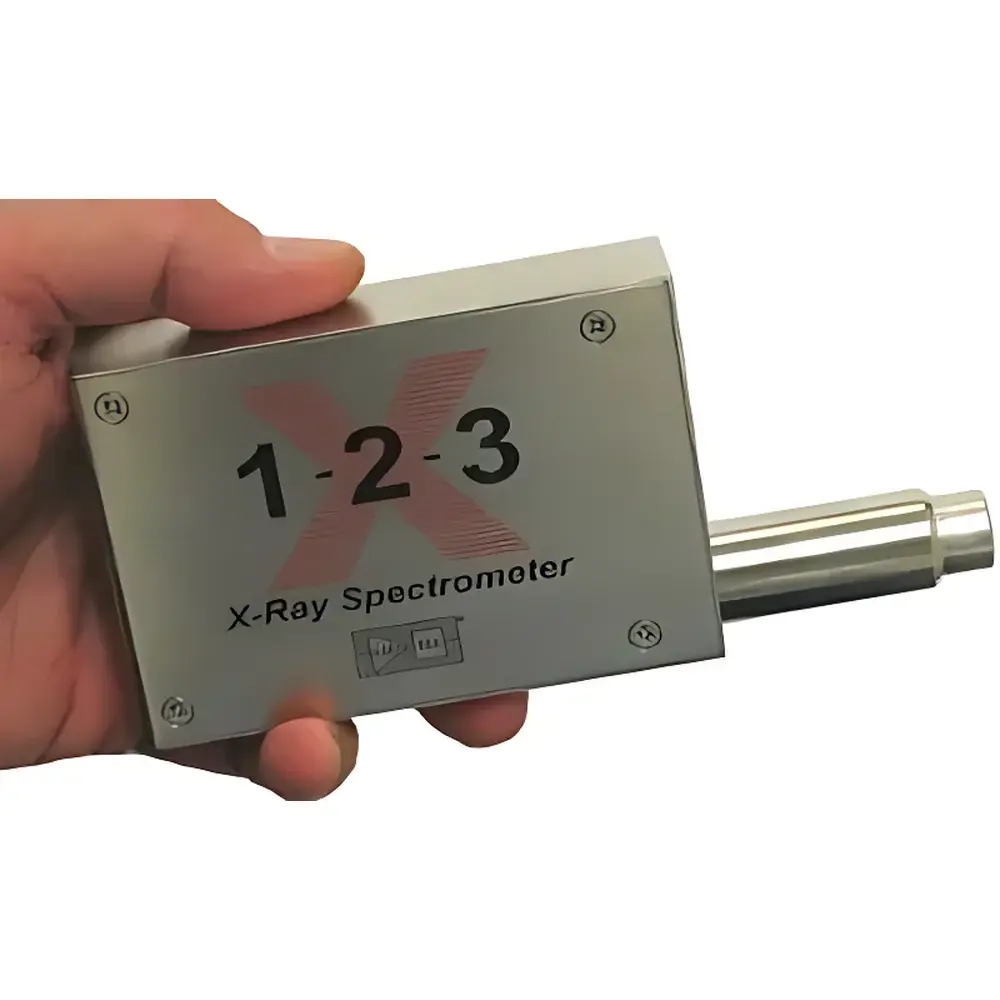
Amptek X-123 Energy Dispersive X-Ray Fluorescence Spectrometer
| Brand | Amptek |
|---|---|
| Origin | USA |
| Model | X-123 |
| Detector Type | Si-PIN |
| Active Area | 6–25 mm² |
| Thickness | 300–500 µm |
| Energy Range | 1.5–40 keV |
| Resolution (FWHM @ 5.9 keV) | 145–230 eV |
| Max Count Rate | 2 × 10⁶ cps |
| Power Consumption | 2.5 W (typ.) |
| Dimensions | 70 × 100 × 25 mm |
| Weight | 180 g |
| Cooling | Two-stage thermoelectric (ΔT ≤ 85 °C) |
| Interface | USB 2.0, RS-232, Ethernet (10BASE-T) |
| Compliance | RoHS, UL 61010-1:2009, CAN/CSA C22.2 No. 61010-1 |
Overview
The Amptek X-123 is a fully integrated, compact energy dispersive X-ray fluorescence (ED-XRF) spectrometer engineered for high-fidelity elemental analysis in field-deployable, OEM, and laboratory-grade applications. Unlike traditional benchtop ED-XRF systems requiring cryogenic cooling or complex peripheral electronics, the X-123 embeds the complete signal chain — from X-ray detection to spectral acquisition — within a single, passively shielded aluminum enclosure (70 × 100 × 25 mm). Its core measurement principle relies on photoelectric absorption in a silicon PIN diode detector: incident X-ray photons generate electron-hole pairs proportional to their energy (3.62 eV per pair in Si), with charge collection amplified by a custom low-noise charge-sensitive preamplifier featuring active reset circuitry. Two-stage thermoelectric cooling stabilizes detector and front-end electronics at sub-ambient temperatures, suppressing leakage current and electronic noise without liquid nitrogen or mechanical chillers. The system operates across a broad energy range (1.5–40 keV), delivering resolution of 145–230 eV FWHM at the Mn Kα line (5.9 keV), enabling robust identification and quantification of elements from sodium (Na, Z=11) through uranium (U, Z=92) under ambient or vacuum conditions.
Key Features
- Fully self-contained architecture: integrates XR100-CR Si-PIN detector, DP5 digital pulse processor, multi-channel analyzer (MCA), and PC5 power management module in one sealed housing.
- Ultra-low power consumption (2.5 W typical) with +5 V DC input, supporting battery-powered portable operation and embedded integration.
- High-resolution digital pulse processing: replaces analog shaping amplifiers with real-time FPGA-based digitization, pulse shaping, peak detection, and histogramming — improving count-rate linearity, stability, and reproducibility.
- Configurable acquisition parameters: software-selectable shaping times (0.8–102 µs), gain (16 coarse × 10-bit fine steps), MCA channel depth (0.25k–8k), and preset modes (live time, total counts, ROI counts).
- Multi-interface connectivity: native USB 2.0 (12 Mbps), RS-232 (115.2 kbps), and optional 10BASE-T Ethernet for remote control and networked deployment.
- Thermally stabilized detector platform: closed-loop thermoelectric controller maintains ΔT up to 85 °C, ensuring consistent spectral calibration across -20 °C to +50 °C ambient operation.
- OEM-ready I/O expansion: 16-pin auxiliary header supports SCA outputs, auxiliary triggers, digital I/O, and synchronization signals for integration into custom analytical platforms.
Sample Compatibility & Compliance
The X-123 is compatible with solid, powder, and thin-film samples across diverse application domains, including RoHS/WEEE-compliant screening of printed circuit boards, alloy verification, cultural heritage pigment analysis, and process monitoring in metallurgy and recycling. Its standard 25 µm Be window enables efficient detection of light elements down to sodium (Na Kα = 1.04 keV), while optional 12.5 µm or 7.5 µm windows further enhance low-energy sensitivity. Multi-layer collimators minimize edge effects and improve peak-to-background ratios by restricting X-ray incidence to the detector’s active volume. The system complies with international safety and electromagnetic compatibility standards, including UL 61010-1:2009 (R10.08), CAN/CSA C22.2 No. 61010-1-04+GI1, and EU RoHS Directive 2011/65/EU. It meets essential requirements for CE marking and carries TÜV certification (CU 72101153 01). For regulated environments, ADMCA software supports audit-trail logging and user-access controls aligned with GLP and ISO/IEC 17025 documentation practices.
Software & Data Management
The X-123 is controlled via Amptek’s ADMCA (Advanced Digital Multichannel Analyzer) software — a Windows-native application supporting spectral acquisition, energy calibration, ROI definition, peak search, and export to CSV, TXT, or binary formats. ADMCA integrates seamlessly with third-party quantitative analysis packages such as XRF-FP, enabling fundamental parameter (FP) modeling for matrix-corrected elemental concentration reporting. A comprehensive DPP API (Dynamic Pulse Processor Application Programming Interface) provides a Windows DLL library with documented C/C++, VB.NET, and C# examples, allowing full programmatic control over all hardware parameters and real-time data streaming. Embedded firmware supports non-volatile storage of configuration profiles, automatic gain stabilization, and temperature-compensated energy calibration. All spectral data include embedded metadata (acquisition time, live time, detector temperature, HV bias), facilitating traceable data lineage in QA/QC workflows compliant with FDA 21 CFR Part 11 when deployed with validated software environments.
Applications
- Risk-based screening for restricted substances (Pb, Cd, Hg, Cr⁶⁺, Br in PBB/PBDE) per EU RoHS Directive and WEEE compliance protocols.
- In-line quality assurance of metal alloys, solder compositions, and plating thicknesses in electronics manufacturing.
- Non-destructive elemental mapping of archaeological artifacts, pigments, and historical manuscripts using handheld or micro-XRF configurations.
- OEM integration into portable analyzers, drone-mounted sensors, and automated sorting systems for scrap metal and e-waste recovery.
- Research-grade spectroscopy in university labs where space, power, and maintenance constraints limit use of LN₂-cooled systems.
- Vacuum-compatible operation (down to 10⁻⁸ Torr) enables enhanced light-element sensitivity for thin-film and surface-layer analysis.
FAQ
Does the X-123 require liquid nitrogen or external cooling?
No. It uses a two-stage thermoelectric cooler with closed-loop temperature control, achieving up to 85 °C temperature differential without cryogens.
What detector options are supported beyond the standard Si-PIN?
The X-123 platform accommodates Si-PIN, silicon drift detectors (SDD), and CdTe detectors — all configurable via the same DP5 processor and PC5 power module.
Can the system operate under vacuum?
Yes. With an O-ring sealed flange interface and optional EXV5/EXV9 vacuum extension tubes, it functions reliably in high-vacuum environments (≤10⁻⁸ Torr).
Is the resolution specification guaranteed across all operating conditions?
Resolution (145–230 eV FWHM at 5.9 keV) is detector- and configuration-dependent; optimal values require appropriate shaping time selection and thermal stabilization.
How is energy calibration maintained during long-term operation?
ADMCA supports automatic gain stabilization routines and stores temperature-compensated calibration coefficients in non-volatile memory, minimizing drift over time and ambient variation.
What regulatory documentation is provided for GMP/GLP validation?
Amptek supplies factory calibration reports, electrical safety test certificates (TÜV), RoHS declarations of conformity, and firmware revision logs — all traceable to NIST-traceable reference sources.




