
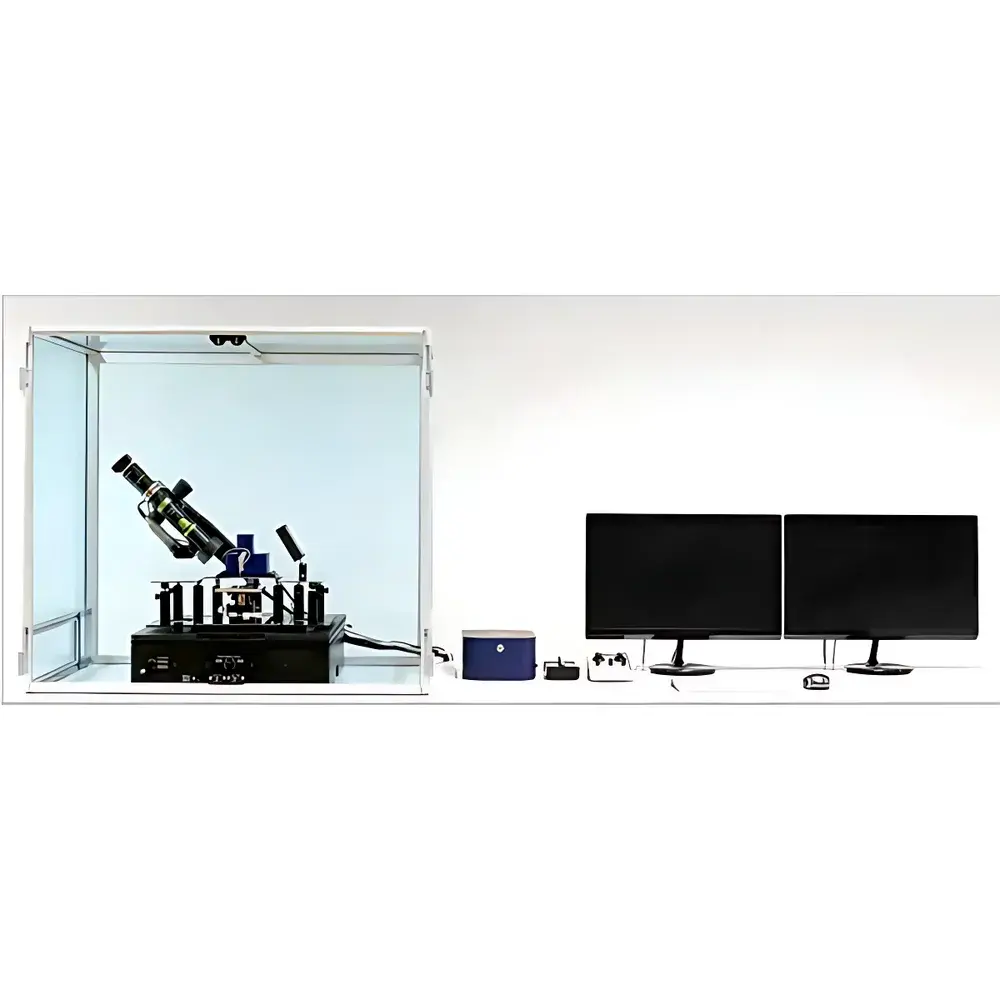
AMPTek 3D Force Measurement System
| Brand | AMPTek |
|---|---|
| Origin | USA |
| Manufacturer Type | Authorized Distributor |
| Origin Category | Imported |
| Model | 3D Force Measurement System |
| Pricing | Upon Request |
Overview
The AMPTek 3D Force Measurement System is a high-precision, multi-axis mechanical testing platform engineered for quantitative biomechanical and micro-force characterization in research laboratories and advanced materials testing environments. Unlike conventional single-axis load cells, this system employs a triaxial force transduction architecture based on optimized strain gauge technology (e.g., Optima HPS-series sensor elements), enabling simultaneous, independent measurement of orthogonal force components (Fx, Fy, Fz) with minimal cross-talk. The system operates on the principle of calibrated piezoresistive or Wheatstone bridge-based transduction, where minute dimensional changes in the sensing element under applied compressive or tensile loads are converted into proportional electrical signals. Designed for integration within optical microscopy workstations, it supports real-time correlation between mechanical stimuli and visual observation—particularly valuable in cell adhesion studies, micro-manipulation, soft-tissue mechanics, and MEMS device validation.
Key Features
- Triaxial force resolution from 5 nN to 100,000 nN (0.005–100 mN), covering nano- to milli-Newton regimes with linear response and low hysteresis.
- Ludl XY-Z motorized stage with 0.1 µm encoder resolution and crossed-roller bearing guideways, ensuring sub-micron positional repeatability and thermal stability during extended measurements.
- Modular sensor interface: interchangeable mounting adapters and custom-configurable probe tips (e.g., spherical, flat, tapered, or bio-functionalized) to accommodate diverse sample geometries and surface properties.
- Z-axis actuation and robotic arm integration support variable working distances and angular approach trajectories—critical for non-planar or topographically complex specimens.
- Low cross-talk performance: ≤ ±0.05% of full-scale load across axes, validated per ASTM E290–22 (Standard Test Methods for Tension Testing of Metallic Materials) principles for multi-component transducer calibration.
- High accuracy: ±0.1% full-scale linearity and repeatability, traceable to NIST-traceable calibration standards.
Sample Compatibility & Compliance
The system accommodates biological samples (e.g., single cells, tissue explants, hydrogels), microfabricated devices, polymer films, and composite laminates. Its non-invasive contact geometry and adjustable tip loading profiles comply with ISO 17025:2017 requirements for accredited testing laboratories. When deployed in GLP or GMP-regulated environments (e.g., preclinical biomaterial evaluation), the platform supports audit-ready data logging—including timestamped force-position metadata—aligned with FDA 21 CFR Part 11 electronic record integrity guidelines when paired with compliant acquisition software. All mechanical interfaces meet RoHS and REACH material restrictions; anti-static universal mounting brackets prevent electrostatic discharge during handling of sensitive electronic or biological specimens.
Software & Data Management
Native operation integrates with MetaMorph® Imaging Software (version 7.8+) for synchronized spatial mapping, patterned stimulus delivery, and region-of-interest (ROI)-triggered force acquisition. Raw analog outputs (±10 V differential) interface via USB or Ethernet to National Instruments DAQ systems (e.g., PXIe-6363), supporting up to 100 kHz sampling with hardware-triggered synchronization. Export formats include CSV, HDF5, and TDMS—compatible with MATLAB, Python (NumPy/Pandas), and LabVIEW-based post-processing pipelines. Audit trails, user access logs, and parameter change histories are retained for regulatory review, satisfying ISO/IEC 17025 Clause 7.7 (Control of Records) and USP Analytical Instrument Qualification protocols.
Applications
- Single-cell adhesion force quantification under controlled shear and normal loading conditions.
- Dynamic characterization of viscoelastic hydrogels during cyclic compression/tension.
- Microscale tribological testing of thin-film coatings and 2D materials (e.g., graphene, MoS₂).
- Calibration and validation of AFM cantilever spring constants using reference force standards.
- Biomechanical modeling input generation for finite element analysis (FEA) of implant-tissue interfaces.
- In situ mechanical stimulation of organ-on-chip platforms with concurrent brightfield/fluorescence imaging.
FAQ
Is the system compatible with inverted or upright microscopes?
Yes—the modular bracket design supports standard C-mount and SM1-threaded optical interfaces, enabling seamless integration with Nikon Eclipse, Zeiss Axio, and Olympus IX series microscopes.
Can the force range be extended beyond 100 mN?
Custom configurations with higher-capacity sensor modules (e.g., AMTI OR6-7) are available upon request, subject to recalibration and mechanical redesign approval.
Does the system support closed-loop force control?
When coupled with MAC6000 motion controller firmware v4.2+, position-force hybrid control modes (e.g., force-clamp, displacement-ramp-with-force-feedback) are programmable via MetaMorph scripting.
What calibration documentation is provided?
Each unit ships with a NIST-traceable calibration certificate covering all three axes at five load points (10%, 25%, 50%, 75%, 100% FS), including temperature-compensated zero drift and sensitivity coefficients.
Is remote technical support available for international users?
Yes—AMPTek-certified application engineers provide remote diagnostics, software configuration assistance, and protocol optimization via secure screen-sharing sessions compliant with GDPR and HIPAA data transfer provisions.



