
Amptek C1/C2 Low-Energy X-ray Windows for SDD Detectors
| Brand | Amptek |
|---|---|
| Origin | USA |
| Model | C1/C2 |
| Window Substrate | Silicon Nitride (Si₃N₄) |
| Top Layer | Aluminum Coating |
| Thickness | C1 ≈ 80 nm, C2 ≈ 150 nm |
| Compatible Detectors | SuperSDD™ Series, 25 mm² / 500 µm thick silicon drift detectors |
| Energy Range Extension | Down to Boron (B, Z=5) and Carbon (C, Z=6) |
| Compliance | ASTM E135 – Standard Terminology Relating to Analytical Chemistry |
Overview
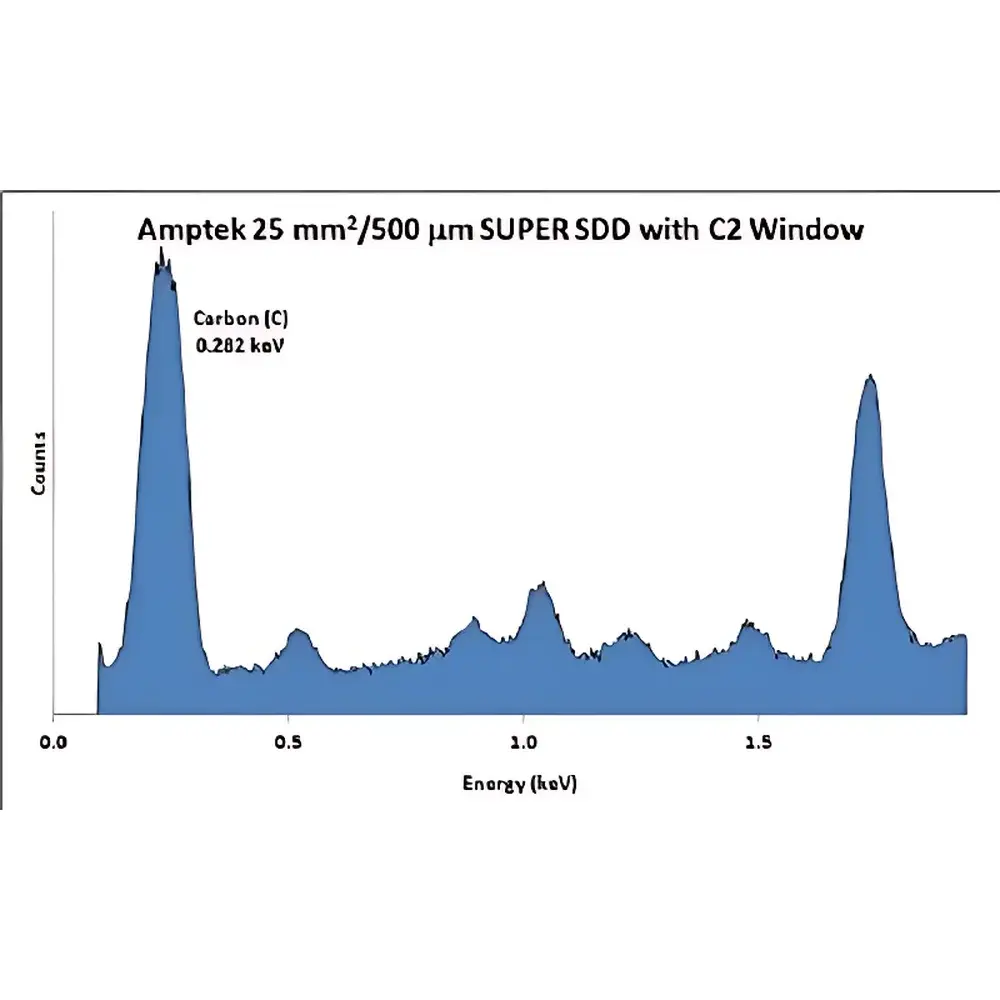
The Amptek C1/C2 Low-Energy X-ray Windows are ultra-thin, high-transmission entrance windows engineered specifically for silicon drift detectors (SDDs) used in energy-dispersive X-ray fluorescence (EDXRF), wavelength-dispersive XRF (WDXRF), scanning electron microscopy (SEM-EDS), and portable/handheld XRF analyzers. Unlike conventional beryllium (Be) windows—whose absorption cutoff limits detection below ~1 keV—the C1/C2 series utilizes a freestanding silicon nitride (Si₃N₄) membrane substrate with an optimized aluminum (Al) anti-reflective and conductive overlayer. This architecture enables measurable transmission down to the Kα line of boron (183 eV) and carbon (277 eV), significantly expanding elemental coverage for low-Z analysis in compliance with ASTM E135 definitions of light-element quantification. The windows are integrated into Amptek’s SuperSDD™ detector modules (e.g., 25 mm² active area, 500 µm depletion depth), supporting high count-rate performance (>1 Mcps) without compromising spectral resolution (<125 eV Mn Kα FWHM at 0°C).
Key Features
- Ultra-low absorption window design: Si₃N₄ membrane thicknesses of ~80 nm (C1) and ~150 nm (C2), each coated with a controlled Al layer for electrical continuity and surface stabilization
- Quantifiable transmission gains for low-Z elements: At the B Kα line (183 eV), C2 delivers >18× higher transmission than 12 µm Be; at C Kα (277 eV), C2 achieves 41.9% transmission versus 0% for standard Be windows
- Thermal and mechanical robustness: Si₃N₄ membranes withstand vacuum differentials up to 1 atm and thermal cycling between −30°C and +60°C without delamination or pinhole formation
- Compatibility with thermoelectric (Peltier) cooling: Designed for integration into Amptek’s air-cooled SDD modules, eliminating dependency on liquid nitrogen while maintaining optimal detector noise floor
- Standardized mechanical interface: 12.7 mm (0.5″) diameter mounting flange with Viton O-ring seal, compatible with industry-standard detector housings and vacuum feedthroughs
Sample Compatibility & Compliance
The C1/C2 windows support quantitative analysis of light elements in diverse sample matrices—including polymers, ceramics, thin-film coatings, geological powders, and biological tissues—without requiring helium purge or vacuum chamber operation in many benchtop configurations. Their performance aligns with ISO 21047 (X-ray fluorescence spectrometry — General requirements and guidance for calibration and verification) and supports traceable measurement protocols under GLP (Good Laboratory Practice) and GMP (Good Manufacturing Practice) frameworks. When deployed in regulated environments (e.g., pharmaceutical raw material screening per USP ), the windows enable full validation of low-Z response curves, including linearity, detection limit (LOD), and repeatability per ICH Q2(R2). Detector systems incorporating C1/C2 windows meet electromagnetic compatibility (EMC) Class B requirements per FCC Part 15 and CE EN 61326-1.
Software & Data Management
Amptek provides native support for C1/C2 window calibration within its DPPM (Digital Pulse Processor Module) firmware and PC-based software suite (XRMC, PMCA, and PyMCA-compatible ASCII output). Users can load element-specific transmission correction tables directly into spectral deconvolution algorithms, enabling accurate matrix correction using fundamental parameters (FP) methods. All spectral acquisition logs include embedded metadata identifying window type (C1/C2), detector temperature, live time, and high-voltage settings—ensuring full auditability per FDA 21 CFR Part 11 when paired with compliant LIMS or ELN platforms. Raw spectrum files (.spe, .mca) retain timestamped detector configuration history for retrospective reprocessing.
Applications
- Low-Z elemental mapping in SEM-EDS: High-fidelity imaging of boron distribution in BN nanotubes or carbon segregation at grain boundaries
- RoHS-compliant screening of Br, Cl, and S in plastics and circuit board laminates using handheld XRF
- Quantitative analysis of Na, Mg, Al, and Si in silicate glasses and catalysts via benchtop EDXRF
- In-line quality control of lithium-ion battery cathode slurries (Li, C, O, F, Ni, Co, Mn)
- Forensic soil and paint chip analysis where detection of B, C, N, and O aids provenance determination
FAQ
What is the primary advantage of C2 over C1 for low-energy X-ray detection?
C2 offers higher transmission across the entire sub-1 keV range due to its thicker Si₃N₄ membrane (≈150 nm vs. ≈80 nm), resulting in improved mechanical stability and reduced risk of breakage during handling or vacuum cycling—while retaining >70% transmission at F Kα (677 eV) and >40% at C Kα (277 eV).
Can C1/C2 windows be used interchangeably with existing Be-window detectors?
Yes—mechanically identical footprint and sealing interface allow direct retrofitting; however, spectral recalibration and updated dead-time and escape-peak corrections are required due to differing absorption profiles.
Are C1/C2 windows compatible with high-vacuum SEM columns?
Yes—they are rated for continuous operation at ≤1×10⁻⁶ Torr and have been validated in field-emission SEM-EDS systems operating at 1–5 kV accelerating voltage.
Does Amptek provide certified reference materials (CRMs) for C1/C2 window validation?
Amptek recommends NIST SRM 2782 (borosilicate glass) and SRM 2783 (aluminosilicate glass) for low-Z response verification; application notes detailing CRM-based calibration workflows are available upon request.
How does humidity affect C1/C2 window performance?
The Al-coated Si₃N₄ surface is hydrophobic and stable under ambient RH ≤80%; prolonged exposure to condensing moisture or corrosive atmospheres (e.g., HCl vapor) may degrade Al layer integrity—thus, use in dry-purged or vacuum environments is recommended for long-term stability.




