
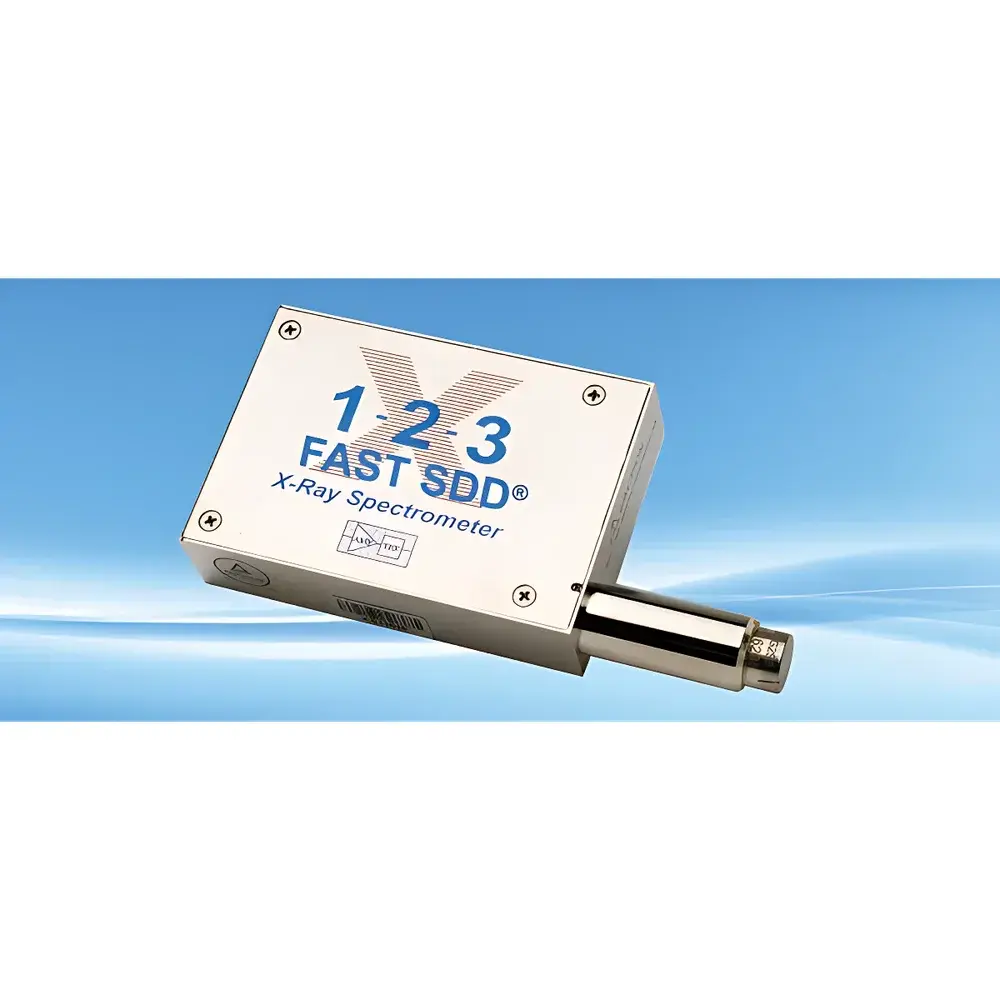
Amptek Fast SDD X-ray Silicon Drift Detector
| Brand | Amptek |
|---|---|
| Origin | USA |
| Model | Fast SDD |
| Energy Resolution (55Fe) | ≤121 eV FWHM |
| Maximum Count Rate | >1 Mcps |
| Peak-to-Background Ratio | 20,000:1 |
| Operating Temperature | <80 K (achieved with thermoelectric cooling at +30 °C ambient) |
| Package | TO-8 vacuum-sealed |
| Detector Type | Silicon Drift Detector (SDD) |
Overview
The Amptek Fast SDD X-ray Silicon Drift Detector is a high-performance, thermoelectrically cooled X-ray detection module engineered for demanding energy-dispersive X-ray fluorescence (EDXRF) and X-ray spectroscopy applications. Based on silicon drift detector (SDD) architecture, it operates on the principle of charge collection in a high-purity silicon depletion layer under controlled reverse bias. Incident X-ray photons generate electron-hole pairs proportional to their energy; the resulting charge is rapidly drifted toward a small anode via an internal electric field gradient, minimizing capacitance and enabling both high resolution and ultrafast signal processing. With a measured full-width at half-maximum (FWHM) energy resolution of ≤121 eV at 5.9 keV (55Fe), the Fast SDD approaches the theoretical Fano limit for silicon—demonstrating exceptionally low electronic noise and optimized charge transport efficiency. Its vacuum-sealed TO-8 package ensures long-term stability under variable environmental conditions, including elevated ambient temperatures up to +30 °C, without performance degradation.
Key Features
- Ultra-low energy resolution: ≤121 eV FWHM at 5.9 keV (55Fe), among the best commercially available for thermoelectrically cooled SDDs
- High count rate capability: sustained operation >1 Mcps (input count rate), with real-time pulse processing supporting peak-shape preservation at elevated fluxes
- Exceptional peak-to-background ratio: 20,000:1, critical for trace-element detection and low-Z element quantification in complex matrices
- Integrated thermoelectric (Peltier) cooling: maintains detector temperature below 80 K at +30 °C ambient—no liquid nitrogen or cryogenic infrastructure required
- Vacuum-hermetic TO-8 packaging: eliminates window absorption losses and ensures mechanical robustness for field-deployable or benchtop integration
- Optimized for short peaking times (0.25–2 µs): enables dynamic trade-off between resolution, throughput, and dead-time correction in real-time spectral acquisition
Sample Compatibility & Compliance
The Fast SDD is compatible with solid, powdered, and thin-film samples across a wide elemental range (Na to U). Its high quantum efficiency above 1 keV and low-noise front-end electronics support quantitative analysis of light elements (e.g., Mg, Al, Si) when coupled with appropriate excitation sources (e.g., Rh or Mo anode X-ray tubes) and vacuum or He-flushed measurement environments. The detector meets key international standards for analytical instrumentation, including ISO 14876 (EDXRF performance verification), ASTM E1621 (standard guide for EDXRF elemental analysis), and supports GLP/GMP-compliant workflows through traceable calibration protocols and stable gain/offset tracking. While not inherently FDA 21 CFR Part 11–compliant, its output data streams are fully compatible with validated third-party software platforms that implement audit trails, electronic signatures, and secure data archiving.
Software & Data Management
The Fast SDD interfaces seamlessly with Amptek’s DP5 digital pulse processor and associated PC-based acquisition software (e.g., X-ray Pulse Processor Software v5.x), providing real-time spectrum visualization, automatic peak identification, and offline quantitative analysis using fundamental parameters (FP) or empirical calibration methods. Raw spectra are exported in standard formats (e.g., .spe, .csv, .asc) for integration into LIMS, MATLAB, Python (NumPy/SciPy), or commercial chemometric tools. Firmware-upgradable processing algorithms support adaptive pile-up rejection, baseline restoration, and dead-time correction—essential for accurate quantification at input count rates exceeding 1.2 Mcps. All calibration coefficients, acquisition parameters, and hardware configuration metadata are embedded in spectrum headers to ensure full experimental reproducibility.
Applications
- Rapid alloy identification and grade verification (e.g., stainless steel 316, solder alloys) with single-second acquisition and sub-percent relative standard deviation
- RoHS/WEEE compliance screening for regulated elements (Pb, Cd, Hg, Cr⁶⁺, Br) in electronics and plastics
- Geological core scanning and mining exploration—high-speed mapping of elemental distributions in drill cores or ore samples
- Thin-film thickness and composition analysis in semiconductor and photovoltaic R&D
- In-line process monitoring in metal recycling and scrap sorting facilities
- Forensic material analysis requiring portable, high-resolution XRF capability
FAQ
What is the typical energy resolution specification for the Fast SDD, and how is it verified?
The specified energy resolution is ≤121 eV FWHM at 5.9 keV, measured using a 55Fe radioactive source under standardized conditions (2 µs peaking time, 25 °C ambient, stabilized detector temperature). This value is traceable to NIST-calibrated reference sources.
Can the Fast SDD operate continuously in non-laboratory environments?
Yes—the vacuum-sealed TO-8 package and integrated thermoelectric cooler enable stable operation at ambient temperatures up to +30 °C for extended periods, making it suitable for mobile labs, factory floors, and field deployments.
Is the detector compatible with existing XRF spectrometers?
The Fast SDD is supplied with standard analog and digital output interfaces (e.g., TTL sync, LVDS), and Amptek provides OEM integration documentation, pinout schematics, and driver libraries for common DAQ platforms (NI, Keysight, Spectrum Instrumentation).
How does peak-shaping time affect resolution and count rate performance?
Shorter peaking times (e.g., 0.25 µs) increase maximum throughput but slightly broaden resolution; longer times (e.g., 2 µs) optimize resolution at the expense of count-rate ceiling. The DP5 processor allows real-time adjustment to match application priorities.
Does Amptek provide calibration services or certified reference materials?
Amptek supplies factory calibration files and recommends use of NIST-traceable standards (e.g., NIST SRM 3155, 3160a) for system validation. Full calibration services are available through authorized partners upon request.






