
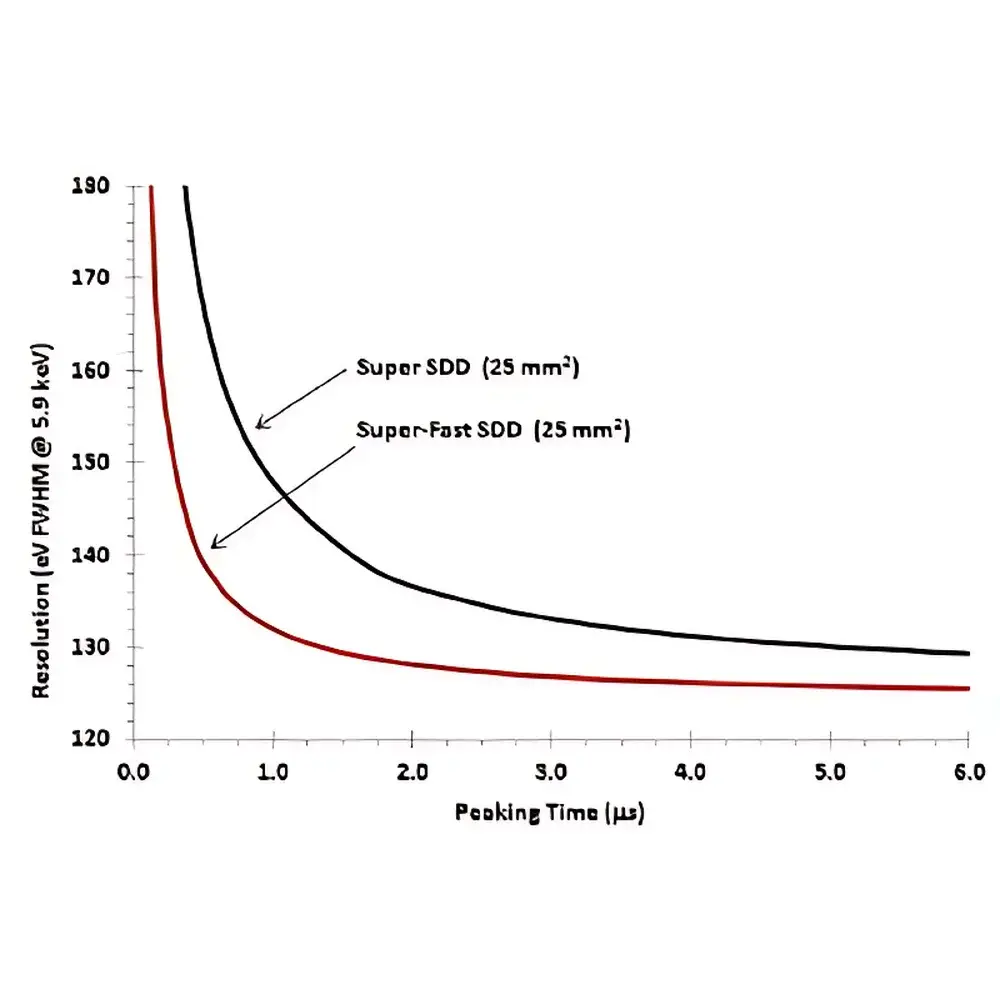
Amptek Fast SDD Super-Fast Silicon Drift Detector
| Brand | Amptek |
|---|---|
| Origin | USA |
| Model | Fast SDD |
| Detector Type | Silicon Drift Detector (SDD) |
| Energy Resolution (FWHM) | ≤125 eV at Mn Kα (5.9 keV) |
| Peak Shaping Time | 0.2–1.0 µs (adjustable) |
| Maximum Input Count Rate | ≥1.2 Mcps |
| Output Count Rate Linearity | >99.5% up to 1.2 Mcps |
| Operating Temperature | −20 °C to −35 °C (Peltier-cooled) |
| Active Area | 50 mm² (standard) |
| Thickness | 450 µm |
| Compliance | RoHS, CE |
Overview
The Amptek Fast SDD Super-Fast Silicon Drift Detector is an advanced X-ray detection system engineered for high-throughput, high-fidelity energy-dispersive X-ray spectroscopy (EDS or EDX). Based on monolithic silicon drift detector architecture with ultra-low capacitance anode design and optimized low-noise ASIC readout electronics, the Fast SDD achieves unprecedented count-rate capability without compromising spectral resolution. Unlike conventional SDDs limited by pulse pile-up and ballistic deficit at elevated input rates, this detector employs adaptive pulse processing with sub-microsecond shaping times (down to 0.2 µs), enabling real-time acquisition at input count rates exceeding 1.2 million counts per second (Mcps) while maintaining full-width half-maximum (FWHM) energy resolution ≤125 eV at Mn Kα (5.9 keV). Its performance bridges the gap between traditional SDDs and high-speed proportional counters—delivering laboratory-grade quantitative accuracy in time-constrained applications such as rapid alloy verification, inline process monitoring, and synchrotron beamline experiments.
Key Features
- Ultra-fast pulse processing with configurable shaping times from 0.2 µs to 1.0 µs, enabling dynamic optimization for resolution vs. throughput trade-offs
- High quantum efficiency across 0.1–20 keV range, supported by 450 µm thick active silicon layer and thin polymer entrance window
- Integrated Peltier thermoelectric cooler maintaining stable operating temperature between −20 °C and −35 °C—no liquid nitrogen required
- Low electronic noise (<12 eV FWHM equivalent noise charge) achieved via custom-designed CUBE or DP5 digital pulse processor
- Robust mechanical housing rated for vacuum (<1×10⁻⁵ Torr) or helium-flushed environments; compatible with standard EDS integration interfaces (e.g., USB 3.0, Ethernet)
- Factory-calibrated energy scale traceable to NIST standards; linear gain stability <0.01% over 8-hour continuous operation
Sample Compatibility & Compliance
The Fast SDD supports a broad range of solid, powdered, and coated samples typical in materials science, metallurgy, geology, and electronics failure analysis. It operates effectively under high-brightness electron beams (SEM/TEM), micro-XRF excitation sources, and portable XRF analyzers. The detector meets international regulatory and quality requirements including RoHS Directive 2011/65/EU and CE marking for electromagnetic compatibility (EMC Directive 2014/30/EU). When integrated into GxP-compliant analytical workflows—such as those governed by ISO/IEC 17025, ASTM E1508, or USP <851>—the system supports audit-ready data logging when paired with Amptek’s DP5 software featuring 21 CFR Part 11–compliant user access control, electronic signatures, and immutable audit trails.
Software & Data Management
Control and spectral analysis are performed using Amptek’s DP5 Digital Pulse Processor firmware and配套 PC software suite (AcqServer, XRS-Fast, and PeakStream). These tools provide real-time spectrum accumulation, automatic peak identification (based on IUPAC-recommended X-ray line databases), matrix correction algorithms (ZAF or φ(ρz)), and statistical uncertainty estimation per element. All raw pulse height data and processed spectra are stored in HDF5 format, ensuring interoperability with third-party platforms such as HyperSpy, PyMCA, or MATLAB. Data export options include CSV, TXT, and CDF formats compliant with ASTM E1301 and ISO 18115-1 metadata conventions. Firmware updates and configuration backups are managed via secure HTTPS interface with version-controlled revision history.
Applications
- Rapid compositional screening of stainless steels (e.g., NIST SRM 3155), aluminum alloys, and solder pastes with single-second acquisition and certified uncertainty propagation
- In-line quality assurance during metal additive manufacturing and electrodeposition processes
- Microstructure-phase mapping in scanning electron microscopy with pixel dwell times <10 µs
- Portable XRF field analysis requiring high signal-to-noise ratio under low-power excitation
- Time-resolved X-ray fluorescence studies at synchrotron facilities utilizing gated detection modes
- Forensic material attribution and regulatory compliance testing (e.g., RoHS screening of Pb, Cd, Hg, Cr⁶⁺, Br)
FAQ
What is the maximum sustainable input count rate without significant resolution degradation?
The Fast SDD maintains ≤130 eV FWHM at Mn Kα up to 1.2 Mcps input count rate when operated at 0.2 µs shaping time and −30 °C detector temperature.
Is liquid nitrogen cooling required?
No. The integrated two-stage Peltier cooler achieves optimal operating temperature without cryogenic consumables.
Can the detector be used in vacuum or inert gas environments?
Yes. The hermetically sealed package supports direct mounting in high-vacuum SEM chambers or He-purged XRF sample chambers.
Does the system support compliance with FDA 21 CFR Part 11?
Full Part 11 functionality—including role-based access, electronic signatures, and audit trail generation—is available when using DP5 firmware v4.2+ with validated AcqServer installation.
How is energy calibration verified and maintained?
Calibration is performed using certified radioactive sources (⁵⁵Fe, ²⁴¹Am) or characteristic X-ray lines from reference materials; long-term drift is compensated via real-time gain stabilization circuitry and periodic automated recalibration routines.




