
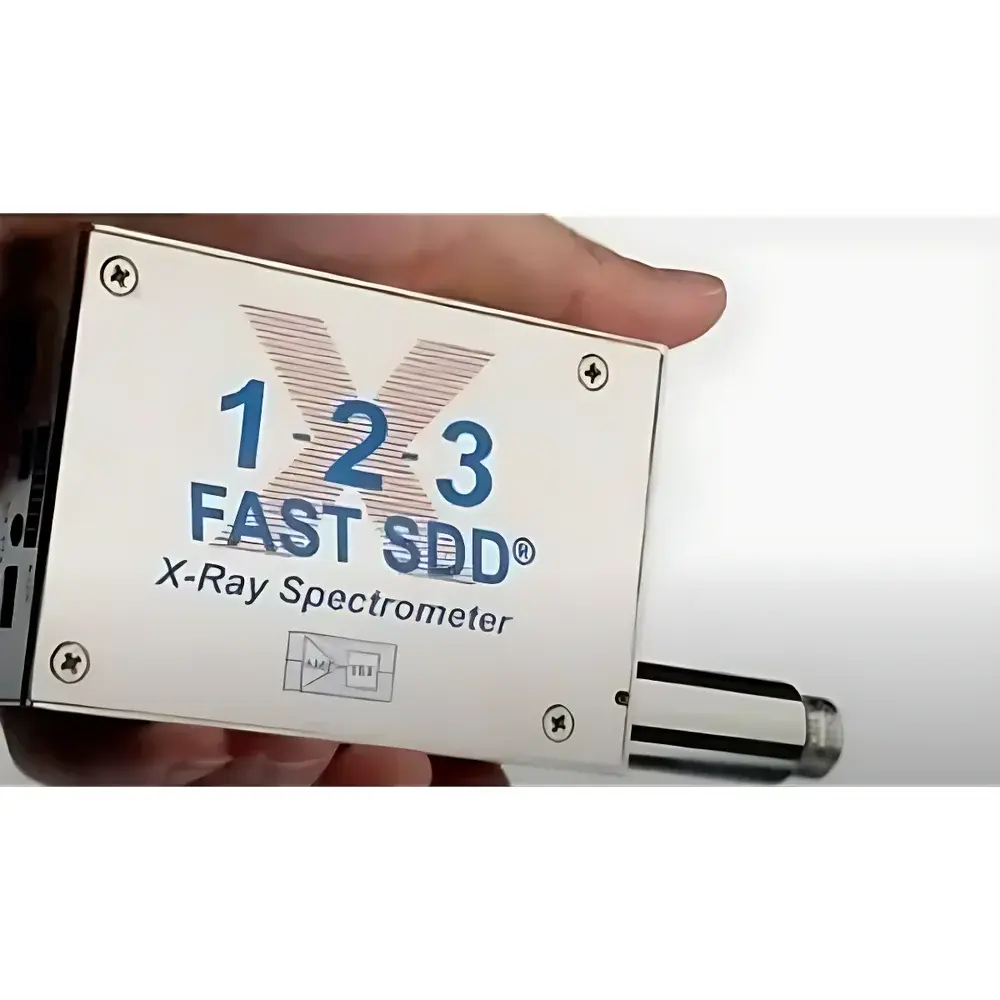
Amptek FASTSDD Silicon Drift Detector (SDD)
| Brand | AMPTEK |
|---|---|
| Origin | USA |
| Model | FASTSDD |
| Active Area Options | 25 mm² (collimated to 17 mm²) or 70 mm² (collimated to 50 mm²) |
| Energy Resolution | ≤122 eV at 5.9 keV |
| Maximum Count Rate | >1,000,000 cps |
| Peak-to-Background Ratio | 26,000:1 |
| Preamplifier Rise Time | <35 ns |
| Window Options | Beryllium (0.5 mil / 12.5 µm) or Silicon Nitride (C-series / Si₃N₄) |
| Detector Thickness | 500 µm |
| Package | TO-8 |
| Cooling Delta-T | >85 K |
| Noise Performance | Optimized for low electronic noise and high charge collection efficiency |
Overview
The Amptek FASTSDD is a high-performance silicon drift detector engineered for demanding X-ray spectroscopy applications requiring simultaneous high resolution, ultra-high count rate capability, and exceptional signal-to-noise fidelity. Based on monolithic silicon drift architecture, the FASTSDD leverages optimized electrode geometry and low-capacitance readout to minimize series noise—enabling energy resolution of ≤122 eV at the Mn-Kα line (5.9 keV), among the best available in commercially packaged SDDs. Its design prioritizes charge collection integrity: reduced leakage current across extended temperature ranges ensures stable spectral shape with minimal peak tailing, while uniform manufacturing yields tight inter-detector response consistency—critical for multi-channel systems and factory calibration traceability. The detector operates with thermoelectric (Peltier) cooling, achieving >85 K ΔT below ambient, eliminating the need for liquid nitrogen or mechanical cryocoolers in most laboratory and field-deployable configurations.
Key Features
- Ultra-high count rate performance exceeding 1,000,000 counts per second (cps) without significant resolution degradation or pulse pile-up distortion
- Low-noise front-end electronics with preamplifier rise time <35 ns, supporting fast timing applications and high-throughput scanning
- Two standard active area configurations: 25 mm² (collimated to 17 mm² effective area) and 70 mm² (collimated to 50 mm²), both optimized for solid-angle efficiency and spatial resolution trade-offs
- Choice of entrance windows: standard beryllium (0.5 mil / 12.5 µm) for general-purpose use or ultra-thin silicon nitride (C-series / Si₃N₄) for enhanced transmission of low-energy X-rays (<1 keV)
- Radiation-hardened structure with 500 µm thick high-purity silicon crystal, enabling long-term stability in high-flux environments including SEM-EDS and online sorting systems
- TO-8 hermetic metal package with integrated thermoelectric cooler and thermal monitoring—designed for OEM integration into compact, ruggedized instruments
- Multi-layer collimator compatibility for precise beam definition in handheld XRF, benchtop analyzers, and micro-XRF mapping platforms
Sample Compatibility & Compliance
The FASTSDD is compatible with a broad range of sample geometries and excitation sources—including air-path, vacuum, and helium-purged chambers—due to its configurable window options and robust vacuum interface design. It meets fundamental requirements for ISO/IEC 17025-accredited laboratories when deployed in calibrated XRF or EDS systems. While the detector itself is not certified to specific regulatory standards, its performance characteristics support compliance with ASTM E1301 (standard guide for application of XRF in elemental analysis), ASTM E1508 (quantitative analysis by wavelength- and energy-dispersive XRF), and IEC 62596 (radiation protection instrumentation). Its low electronic noise floor and high peak-to-background ratio (>26,000:1) contribute directly to improved detection limits and measurement reproducibility in GLP/GMP-constrained environments.
Software & Data Management
The FASTSDD interfaces via standard analog pulse output or digital USB/RS-485 protocols, supporting seamless integration with Amptek’s DP5 Digital Pulse Processor or third-party spectroscopy platforms (e.g., Bruker ESPRIT, Thermo Pathfinder, or custom LabVIEW/FPGA-based acquisition engines). Firmware supports real-time dead-time correction, pile-up rejection, and adaptive shaping time optimization. All spectral data are timestamped and include embedded detector metadata (temperature, bias voltage, gain setting), facilitating audit-ready data provenance. When used with compliant host software, the system can meet FDA 21 CFR Part 11 requirements for electronic records and signatures—including secure user authentication, audit trails, and data integrity safeguards—provided the full instrument stack (detector, processor, PC, and software) is validated as an integrated unit.
Applications
- High-speed energy-dispersive X-ray spectroscopy (EDS) in scanning electron microscopy (SEM), especially for rapid elemental mapping and live compositional imaging
- Benchtop and handheld X-ray fluorescence (XRF) analyzers for alloy verification, RoHS screening, mining geochemistry, and environmental soil testing
- Online X-ray sorting systems for recycling facilities, where throughput >1,000 samples/hour demands sustained high count rates and thermal stability
- OEM integration into portable nuclear material identification devices (NMIDs) and safeguards-grade isotopic analysis platforms
- Micro-XRF microprobes and synchrotron beamline end-stations requiring sub-130 eV resolution with large-area detection efficiency
- Space-qualified instrumentation development, leveraging radiation tolerance and low-power Peltier operation
FAQ
What is the primary advantage of the FASTSDD over conventional SDDs?
Its architecture delivers superior charge collection efficiency and lower electronic noise—resulting in consistently better energy resolution (≤122 eV), higher peak-to-background ratio, and minimal spectral tailing—even at count rates exceeding 1 Mcps.
Can the FASTSDD operate without liquid nitrogen cooling?
Yes. It uses thermoelectric (Peltier) cooling capable of >85 K temperature differential, enabling stable operation from –30 °C to +40 °C ambient without cryogens.
Is the Si₃N₄ window suitable for light-element detection?
Yes—the C-series silicon nitride window transmits photons down to ~100 eV, making it ideal for detecting Be, B, C, N, and O in materials science and battery research applications.
How is energy calibration maintained across multiple detectors?
Tight process control during fabrication ensures excellent inter-unit consistency; factory energy calibration is traceable to NIST-standard radioactive sources (⁵⁵Fe, ¹⁰⁹Cd), reducing re-calibration frequency in multi-detector arrays.
Does the FASTSDD support real-time spectrum processing?
When paired with Amptek’s DP5 digital processor or equivalent FPGA-based systems, it supports on-the-fly pile-up rejection, dead-time correction, and region-of-interest (ROI) extraction—essential for closed-loop industrial control applications.




