
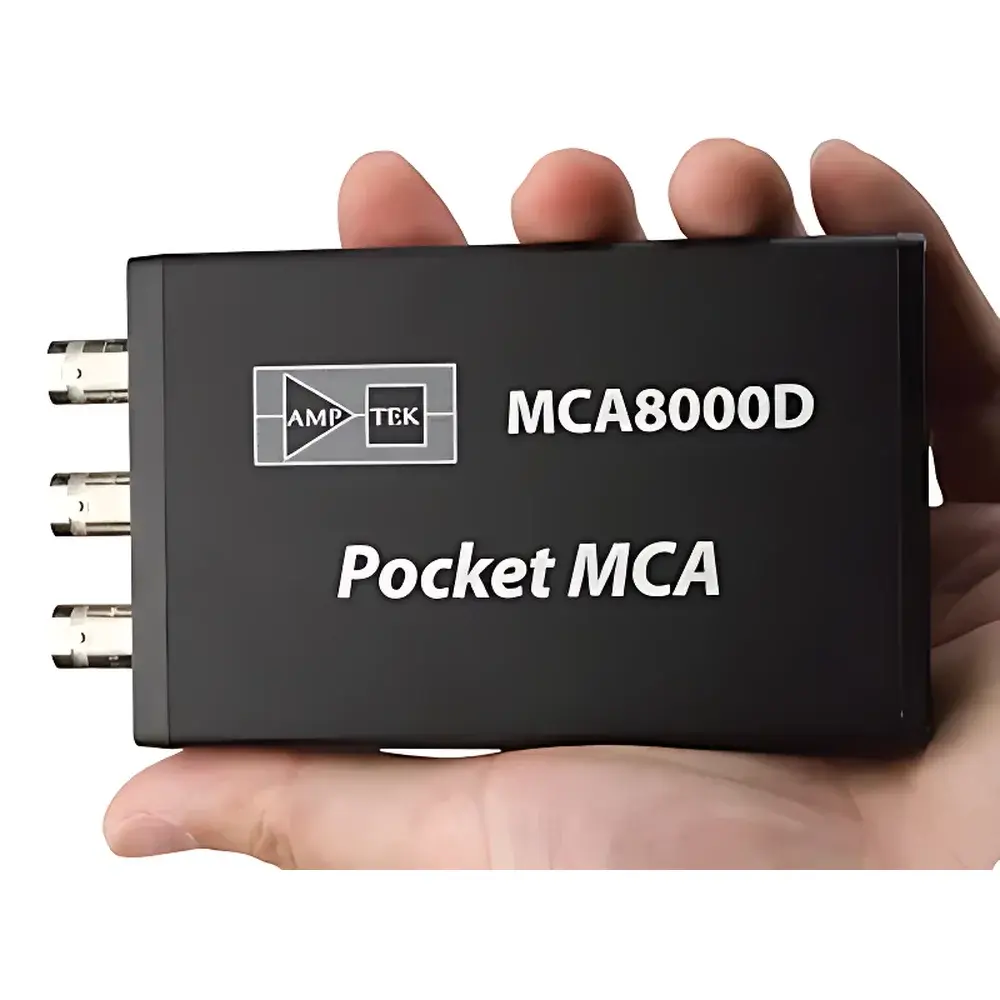
Amptek MCA8000D Digital Multichannel Analyzer Module
| Brand | Amptek |
|---|---|
| Origin | USA |
| Model | MCA8000D |
| ADC | 100 MHz, 16-bit |
| Channel Count | 8,192 (8K) |
| Pulse Peaking Time | ≥500 ns (200 ns shaping) |
| Conversion Time | 10 ns |
| Differential Nonlinearity | <±0.6% |
| Integral Nonlinearity | <±0.02% |
| Input Range | 0–1 V or 0–10 V (software-selectable) |
| Interfaces | USB 2.0 Full-Speed, RS-232 (115 kbps), Ethernet (10BASE-T) |
| Dimensions | 125 × 71 × 20 mm |
| Weight | 165 g |
| Operating Temperature | −20 to +60 °C |
| Power | +4 to +5.5 V DC, ≤2 W |
Overview
The Amptek MCA8000D is a compact, high-performance digital multichannel analyzer (MCA) module engineered for precision pulse-height analysis in X-ray spectroscopy, gamma-ray detection, and airborne particle monitoring systems. Unlike legacy analog MCAs, the MCA8000D digitizes the output of external analog pulse-shaping amplifiers—enabling full compatibility with existing detector chains while delivering superior spectral fidelity, timing resolution, and stability. Its core architecture centers on a 100 MHz, 16-bit analog-to-digital converter (ADC) with a 10 ns conversion time, supporting real-time acquisition at high count rates without dead-time penalties typical of older architectures. The device implements sliding-scale linearization to preserve energy calibration integrity across the full dynamic range, making it suitable for quantitative applications requiring traceable energy response—such as ISO 8505-1 compliant aerosol size distribution analysis or ASTM E1452-20 certified XRF system integration.
Key Features
- High-speed 100 MHz, 16-bit ADC with 10 ns conversion time and software-selectable input ranges (0–1 V or 0–10 V)
- 8,192-channel spectrum storage with configurable binning (256 to 8K channels)
- Two peak detection modes: first peak above threshold (standard for nuclear spectroscopy) and maximum peak above threshold (optimized for aerosol particle sizing)
- Dual TTL-compatible gate inputs (GATE1 and GATE2) for pile-up rejection, coincidence/anti-coincidence logic, and hardware-synchronized acquisition
- Three standard communication interfaces: USB 2.0 Full-Speed (12 Mbps), RS-232 (up to 115 kbps), and Ethernet (10BASE-T, 10 Mbps)
- Low-power design (≤2 W), ultra-portable form factor (125 × 71 × 20 mm; 165 g), and dual power options (USB bus-powered or external AC/DC adapter)
- Advanced linearity correction: differential nonlinearity <±0.6%, integral nonlinearity <±0.02% over full scale
- Temperature-stable gain and zero drift: ±10 ppm/°C typical, enabling unattended field deployment
Sample Compatibility & Compliance
The MCA8000D interfaces directly with a broad range of radiation and particle detectors—including Si-PIN, SDD, CdTe, NaI(Tl), and scintillation-based sensors—when paired with appropriate analog preamplifiers and shaping amplifiers. It supports both unipolar and bipolar semi-Gaussian pulses with shaping time constants ≥200 ns and peaking times ≥500 ns. Input impedance options (1 kΩ or 100 kΩ) allow optimization for low-noise or high-bandwidth detector configurations. The module complies with electromagnetic compatibility standards per FCC Part 15 Class B and CE Directive 2014/30/EU. Its firmware and DPPMCA software support audit-ready data handling in accordance with GLP and GMP environments, including timestamped ROI metadata, energy calibration logs, and full acquisition parameter archiving—facilitating traceability under FDA 21 CFR Part 11 when deployed in regulated analytical workflows.
Software & Data Management
The MCA8000D operates with Amptek’s DPPMCA software suite—a cross-platform application compatible with Windows, Linux, and macOS. DPPMCA provides full control over region-of-interest (ROI) definition, energy calibration (linear and polynomial), peak search and deconvolution, spectrum overlay, and batch file management. All acquisition parameters—including live/real time counters, preset counts, gate logic states, and threshold settings—are saved in human-readable XML configuration files. Raw spectra are stored in standard binary formats (.mca) with embedded metadata (timestamp, detector ID, HV setting, temperature), enabling seamless import into third-party analysis tools such as PyMCA, AXIL, or custom Python-based spectral processing pipelines. Optional PA Configuration Packages extend functionality for ambient aerosol monitoring, including real-time size-bin mapping and ISO 21501-4 compliant counting efficiency correction.
Applications
- X-ray fluorescence (XRF) spectrometers requiring compact, low-power MCA modules for handheld or OEM integration
- Portable gamma spectroscopy systems used in environmental remediation, nuclear safeguards, and emergency response
- Aerosol particle sizing instruments measuring scattered X-ray or beta-induced signals in cleanroom and HVAC monitoring
- Research-grade benchtop XRD/XRF systems where space-constrained electronics demand high channel density and low dead time
- Teaching laboratories needing robust, USB-controllable MCA platforms for undergraduate nuclear physics experiments
- OEM integration into automated QA/QC analyzers for pharmaceutical tablet coating thickness verification via X-ray transmission
FAQ
Is the MCA8000D compatible with legacy analog shaping amplifiers?
Yes—the MCA8000D is explicitly designed to accept analog pulse outputs from standard shaping amplifiers (e.g., spectroscopy-grade CR-RC or Gaussian shapers), eliminating the need for system-level redesign when upgrading from MCA8000A or similar units.
Does the MCA8000D support energy calibration traceability?
Yes—DPPMCA software stores full calibration coefficients (gain, offset, nonlinearity correction tables) with timestamps and user annotations, enabling compliance with ISO/IEC 17025 calibration record requirements.
Can the MCA8000D be synchronized with external triggers or detectors?
Yes—dual TTL gate inputs support hardware-level start/stop, anti-coincidence vetoing, and multi-detector synchronization, critical for time-resolved X-ray diffraction or coincidence gamma spectroscopy.
What is the maximum sustainable count rate without significant dead-time loss?
At 500 ns peaking time and optimal shaping, the MCA8000D achieves <2% dead time at input rates up to 250 kcps—validated using calibrated 55Fe and 241Am sources per IEC 61000-4-3 test methodology.
Is firmware update capability available over USB or Ethernet?
Yes—field-upgradable firmware is delivered via signed binary packages through DPPMCA; updates preserve all user configuration and calibration history.



