
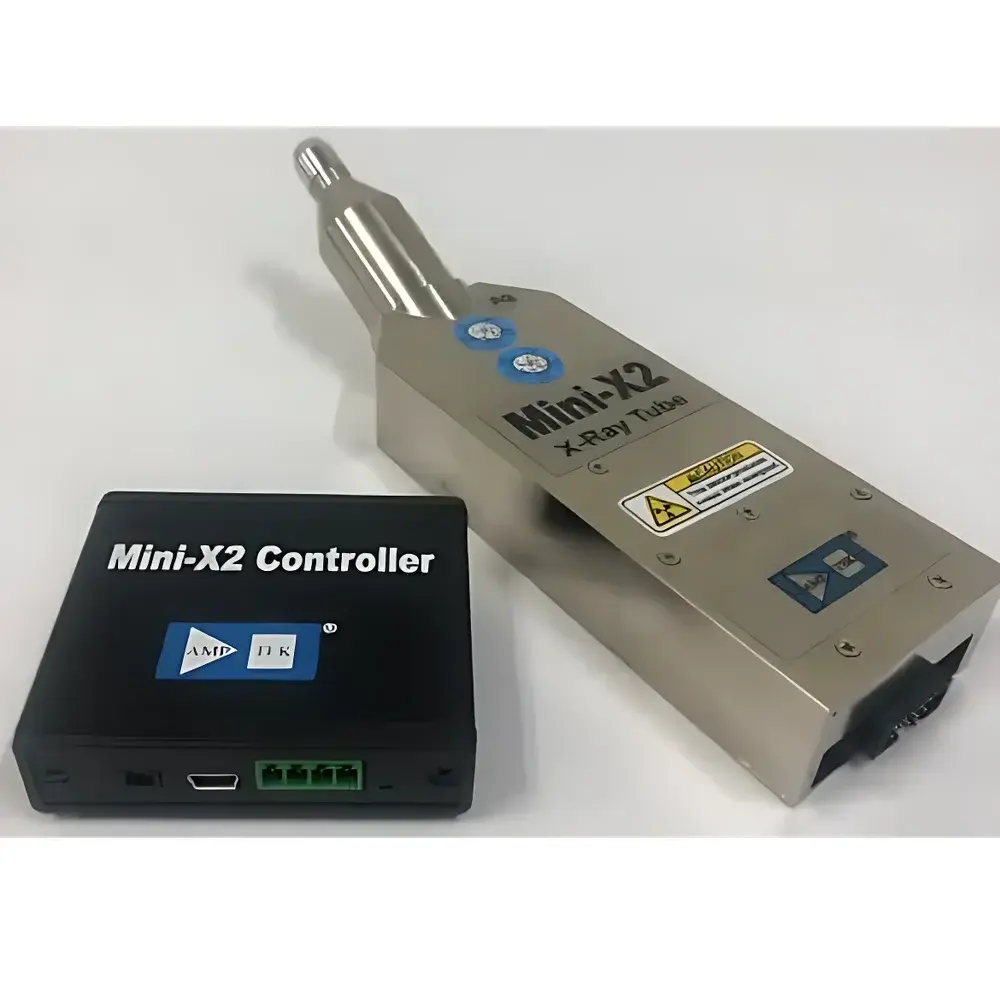
Amptek Mini-X2 Microfocus X-ray Tube System
| Key | Brand: Amptek |
|---|---|
| Origin | USA |
| Model | Mini-X2 |
| Max Power | 4 W or 10 W |
| Max HV | 50 kV or 70 kV |
| Anode Materials | Ag, Rh, Au, W |
| Tube Voltage Range | 10–50 kV or 35–70 kV |
| Tube Current Range | 5–200 µA |
| Anode Thickness | Ag/Rh = 0.75 µm (±0.1 µm), Au/W = 1.00 µm (±0.1 µm) |
| Window Material | Be (127 µm) |
| Focus Size | ~2 mm |
| HV Polarity | Grounded Anode |
| HV Stability | <0.1% |
| Output Flux Stability | <0.3% (temperature-stabilized) |
| Beam Divergence | 120° |
| Cooling | Air-cooled |
| Leakage Radiation | <5 µSv/h at 5 cm with safety plug |
| Operating Temp | −10°C to +50°C |
| Storage Temp | −25°C to +60°C |
| Humidity | 30–90% RH (non-condensing) |
| Interface | USB 2.0 (mini-USB), 12 VDC input, AUX I/O with interlock & status indicators |
| Control Software | Mini-X Control GUI + Mini-X API (C/C++, Python, LabVIEW) |
| Warranty | 1 year or 2000 operating hours, whichever occurs first |
Overview
The Amptek Mini-X2 Microfocus X-ray Tube System is a fully integrated, compact X-ray source engineered for precision in portable and benchtop X-ray fluorescence (XRF) instrumentation. Unlike conventional high-voltage X-ray generators requiring external cooling, shielding, or complex power supplies, the Mini-X2 integrates the microfocus X-ray tube, high-voltage power supply, digital control electronics, and USB communication interface into a single 400 g module. It operates on a grounded-anode architecture—enabling safe, low-noise operation while maintaining high beam stability and repeatable spectral output. The system leverages thermionic emission from a tungsten filament cathode and delivers controllable bremsstrahlung and characteristic radiation across a tunable energy range (10–50 kV or 35–70 kV), optimized for excitation of K- and L-lines in elements from Na to U. Its 120° natural beam divergence, combined with standardized 10-pin flex cable interconnection and Be window (127 µm), ensures compatibility with collimators, detectors, and sample chambers commonly deployed in field-deployable XRF analyzers, educational labs, and process monitoring systems.
Key Features
- Two power classes: 4 W (low-heat, extended-life configuration) and 10 W (higher flux for rapid analysis), both rated for continuous 100% duty cycle operation
- Selectable anode materials—Ag, Rh, Au, and W—with precisely controlled thicknesses (0.75 µm for Ag/Rh; 1.00 µm for Au/W) to balance characteristic line intensity, thermal load, and spectral background
- High-voltage stability better than ±0.1% and output flux stability <±0.3% under temperature-stabilized conditions—critical for quantitative XRF calibration transfer and long-term drift compensation
- Dual-range HV capability: standard 10–50 kV mode for general-purpose analysis; extended 35–70 kV mode for heavy-element excitation (e.g., Pb L-lines, U K-lines), with Ag anode excluded above 50 kV per material physics constraints
- Integrated safety architecture including hardware interlock circuit (fail-safe LED driver), audible alarm (buzzer), and real-time fault monitoring (over-temperature, over-current, HV arc detection)
- USB 2.0 interface with vendor-provided Mini-X Control GUI and cross-platform Mini-X API (supporting C/C++, Python, and LabVIEW)—enabling full remote scripting, parameter sweeps, and integration into OEM instrument control stacks
- Compact mechanical footprint (identical form factor to MX-50 series) and 12 VDC input simplify integration into battery-powered or embedded platforms without additional AC/DC conversion stages
Sample Compatibility & Compliance
The Mini-X2 is designed for direct integration into XRF systems compliant with ISO 21043 (XRF spectrometry — General requirements), ASTM E1621 (Standard Guide for XRF Elemental Analysis), and IEC 61000-6-3 (EMC emissions). Its grounded-anode configuration meets IEC 61010-1 safety requirements for Class I laboratory equipment. The Be window (127 µm) provides optimal transmission for photons >1 keV while retaining structural integrity under vacuum or inert gas environments. For regulatory traceability, all units ship with individual calibration certificates referencing NIST-traceable HV and current measurement standards. The system supports GLP/GMP workflows via audit-ready software logging (enabled through Mini-X API timestamped command history) and satisfies FDA 21 CFR Part 11 requirements when deployed with validated instrument control software featuring electronic signatures and immutable data records.
Software & Data Management
The Mini-X2 is controlled exclusively via the next-generation Mini-X Control Software suite—backward-compatible with legacy Mini-X functionality while introducing advanced operational modes: dynamic current ramping, multi-step voltage/current sequencing, and real-time telemetry streaming (HV, current, temperature, interlock status). The Mini-X API exposes low-level register access and asynchronous event handling, enabling OEM developers to embed Mini-X2 control within custom GUIs or industrial PLC-linked HMI systems. All firmware updates are delivered via signed USB packet payloads, ensuring secure field upgrades. Configuration persistence is maintained across power cycles using onboard EEPROM storage. Data export supports CSV and HDF5 formats, facilitating direct ingestion into chemometric platforms (e.g., Unscrambler, MATLAB) for multivariate calibration modeling.
Applications
- Portable and handheld XRF analyzers for alloy identification, mining exploration, and scrap metal sorting
- Benchtop XRF systems used in academic teaching laboratories to demonstrate Moseley’s law, absorption edges, and matrix correction algorithms
- In-line elemental monitoring in cement, coal, and polymer production lines—leveraging its air-cooled design and robust 12 VDC operation
- Micro-XRF mapping systems where focal spot size (~2 mm) and beam geometry support raster-scanned surface analysis at ≤100 µm resolution
- Calibration reference sources for detector energy calibration (e.g., Mn Kα at 5.9 keV from Fe-55, Ag Kα at 22.1 keV) and dead-time characterization
- Radiation hardness testing of semiconductor devices and optoelectronic sensors under controlled, low-dose-rate exposure
FAQ
Can the Mini-X2 operate continuously at maximum power?
Yes—both 4 W and 10 W variants are rated for indefinite 100% duty cycle operation under specified ambient conditions (−10°C to +50°C, non-condensing humidity). Thermal management relies on passive convection and internal thermal derating logic.
Is Ag anode compatible with the 70 kV option?
No—Ag anodes are limited to ≤50 kV due to reduced thermal conductivity and increased risk of target melting at higher electron beam power densities. Rh, Au, and W anodes support the full 70 kV range.
What safety certifications does the Mini-X2 hold?
The system complies with IEC 61010-1 (Safety Requirements for Electrical Equipment for Measurement, Control, and Laboratory Use) and meets CE marking requirements for EMC (IEC 61000-6-3) and Low Voltage Directive (2014/35/EU). It is not classified as a medical device and carries no FDA 510(k) clearance.
How does the Mini-X2 differ from the original Mini-X?
Mini-X2 introduces enhanced real-time diagnostics, faster control loop response (<1 s stabilization), reprogrammable interlock logic, and expanded software configurability—including user-defined fault thresholds and telemetry logging. Hardware pinout differs on the AUX connector; legacy Mini-X cables are not mechanically or electrically compatible.
Does the system include radiation shielding?
No—the Mini-X2 is supplied as a bare X-ray source module. End users must integrate it into a shielded enclosure meeting local regulatory limits (e.g., <1 µSv/h at 5 cm for Class I devices per IEC 61010-1). A safety plug is provided to cap the Be window during maintenance, limiting leakage to <5 µSv/h at 5 cm.
Related Products



