
Amptek OEM System Package for Energy Dispersive X-Ray Fluorescence (ED-XRF) Spectrometry
| Brand | Amptek |
|---|---|
| Origin | USA |
| Manufacturer Type | Authorized Distributor |
| Product Category | Imported |
| Model | OEM System Package |
| Form Factor | Handheld or Benchtop Configurable |
| Instrument Type | Conventional ED-XRF |
| Industry-Specific Design | Electronics Manufacturing & RoHS Compliance |
| Elemental Range | Na (Z=11) to U (Z=92) |
| Quantification Range | 1 ppm – 99.99 wt% |
| Energy Resolution | <140 eV at Mn Kα (5.9 keV) |
| Repeatability | ≤0.1% RSD (for major elements under controlled conditions) |
| Detector | Silicon Drift Detector (SDD) with Peltier cooling |
Overview
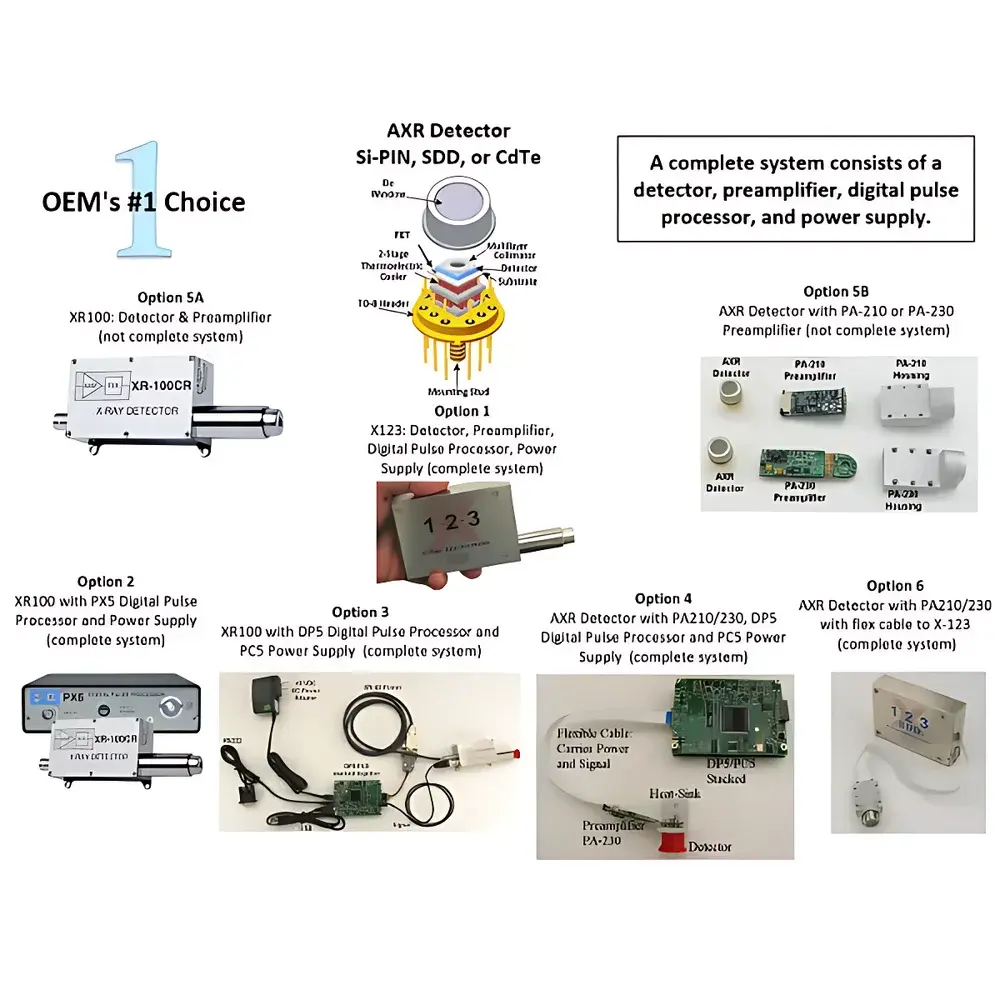
The Amptek OEM System Package is a fully integrated, modular energy dispersive X-ray fluorescence (ED-XRF) spectrometry platform engineered for original equipment manufacturers (OEMs) seeking to embed high-performance elemental analysis capability into handheld, portable, or benchtop analytical instruments. Built upon Amptek’s industry-proven silicon drift detector (SDD) architecture, this system operates on the fundamental principle of X-ray fluorescence: primary X-rays from a microfocus X-ray tube excite inner-shell electrons in sample atoms; upon relaxation, characteristic secondary X-rays are emitted and resolved by the SDD based on their photon energy. The resulting spectrum enables qualitative identification and quantitative determination of elemental composition across the full range from sodium (Z = 11) to uranium (Z = 92). Designed explicitly for integration—not end-user operation—the package delivers laboratory-grade spectral fidelity in a compact, thermally stabilized, and electrically noise-optimized form factor. Its modular architecture supports flexible mechanical integration, customizable shielding configurations, and direct interface with host control systems via standard digital protocols.
Key Features
- High-resolution silicon drift detector (SDD) with Peltier thermoelectric cooling, delivering <140 eV full-width at half-maximum (FWHM) resolution at Mn Kα—critical for resolving overlapping peaks in complex alloys and coated electronics substrates.
- Digital pulse processor (DPP) with real-time pile-up rejection, baseline restoration, and adaptive shaping—enabling high count-rate performance (>100 kcps) without spectral distortion.
- Low-noise front-end amplifier (PA) optimized for SDD capacitance matching and signal-to-noise ratio preservation across wide dynamic ranges.
- Compact, shielded mechanical housing designed for EMI/RFI mitigation and mechanical stability during field deployment or automated production-line integration.
- Integrated microfocus X-ray tube with adjustable kV (typically 10–50 kV) and current control, supporting both light-element excitation (e.g., Mg, Al, Si) and heavy-metal quantification (e.g., Pb, Cd, Hg, Cr).
- Complete power management subsystem—including regulated DC supply and AC adapter—engineered for low ripple and transient immunity in battery-powered or industrial mains environments.
- Comprehensive software suite included at no additional cost: Spectrum Acquisition Software (for calibration, acquisition, and basic quantification), Real-Time Display Interface (RTDI), and a full-featured SDK supporting C/C++, Python, and LabVIEW for custom OEM application development.
Sample Compatibility & Compliance
The OEM System Package is compatible with solid, powdered, and thin-film samples typical in electronics manufacturing, scrap metal sorting, and regulatory compliance testing (e.g., RoHS, WEEE, CPSC). Its configurable geometry accommodates both air-path and helium-purged analysis environments—enabling reliable detection of light elements (Na–Cl) when required. The system meets electromagnetic compatibility requirements per FCC Part 15 Class B and CE EN 61326-1 for industrial measurement equipment. While not certified as a standalone medical or safety device, it is designed to support final instrument compliance with ISO 17025 (when used in accredited labs), IEC 62321-5 for restricted substance screening, and ASTM E1621 for ED-XRF quantitative analysis. All firmware and data handling routines adhere to GLP-aligned audit trail principles, with timestamped spectra storage and user-accessible metadata logging.
Software & Data Management
The included software stack provides three interoperable layers: (1) A GUI-based acquisition interface for system commissioning, spectral calibration (energy and efficiency), and empirical or fundamental parameter (FP) quantification; (2) A real-time display engine supporting live spectrum overlay, region-of-interest (ROI) integration, and alarm-triggered event capture; and (3) A documented SDK with header files, API reference manuals, and example source code for Windows/Linux embedded platforms. Data export follows ASTM E1348-compliant ASCII formats (.csv, .asc) and includes full spectral metadata (live time, real time, detector temperature, tube settings). All spectral files are stored with SHA-256 checksums to ensure integrity. For regulated environments, optional firmware extensions support 21 CFR Part 11-compliant electronic signatures and audit trail generation—available under separate validation agreement.
Applications
This OEM platform is routinely integrated into handheld analyzers for rapid material verification in electronics recycling facilities, PCB component screening for halogen-free and RoHS-conformant materials, and incoming inspection of solder pastes and plating baths. In benchtop configurations, it serves as the core engine for automated QA/QC stations performing coating thickness measurement (e.g., Ni/Au on Cu pads), alloy grade verification (e.g., stainless steel 304 vs. 316), and catalyst composition monitoring in semiconductor packaging processes. Academic and government labs utilize the system for method development in environmental soil screening (As, Cd, Pb), cultural heritage pigment analysis, and forensic glass fragment comparison—leveraging its broad elemental coverage and sub-ppm detection capability under optimized measurement conditions.
FAQ
Is this system pre-calibrated for quantitative analysis?
No—calibration is performed post-integration by the OEM using certified reference materials appropriate to the target application. The package includes calibration utilities but does not ship with factory-applied quantification models.
Can the detector operate continuously at ambient temperatures above 35°C?
Yes—the Peltier cooler maintains detector junction temperature at ≤−20°C under continuous operation up to 40°C ambient, provided adequate heat-sink thermal resistance (<0.5 K/W) and airflow ≥1 m/s are maintained per mechanical integration guidelines.
What communication interfaces are supported?
USB 2.0 (standard), with optional UART TTL-level serial or SPI interface variants available upon request for embedded microcontroller integration.
Does the SDK support multi-threaded acquisition and real-time processing?
Yes—the DPP firmware exposes asynchronous data streaming via ring-buffer DMA, and the SDK provides thread-safe APIs for concurrent acquisition, spectrum fitting, and external control loop execution.
Is radiation shielding included in the OEM housing?
The standard enclosure incorporates 1.5 mm lead-equivalent shielding around the detector and tube assembly. Custom shielding upgrades (e.g., tungsten-lined cavities or collimated beam paths) are available under NDA-supported engineering collaboration.




