
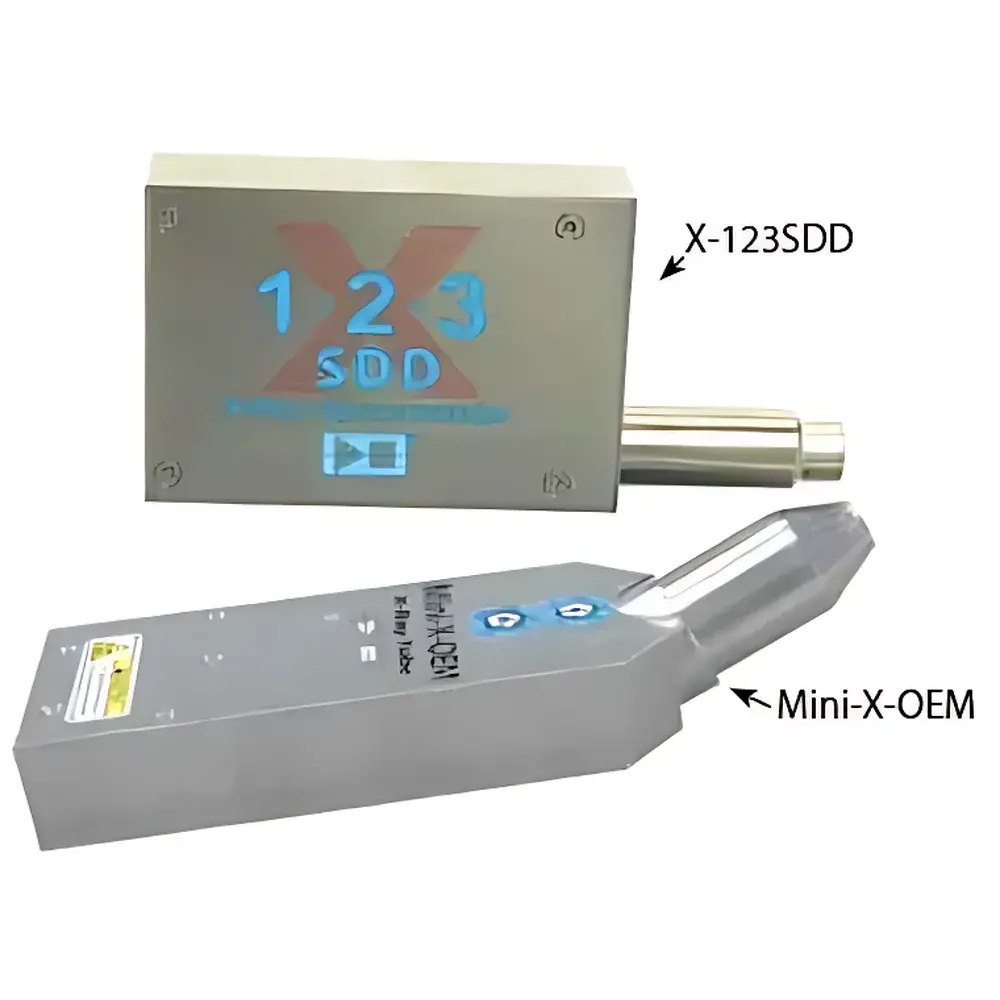
Amptek OEM System Package for Energy Dispersive X-Ray Fluorescence (ED-XRF) Spectrometry
| Brand | Amptek |
|---|---|
| Origin | USA |
| Manufacturer Type | Authorized Distributor |
| Origin Category | Imported |
| Model | OEM System Package |
| Pricing | Upon Request |
Overview
The Amptek OEM System Package is a fully integrated, modular hardware platform engineered for the development of custom energy dispersive X-ray fluorescence (ED-XRF) spectrometers. Designed explicitly for original equipment manufacturers (OEMs), this system enables rapid integration into handheld, benchtop, or process-integrated analytical instruments. At its core, the package leverages fundamental XRF physics: incident X-rays from a Mini-X-OEM microfocus X-ray tube excite characteristic secondary (fluorescent) X-rays from sample atoms; these emitted photons are resolved by high-resolution semiconductor detectors—either silicon PIN (Si-PIN) or silicon drift detectors (SDD)—and digitized via Amptek’s proprietary digital pulse processor (DPP) architecture. The system operates on the principle of energy discrimination, where photon energy (keV) is directly correlated to elemental identity, enabling qualitative and semi-quantitative multi-element analysis from sodium (Na) to uranium (U) in solid, powder, and thin-film samples.
Key Features
- Fully pre-integrated OEM architecture with mechanical, electrical, and thermal co-design for reliable field deployment
- Choice of detector technologies: Si-PIN (e.g., X-123) or high-resolution SDD (e.g., X-123SDD), both optimized for low-noise, high-count-rate performance
- Mini-X-OEM microfocus X-ray tube with adjustable kV (4–50 kV) and current (0–200 µA), supporting flexible excitation conditions for light- and heavy-element analysis
- Digital Pulse Processor (DPP) with real-time pile-up rejection, adaptive shaping, and onboard spectrum accumulation—eliminating need for external MCA hardware
- Pre-mounted front-end electronics: PA210/PA230 (for Si-PIN) or PA210SDD/PA230SDD (for SDD), housed in EMI-shielded enclosures with thermal stabilization
- PC5 programmable power supply module providing regulated, low-ripple bias and operational voltages for all subsystems
- Complete mechanical enclosure with standardized mounting interfaces, Be-window options (1 mil for Si-PIN, 0.5 mil for SDD), and radiation shielding compliance per IEC 61010-1
Sample Compatibility & Compliance
The OEM System Package supports direct analysis of heterogeneous solids, pressed pellets, fused beads, and coated substrates without destructive preparation. Detector window thickness and tube voltage selection allow optimization for light elements (e.g., Mg, Al, Si) down to ~1 keV or heavy metals (Pb, U) up to 20+ keV. All modules comply with RoHS directives and meet CE marking requirements for electromagnetic compatibility (EN 61326-1) and safety (EN 61010-1). When integrated into final instruments, the system supports alignment with ISO 12885 (XRF safety), ASTM E1621 (standard guide for ED-XRF elemental analysis), and GLP/GMP documentation workflows through traceable firmware versioning and hardware calibration logs.
Software & Data Management
Amptek provides complimentary PC-based software suite including DPPMCA for real-time spectral acquisition, display, and basic peak identification; and the Amptek SDK (C/C++, Python, LabVIEW APIs) for deep OEM integration. The SDK supports full control of acquisition parameters (live time, dead time, gain, threshold), raw histogram streaming, and embedded calibration file management. All software modules generate ASCII and CSV output formats compatible with LIMS environments and support audit-trail generation required under FDA 21 CFR Part 11 when deployed in regulated QC/QA laboratories. Firmware updates are delivered via signed binary packages with SHA-256 verification.
Applications
- Rapid alloy identification and grade verification in scrap metal sorting and aerospace manufacturing
- RoHS and WEEE screening of electronic components for restricted substances (Pb, Cd, Hg, Cr⁶⁺, Br)
- Geochemical mapping and soil contamination assessment (As, Cu, Zn, Ni, Co)
- Coating thickness and composition analysis in automotive and decorative plating lines
- Quality control of catalysts, battery cathode materials, and ceramic pigments
- Portable mining exploration tools requiring low-power, high-sensitivity elemental profiling
FAQ
Is this system suitable for regulatory-compliant quantitative analysis?
Yes—when paired with matrix-matched standards and validated calibration curves, the system meets ASTM E2891 and ISO 21043 requirements for precision and accuracy in industrial ED-XRF applications.
Can the OEM package be modified for vacuum or helium purge operation?
Yes—detector housings and tube ports are designed with standard CF-16 or KF-16 flange options to support evacuated or inert-gas purged measurement chambers.
What level of technical support does Amptek provide to OEM partners?
Amptek offers dedicated engineering support including application-specific detector selection guidance, spectral simulation (using GUPIX or PyMca), mechanical integration review, and firmware customization services under NDA.
Are calibration standards included with the OEM package?
No—calibration standards must be selected based on end-user application; however, Amptek provides detailed spectral response characterization data (FWHM, peak shift vs. temperature, escape peak profiles) for each shipped detector unit.
Does the SDK support real-time spectral processing on embedded ARM platforms?
Yes—the DPP firmware exposes low-latency data streaming via USB 2.0 or UART; the SDK includes optimized ARM64 build targets and memory-mapped I/O examples for Linux-based edge devices.
Related Products



